


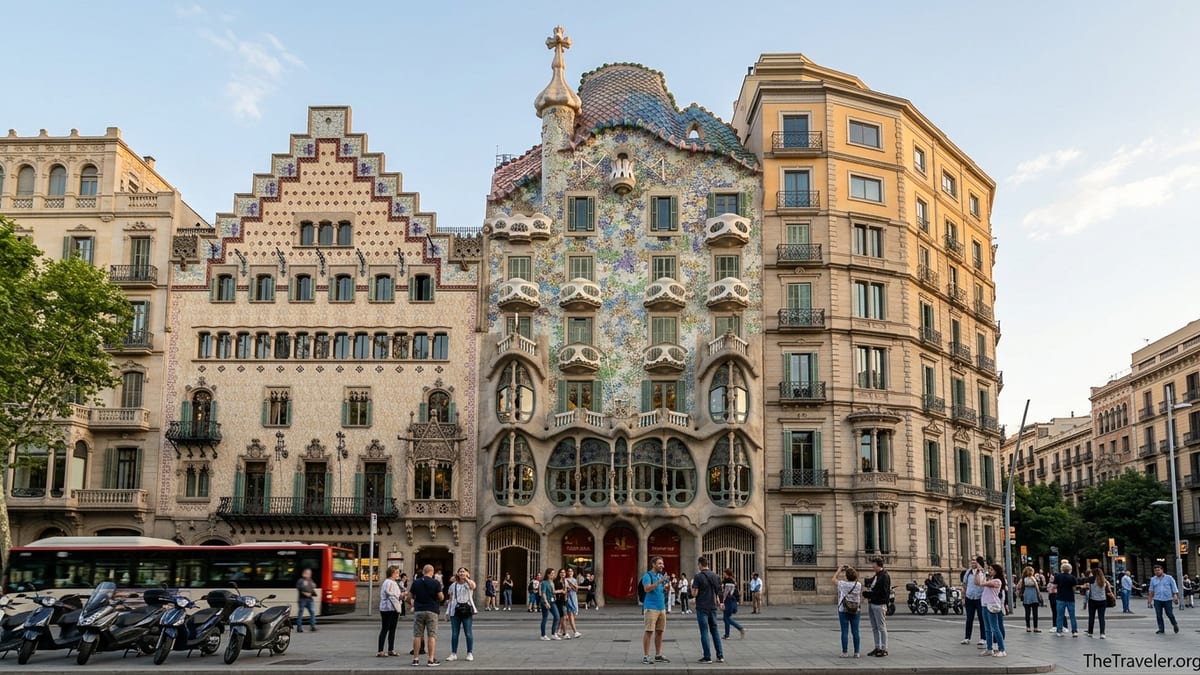
On Barcelona’s grand Passeig de Gràcia, traffic, shoppers and tour groups flow past a façade that seems to ripple and breathe. Balconies curve like bones, colored glass shimmers like water, and a tiled spine arches across the rooftop like a resting dragon. This is Casa Batlló, one of Antoni Gaudí’s most celebrated works and a UNESCO World Heritage site, and for many travelers it is the single building that best captures the architect’s wild imagination.
Get the latest updates straight to your inbox!
What Exactly Is Casa Batlló?
Casa Batlló is a remodeled apartment building in the heart of Barcelona, transformed by Catalan architect Antoni Gaudí between 1904 and 1906 for textile industrialist Josep Batlló. The original structure dated from the 1870s, but Batlló gave Gaudí near-total freedom to reinvent it, from the street façade to the light-filled courtyards and sculptural rooftop. Today, instead of private apartments for Barcelona’s bourgeoisie, the building functions as an immersive cultural attraction, open daily and receiving well over a million visitors a year.
The house sits at number 43 on Passeig de Gràcia, a broad avenue lined with high-end boutiques and other modernist mansions. It forms part of the so-called “Block of Discord,” a stretch where several prominent architects of the period competed for attention with increasingly extravagant designs. Even among its neighbors, Casa Batlló stands out. Seen from across the street, the façade looks almost alive: there are no straight lines, and nearly every surface is curved, glazed or carved.
In 2005, Casa Batlló was inscribed as part of the “Works of Antoni Gaudí” UNESCO World Heritage listing, a recognition it shares with structures like the Sagrada Família and Park Güell. For travelers, that designation is not just symbolic. It underpins ongoing conservation, research and restoration projects, from recent work on the rear façade and courtyard to the recovery of an original Gaudí-designed apartment, which opened to visitors in 2026 as a private, bookable experience.
Visiting Casa Batlló today means stepping into a carefully managed, museum-like environment. Timed tickets control the flow of people; smart audio guides and projected light shows interpret the spaces; and the visit route has been designed so you can trace the building from its noble floor, where the Batlló family lived, up through the attic and onto the rooftop, before descending through one of the light wells back to street level.
Why Casa Batlló Is Considered One of Gaudí’s Masterpieces
Antoni Gaudí’s output in Barcelona is rich and varied, yet Casa Batlló is often singled out as the moment where his mature style crystallized. Unlike the more monumental Sagrada Família or the massive stone forms of Casa Milà, Casa Batlló is intensely playful and intimate. It demonstrates, within the confines of a single residential block, many of the principles he developed over decades of experimentation.
One reason art historians prize Casa Batlló is the way Gaudí seamlessly unites structure, decoration and symbolism. The undulating stone façade is not just decorative; its columns act like bones supporting a living organism. The colorful mosaic skin does more than catch the light; it suggests scales, water, and a festive atmosphere all at once. Even the chimneys on the rooftop are carefully shaped to deflect wind and prevent backdrafts, while reading visually as sculptural groupings.
Another reason is Gaudí’s holistic control over the project. For Casa Batlló he designed not only the architecture but also key interior elements, from doors and windows to built-in seating and bespoke wooden handles that nestle naturally into the hand. When the building hosts temporary events or private dinners today in the restored third-floor apartment, guests sit among curves and fixtures that were conceived as part of an integrated artistic vision, rather than added as later decoration.
Finally, Casa Batlló distills themes that run through Gaudí’s oeuvre: a fascination with nature, a drive to eliminate straight lines, a pioneering approach to light and ventilation, and an interest in turning everyday structures into theatrical experiences. For many visitors who see multiple Gaudí sites in one trip, Casa Batlló is the building where these ideas feel most concentrated and understandable, because they unfold along a clear, walkable route through a single house.
The Dragon, the Sea and the Bones: Symbolism on the Façade
Casa Batlló’s façade has generated endless interpretations, but the most widely shared reads it as a retelling of the legend of Saint George and the dragon, an important story in Catalan culture. Look up from the sidewalk and you will see a roofline that rises and falls like the back of a reptile, clad in shimmering ceramic tiles that change from green to blue to violet depending on the light. This is often described as the dragon’s spine, pierced on one side by a turret topped with a cross, symbolizing the saint’s victorious lance.
Beneath that tiled roof, the façade’s middle section ripples outward in sculpted stone and polychrome glass. Mask-like balconies with oval openings have been compared to skulls or carnival masks, adding an eerie, theatrical note. Between them, slender pillars resemble bones, earning the noble floor’s main windows the popular nickname “the House of Bones.” Travelers standing across Passeig de Gràcia, perhaps after a coffee at a nearby terrace, can appreciate how these elements align and overlap, creating a façade with very few flat planes.
The lower part of the façade feels closer to the sea than to a battlefield. Large, irregular windows framed by pale stone let daylight flood into the Batlló family’s main salon, while a skin of broken ceramic and glass pieces creates a shimmering surface reminiscent of water. This mosaic technique, known as trencadís, was a Gaudí hallmark. In practice, it allowed him to create complex color gradients using offcuts and recycled tiles from nearby factories, a pragmatic approach that feels strikingly contemporary to today’s sustainability-minded travelers.
Because the façade is so visually rich, it has become one of Barcelona’s most photographed sights. During peak season, you are likely to see visitors crouching to frame the dragon roof against a blue sky, or stepping into the median of Passeig de Gràcia to capture the full height of the building. Early morning or late evening, when the sun slants across the tiles and the crowds thin slightly, is often the best time to appreciate how the surface colors shift and how Gaudí used depth and shadow to animate what is, ultimately, a stone wall.
Inside the House: Light Wells, Attics and a Rooftop Like No Other
While the façade attracts the cameras, many visitors fall in love with Casa Batlló once they step inside. The standard visit route leads you into the noble floor, the Batlló family’s former residence, where a grand room facing Passeig de Gràcia curves around a central mushroom-like column. Here, a huge picture window and stained glass panes create a dappled underwater effect. Travelers with a good eye for detail notice how the window’s wooden frames bend gently outward, avoiding right angles and echoing the waves suggested on the exterior.
One of Gaudí’s most ingenious moves at Casa Batlló was his treatment of the two interior light wells, or patios. In many 19th-century apartment buildings, these vertical shafts were gloomy and purely functional. Gaudí instead tiled Casa Batlló’s wells in varying shades of blue, darker at the top and lighter near the bottom. Combined with carefully sized windows on each floor, this creates an even spread of daylight from rooftop to lower levels. As you descend via the staircase and pause on the landings, you can test the effect yourself: the light feels surprisingly gentle, even several floors below street level.
Higher up, in the attic, Gaudí’s structural innovation becomes visible. The space is defined by a sequence of catenary arches, often compared to the ribcage of some great animal. Originally these whitewashed brick arches housed service areas and storage for the tenants. Today, they form one of the most atmospheric sections of the visit, with gentle lighting that accentuates their rhythm. Photographers often spend several minutes lining up shots down the corridor of arches, taking advantage of the soft, indirect light.
The rooftop is the climax of most visits. Here, the dragon’s back reveals itself up close as a series of colored ceramic tiles, while groups of chimneys cluster together like surreal sculptures. Each chimney is subtly twisted to reduce wind resistance, a practical feature that also helps channel smoke. Many travelers spend 20 to 30 minutes here alone, walking the perimeter and capturing views of Barcelona’s Eixample grid. Standard tickets that include rooftop access are particularly prized around sunset, when the tiles glow warm and music sometimes drifts up from events on the terrace below.
A Living Monument: Restoration, Innovation and Visitor Experience
Casa Batlló is not a static relic. Over the past two decades, its owners and a team of conservators have undertaken extensive restoration projects, from cleaning the façade to recovering original colors in interior spaces. In 2025, work on the rear façade and the private courtyard of the noble floor concluded, bringing back lost garden elements and original tones. This means that visitors who book premium or small-group experiences that include views onto the rear of the building now see something much closer to what the Batlló family would have enjoyed in the early 1900s.
The house has also become known for integrating technology into the visit. Standard tickets typically include a smart audio guide, available in multiple languages, which uses a combination of narration and augmented imagery to reveal details that might otherwise go unnoticed. For example, when you stand in the main salon, the device can overlay historical photographs or animated patterns that show how Gaudí’s decorative motifs echo marine life. Travelers who prefer a quieter experience can dial down the audio and simply use the device for basic orientation.
In 2026, Casa Batlló added another layer to its offerings by opening the restored third-floor apartment as a private, reservable space. For the first time, visitors can book intimate events, dinners or small meetings inside what is considered the last largely intact Gaudí-designed domestic interior in the building. While this is marketed as an exclusive experience, it also supports the site financially and helps maintain the building as a “lived” environment rather than a purely museum-like shell.
All of this comes with careful crowd management. Travelers today encounter timed entries, security checks and staff posted at bottlenecks like the rooftop staircases. At busy times of year, particularly spring and early summer weekends, you may feel the flow of visitors shaping your pace, especially in narrower areas such as the attic arches. Planning an early morning slot, or visiting in the shoulder months, can make the experience feel more contemplative and closer to the atmosphere Gaudí may have imagined.
Practicalities: Tickets, Times and What It’s Like to Visit
Casa Batlló is typically open every day of the year, with visiting hours that often run from morning into late evening, allowing for nighttime experiences during certain seasons. Timetables and any seasonal changes are updated regularly, so it is wise to check closer to your travel dates, especially around Christmas and New Year when hours can shift slightly. Entry is based on timed tickets, which help spread visitors throughout the day and are scanned at the entrance beneath the main façade.
Ticket structures can change, but as of mid 2026 most visitors choose from tiered options that might be described as basic, standard and premium experiences. The more affordable tiers generally include access to the main visit route and the audio guide, while higher-priced options can add early entry, access to additional rooms or a more in-depth guided experience. Prices fluctuate by season and day of the week, but for planning purposes many travelers budget the equivalent of several tens of euros per adult, more than for a typical historic house museum yet comparable to major attractions such as La Pedrera or the Sagrada Família.
Recent changes have also affected what different ticket levels include. For instance, since 2025 some of the simplest tickets no longer provide access to the rooftop, reserving that highlight for mid-range and premium options. This means that visitors who particularly want to see the dragon’s back and the sculptural chimneys should double-check the inclusions before purchasing. Travel forums frequently feature comments from people who only realized this after arriving, so a quick review of the current ticket descriptions can save disappointment.
Most visitors spend between 60 and 90 minutes on site, though architecture enthusiasts, photographers and those using the full audio guide may stay closer to two hours. The experience is largely self-paced within the constraints of the one-way route. There are cloakroom facilities, restrooms and a well-stocked gift shop that has earned a reputation, even in travel magazines, as one of the better museum stores in the city, with design books, reproductions and Gaudí-inspired objects. For families, the tactile nature of the building and the visual storytelling of the audio guide tend to keep older children engaged, though strollers may need to be parked or folded in some narrower sections.
How Casa Batlló Compares to Other Gaudí Icons
Barcelona offers multiple Gaudí experiences, and travelers often debate whether Casa Batlló, Casa Milà (La Pedrera) or Park Güell should come first. Each showcases a different facet of the architect’s work. Casa Batlló is the most consciously theatrical and jewel-like, compressing Gaudí’s ideas into a relatively compact footprint. Casa Milà, just a short walk up Passeig de Gràcia, emphasizes monumental stone forms and a rooftop landscape of tall chimneys that feel like guardians watching over the city. Park Güell, on a hillside overlooking Barcelona, spreads his imagination across a garden setting with sweeping views and open-air structures.
Compared with these, Casa Batlló often feels the most “finished” as an interpretive experience. The carefully curated route, smart guide and restored details make it easy for first-time visitors to grasp the narrative, even without prior knowledge of architecture. Travelers who prioritize immersive storytelling and detailed craftsmanship usually find Casa Batlló especially satisfying, whereas those drawn to broader city views might rank Park Güell or La Pedrera’s rooftop higher.
Another difference lies in how lived-in each site feels. The Sagrada Família remains an active basilica under construction, with cranes overhead and ongoing works. Casa Milà houses cultural institutions and some private residences alongside visitable areas. Casa Batlló, by contrast, is dedicated almost entirely to the visitor experience, with even formerly private apartments now restored and integrated into special tours or private hire. For some visitors this heightened theatricality is a plus; others prefer the more everyday feel of Gaudí’s lesser-known works such as Casa Vicens.
In practice, many travelers plan a “Gaudí day” that pairs Casa Batlló with another major site. One common route is to book a late-morning slot at Casa Batlló, have lunch on or near Passeig de Gràcia, then stroll up to La Pedrera for an afternoon or early evening rooftop visit. This creates a clear sense of progression: from the colorful, marine-inspired richness of Casa Batlló to the rugged, stone-carved boldness of Casa Milà, both within walking distance of central hotels and metro lines.
The Takeaway
Casa Batlló is more than a photogenic façade on a busy Barcelona boulevard. It is a complete, carefully orchestrated environment where Gaudí’s ideas about nature, light, structure and symbolism converge within the frame of a single family home. From the dragon-backed rooftop and mask-like balconies to the softly lit attic arches and blue-tiled light wells, every corner feels considered and interconnected.
For travelers, this makes Casa Batlló one of the most rewarding introductions to Gaudí’s world. It is compact enough to explore thoroughly in an hour or two, rich enough to sustain repeat visits, and centrally located so it fits easily into almost any Barcelona itinerary. While ticket prices reflect its global fame, thoughtful timing and the right choice of ticket tier can turn a quick photo stop into an in-depth encounter with one of modern architecture’s defining works.
Ultimately, Casa Batlló is celebrated not just because it is beautiful, but because it demonstrates how a conventional 19th-century building could be transformed into something organic, symbolic and joyfully experimental. Standing on the sidewalk of Passeig de Gràcia or on the rooftop beside the dragon’s scales, you feel the city around you, yet you also step into Gaudí’s singular imagination. That tension between everyday life and dreamlike vision is what keeps Casa Batlló at the top of so many must-see lists, decade after decade.
FAQ
Q1. Where is Casa Batlló and how do I get there?
Casa Batlló is on Passeig de Gràcia in central Barcelona, within walking distance of Plaça de Catalunya and served by multiple metro and bus lines.
Q2. How long does a typical visit to Casa Batlló take?
Most visitors spend between 60 and 90 minutes inside, though architecture fans and photographers often stay closer to two hours to explore every detail.
Q3. Do I need to buy tickets for Casa Batlló in advance?
Advance purchase is strongly recommended, especially in spring, summer and on weekends, as timed entry slots can sell out or become very limited.
Q4. Is the rooftop included with all tickets?
Not always. Some lower-tier tickets may exclude rooftop access, so check the current ticket descriptions carefully if the rooftop is a priority for you.
Q5. Is Casa Batlló suitable for children?
Yes. The building’s shapes and colors, along with the interactive audio guide, usually appeal to children, though strollers may be restricted in narrow areas.
Q6. Can I visit Casa Batlló in bad weather?
Yes. Most of the route is indoors, but the rooftop is open air, so on rainy or very hot days you may spend less time there than in good weather.
Q7. Is Casa Batlló accessible for visitors with reduced mobility?
There are lifts and adapted routes for visitors with mobility issues, though some historic areas and rooftop sections may remain partially challenging.
Q8. Are photos allowed inside Casa Batlló?
Yes, personal photography is generally allowed, but tripods, flash and professional equipment may be restricted, especially in crowded areas.
Q9. What is the best time of day to visit Casa Batlló?
Early morning or late afternoon often provide a calmer atmosphere, softer light for photos and slightly fewer crowds than the middle of the day.
Q10. How does Casa Batlló differ from Casa Milà (La Pedrera)?
Casa Batlló is more colorful and ornamental, with a strong focus on symbolism and interior details, while Casa Milà emphasizes massive stone forms and city views.