


Walk along Barcelona’s elegant Passeig de Gràcia and you can feel the street change in front of Casa Batlló. Traffic noise seems to fade, heads tilt upward in unison, and for a moment the city revolves around this shimmering facade of coloured glass, bone-white balconies and a dragon-backed roof. For many visitors, it is love at first sight. Yet the story behind Casa Batlló, and the extraordinary ideas hidden in its design, is even more fascinating than its fairytale looks.
Get the latest updates straight to your inbox!
From Ordinary Townhouse to Modernist Icon
Casa Batlló did not begin life as a masterpiece. Around 1877 it was a fairly standard bourgeois townhouse in the middle of what Barcelonans call the "Block of Discord" on Passeig de Gràcia, a stretch where wealthy families competed through extravagant architecture. In 1900 the property at number 43 was purchased by textile industrialist Josep Batlló i Casanovas, who wanted a home and rental property that would stand out on one of the city’s most fashionable avenues.
By the early 1900s Antoni Gaudí was already a well-known architect, busy with projects such as the Sagrada Família and Park Güell. When Batlló commissioned him in 1904, the original idea was to demolish the old house and build anew. Instead, Gaudí proposed something more radical and economical: a complete reinvention of the existing structure. Between 1904 and 1906 he transformed the dull facade, reworked the internal layout, enlarged the central light well and added new floors, creating the fantastical building we see today.
Travelers sometimes assume Casa Batlló is a brand‑new construction like some grand palaces of Europe, but part of its magic lies in how Gaudí sculpted an existing skeleton. When you climb the main staircase or look into the inner courtyard, you are moving through layers of history that predate the renovation. This mix of old and new is one reason UNESCO added Casa Batlló to the World Heritage list in 2005, recognizing not only its artistic value but also its innovative approach to urban renovation.
Today the house is owned by the Bernat family, known for founding the Chupa Chups confectionery brand, and operates as a cultural attraction visited by hundreds of thousands of people each year. For around 35 to 45 euros depending on season and ticket type, travelers can step inside what was once a private family residence and experience the building as both a historic home and an immersive museum.
The Batlló Family and Gaudí’s Creative Freedom
The story of Casa Batlló is inseparable from the relationship between its client and architect. Josep Batlló was part of Barcelona’s industrial elite, and his family wanted a residence that reflected their status without simply copying their neighbors. Instead of dictating a strict program, Batlló gave Gaudí extraordinary creative freedom. Contemporary accounts highlight that he allowed Gaudí to redesign the structure as he saw fit, as long as the result was striking and comfortable.
This freedom is evident from the moment you enter the building through the noble floor. Rather than a conventional lobby and stairwell, Gaudí designed a flowing entrance with organic curves and sculpted wood that feels closer to a living organism than a traditional house. He added separate doors for the shop, garage and residential areas, which in the early 1900s would have made daily life smoother for a family whose routine included carriages, staff and deliveries.
For modern visitors, this intimate domestic history can be felt most clearly in the recently restored third‑floor apartment, which in 2026 opened for private visits and events after being home to Batlló descendants until 2019. Restoration work peeled back 20th‑century modifications to reveal original ceilings, doors and layouts dating to 1906. Travelers who book these exclusive experiences, which are priced well above the standard visit, get a rare sense of how the Batlló family might have used the library, dining rooms and bedroom suites more than a century ago.
Gaudí also thought carefully about the needs of the building’s tenants. While the Batlló family occupied the main floor, the upper levels were divided into apartments. By widening the central light well and improving ventilation, he ensured that even renters on higher floors had access to daylight and fresh air. When you take the elevator or climb the internal staircase today, the changing blue tiles of the courtyard, from deep cobalt at the top to pale near the bottom, visually balance the light so that each level feels equally bright.
Nature, Myth and the Dragon on the Roof
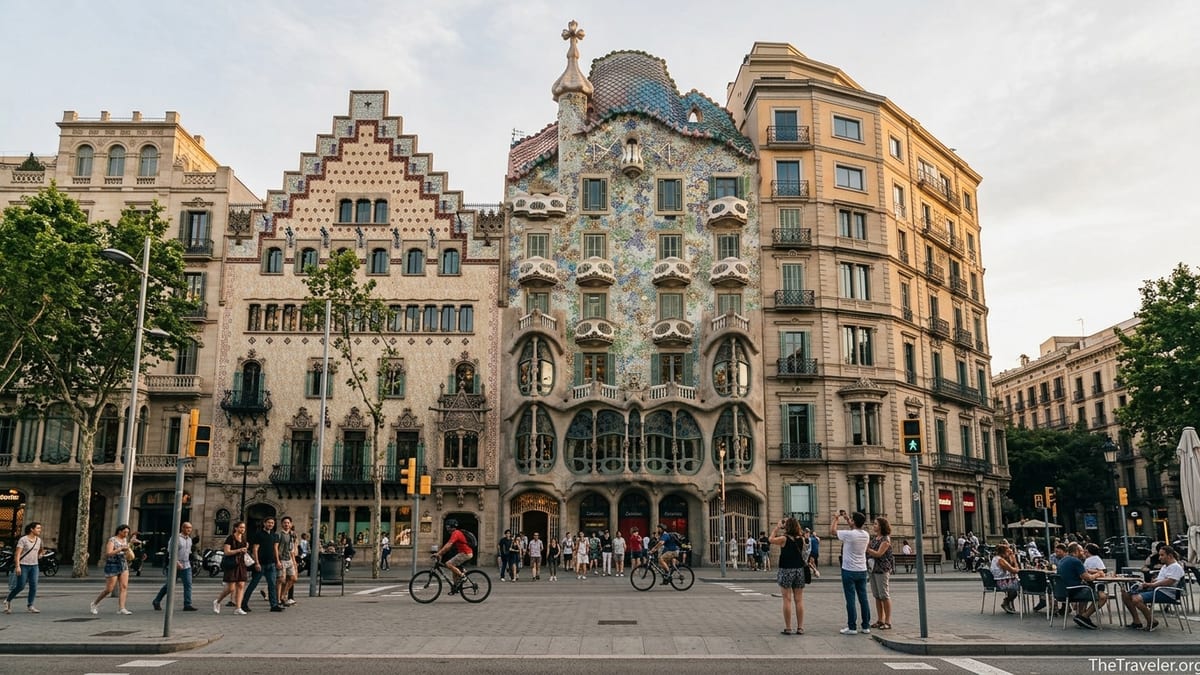
Casa Batlló’s facade is where Gaudí’s imagination and symbolic language are most visible. Seen from across Passeig de Gràcia, the building’s skin undulates like a calm sea, thanks to a surface of irregular glass and ceramic fragments. Up close, details emerge: mask‑shaped balconies, bone‑like columns and a roofline covered in iridescent tiles. Many locals refer to it as the "House of Bones" or the "House of the Dragon," and Gaudí invited these nicknames through his design.
One widely accepted interpretation connects the building to the legend of Saint George (Sant Jordi), the patron saint of Catalonia. In this reading, the scaly tiled roof represents the back of the dragon, the turret crowned by a cross becomes the knight’s lance piercing the beast, and the balconies resemble skulls and bones of its victims. While Gaudí left no definitive written manifesto on this symbolism, the imagery is strong enough that tour guides often pause across the street to trace the dragon’s spine along the roofline for visitors.
At the same time, Casa Batlló is steeped in references to the sea. The wavy facade, the shimmering trencadís mosaic and the organic shapes of the stone columns all evoke an underwater world. Inside, the central patio feels like a light shaft through a watery blue environment, with tiles arranged to simulate the way sunlight filters down into the depths. Travelers who have already visited coastal spots like Barceloneta Beach or the Costa Brava often comment that the building seems to bring the Mediterranean into the heart of the city.
Gaudí’s use of nature and myth was not just decorative. It helped create a coherent story that visitors can feel even without technical knowledge of architecture. Families queuing outside with audio guides in hand, couples taking in the facade from café terraces, and photographers framing the dragon roof at sunset are all participating in this narrative, whether they are thinking of Saint George, the sea, or simply an otherworldly creature sleeping above the street.
Inside the Organic Machine: Light, Air and Everyday Comfort
Step through the main entrance of Casa Batlló and the apparent fantasy resolves into a highly practical, almost scientific design for urban living. Gaudí approached the house as an organic machine that needed to manage light, air, circulation and temperature without the benefit of modern air conditioning or electric lighting systems as we know them today.
The central light well is one of his key solutions. By enlarging it and lining it with ceramic tiles that range from dark blue at the top to pale near the bottom, Gaudí countered the natural tendency for upper floors to be brighter than lower ones. Windows facing the courtyard are smaller near the top and larger below, further evening out the distribution of light. On a typical visit, when you ride the elevator to the upper floors and look into the patio, you can see how this gradient creates a sense of gentle, even illumination rather than harsh contrast.
Ventilation is handled with similar care. In the noble floor salon, the large wooden windows on Passeig de Gràcia incorporate discreet adjustable vents that allow air to circulate even when the glass remains closed for noise or privacy. Door and window frames throughout the house are subtly rounded and jointed so that they seal tightly but can be easily opened to channel breezes. Guides often demonstrate these details during tours, inviting visitors to slide wooden vents or swing a door to feel how smoothly it moves.
Even the famous staircase, with its spine‑like wooden handrail, is designed for comfort and safety. The treads are gently curved, the height between steps is carefully calibrated and the railing fits naturally under the hand. Travelers who struggle with steep historic staircases in European castles and churches often remark that climbing Casa Batlló feels unexpectedly easy, despite its age. Gaudí’s organic shapes are beautiful, but they also follow the ergonomics of the human body.
Materials, Colors and the Craft of Trencadís
Casa Batlló could not exist without the craftspeople who worked alongside Gaudí. The building is a showcase of Catalan Modernisme’s collaborative spirit, where architects, ceramicists, carpenters, ironworkers and glassmakers combined their skills. Gaudí used relatively ordinary materials for the time, such as brick, stone, wood and glass, but arranged them in ways that pushed craft techniques to new limits.
One of the most recognizable features is the trencadís mosaic on the facade and roof. This technique uses broken pieces of ceramic and glass, often recycled from discarded tiles, arranged in fluid patterns. In Casa Batlló the trencadís shifts from green and blue to gold and orange, suggesting both the sea and a dragon’s iridescent scales. When you stand on the sidewalk in late afternoon, the low sun catches these shards and makes the facade flicker subtly as if it were alive.
Inside, Gaudí used finely crafted oak for doors, window frames and the sinuous main staircase. Many surfaces are left unpainted so that visitors today can appreciate the natural grain and the way it responds to changing light. Decorative elements like the famous whirling ceiling in the main living room, shaped like a spiraling vortex, were modeled in plaster but designed to feel like movement in air or water. The result is a warm, tactile interior that contrasts with the sometimes hard, sleek surfaces of contemporary architecture.
The roof terrace, which in recent years has required a higher‑tier ticket to access, offers perhaps the most playful examples of Gaudí’s material experimentation. Chimneys are grouped into sculptural clusters, clad in colorful ceramics that prevent downdrafts and protect against rain. Visitors wandering among them today often treat the space as an open‑air gallery, taking photos with the dragon back on one side and the Eixample grid stretching out on the other. Despite the Instagram popularity, these elements still perform their original technical functions for the building.
A Living Landmark: Immersive Experiences and Recent Restorations
Casa Batlló is not a frozen monument. In the last decade it has become a testing ground for new ways of presenting heritage architecture to a global audience. The most notable change for visitors is the "10D Experience," an expanded museum route with immersive rooms like the Gaudí Dôme and Gaudí Cube. These spaces use projection, sound and even subtle wind effects to give a sensory introduction to Gaudí’s inspirations before or after you walk through the historic rooms.
In the Gaudí Cube, billed as a one‑of‑a‑kind six‑sided LED room, visitors stand surrounded by moving images that reinterpret motifs from Gaudí’s work. The installation, created with contemporary digital artist Refik Anadol, has become a highlight for tech‑savvy travelers and families with teenagers, especially as part of premium ticket options that can reach or exceed 45 euros in high season. While some purists prefer a quieter visit, many visitors say the immersive elements help them notice real architectural details afterward, such as the curve of a window frame or the way a tile reflects light.
Restoration has also been ongoing. In 2025, work on the rear facade recovered much of its original appearance after decades of alterations, giving visitors who look out from the inner rooms a chance to see Gaudí’s design the way early 20th‑century residents would have experienced it. More recently, the opening of the restored third‑floor apartment has added a fresh layer to the story, inviting small groups to sit in rooms that retain their original doors, windows and ceilings while enjoying contemporary uses like private dinners or cultural events.
For practical planning, travelers should be aware that ticket structures change periodically. As of 2026, basic entry starts in the low 30‑euro range, with higher prices for options that include rooftop concerts, night visits or full access to immersive spaces. Booking online in advance, especially in summer or around public holidays, is strongly recommended, both to lock in your preferred time slot and to compare clearly which areas of the house are included in each ticket tier.
How to See the Design Story on Your Own Visit
Knowing the history and ideas behind Casa Batlló can make a one‑to‑two‑hour visit far richer. Even without a guide, you can follow a simple route that lets the building reveal its story layer by layer. Many travelers start by crossing to the opposite side of Passeig de Gràcia before their entrance time to get an unobstructed view of the full facade. From there, try to trace the dragon’s back along the roofline and notice how the bone‑like columns of the main floor differ from the lighter mask balconies above.
Once inside, pay attention to how your body feels in the space. Climb the main staircase slowly, running your hand along the smooth wooden rail to sense its spine‑like rhythm. In the noble floor salon, stand by the large front windows and look at the subtle vents in the woodwork, then glance up at the swirling ceiling that seems to funnel light toward the center of the room. These details show how Gaudí combined aesthetics with invisible technical solutions for comfort.
In the central patio, either from the stairwell or the lift, try to focus on the tiles rather than the overall light. Notice how the blues are deepest at the top, then gradually pale as they descend. Gaudí’s team adjusted the tile colors and window sizes here to balance daylight, a simple but ingenious method that still works more than a century later. Finally, if your ticket includes the rooftop, take time to walk around the chimneys instead of heading straight for the dragon back photo. From certain angles, the terrace almost feels like the deck of a ship, with the city sea stretching all around.
For many visitors, visiting Casa Batlló alongside another Gaudí house, such as La Pedrera (Casa Milà) a short walk away, provides helpful contrast. La Pedrera’s rough stone waves and spacious attic feel more monumental and sculptural, while Casa Batlló can seem more intimate and colorful. Experiencing both in a single day, perhaps with a lunch break at one of the cafés along Passeig de Gràcia, gives a fuller picture of how Gaudí developed his ideas about structure, light and organic forms.
The Takeaway
Casa Batlló is often described as a fairytale house, but behind its dreamlike appearance lies a deeply rational design. Gaudí and his collaborators took a conventional 19th‑century townhouse and, between 1904 and 1906, turned it into a holistic work of art that solved everyday problems of light, air and comfort while telling a rich story through myth and nature. The dragon on the roof, the bone‑like columns, the underwater blues of the patio and the ergonomic staircase are not isolated flourishes but parts of a carefully orchestrated whole.
For today’s travelers, this makes Casa Batlló more than a beautiful backdrop for photos. It is a place where you can feel how visionary architecture transforms ordinary urban life. Whether you come for the immersive 10D experience, the rooftop concerts, a private visit to the restored family apartment or a simple daytime tour, taking time to notice the design decisions embedded in every surface will reveal a building that is both a historical landmark and a continuing experiment in how we live in cities.
FAQ
Q1. What is Casa Batlló and why is it important?
Casa Batlló is a renovated townhouse in central Barcelona redesigned by Antoni Gaudí between 1904 and 1906. It is important as one of the most original examples of Catalan Modernisme, showcasing Gaudí’s mastery of organic forms, light and ventilation, and has been listed as a UNESCO World Heritage site since 2005.
Q2. Who commissioned Casa Batlló and what was the original purpose of the building?
The house was commissioned by textile industrialist Josep Batlló i Casanovas, who wanted a prestigious family residence and rental property on Passeig de Gràcia. Gaudí transformed the existing 19th‑century structure into a unique home for the Batlló family on the main floor, with apartments for tenants on the upper levels.
Q3. What is the meaning behind the dragon‑shaped roof?
The roof is often interpreted as the back of a dragon from the Catalan legend of Saint George. The scaly ceramic tiles suggest the creature’s spine, while a turret crowned by a cross is thought to represent the saint’s lance piercing the dragon, although Gaudí himself never published a definitive explanation.
Q4. Why are the balconies and columns on the facade sometimes called "bones" and "masks"?
The stone columns of the main floor resemble long bones or limbs, and the smaller individual balconies have openings that look like eye sockets and noses. Locals nicknamed the house "Casa dels Ossos" or "House of Bones" because these sculpted shapes suggest skulls and skeletons, reinforcing the building’s fantastical character.
Q5. How did Gaudí improve light and air inside Casa Batlló?
Gaudí enlarged the central light well and covered it in graded blue tiles, with darker shades at the top and lighter ones below, to distribute light more evenly. He combined this with carefully sized windows and adjustable wooden vents in doors and frames, creating natural cross‑ventilation and a comfortable indoor climate long before mechanical air conditioning.
Q6. What is the "10D Experience" at Casa Batlló?
The "10D Experience" is the current museum route that adds immersive elements to the traditional visit. It includes spaces like the Gaudí Dôme and Gaudí Cube, where visitors encounter projections, 3D sound and light effects that introduce Gaudí’s inspirations before or after exploring the historic rooms of the house.
Q7. How much do tickets to Casa Batlló cost and what do they include?
Ticket prices vary by season and option, but standard daytime visits typically start in the low 30‑euro range for adults. More expensive tickets can include access to the rooftop, immersive rooms, nighttime visits or special events such as rooftop concerts. Specific inclusions and prices can change, so checking current details before booking is advisable.
Q8. Can you visit the rooftop terrace and dragon back?
Yes, visitors can access the rooftop terrace and walk alongside the dragon‑shaped roof with the appropriate ticket category. In recent years, rooftop access has usually been reserved for mid‑range or premium tickets rather than the most basic option, reflecting the terrace’s popularity and the need to manage visitor numbers.
Q9. What recent restorations or changes should visitors know about?
Recent years have seen restoration of the rear facade to more closely match its original appearance and the opening of the third‑floor apartment, which preserves much of Gaudí’s domestic layout. These projects, along with evolving ticket formats and immersive installations, mean the visitor experience at Casa Batlló continues to change and expand.
Q10. How long should I plan for a visit to Casa Batlló?
Most travelers spend between one and two hours inside Casa Batlló, depending on how closely they study architectural details and whether they visit the rooftop or immersive rooms. Those booking special experiences, such as evening concerts or private events in the restored apartment, may wish to allow additional time to enjoy the setting fully.