


Few cities in Europe are as fiercely proud of their architecture as Barcelona, and few buildings are photographed more than Antoni Gaudí’s masterpieces. With the Sagrada Família finally edging toward completion and La Pedrera hosting rooftop jazz nights, it would be easy for a century‑old apartment house to slip into the background. Yet Casa Batlló, the fantastical townhouse on Passeig de Gràcia, continues to stand out among the city’s architectural icons, drawing first‑time visitors and repeat Gaudí devotees who want to understand why this single façade has become shorthand for Barcelona’s creative spirit.
Get the latest updates straight to your inbox!
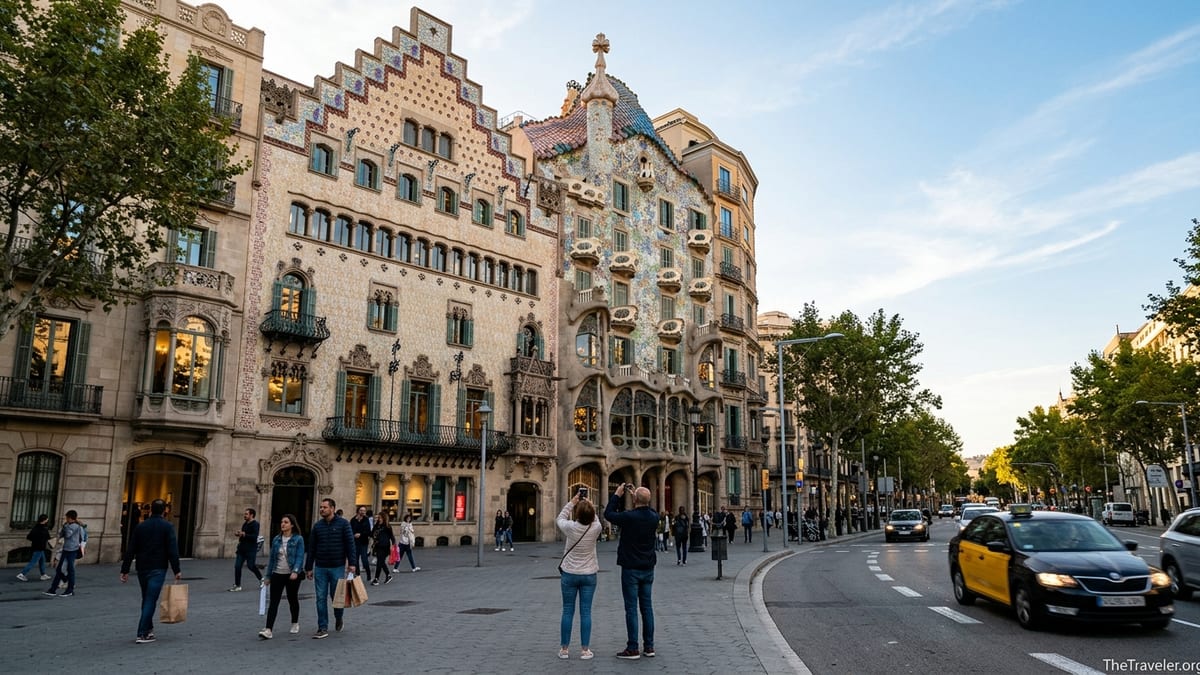
A Dragon on Passeig de Gràcia: First Impressions That Linger
Casa Batlló’s impact begins long before you step inside. Walking up Passeig de Gràcia, past flagship boutiques and office blocks, the building appears like something alive wedged into the “Block of Discord,” that famous row where Casa Amatller and Casa Lleó Morera compete in decorative bravado. Then your eye hits Gaudí’s façade: a rippling skin of colored glass and ceramic discs, an undulating stone balcony line, and that unmistakable, scale‑like roof that locals liken to the back of a dragon. Even if you have just walked past La Pedrera a few blocks away or can see the towers of the Sagrada Família down the avenue, it is Casa Batlló that often stops pedestrians in their tracks and fills their phone galleries.
Part of the reason is scale. Compared with the vast basilica or the hulking stone mass of La Pedrera, Casa Batlló has an almost domestic size. Travelers often mention that they can stand on the opposite sidewalk and take in the whole composition at once, from the mask‑shaped balconies on the main floor to the bulbous turret topped by a cross. This digestible scale, combined with the intense color and whimsical forms, makes the building instantly legible in photographs and social media posts, which in turn keeps it in constant circulation as a symbol of Barcelona.
The building’s street‑level presence is also unusually transparent. While many historic façades in the Eixample shield their interiors behind heavy stone and shuttered windows, Gaudí carved Casa Batlló’s main floor into a sweeping gallery of organic‑shaped windows. Today, because the museum keeps these spaces active and lit late into the evening, passersby can glimpse soft blue light and curved wooden forms from the street. It feels less like an untouchable monument and more like a living organism that happens to be open to the public.
Gaudí’s Storytelling: From Saint George to the Sea
What really distinguishes Casa Batlló from other modernista buildings is the clarity of its narrative. Guides and audio tours routinely describe the house as a three‑dimensional fable loosely inspired by the Catalan legend of Saint George and the dragon. The roof arch reads as the dragon’s spine, its ceramic tiles shifting from deep blue to rusty green and violet. The turret crowned by a four‑armed cross rises like the saint’s lance, while the balconies below take on the appearance of skulls or theatrical masks, suggesting the dragon’s victims. Guests do not need an art history degree to grasp the story; it is the kind of visual metaphor that families discuss on the pavement while pointing up at the façade.
Inside, Gaudí extends that storytelling into a marine world. Visitors who book a standard “Blue” ticket, which as of mid‑2026 typically starts in the mid‑30 euro range with online purchase, move through rooms washed in shades of blue and sand. The main staircase curves like the spine of a great beast, and the noble floor’s living room windows, overlooking Passeig de Gràcia, filter daylight through stained glass circles reminiscent of bubbles rising through water. Travelers routinely compare this to stepping inside a ship’s hull, especially on overcast days when the filtered light feels almost submarine.
The central light well is perhaps the clearest example of Gaudí’s fusion of narrative and pragmatism. To pull daylight down through the entire height of the building, he lined this vertical shaft with tiles that shift from very dark blue near the top, where sunlight is strongest, to pale blue near the bottom, where light is weaker. Visitors riding the elevator or climbing the stairs often only notice the color gradient on the way down, realizing that the changing blues have quietly evened out the light on every floor. It is a small revelation that makes the building feel not just symbolic but ingeniously functional.
Intimacy vs Monumentality: Why the Interior Feels So Human
Many travelers who tour both Casa Batlló and the Sagrada Família remark on the difference in emotional scale. Where the basilica’s nave soars like a stone forest meant to evoke religious awe, Casa Batlló works on a more human, domestic register. The noble floor’s salon, reconstructed with curved wooden doors and sinuous ceilings, gives visitors a sense of how a wealthy family might actually have lived here in the early 1900s, receiving guests while looking out onto Passeig de Gràcia’s carriages and, today, its taxis and tourist buses.
That sense of intimacy has been deepened by recent conservation efforts. In 2026, local media reported that the house had recovered one of Gaudí’s last surviving original apartments on an upper floor, opening it as a complementary, small‑group experience. Instead of walking through theatrical light shows, those who pay for this premium add‑on are led into a remarkably intact domestic space, with original interior layouts and materials largely preserved. For architecture enthusiasts, this is a rare chance to see how Gaudí’s curves and custom carpentry operated not just as spectacle but as everyday living environment.
Even standard visits avoid the roped‑off, “do not touch” atmosphere common in historic houses. Doors are opened, windows are left partially ajar to let in street sounds, and the attic’s parabolic arches are close enough to run a hand along the plaster. Compared with the more didactic museum spaces at the Hospital de Sant Pau or the strictly controlled movement inside the Sagrada Família, Casa Batlló feels like a house that happens to be a museum, not the other way around.
Immersive Technology That Enhances Rather Than Distracts
One of the reasons Casa Batlló continues to stand out in a city full of Gaudí experiences is its embrace of carefully curated technology. While some heritage sites have hesitated to add multimedia for fear of trivializing their history, Casa Batlló has leaned into immersive storytelling and, in doing so, has turned the visit into something closer to a narrative journey than a simple architectural tour.
The backbone of this approach is the smart audio guide, typically included in standard tickets and available in several languages. Instead of a traditional commentary that lists dates and names, the device synchronizes soundscapes and short narratives with each room. In the main staircase, you might hear the creak of ship timbers and the rush of imaginary waves; in the attic laundry rooms, the subtle clank of basins and echo of footsteps. This kind of layered sound design is particularly effective for families and casual visitors who may be more engaged by atmosphere than by technical details.
Casa Batlló has also become known for its “10D Experience,” a ticket tier that adds high‑intensity immersive environments such as the Gaudí Dome and the Gaudí Cube. In the Dome, an enveloping projection animates Gaudí’s inspirations, from plant geometries to starry skies, while visitors stand beneath a constellation of small, glowing apertures. The Cube, meanwhile, uses mirrored walls and synchronized projections to create the sensation of floating through abstracted Gaudí motifs. For many travelers, these spaces serve as an accessible introduction to Gaudí’s underlying ideas before they confront the more complex geometries of the Sagrada Família.
Crucially, the technology does not replace the house itself. The most memorable moments still tend to be analog: holding the wooden rail of the main staircase, stepping out onto the tiled roof terrace, or noticing how a window handle is shaped to fit the palm. In that balance between digital spectacle and material detail, Casa Batlló has become a benchmark for how historic buildings can adapt to contemporary expectations without losing their soul.
Living Culture: Contemporary Art and Year of Gaudí 2026
In 2026, Barcelona is officially recognized as the World Capital of Architecture, a designation that coincides with the centenary of Gaudí’s death. Many institutions are using the moment to refresh their programming, and Casa Batlló has been particularly proactive. Early in the year, it inaugurated a new contemporary art space on one of its previously closed floors, designed by local studio Mesura. This gallery, inserted into rooms that once formed part of the private residence, now hosts rotating exhibitions that respond to Gaudí’s work rather than merely celebrating it.
For visitors, this means that a ticket to Casa Batlló increasingly offers more than a static, once‑in‑a‑lifetime checklist item. A traveler arriving in March might find an installation that reinterprets the building’s dragon motif through light and shadow; someone visiting in October could encounter a multimedia piece exploring the relationship between Catalan identity and tourism. The effect is to position Casa Batlló as an active cultural venue, aligned with the city’s wider debates about how to treat its architectural heritage in an era of mass tourism.
This strategy contrasts with other icons. The Sagrada Família is focused on the monumental task of finishing its towers and adjusting visitor flows, while La Pedrera leans on its rooftop concerts and stable exhibitions about Gaudí’s methods. Casa Batlló, by comparison, feels more experimental, willing to let contemporary artists intervene in its spaces and challenge visitors to see the building as part of a living conversation rather than a relic.
Practical Magic: Tickets, Crowds and Return Visits
From a traveler’s perspective, another reason Casa Batlló remains top of mind is the way it manages the practical side of mass popularity. The house operates with timed entry, and advance online booking is strongly recommended, especially in spring and autumn when Barcelona’s visitor numbers surge. As of the 2026 season, basic daytime visits with audio often fall somewhere in the 30 to 40 euro range for adults when purchased in advance, with prices fluctuating slightly depending on time slots and seasons. Premium experiences such as night visits on the roof terrace, or combined tickets including the immersive features and access to special spaces, climb higher but tend to appeal to travelers seeking a single, memorable splurge.
Crucially, the interior circuit is designed to keep visitors moving without feeling rushed. Small design choices such as one‑way routes, staggered access to the staircase, and staff positioned at key pinch points mean that even at busy times, guests can usually step aside to photograph a detail or listen to a full audio segment. Compared with the intense security checks and choir of guards at the Sagrada Família, the mood here is more house‑like and relaxed, which many visitors cite as a reason they would return with friends or family.
The existence of clear, differentiated experiences also encourages repeat visits. Someone who toured Casa Batlló a decade ago might come back now specifically to see the Gaudí Dome and Cube, or to experience a temporary exhibition in the contemporary gallery. Others might time their visit for a rooftop event, choosing a late‑evening slot to see the ceramic roof change color as the city’s lights come on. This modularity of experiences helps explain why Casa Batlló remains prominent in travel discussions even among those who have already “done” Gaudí’s main sites.
How Casa Batlló Compares With Barcelona’s Other Icons
When travelers debate which Gaudí building to see with limited time or budget, comparisons tend to come down to atmosphere and priorities. The Sagrada Família is the spiritual and structural pinnacle, a once‑in‑a‑lifetime space whose forest of columns and stained glass defy easy description. La Pedrera, with its wave‑like stone façade and helmeted rooftop chimneys, offers a particularly pure expression of Gaudí’s mature structural ideas and often draws architecture students and professionals.
Casa Batlló, however, occupies a distinctive middle ground. It has enough structural invention to fascinate experts, yet it remains compact, legible and emotionally immediate for casual visitors. A first‑time traveler staying in the Eixample might easily visit Casa Batlló in the late morning, wander down Passeig de Gràcia for lunch, and still have energy to explore the Gothic Quarter by afternoon. In contrast, a full visit to the Sagrada Família, with its museum spaces and tower ascents, often becomes the central event of the day.
The house also benefits from its location within everyday urban life. While Park Güell and some other major sites require detours into hillside neighborhoods, Casa Batlló sits amid offices, hotels and shops. Commuters in business attire hurry past its dragon roof each weekday, and tram and bus riders glimpse it from their seats. For travelers, this makes it easy to fold into an itinerary without a special trip, but it also reinforces the building’s identity as an integral part of Barcelona’s daily fabric rather than an isolated attraction.
The Takeaway
More than a century after Gaudí transformed a conventional townhouse into a living dragon of stone and glass, Casa Batlló continues to stand out because it is both instantly understandable and endlessly reinterpretable. Its façade tells a story children can grasp from the sidewalk, while its interiors reveal subtle feats of light control and ergonomic design that reward attentive adults. Technological additions, far from smothering the architecture, have made its ideas more accessible to contemporary audiences, and new exhibition spaces ensure that the building keeps changing with the city around it.
In a Barcelona crowded with icons, from the ever‑rising towers of the Sagrada Família to the rolling roofline of La Pedrera, Casa Batlló earns its enduring prominence not by being the biggest or the most monumental, but by being the most vividly alive. For travelers deciding which landmarks deserve precious hours in a short stay, that sense of a house that still breathes, still tells stories, and still invites debate about what architecture can be is precisely why Casa Batlló remains unmissable.
FAQ
Q1. Is Casa Batlló worth visiting if I have already seen the Sagrada Família?
Yes. Casa Batlló offers a very different, more intimate experience, focusing on domestic spaces, immersive storytelling and tactile details that complement, rather than duplicate, the basilica.
Q2. How much time should I plan for a visit to Casa Batlló?
Most visitors spend between 60 and 90 minutes inside, longer if they linger on the roof terrace or explore premium experiences such as immersive rooms and special exhibitions.
Q3. What is the best time of day to visit Casa Batlló?
Mornings just after opening and later evening slots tend to feel calmer. Early visits offer softer interior light, while evenings highlight the illuminated façade and roof tiles.
Q4. Are the immersive Gaudí Dome and Gaudí Cube suitable for children?
Generally yes. The projections and soundscapes are designed to be engaging rather than frightening, though very young or noise‑sensitive children may prefer shorter stays inside these rooms.
Q5. How does Casa Batlló compare with La Pedrera for a rooftop experience?
La Pedrera’s roof is larger and more sculptural, with dramatic chimneys and open views, while Casa Batlló’s terrace feels more compact and focused on the dragon‑like roof and ceramic details.
Q6. Can I visit Casa Batlló without booking in advance?
It is sometimes possible to buy same‑day tickets at the onsite counters, but time slots can sell out in busy seasons, so advance online booking is strongly recommended.
Q7. Is Casa Batlló accessible for visitors with reduced mobility?
There is elevator access to most areas of the house and staff trained to assist, though some historic spaces and sections of the roof terrace may have limitations due to original layouts.
Q8. Are guided tours available, or is it mainly an audio guide visit?
The standard format is a self‑paced visit with an included smart audio guide, but small‑group guided tours and private visits are sometimes offered as premium options.
Q9. Can I take photos inside Casa Batlló?
Yes, non‑flash photography for personal use is generally allowed in most areas, though tripods, large equipment and commercial shoots require special permission.
Q10. Is Casa Batlló a good choice for travelers on a tight budget?
Tickets are not inexpensive, but many visitors feel the combination of architecture, immersive experiences and central location justifies choosing Casa Batlló as one key paid attraction.