


More news on this day
Cheaper first and business class tickets are showing up more often in flight searches, tempting travelers with lie flat seats and priority boarding for less. But behind those lower headline prices, airlines are quietly redefining what premium cabins include, carving out perks and flexibility in ways that can leave passengers paying more overall for the experience they used to get as standard.
Get the latest news straight to your inbox!
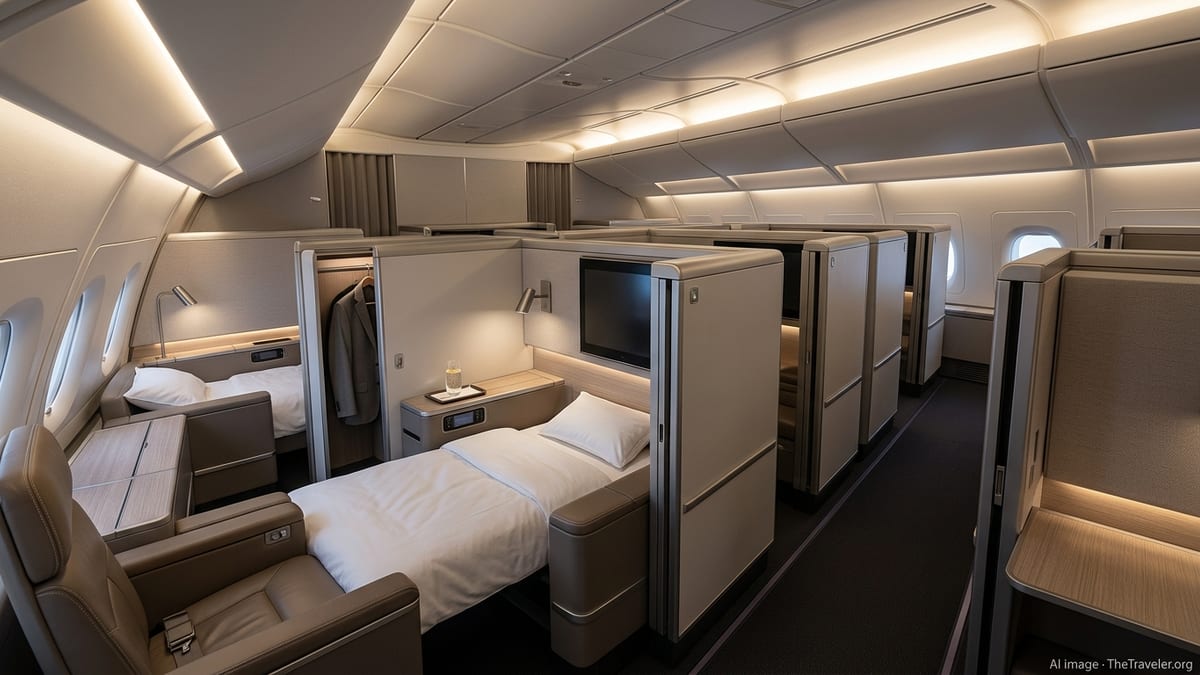
Basic Premium Cabins Move Into the Mainstream
Over the past several years, major carriers have steadily expanded the number of premium seats on their aircraft while also unbundling what those cabins include. Publicly available information from industry analyses indicates that premium cabins have become one of the most profitable parts of the business, encouraging airlines to find new ways to sell more seats at varying price points rather than discounting standard business or first class across the board.
One outcome is a growing range of stripped down products in the very front of the plane. Industry reports describe offerings marketed as basic business, business basic or similar names, positioned as a cheaper way to access a premium seat without the full set of perks. The strategy mirrors what happened when basic economy was introduced to compete with ultra low cost carriers, but this time the changes are aimed at travelers willing to pay extra for comfort.
Analysts note that the approach relies on price segmentation. Travelers with a higher willingness to pay still purchase fully flexible premium fares, while more price sensitive leisure passengers are drawn into these new entry level products. The headline price appears more accessible, yet the underlying goal for airlines is to raise average revenue per seat by charging separately for benefits that were once bundled.
What Disappears When First Class Gets “Cheaper”
The most visible compromise with cheaper premium fares is flexibility. According to airline fare descriptions and coverage in industry publications, many basic business or basic first tickets carry higher change fees or may be entirely nonrefundable, even though they sit in the same cabin as flexible tickets. For travelers whose plans are not completely fixed, that can quickly erase any savings if schedules shift.
Other differences are less obvious until after booking. Some new premium fare types assign seats only at check in, limiting a passenger’s ability to select a window or aisle or to sit next to a companion in advance. On certain carriers, entry level business products are reported to offer a reduced mileage earning rate compared with standard fares, affecting frequent flyer balances and elite status qualification.
Lounge access is another area where inclusions are being pared back. Public fare rules and travel reports show that some discounted first and business fares now omit automatic access to airline lounges or to more exclusive flagship lounges, leaving travelers to rely on separate memberships or credit card benefits if they want the traditional pre flight experience. In some cases, even dedicated premium check in areas are reserved for higher priced tickets.
Inflight, the hard product usually remains the same lie flat seat or wider recliner, but soft product variations are appearing at the margins. Industry observers point to examples where amenity kits, enhanced dining options or special pre departure services are aligned to higher fare types, further distinguishing what a premium cabin includes depending on how much was paid.
How Revenue Strategies Shape Passenger Choices
Economists who study airline pricing describe these developments as a textbook case of revenue management. Research on fare structures in international markets highlights how carriers use a mix of booking restrictions, cabin classes and ancillary fees to match different willingness to pay levels, then allocate a limited number of seats to each category to maximize total revenue on every flight.
From that perspective, cheaper first class is not a sign that airlines are becoming more generous. Instead, it represents another layer in a complex pricing ladder designed to encourage customers to trade up just far enough. A traveler attracted to a restricted premium fare might later pay extra to select seats, access a lounge or add checked bags, spending more in total than they would have under a simpler, all inclusive fare.
Industry data also suggests that the rapid growth of premium leisure travel is influencing these strategies. With many corporate travel policies still tightly controlling business and first class bookings, airlines are increasingly targeting self funded vacationers who will splurge for comfort on long haul flights. Entry level premium fares serve as a gateway, nudging these customers into cabins that used to be dominated by corporate contracts.
Academic work examining the environmental and economic impact of premium cabins further notes that the extra space and weight assigned to these seats raise operating costs, creating pressure to extract more revenue from each one. In that context, unbundling perks and testing new price points becomes a logical extension of efforts to keep high margin seats filled year round.
Why “Cheaper” May Not Mean Better Value
For travelers, the key question is whether a lower premium fare represents real value once all trade offs are considered. Consumer advocates warn that comparisons can be misleading when search results highlight only the initial price without clearly flagging what is missing. A nonrefundable basic business ticket with limited changes, no lounge access and reduced mileage accrual may end up costing more than a standard premium fare if a trip has to be adjusted or if paid extras are added later.
The risk is particularly high for infrequent flyers who may assume all seats in business or first come with the same entitlements. Without careful reading of fare rules, these passengers can be surprised at the airport when they discover that certain lines, lounges or services are restricted to those on higher priced tickets. In that sense, cheaper first class can shift complexity and risk from airlines to customers.
At the same time, the new structure can work for travelers with simple, fixed itineraries who care only about the seat and are willing to forgo extras. For someone flying overnight on a long haul route who does not need lounge time or flexible dates, a discounted lie flat seat can still be a meaningful upgrade in comfort compared with economy or premium economy, provided the limitations are fully understood.
Because fare classes, names and exact conditions vary widely between airlines and even between routes, travel specialists recommend checking not only the cabin label but also the detailed fare basis and inclusions. That level of scrutiny, once largely reserved for corporate travel managers, is increasingly necessary for anyone trying to decide whether a cheaper first class fare is truly a deal or simply the entry point to a more fragmented premium experience.
The Next Phase of Premium Cabin Experimentation
Recent developments suggest that unbundling at the front of the plane is still in its early stages. Airline executives have publicly emphasized the financial importance of premium products, and aircraft orders and cabin retrofits indicate that carriers are planning for more premium seats in the years ahead. As those cabins grow, so too does the incentive to slice them into ever finer price bands.
Industry observers expect future experiments to focus on further differentiating the most exclusive products from entry level options, with the most spacious suites and personalized service reserved for fully flexible or highest fare tickets. At the same time, there is interest in testing bare bones premium seats that strip away nearly everything but the physical space, offering what amounts to an extra large seat paired with a no frills experience.
The trend fits into a wider pattern in commercial aviation in which both ends of the plane are being reshaped. Basic economy has redefined what the lowest fare includes, while basic style premium products are beginning to redraw expectations at the top. Between them, standard economy, extra legroom and premium economy continue to evolve, giving travelers a growing number of choices, each with its own set of caveats.
For now, cheaper first class fares are likely to remain visible in search results and advertising, catching the eye of travelers planning big trips. The real change is not simply that prices seem lower, but that the definition of first and business class is splintering. Understanding that shift is becoming as important as watching the fare itself for anyone trying to balance comfort, cost and predictability in an increasingly segmented sky.