


More news on this day
Hundreds of international passengers were left waiting outside Chennai airport’s terminal in the early hours of Tuesday, after restricted entry access created long queues and forced many travelers to rush through pre-flight formalities.
Get the latest news straight to your inbox!
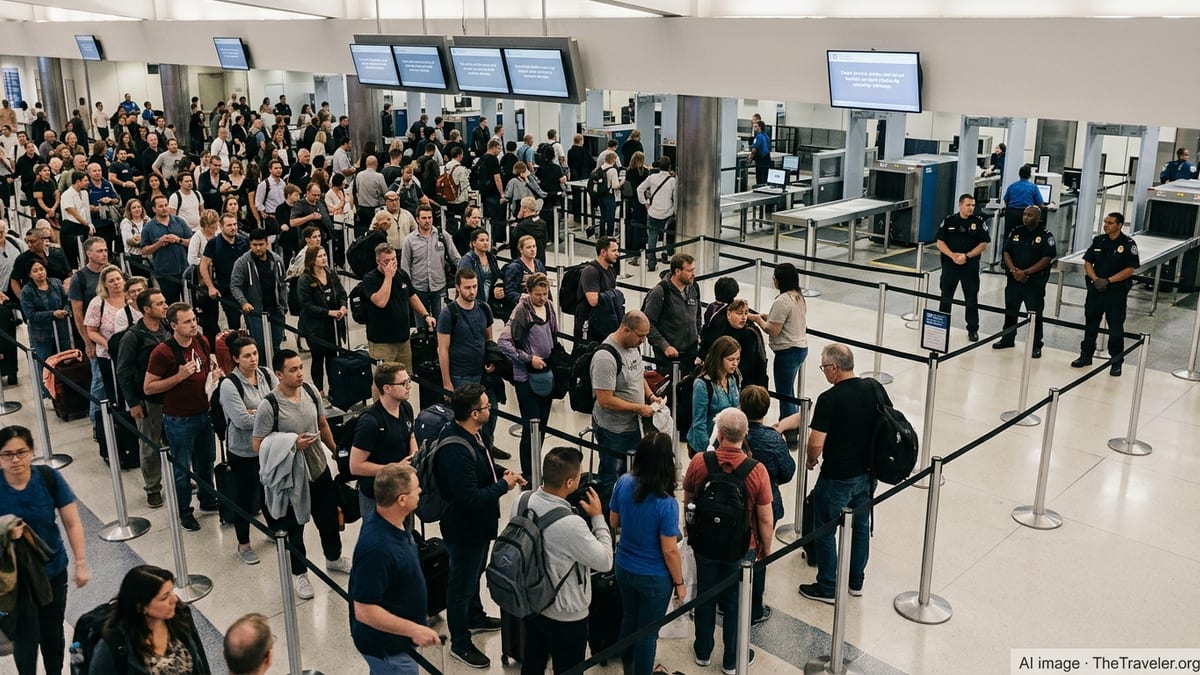
Early-morning queues stretch as gates stay shut
Published coverage from Indian news outlets indicates that the disruption unfolded during peak departure hours on Tuesday morning at Chennai International Airport’s international terminal. Several entry gates reportedly remained closed for an extended period, even as a wave of outbound passengers arrived to catch long-haul flights.
Reports describe queues stretching across the terminal forecourt as travelers waited to clear the initial security and document checks required to enter the building. Many passengers had arrived well ahead of their scheduled departures, but the limited access points meant movement into the terminal was significantly slower than usual.
The bottleneck at the doors effectively shifted congestion to the airport perimeter rather than inside the terminal. Visuals shared in local media show large crowds with luggage lined up in front of the entry zone, suggesting that the queues built up steadily over several hours before all gates were fully opened.
The incident follows a series of complaints over recent months about crowding and queue management at busy Indian hubs. At Chennai, the focus this time was not on check-in or immigration counters, but on the basic ability of passengers to enter the air-conditioned terminal space in time for their flights.
Flights to major hubs hit as passengers race the clock
According to national business dailies and regional news sites, the disruption affected passengers booked on flights to several major international hubs, including London, Dubai, Singapore, Doha and destinations in Southeast Asia. With multiple widebody departures clustered in the same pre-dawn window, the restricted access had a cascading effect on schedules and passenger experience.
Once inside the terminal, travelers still had to complete standard departure procedures such as airline check-in, baggage drop, customs and immigration inspection, and final security screening. Reports note that the initial delay at the entrance compressed the time available for these steps, leaving many passengers moving at a hurried pace through each touchpoint.
Local coverage highlights accounts of passengers who feared missing their flights despite having arrived several hours before departure. In some cases, boarding gates reportedly opened while travelers were still working their way through immigration and security, adding to the sense of urgency.
While there have not yet been detailed public tallies of missed flights linked directly to the entry queues, travel industry trackers and aviation commentators in India have pointed to the incident as evidence of how quickly things can deteriorate when a single choke point is allowed to form during peak operations.
Passenger frustration over crowd management and planning
The episode has intensified long-standing criticism of passenger handling at Chennai airport, which serves one of India’s largest metropolitan areas and a significant diaspora. On social media and in travel forums, flyers have contrasted the international terminal experience in Chennai with that at privately operated hubs in Delhi, Mumbai and Bengaluru, where entry queuing systems are often seen as more streamlined.
Publicly available commentary from regular travelers suggests growing impatience with ad hoc crowd control at the airport’s access points. Complaints commonly reference inconsistent opening of gates, limited staff presence at key junctions, and a lack of clear, visible information for those arriving during busy banks of flights.
The latest disruption adds to a broader debate in Tamil Nadu about airport capacity and long-term planning. Chennai International Airport has undergone a major expansion in recent years with the commissioning of a new integrated terminal, but aviation analysts have repeatedly noted that the facility is expected to reach its overall design capacity within the next decade.
In that context, recurring scenes of bottlenecks during predictable peaks are being interpreted by some local observers as warning signs that operational fixes and better passenger flow design are needed well before any new greenfield airport outside the city is completed.
Calls for all gates to open during peak hours
News reports state that affected passengers and frequent flyers are now urging a review of entry procedures at the international terminal. Suggestions highlighted in published coverage include keeping all available doors staffed and open during early-morning and late-night departure waves, when multiple long-haul flights depart in short succession.
Travelers have also called for clearer communication about which gates are in use and for real-time management of queues outside the building, rather than allowing lines to grow unchecked. Some commentators argue that even modest changes in staffing patterns and signage could significantly reduce the risk of long waits at the curbside.
The episode comes as India’s central government has placed renewed attention on airport passenger experience and immigration efficiency nationwide. Recent policy announcements have emphasized the need to reduce waiting times and improve coordination between airport operators, security agencies and border control staff.
Within that national push, the situation at Chennai is being watched as a test of how quickly operational issues at a busy metro airport can be resolved. For international travelers using the airport in the coming weeks, the incident serves as a reminder to allow additional buffer time during peak night and early-morning departures, particularly if entry gate patterns remain unchanged.
Broader lessons for airport entry bottlenecks
Beyond Chennai, specialists in crowd dynamics and airport design have long warned that narrow entry points can become critical weak links in passenger journeys. Even when check-in counters, immigration desks and security lanes are adequately staffed, a restricted doorway or poorly managed access corridor can erase those gains by delaying passengers before they ever reach the main processing areas.
Studies on terminal congestion consistently highlight the importance of matching entry capacity with forecast demand during peak banks of flights. This involves not only opening sufficient gates but also smoothing vehicle drop-off flows, organizing queues into clearly marked lanes and deploying roving staff to direct passengers to underused access points.
For travelers, recent events at Chennai reinforce practical advice that has emerged from similar disruptions at major hubs worldwide: arrive early for international departures, monitor airline and airport advisories for any changes to entry procedures, and be prepared for potential delays outside the building during busy travel periods.
As international travel from India continues to grow, the ability of airports to maintain reliable first points of contact is likely to remain under scrutiny. The latest queues at Chennai show how quickly a few locked gates at the entrance can ripple through the entire departure process, turning what should be a predictable routine into an anxious race against the clock.