


Chiang Mai International Airport may be compact, but its arrivals area can feel hectic when several flights land at once. For many visitors, the first challenge is simply figuring out how to get from the terminal to a hotel in the Old City, Nimmanhaemin, or further afield without overpaying or getting lost. This guide explains exactly how Grab works at Chiang Mai Airport, where to meet your driver, what you can expect to pay at different times of day, and when it is simpler to walk over to the official airport taxi desk instead.
Get the latest updates straight to your inbox!
How Ground Transport Works at Chiang Mai International Airport
Chiang Mai International Airport (CNX) sits only about 3 to 4 kilometers from the Old City moat, which keeps transfers short and usually inexpensive compared with many Asian airports. Most visitors arriving in 2026 choose between Grab, the official airport taxi counter, red songthaew trucks, or a pre-booked hotel or private transfer. Journey time into the Old City is typically 10 to 20 minutes in light traffic and can stretch to 30 minutes or more at rush hour or during festivals such as Yi Peng and Songkran.
The terminal is straightforward. Both domestic and international arrivals empty out onto the ground floor. After immigration and baggage claim, you pass through customs and emerge into a public arrivals hall lined with currency exchange kiosks, small cafes, mobile SIM counters and transport desks. From here, it is only a short walk to the doors that lead to the road and the designated Grab pickup area just beyond the main building.
Because the airport is so close to town, price differences between transport options are often less than the cost of a coffee. That means you can focus more on convenience than on saving the last few baht. A family landing with two big suitcases at 11 p.m. may prefer the predictability of Grab or an airport taxi, while a backpacker arriving midday with only a daypack might be happy to negotiate with a red songthaew parked outside the terminal.
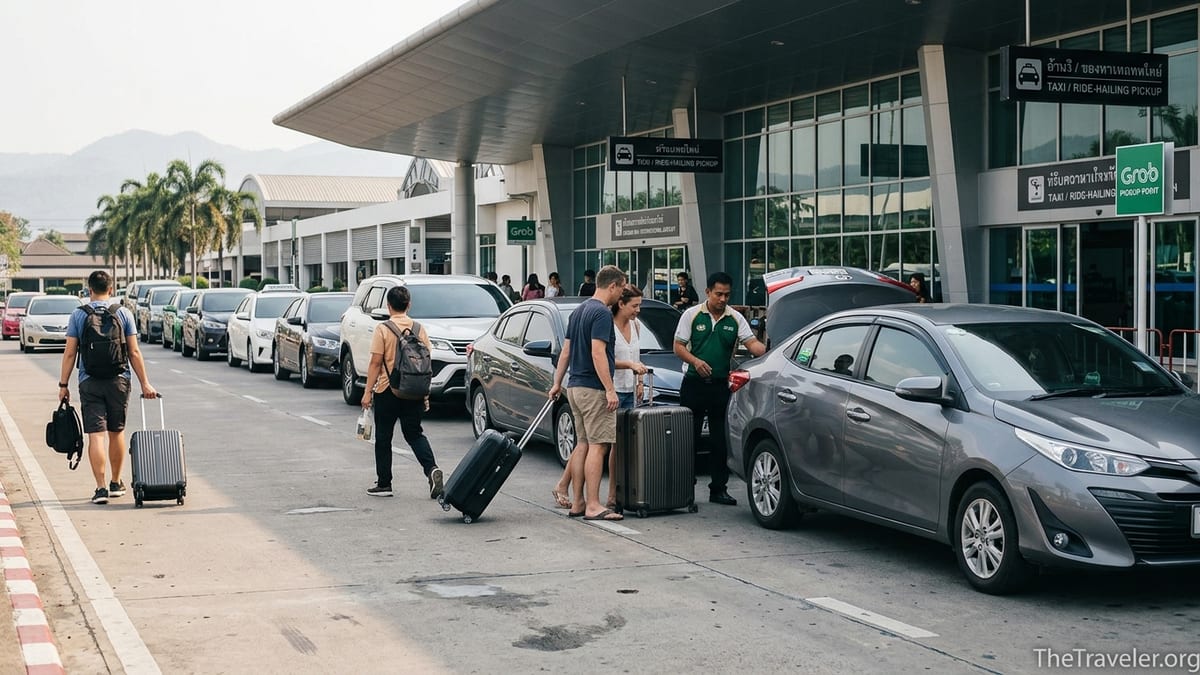
One important change in recent years is that Grab is now officially allowed to pick up at CNX. In cooperation with Airports of Thailand, Grab and the airport operator have created a signed pickup and drop-off zone and a small service center area for drivers. This has largely removed the uncertainty that used to surround ride-hailing at the airport and made it a mainstream choice for both locals and tourists.
Finding the Grab Pickup Point: Step-by-Step
Once your flight lands, you can request a Grab after you have collected your luggage and switched on mobile data. The app works with both local Thai SIM cards and roaming plans. Many travelers buy a Thai eSIM or SIM at the booths just outside customs, which makes it easier to confirm your ride and contact the driver if needed.
From both domestic and international arrivals, the route to the Grab area is similar. After you exit into the arrivals hall, walk straight toward the glass sliding doors leading to the roadway. Signage in English and Thai directs passengers to various transport options, including taxis and Grab. The official information from the airport and Grab indicates that the pickup and drop-off point is on the public side of the ground floor near the domestic arrivals area, slightly to the north of the main exits. In practice, this means you may walk 1 or 2 minutes along the sidewalk, following signs or asking an airport staff member for the “Grab pickup point.”
The Grab zone functions like a small parking strip where ride-hailing cars queue and briefly stop to collect passengers. Drivers are instructed to wait in a nearby holding area and only pull into the lane when the passenger is ready. When your ride is confirmed, the app will usually display a note such as “Pickup: Chiang Mai International Airport Grab point, Domestic arrivals, ground floor.” The driver may also send a quick message in English or auto-translated Thai asking what you are wearing or confirming the color of their car to make meeting easier.
As a real-world example, a couple arriving on a late afternoon flight from Bangkok might collect their bags at domestic arrivals, open Grab, and select “GrabCar” with the pickup point automatically pinned at “CNX Grab pick-up.” After a 2 to 4 minute wait, their silver Toyota sedan pulls into the signed lane outside the domestic exits. They roll their luggage across the curb, confirm their destination in the Old City, and are on their way within minutes.
If you cannot spot the Grab signs immediately, look for airport staff in purple or dark uniforms near the doors, or ask “Grab car, where?” Most are used to this question and will point you in the right direction. Avoid following anyone who approaches you inside the terminal offering a cheaper “Grab” in cash, as legitimate Grab bookings are always handled through the app and charged by card or in-app wallet, or in some cases via cash that is clearly indicated in the app.
Typical Grab Prices from CNX and When They Spike
Because Chiang Mai Airport is so close to the city, standard Grab fares are generally modest. As of mid 2026, a GrabCar or similar basic option from CNX to a guesthouse inside the Old City walls commonly costs in the rough range of 120 to 200 Thai baht, depending on traffic, demand and any promotions running in the app. Journeys to Nimmanhaemin Road, a popular area west of the Old City, are usually in a similar or slightly higher bracket, often roughly 150 to 220 baht.
For example, travelers arriving around 2 p.m. on a weekday have reported paying around the mid-100s in baht for an air-conditioned GrabCar from the airport to Tha Phae Gate on the east side of the Old City. Early afternoon is generally off-peak, with shorter wait times of 3 to 8 minutes common. During shoulder seasons, such as May or September, when tourism is a bit quieter, fares can dip toward the lower end of these ranges.
Prices rise with larger vehicle types and distance. A GrabCar Plus or Premium-style option suitable for three adults with large suitcases might be closer to the upper 100s or low 200s into central Chiang Mai, and more for destinations like Mae Hia, the bus terminal, or resorts in the Mae Rim direction. A ride from CNX to some hotels along the northern highway or toward the Green Bus terminal can often fall in the approximate 180 to 260 baht range under normal conditions.
The main time Grab prices spike notably is during very high demand periods. Examples include international flight banks arriving late at night in peak season, festival weekends, or heavy rainstorms when fewer drivers are on the road. In these cases, the app may show higher estimated fares or a surge notification. Late on a Saturday in December, you might see an airport to Old City fare temporarily climb into the 220 to 300 baht bracket for a standard car. The price is still reasonable in absolute terms, but close enough to the airport taxi rate that convenience may become the deciding factor.
Grab vs Airport Taxi: Which Is Easier in Real Life?
Chiang Mai’s official airport taxi system is simple. After you exit customs into the arrivals hall, you can walk to the airport taxi counter, usually located near the doors. Staff will ask for your hotel name or address, write the destination on a slip, and quote a flat fare for the city area. Recent traveler reports suggest this flat rate for most central Chiang Mai locations has typically been in the ballpark of 150 to 200 baht and is paid directly to the driver in cash.
In practice, this means that for a solo traveler going to a guesthouse near Chiang Mai Gate, the airport taxi and a non-surge GrabCar will often cost roughly the same. The airport taxi may be slightly more predictable, since the price is fixed and does not depend on demand algorithms, while Grab can sometimes be a few baht cheaper off-peak or slightly more expensive at busy times. For visitors arriving from long-haul flights or juggling tired children and multiple bags, simply walking up to the taxi desk can be less stressful than focusing on phone screens and pickup pins.
Grab becomes more attractive when you value in-app clarity and card payment. With Grab, you see the estimated fare before confirming, can track the car’s route on the map, and can pay without needing local currency if your profile is set up with a credit card or digital wallet. For example, a couple landing with only digital payment options might find it easier to open Grab, order a car to their hotel in the Night Bazaar area, and pay automatically in the app, avoiding the need to withdraw cash in the arrivals hall.
There are also times when Grab is clearly cheaper. If the official taxi flat rate into the city is toward the higher end of its usual range and the app is not surging, a standard GrabCar may undercut the taxi by a noticeable margin, especially for short distances. Conversely, if you open the app after a cluster of flights has just arrived and see surge pricing pushing a simple airport to Old City trip above what the taxi desk is quoting, it can be smarter to close the app and head to the taxi counter instead. Many seasoned visitors choose whichever is cheaper and quicker at that exact moment rather than committing to one method in advance.
Handling Luggage, Groups and Special Situations
Both Grab and airport taxis at CNX are used to passengers with luggage. Standard sedan-type cars can comfortably handle one large suitcase and one smaller bag per person for two travelers. If you are a group of three or four adults each with big checked bags, consider requesting a larger category in the Grab app or be prepared that the airport taxi dispatcher may assign you a bigger vehicle or minivan at a slightly higher fixed fare.
An example scenario: four friends arrive from Singapore with four 25-kilogram suitcases, two carry-ons, and a guitar. When they open Grab, they might see a standard car option that looks tight for their bags and a larger vehicle type with a higher price. Booking the larger option will usually be more comfortable and safer for the luggage, and the extra cost spread over four people remains relatively small. At the taxi counter, the staff may flag their luggage and direct them to a larger vehicle as well, with the fare quoted accordingly.
Strollers, sports equipment, and musical instruments are also common. Most Grab drivers are flexible about folding strollers or medium sports bags, but long surfboards or bicycles will not fit in standard sedans. If you are traveling with this kind of oversized gear, a pre-booked private van or hotel transfer from CNX is often more reliable than hoping for a suitable Grab at the last minute. For regular suitcases, it is courteous to stand by the trunk and help the driver arrange bags, especially when space is tight.
Travelers with mobility concerns should expect basic but not highly specialized vehicles. Grab does not routinely offer wheelchair-adapted cars at CNX. If you need a ramp or the ability to stay in your chair, it is better to coordinate in advance with a hotel or local travel agency. For many visitors who can transfer into a car seat with some assistance, both Grab and airport taxis can work fine, but asking the driver to pull up as close as possible to the curb at the designated pickup point helps minimize the distance you need to walk.
Late Arrivals, Surge Pricing and Backup Plans
Chiang Mai International Airport has extended operating hours, and passenger traffic continues until late at night. Grab itself is available 24 hours a day in Chiang Mai, but actual driver availability around the airport can vary with the time and season. In the high season from roughly November to February, you can often find multiple drivers near the airport well past midnight. During quieter months or midweek nights, you might occasionally wait longer than usual or see higher estimated fares.
If you land after 11 p.m. and open Grab only to find no cars available or very high surge pricing, the airport taxi counter is your most reliable backup option. Staff generally remain on duty for late-night arrivals, and taxis continue to operate while flights are still landing. In many cases, the flat-rate taxi can even be slightly cheaper than a surging Grab fare at these hours. For instance, a traveler arriving at 12:30 a.m. on a winter charter flight may find the Grab quote to the Old City has jumped into the upper 200s in baht, while the airport taxi offers a predictable city-center fare that is lower or roughly equivalent.
Daytime surge patterns relate more to local traffic and weather than to the clock. Heavy rain in the late afternoon can push more residents to order Grab rides, shrinking the available pool of drivers for airport pickups. If you see a surge multiplier or a noticeably higher fare on your first check, you can wait 5 to 10 minutes and refresh the app to see if demand eases. Because the distance into the city is short, the absolute increase is still modest, but if budget is critical, patience or the taxi counter can help you avoid paying extra.
For particularly time-sensitive trips, such as catching an early morning domestic flight out of CNX, many residents use Grab’s pre-book or scheduled ride function when available, or arrange a car via their hotel or a local driver contact. While this guide focuses on arrivals, it is worth knowing that if you are leaving Chiang Mai, a pre-arranged transfer can feel more secure at 5 a.m. than hoping a Grab will be driving past your guesthouse in a quiet lane.
Alternatives: Songthaews, Tuk-tuks and Private Transfers
Beyond Grab and airport taxis, Chiang Mai offers a few other ways to get between CNX and the city. The most visible local option is the red songthaew, a shared pickup-truck taxi with bench seats in the back. These usually wait outside popular areas in town and sometimes appear near the airport perimeter road. At the terminal itself, availability can be inconsistent. If you do find a red truck at arrivals, you should expect to negotiate the price in advance, often somewhere from tens of baht per person for central destinations, depending on distance and how many passengers share the ride.
Tuk-tuks, the three-wheeled open taxis seen around the Old City and Night Bazaar, are less common directly at the arrivals curb, but you may encounter them on the road just outside the main airport entrance. A tuk-tuk to the Old City might agree to a fare in the approximate range of 100 to 150 baht in quiet periods, though this is highly negotiable and depends on your bargaining comfort level. While tuk-tuks are fun for short hops, they are not ideal after a long flight with heavy luggage or in heavy rain.
Private transfers and hotel cars fill the top end of the market. Many mid-range and upscale hotels in Chiang Mai offer pre-booked airport pickups, which might range from modest surcharges at boutique guesthouses to significantly higher rates at luxury resorts that include a private van, cold towels and refreshments. These can be worthwhile when you value seamless arrival above all and do not mind paying more than the meter or app price. A common scenario is a family of four with children arriving near midnight who prefer to see a driver holding their name sign at the arrivals hall instead of working through transport options on the spot.
A growing number of services also operate via advance booking platforms, arranging private cars or vans between CNX and nearby destinations like Pai or Chiang Rai. For example, rather than taking a bus after landing, some travelers book a direct car from CNX to Pai, accepting the higher cost for comfort on the winding mountain road. These are usually coordinated in advance, with the driver meeting you at a clearly defined point in the arrivals hall before walking with you to the parking area.
Practical Tips to Make Your CNX Grab Ride Smoother
A few preparation steps can make grabbing a ride from CNX almost effortless. First, install the Grab app and set up your payment method before you fly. Add at least one Thai address or saved place, such as your hotel’s full name and district. Many properties in Chiang Mai have similar names, and it is easy to choose the wrong “Old City guesthouse” if you are rushing at baggage claim. Confirm the hotel’s Thai address from your booking confirmation and match it in the app to avoid confusion when you meet your driver.
Second, consider your connectivity. While the airport offers basic Wi-Fi, it can be crowded at peak times. Buying a local SIM or eSIM package that activates on arrival gives you more reliable data for requesting a Grab, messaging your driver, and navigating once you reach the city. If you are traveling as a couple or group, having at least one working phone with data simplifies meeting the driver and sharing your live location if needed.
Third, stay aware of traffic and local events. Chiang Mai’s roads around the moat and the bridge near the Night Bazaar can become congested during evening markets, major festivals, or the popular Sunday Walking Street. If you open Grab and see a longer than usual estimated journey time, do not be surprised. It might still be quicker than alternative modes because the distance is short, but it will help manage your expectations. Arriving on the afternoon of a big festival might mean your 15-minute transfer becomes 30 minutes or more.
Finally, communicate clearly with your driver. Use the in-app chat to confirm your exact meeting point, especially if you are coming out of international arrivals and they are waiting closer to domestic exits. A simple message such as “I am in front of Door 3, wearing a blue backpack” can cut several minutes of searching. Most drivers have at least basic English recognition via the app’s text translation features and will reply with their car description or a confirmation that they are entering the pickup lane.
The Takeaway
Chiang Mai International Airport is one of the easier airports in Southeast Asia for arrivals, thanks to its compact layout and short distance to the city. With an officially recognized pickup area and clear in-app instructions, Grab has become a comfortable, mainstream choice for visitors who want predictable pricing and the convenience of paying by card or digital wallet. At the same time, the long-running airport taxi system offers a simple flat-rate alternative that is often just as affordable for central destinations.
For most travelers, the best strategy is flexible. On arrival, check the Grab app once you have your bags. If the fare to your hotel in the Old City or Nimmanhaemin looks reasonable and the waiting time is short, use the app and follow the signs to the Grab pickup point. If prices are surging or drivers are scarce, simply walk to the airport taxi counter and accept the flat rate instead. With distances this short, the difference in cost is rarely dramatic, and a calm, well-planned start to your Chiang Mai stay matters more than saving a handful of baht.
Whether you roll your suitcase straight into a waiting Grab, share a red songthaew, or climb into an official taxi, you can usually expect to be checking in at your hotel within half an hour of leaving the terminal. Knowing where to wait, what price range to expect, and how to handle your bags will help you make quick, confident decisions and get your time in Chiang Mai off to a smooth start.
FAQ
Q1. Can I use Grab to get picked up directly at Chiang Mai International Airport?
Yes. Grab is officially allowed to pick up at CNX and there is a designated Grab pickup area on the public side of the ground floor near the domestic arrivals exits.
Q2. Where exactly should I meet my Grab driver at CNX?
After exiting into the arrivals hall, walk toward the ground floor doors and follow the signs for Grab or ride-hailing. The pickup point is near the domestic arrivals area, just outside the main building, where Grab cars briefly queue to collect passengers.
Q3. How much does a Grab ride from Chiang Mai Airport to the Old City usually cost?
Typical app fares for a standard car from CNX to most Old City locations often fall in a rough range of around 120 to 200 baht in normal, non-peak conditions.
Q4. Is Grab cheaper than the official airport taxi?
It depends on demand at the moment you arrive. In off-peak times, a Grab ride can be slightly cheaper than the airport’s flat-rate taxi. During surge pricing or busy periods, the fixed taxi fare may be equal to or lower than the Grab quote.
Q5. What happens if I arrive late at night and there are no Grab cars available?
If the Grab app shows few or no drivers, walk to the airport taxi counter in the arrivals hall. Taxis continue operating for late-night flight arrivals and offer simple flat-rate fares into the city.
Q6. Can I pay for my Grab ride from CNX with a credit card?
Yes. If you have added a card or digital wallet to your Grab account, you can pay in the app without needing cash. Some rides may also allow cash payment, but that option should be clearly shown before you confirm.
Q7. Is it easy to use Grab if I have a lot of luggage or am traveling with a group?
Yes, but choose the right vehicle category. Two travelers with regular suitcases fit comfortably in a standard car. For three or four people with large bags, select a larger car type in the Grab app or be ready for the airport taxi dispatcher to assign a bigger vehicle.
Q8. Are songthaews or tuk-tuks a good alternative from the airport?
They can work for light-pack travelers comfortable with negotiation. Red songthaews and tuk-tuks may be found outside or near the airport perimeter, but availability is less predictable than Grab or official taxis, and fares must be agreed in advance.
Q9. Do I need a Thai SIM card to use Grab at Chiang Mai Airport?
You can use Grab with international roaming, but a Thai SIM or eSIM usually provides more reliable data. Many travelers buy one at the airport so they can easily request rides and contact drivers.
Q10. How long does it usually take to get from CNX to central Chiang Mai?
In light traffic, most rides from the airport to the Old City or Nimmanhaemin take around 10 to 20 minutes. During heavy traffic, rain, or big events, the journey can stretch to 30 minutes or slightly more.