


Landing in Chiang Mai and heading straight for the Night Bazaar area is one of the most popular moves for first-time visitors. The district along Chang Klan Road sits between the Old City moat and the Ping River, with hotels in every price range and an evening market that comes alive nightly. This guide explains the most practical ways to get from Chiang Mai International Airport to the Night Bazaar, what to expect in terms of cost and travel time, and whether staying near the market is a smart base for your trip.
Get the latest updates straight to your inbox!
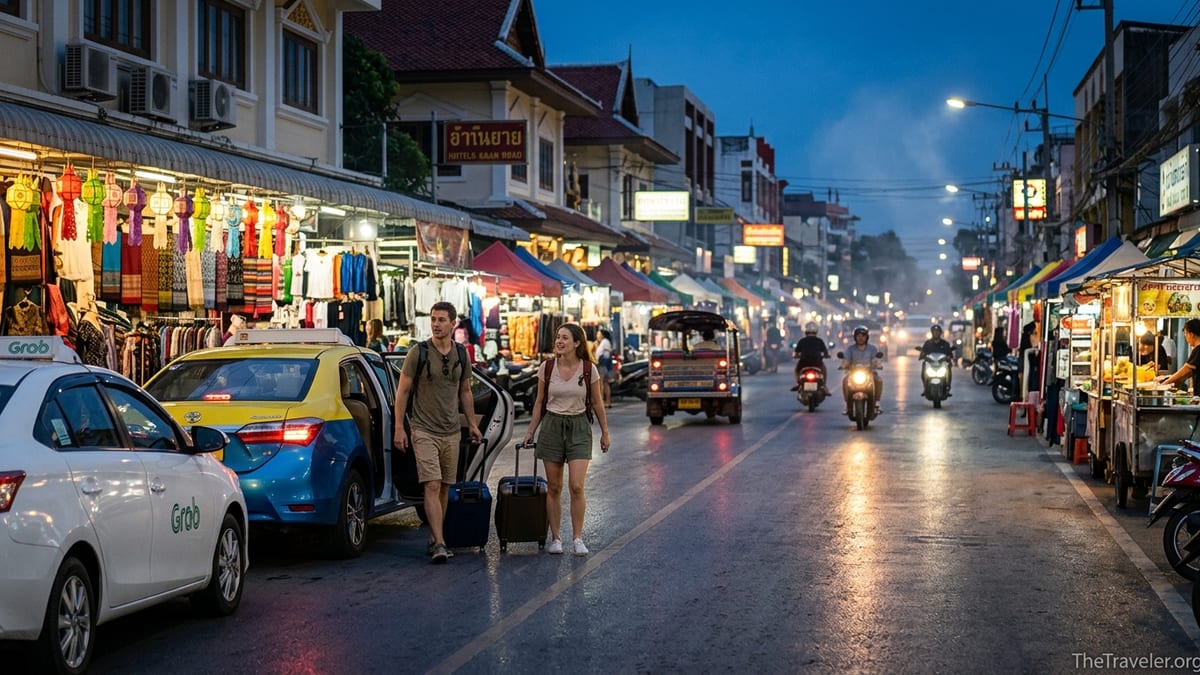
Understanding the Route from Airport to Night Bazaar
Chiang Mai International Airport sits just southwest of the Old City. The Night Bazaar area is on Chang Klan Road to the east of the moat, between Tha Phae Road and Sridonchai Road. In distance terms it is a short hop, roughly 5 to 6 kilometers depending on your exact hotel, which means that in light traffic you can be checking in within 15 to 20 minutes of collecting your bags.
In practice, the drive time depends heavily on traffic around the moat and the Chang Klan corridor. Midday on a normal weekday, an airport taxi to a hotel like Le Meridien Chiang Mai, Duangtawan Hotel, or Movenpick Suriwongse often takes around 20 minutes. Around peak commuter hours, or during major festivals such as Loy Krathong and Yi Peng in November, the same journey can stretch toward 35 minutes as cars back up at key junctions like Chiangmai Gate and the intersection at Sri Donchai Road.
For most visitors, the Night Bazaar area is simple to navigate even if you arrive for the first time at night. The main strip along Chang Klan Road is well lit, and major hotels are clustered along or just off the road. Smaller guesthouses and boutique hotels are tucked into side lanes leading toward the river or back toward the Old City, but in general your driver will know the most established properties and use navigation for newer ones.
If you are arriving with heavy luggage, the short distance has two important advantages. First, it keeps transfer costs relatively modest compared with other Thai cities. Second, it reduces the time you have to spend in traffic after a flight, which is welcome if you are arriving from Bangkok, Singapore or Hong Kong on an evening flight and heading straight into Chiang Mai’s night air.
Official Airport Taxis: Easiest Option After Landing
The simplest way to reach the Night Bazaar with luggage is the official airport taxi. Inside the arrivals hall, near the exit doors, you will find taxi counters that operate a fixed-fare system to central Chiang Mai. While exact prices can change, recent conference materials and local guidance suggest that rides into the downtown area typically fall into a moderate range that is considered good value for a private car, especially when split between two or three passengers.
At the counter, you give the staff your hotel name, pay the quoted fare, and receive a slip with the destination and car number. You then walk outside where a dispatcher matches you with your taxi. This system is straightforward even if you are tired, and because the fare is agreed upfront you avoid haggling. For a couple staying, for example, at DusitD2 Chiang Mai or a family heading to the Shangri-La, this usually works out cheaper and less stressful than arranging a transfer in advance.
Travel time in an airport taxi to the Night Bazaar area is usually 15 to 25 minutes in normal conditions. The car will exit the airport, pass near Central Chiang Mai Airport mall, then head toward the city moat before cutting across to Chang Klan Road. Drivers do this route all day and are used to navigating one-way systems and small detours. If you arrive late at night, such as on a flight landing after 22:00, traffic thins out and the drive can be closer to 15 minutes.
For travelers with bulky or multiple suitcases, official taxis are especially useful because they are typically sedans or small SUVs with standard luggage space. Two large checked bags and two cabin bags usually fit in the trunk. If you are carrying sports gear, such as a bicycle box or large musical instrument, it is worth showing a photo of your luggage at the counter so they can call a larger vehicle or minivan where possible.
Grab and Ride-hailing: When It Makes Sense
Grab, the leading ride-hailing app in Thailand, is widely used in Chiang Mai and can be an excellent alternative to the taxi counter for transfers to the Night Bazaar. Once you connect to airport Wi-Fi or a local SIM, you can request a GrabCar or GrabTaxi to a specific hotel like Yaang Come Village or Anantara Chiang Mai, which sit in or near the Night Bazaar zone. Prices fluctuate with demand but often fall in a similar band to an official taxi, sometimes slightly cheaper, occasionally a little more during peak hours.
One common pattern is that frequent visitors or digital nomads who already have Thai data plans open the Grab app as soon as they collect their bags, comparing the quoted rate to the posted airport-taxi fare. If Grab shows a short wait time and a competitive price, they walk straight outside to the general pick-up area. If the wait is long or the price is surging, they simply head to the taxi counter instead. This flexible approach works well when you are not traveling with small children or very heavy baggage.
With Grab, your destination is pinned precisely on the map, which can help when you are staying at smaller hotels on side streets such as Sri Poom Place or more modest guesthouses behind the main Chang Klan strip. The driver sees the exact drop-off location, reducing the chance of being left on the main road to walk with luggage. However, at the airport you may sometimes need to walk a short distance to the designated ride-hailing pick-up point rather than having the driver meet you right at the arrivals curb.
For late-night arrivals, Grab availability around Chiang Mai Airport is usually adequate, but it can be thinner in the very early morning hours. If your flight lands after midnight, it is wise to check Grab while still on the plane or at the baggage carousel. If cars are showing long wait times, using the official taxi counter or arranging a hotel transfer is likely to be smoother. Travelers arriving during busy festival weekends may also find that booking a Grab from the Night Bazaar back to the airport at peak departure times takes longer due to traffic and higher demand.
Airport Shuttle Buses and Public Transport
Chiang Mai has gradually developed a small network of city buses, including routes that serve the airport. An official airport shuttle bus operates between the terminal and central city areas, with stops along major roads, including the Night Bazaar and hotels on or near Chang Klan Road. This service typically runs between morning and late evening hours, with fares that are much lower than a taxi fare, making it an appealing option for solo budget travelers with light luggage.
In real terms, you might pay a local bus-style fare for the shuttle to reach a point close to the Night Bazaar, then walk the final few hundred meters to your hotel. For example, you could ride to a stop near the intersection of Chang Klan and Tha Phae Road and then walk to properties such as Royal Lanna Hotel or Nap in Chiang Mai. Buses are air conditioned but may be crowded at peak times and involve waiting at a stop for the next departure, which is not ideal after a long flight or when traveling with small children.
The wider Chiang Mai City Bus network, sometimes branded as RTC Chiang Mai, includes routes that loop between the airport, Nimman, the Old City and eastern districts. Some lines pass within walking distance of the Night Bazaar area. However, stops are not always intuitive for new arrivals and the schedule can vary, so this is generally an option best suited to experienced travelers who are comfortable reading route maps, waiting with luggage and perhaps using a translation app to clarify directions with the driver.
If your priority is to minimize stress on arrival, a taxi or Grab remains a better choice, but the shuttle bus can be worthwhile when you have time, are arriving during daytime, and want to keep costs as low as possible. For someone on an extended backpacking trip through northern Thailand, this might mean using the shuttle from the airport to the Night Bazaar, checking into a budget guesthouse off Loi Kroh Road, and putting the savings toward an extra street-food dinner or a visit to Doi Suthep instead.
Luggage, Families, and Late-night Arrivals
How much luggage you are carrying and what time you land in Chiang Mai should heavily influence which transfer you choose. If you are a solo traveler with a carry-on backpack arriving at midday, almost any option from shuttle bus to Grab will be workable. If you are a family of four arriving from Europe after multiple connections, each person with a checked suitcase, a pre-arranged car or an airport taxi is going to feel far more comfortable.
Most standard taxis and Grab cars can handle two large suitcases plus hand luggage in the trunk. A common real-world scenario is a couple flying up from Bangkok for a three-night stay near the Night Bazaar: they each have a medium checked bag and a cabin roller. An airport taxi has no trouble handling this, and the driver can drop them directly at a hotel entrance like the Imperial Mae Ping or the Dusit Princess, so they do not need to drag their bags along busy pavements.
For larger groups or those traveling with bulky gear, you can often request a larger vehicle, such as a GrabCar Plus or minivan, though availability fluctuates by time of day. Families with young children sometimes pre-book a private transfer that includes child seats, arranged through their hotel or a local agency. In this case, a driver meets you in the arrivals hall with your name on a sign and walks you to a waiting van. The cost is typically higher than a metered taxi, but it removes uncertainty and can be worth it after a long-haul flight.
Late-night and very early morning arrivals pose their own challenges. While Chiang Mai is generally safe, many visitors prefer to minimize time spent searching for a car or hotel at 02:00. For flights landing after midnight, check in advance whether your hotel’s reception is open 24 hours or if they arrange after-hours check-in. Many larger Night Bazaar properties do operate 24-hour front desks, while some smaller guesthouses lock their main doors late at night. Confirming this detail before you travel will prevent a tired walk down a quiet soi trying to locate a shuttered lobby.
Traffic Patterns: When the Short Drive Becomes Longer
Although the physical distance between Chiang Mai Airport and the Night Bazaar area is short, traffic conditions can be surprisingly variable. During the morning commute, roads near key intersections such as Chiangmai Gate, the southwest corner of the Old City, and the route toward Chang Klan Road often slow down as local commuters and delivery vehicles converge. If your inbound flight lands between 08:00 and 09:30, you may find that your taxi crawls through a few congested stretches before reaching the Night Bazaar.
Evening rush hour and festival periods can be more intense. On days when the Sunday Walking Street market takes over Ratchadamnoen Road in the Old City, or during the Loy Krathong lantern releases, authorities may close or divert certain streets. Drivers then use back lanes and alternative routes, which can add 10 to 20 minutes to the airport transfer. Around the Night Bazaar itself, the period between 18:30 and 21:30 often brings a slow-moving flow of tuk tuks, songthaews, motorbikes and tour buses.
In day-to-day terms, it is sensible to allow extra buffer time for your return journey from the Night Bazaar area to the airport, particularly if your flight departs during late afternoon or early evening. For example, if you are staying near Anusarn Market and have a domestic flight at 18:00, booking a taxi for around 15:30 or a bit earlier provides a comfortable margin, even if traffic is heavy. Many local drivers are familiar with typical congestion patterns and can suggest a suitable departure time when you book.
Within the Night Bazaar area itself, foot traffic also affects the feel of your arrival. During high season, pavements along Chang Klan Road can be crowded with stalls and visitors in the evening, so if your taxi drops you at the main road you may need to walk the final short distance to your hotel entrance through the market. This is usually manageable, but if you have mobility issues or very heavy cases, you might ask your hotel in advance about the best drop-off point on a side lane or rear entrance.
Is the Night Bazaar a Convenient Base for Your Stay?
Opinions on staying near the Night Bazaar as a base are mixed, but most sources agree on one point: the location is very convenient. The area sits roughly between the Old City and the Ping River, so guests can walk to Tha Phae Gate in about 10 to 15 minutes from many hotels, and reach riverside restaurants and cafes in a similar time. This centrality means that transfers from the airport are quick and that day trips and tours frequently offer pick-ups from Night Bazaar hotels.
On the positive side, the Night Bazaar area is ideal if you enjoy having something to do every evening without needing to travel across town. You can step out of your hotel and immediately find stalls selling clothes and souvenirs, food courts with live music, and venues showing Muay Thai bouts. Travelers who arrive in the late afternoon can often check in, freshen up, and be wandering among stalls at Anusarn Market or along Chang Klan Road by early evening without any additional planning.
The drawbacks relate mainly to noise, atmosphere and how you like to structure your days. Some visitors feel that the Night Bazaar strip has become more commercial than charming, with a steady focus on souvenirs, tour booths and neon signage. Street noise, including live music, motorbikes and tuk tuk drivers calling for customers, can continue until 23:00 or later, especially during high season. Rooms facing the main road or very close to performance stages are likely to pick up this sound, while hotels tucked further back in side streets tend to be quieter.
For travelers whose main goal is temple-hopping, cafe culture and leisurely exploration of narrow lanes, staying inside or immediately around the Old City may be more atmospheric. However, many experienced Chiang Mai visitors use a compromise strategy: they book a hotel in the Night Bazaar area but on a quieter side street, or stay near the southeast corner of the Old City so they can walk easily to both the markets and the historic center. This approach keeps transfers simple while allowing for a balance between convenience and local character.
Comparing Night Bazaar with Other Chiang Mai Areas
To decide whether the Night Bazaar area makes sense as your base, it helps to compare it with other popular neighborhoods. The Old City is the historic heart of Chiang Mai, encircled by a square moat and remnants of walls. Staying near landmarks such as Wat Chedi Luang or Wat Phra Singh places you close to temples, leafy lanes and many small guesthouses and cafes. It is very walkable by day and relatively quiet at night, aside from the weekend walking streets and a few nightlife pockets.
Nimman, or Nimmanhaemin Road, lies to the west of the Old City near Chiang Mai University. It is known for chic cafes, boutique shops, co-working spaces and a more modern, sometimes upscale vibe. Many digital nomads and long-stay visitors favor this area for its coffee culture and convenient services. However, it is farther from the Night Bazaar and riverside, and traffic on the main road can be heavy at rush hour, making the airport transfer slightly longer and sometimes less predictable than going straight to the Night Bazaar area.
Riverside districts along the Ping River, such as the stretch near Wat Ket, offer quieter stays with scenic views. Boutique hotels here emphasize garden settings, rooftop terraces and riverside dining. The trade-off is that you will generally walk or take short rides to reach the Old City and the main markets, although the distance from many riverside hotels to the Night Bazaar is still walkable. Other residential neighborhoods like Chang Phueak and Hai Ya provide more local atmospheres but involve more transport planning if you want easy nightly access to markets.
For most short stays of three to five nights, especially for first-time visitors, the Night Bazaar area or the eastern edge of the Old City works well as a base. You can walk to many restaurants, markets and massage shops, arrange tours that include hotel pick-up, and still be only a short taxi ride from the airport. If you plan to spend weeks or months in Chiang Mai, you may prefer quieter areas, but for typical holiday visits the convenience of the Night Bazaar area is hard to beat, as long as you choose your exact street carefully.
Practical Tips for a Smooth Airport-to-Hotel Transfer
A few simple steps taken before your flight can make your arrival in Chiang Mai and your ride to the Night Bazaar area smoother. First, keep your hotel’s name and address written in both English and Thai if possible. Many properties provide this on their booking confirmations. Having a screenshot on your phone allows you to show it to taxi counter staff or drivers even if your mobile data is not yet active. This is especially useful for smaller boutique hotels or guesthouses on quiet sois off Chang Klan Road.
Second, decide in advance whether you prefer to use the airport taxi counter, book a private transfer, or rely on Grab. If using Grab, ensure your app is updated and linked to a payment method that works in Thailand, or plan to pay cash where allowed. If you know that your flight lands late at night, ask your hotel if they can arrange a driver to meet you in the arrivals hall. While this is often more expensive than the taxi counter, the peace of mind can be worth it after a long journey.
Third, carry a small amount of Thai baht in cash for transport and small purchases, even if you mostly rely on cards. While ride-hailing and some taxis accept digital payments, having enough cash for at least one airport transfer removes a potential point of stress. Larger notes are usually accepted, but having change for smaller denominations makes paying smoother, especially for buses, shuttle services or songthaews.
Finally, think about your first hour after arrival and pack accordingly. Keeping a light jacket, water bottle and basic toiletries in your carry-on can make a big difference if you land into cool evening air or feel tired after a delayed flight. Once you reach the Night Bazaar area and check into your hotel, you will typically find convenience stores, pharmacies, street food and cafes within a short walk, but having a few essentials easily accessible helps you bridge the gap between airport and room without rushing out again immediately.
FAQ
Q1. How long does it usually take to get from Chiang Mai Airport to the Night Bazaar?
In normal traffic the drive typically takes 15 to 25 minutes. At rush hour or during major festivals it can stretch closer to 30 to 35 minutes, so allow extra time.
Q2. What is the most convenient transport option from the airport if I have heavy luggage?
The official airport taxi counter is usually the easiest choice. You pay a fixed fare, get a private car, and are dropped directly at your hotel entrance without needing to manage stairs or crowded buses.
Q3. Is Grab reliable for transfers between Chiang Mai Airport and the Night Bazaar?
Grab is widely used and generally reliable. Many travelers compare the Grab price and wait time with the airport taxi fare on arrival, then choose whichever looks better at that moment.
Q4. Are there any airport shuttle buses that stop near the Night Bazaar area?
Yes, there is an airport shuttle bus and city bus routes that connect the airport with central Chiang Mai, including stops within walking distance of the Night Bazaar, but they require more time and navigation effort.
Q5. Is it safe to arrive at the Night Bazaar late at night?
The Night Bazaar area is usually active and reasonably busy into the late evening, and many hotels have 24-hour receptions. As with any city, keep normal personal safety habits and confirm your hotel’s late check-in arrangements.
Q6. Is staying near the Night Bazaar a good idea for first-time visitors?
Yes, for short stays it is a convenient base, with easy access to markets, restaurants and tours. Some visitors find it busy or commercial, so choosing a hotel on a quieter side street can balance convenience with calmer nights.
Q7. How does the Night Bazaar area compare to the Old City as a place to stay?
The Old City offers more historic charm and temples within walking distance, while the Night Bazaar area is better for immediate access to nightly markets and shopping. Many visitors enjoy staying near the border between the two.
Q8. Can I walk from Night Bazaar hotels to other main attractions?
From many Night Bazaar hotels you can walk to Tha Phae Gate in about 10 to 15 minutes, reach parts of the Old City on foot, and access the Ping River and several night markets without needing a taxi.
Q9. What should I do if my flight to Chiang Mai arrives after midnight?
Check first that your hotel’s front desk operates 24 hours or offers late check-in, then consider arranging a private transfer or using the airport taxi counter to avoid long waits for ride-hailing cars at that hour.
Q10. Is the Night Bazaar area suitable for families with children?
Many families stay there happily due to short transfer times and plentiful food options. Choosing a hotel with family rooms on a quieter side street can help ensure children sleep well despite the lively evening atmosphere.