


Landing at Chiang Mai International Airport and heading straight to Pai is tempting. The mountain town is only around 135 to 150 kilometres away, but the famous Route 1095 with its 762 curves turns this into a very specific kind of journey. Planning how you move from airport arrivals to Pai’s walking street makes a big difference to comfort, cost and how you feel when you finally roll into the valley.
Get the latest updates straight to your inbox!
Understanding the Route: From Runway to the 762 Curves
Chiang Mai International Airport sits on the southwest edge of the city, about 10 to 15 minutes by taxi from the Old City when traffic is light. Pai lies to the northwest in Mae Hong Son province, reached by Route 1095, a narrow, winding mountain road known for roughly 762 curves. In distance terms it is not especially far, but in driving terms it is a slow, technical climb and descent that usually takes 3 to 4 hours in a minivan or car, even in good conditions.
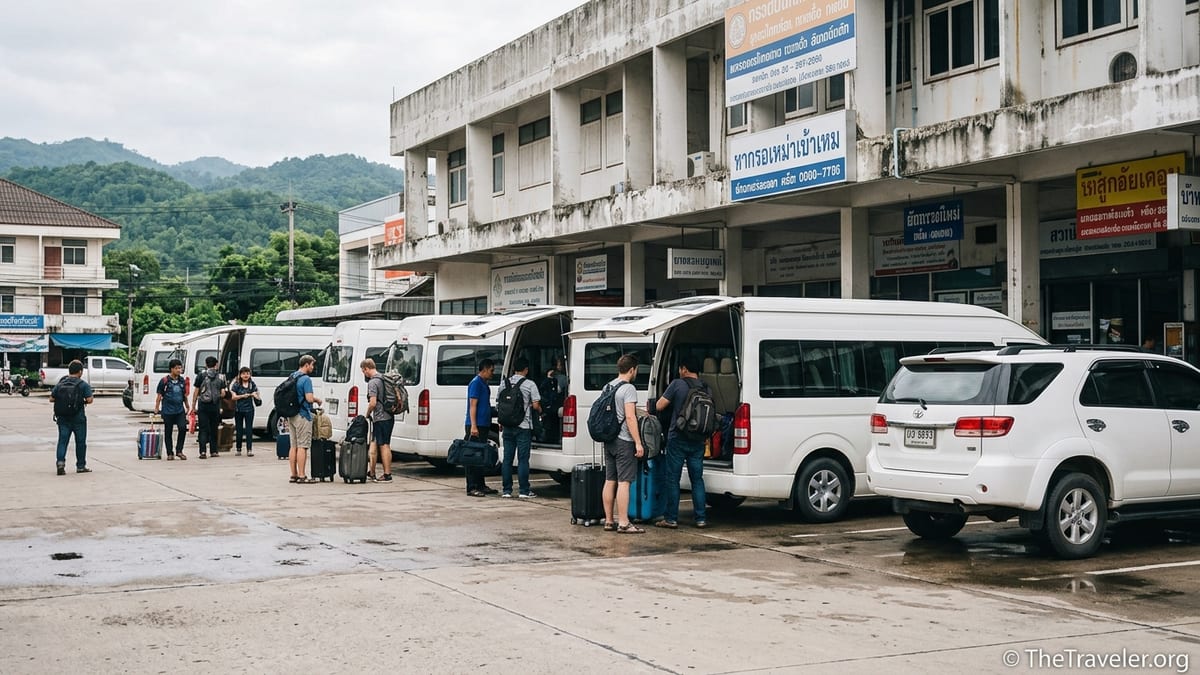
Most shared minivans to Pai do not leave from the airport itself. They operate from Chiang Mai’s Arcade Bus Terminal on the northeast side of the city or from nearby private minivan offices. This means any journey from the airport to Pai, unless pre-arranged with a private driver, involves two main legs: airport to Arcade, then Arcade to Pai. Understanding that changeover is key for tight flight arrivals, especially if you land in the late afternoon.
On the road itself, expect a sequence of continuous bends, short straights and frequent changes in elevation. The first hour after you leave Chiang Mai rolls through lowland villages and forest, and then the road climbs steadily toward the high point of the pass before dropping into the Pai valley. The scenery can be beautiful, especially in the cool season from roughly November to February when skies are clearer and you get long views over green hills, but you will not be moving quickly.
Because of the road’s character, this is not a route where you can easily make up time if you are running late. Drivers who know the road tend to have a natural pace that balances progress and safety, and they also have set rest stops half way. When you plan a same-day airport to Pai connection, building in buffer time is more important than trying to squeeze onto the last minivan of the day.
Airport to Arcade Bus Station: Step One of the Journey
Once you clear immigration and baggage claim at Chiang Mai International Airport, your first decision is how to reach Arcade Bus Terminal. The simplest option is a meter taxi or ride-hailing car. In mid 2026, a standard airport taxi into town is often around 150 to 200 baht to the Old City, and roughly 200 to 250 baht to Arcade depending on traffic and the exact drop-off point. For two or three people sharing, this is usually the most straightforward balance of price and convenience.
Inside the arrivals hall you will see an official taxi counter and, just outside, a line of red songthaews and occasionally Grab or Bolt drivers picking up. A songthaew is cheaper per person if you are already heading to a central guesthouse, but for Arcade specifically most drivers will quote you a private charter price because it is out of the usual tourist loop. Travelers with larger luggage or bulky backpacks generally find an airport taxi or ride-hailing sedan much less stressful than negotiating with multiple drivers while wheeling suitcases.
For timing, allow 20 to 30 minutes from walking out of arrivals to walking into Arcade, assuming normal afternoon traffic. If your flight lands around midday, you can realistically make an early to mid afternoon minivan departure. If you land after 3 pm, it becomes important to know the day’s last van to Pai. Schedules can shift, but many operators run final services somewhere between 4 pm and 6 pm. Arriving on an evening flight after that window usually means either an expensive last-minute private transfer direct from the airport or an overnight stay in Chiang Mai before continuing the next morning.
If you have a few hours between landing and your minivan, you can leave larger bags at the left-luggage counter at the bus station or keep them with you and head to one of the simple food stalls and coffee stands around Arcade. Many travelers use this wait to buy snacks, water and motion sickness tablets from the pharmacies inside or just outside the terminal, rather than trying to do that on the fly once the van is already climbing into the hills.
Minivans from Chiang Mai to Pai: Schedules, Comfort and Booking
Shared minivans remain the default way most visitors travel between Chiang Mai and Pai. Services from Arcade bus station and nearby private depots typically take 3 to 4 hours, depending on traffic, weather and how many intermediate stops are made for passengers. Rough mid 2026 pricing for a seat on these vans often falls in the 150 to 260 baht range per person, which makes them one of the most budget-friendly options for solo travelers and couples.
Several operators run this route. One of the best-known is Prempracha, long associated with the Arcade to Pai run, but other companies and online ticket agents now bundle similar services. Departures are frequent in the morning and early afternoon: in high season you may see vans leaving every hour or so from around 7 am until late afternoon. In shoulder and low season, frequencies may drop. Locally, it is increasingly common for popular departures, especially late morning and around lunchtime, to sell out a day or two in advance, particularly during peak travel weeks when Pai is busy.
Booking strategies depend on how fixed your dates are. If you know exactly when you will travel, booking a seat online a few days in advance can help you secure your preferred time, though you will still need to check in at the counter and convert your booking into a physical ticket. Travelers with flexible itineraries sometimes just show up at Arcade and buy on the day. This can work outside of Thai holidays, but if you are landing from a long-haul flight and want to head straight to Pai, pre-booking at least the first minivan after your arrival window removes a lot of uncertainty.
In terms of comfort, minivans are compact. A typical vehicle seats nine to twelve passengers plus the driver. Luggage is stacked in the back row or on a small roof rack, so space in the cabin can feel tight if the van is full and several people have large suitcases. Seats at the very rear tend to feel the twists and bumps most sharply. If you are prone to motion sickness, many travelers report that the front row and seats near the middle of the van are noticeably more comfortable than the back.
Private Transfers: When a Car or Van Makes Sense
For small groups, families, or anyone the least bit anxious about sharing a tight minivan on a winding road, a private transfer from Chiang Mai to Pai can be a smart upgrade. Instead of paying per person, you pay per vehicle, which makes this option increasingly economical as you add passengers. In 2026, many Chiang Mai based transfer companies and hotels quote roughly 2,500 to 4,000 baht for a private car or minivan from Chiang Mai city or the airport to Pai, per way, for up to three or four passengers. Larger vans seating six to nine people cost more but spread nicely across a group.
One example is a boutique resort in Pai that lists a private car transfer from Chiang Mai Airport to the property for about 3,000 baht for up to four guests, with a duration of around three hours in normal conditions. Other travelers report recent quotes in the 2,500 to 3,500 baht range when arranging a car via their Chiang Mai guesthouse or via well reviewed local drivers recommended in community groups. These rates usually include fuel, tolls and one or two rest stops on the way.
The advantage of a private transfer over a shared minivan is control. You can ask the driver to go at a more relaxed pace, request extra photo or toilet stops, and adjust departure time to match your flight. Families with young children often appreciate being able to stop whenever a child feels queasy, without worrying about frustrating a van full of strangers. Travelers with surfboard-sized backpacks or checked hard-shell cases appreciate having the entire trunk to themselves rather than worrying whether their bag will be strapped to the roof.
Booking a private car is best done at least a day or two in advance, especially in high season around December and January when both Chiang Mai and Pai are at their busiest. Many visitors contact their hotel in Pai or Chiang Mai before arrival and ask for driver recommendations. Ride-hailing apps sometimes display tempting fares to Pai that look cheaper than a pre-booked transfer, but in practice drivers are often reluctant to accept these long out-of-town jobs at app rates, because they must return to Chiang Mai empty. For airport-to-door convenience and a reliable pickup at the arrivals exit, a pre-confirmed private driver is far more dependable.
Luggage, Comfort and Coping with Motion Sickness
Luggage is a bigger factor than many first-time visitors realise on the Chiang Mai to Pai run. Shared minivans assume one medium backpack per passenger, not a pair of 23-kilogram hard cases. If you are carrying larger bags, arrive at the depot early so staff can load your things into the best available space. On busy departures, very large or extra bags may attract a small surcharge or, in rare cases, be asked to wait for the next van if space simply does not exist. For private transfers, tell the company in advance how many bags you have so they can match you with an appropriate vehicle.
Inside the vehicle, think in terms of comfort over three to four hours, not just the first twenty minutes. Wear light, breathable clothing because air-conditioning in older vans can be patchy, and the cabins are rarely spacious. Slip-on shoes help if you need to step out quickly at rest stops or choose to sit cross-legged at your seat. Many travelers carry a light scarf or hoodie because mountain air can be cooler than Chiang Mai city, especially in December and January, and the contrast between warm rest stops and a chilly van can be tiring.
Motion sickness is the most common complaint on this route. The combination of low-speed, high-frequency curves and changes in elevation is exactly the kind of motion that makes many people feel queasy. If you know you are sensitive, take motion sickness medication at least 30 minutes before departure, not after you start to feel unwell. Thai pharmacies near Arcade sell common brands over the counter, and many travelers arrive at the station a little early specifically to buy these. Choose a front or middle seat if possible, focus your eyes on the road ahead or the horizon, avoid looking at your phone, and eat something light but not greasy before boarding.
If you start to feel unwell, it is perfectly acceptable to ask the driver to stop at the next safe pull-out, especially on a private transfer. Even in shared vans, drivers are used to passengers needing breaks. Most services include one planned rest stop at a small roadside cluster of shops where you can use a toilet, buy drinks and snacks and get some fresh air. Carry tissues or wipes, a small plastic bag and some water in your daypack in case nausea escalates suddenly.
Travel Time, Seasonality and When to Travel
On paper, the Chiang Mai to Pai journey usually runs 3 to 4 hours by road, whether you take a minivan or a private car. In reality, plenty of small variables nudge this up or down. Leaving Chiang Mai during weekday rush hour or a weekend afternoon can add 20 to 30 minutes as you crawl through city traffic to reach the outskirts. Heavy rain in the mountains can slow drivers down significantly, because visibility drops and the surface becomes more slippery. Roadworks, occasional landslides in the wet season and holiday congestion around Thai festivals can all add extra time.
The time of year matters too. The cool season from approximately November to February is generally the most comfortable for travel, with cooler air, clearer views and lower humidity. Vans can maintain a steadier speed and passengers tend to feel less drained on arrival. Hot season around March and April coincides some years with serious smoke and haze in northern Thailand, as agricultural burning raises pollution levels in Chiang Mai, Pai and surrounding mountains. During this period, even if the road is open and travel times remain similar, some visitors choose to delay or skip Pai because of air quality and reduced visibility in the hills.
The rainy season from roughly May to October brings greener landscapes and fewer crowds. The route can be beautiful, with low clouds hugging the slopes and occasional waterfalls, but showers can be sudden and intense. Professional drivers know the road well and adjust accordingly, but you should expect slower progress during heavy rain and build that into your planning, particularly if you have a same-day connection back to a flight from Chiang Mai.
For airport-to-Pai travelers, a practical rule of thumb is to avoid planning tight same-day connections. If your flight into Chiang Mai is delayed by an hour or two and you miss your reserved van, you may find later departures sold out or cancelled. Likewise, on the return journey, it is risky to book a flight out of Chiang Mai less than 4 to 5 hours after your scheduled departure from Pai if you are relying on road transport. Building in generous margins reduces stress and makes the trip feel more like part of the holiday than a race.
Should You Stay in Chiang Mai First or Go Straight to Pai?
One of the most common planning questions is whether to head directly from Chiang Mai Airport to Pai or spend a night or two in Chiang Mai first. The answer depends on your arrival time, your energy level after the flight and what you hope to experience in northern Thailand. Travelers landing on late-night flights, or even those arriving mid-afternoon from long-haul routes, often find that breaking the journey with at least one night in Chiang Mai leads to a much more pleasant ride up to Pai.
Staying in Chiang Mai first also lets you explore the Old City temples, night markets and cafes, and adjust to the slower northern pace before tackling the mountain road. Many visitors spend two or three nights in Chiang Mai, then head to Pai for another three or four nights, and possibly return to Chiang Mai for a final night before onward flights. A sample itinerary might look like this: arrive in Chiang Mai on a Monday evening, wander the Old City and Sunday walking street the next day, then take a mid-morning van or private car to Pai on Wednesday when you are rested and acclimatised.
Going straight to Pai same day can make sense in specific scenarios. For example, if you land in Chiang Mai around 9 or 10 am on a regional flight from Bangkok, feel fresh, and have pre-booked an 11:30 am or noon minivan or a private driver, you can realistically be in Pai by late afternoon. This works well for travelers on tight schedules who plan to spend almost all their northern time in Pai itself. Another case is travelers who have already spent days in Chiang Mai on a previous trip and now want to maximize time in the valley.
Energy and motion sickness tolerance should guide your decision. Combining a red-eye or long-haul flight into Thailand with an immediate 3 to 4 hour winding van journey is tough on the body. If you already know that you get queasy on mountain roads, or if you are travelling with children, it is usually wiser to rest in Chiang Mai at least one night. The marginal cost of a guesthouse night in Chiang Mai is small compared with the value of starting the Pai journey rested, fed and with daylight to spare.
The Takeaway
Travel between Chiang Mai International Airport and Pai is straightforward in logistical terms but demanding in physical terms. The road distance looks short on a map, yet the three to four hours of curves on Route 1095 are intense enough that planning your timing, vehicle type and state of mind becomes more important than the exact number of kilometres. Choosing between a shared minivan and a private transfer, and deciding whether to stay overnight in Chiang Mai first, shapes how you experience the journey as much as what you ultimately do in Pai.
For budget-conscious solo travelers who feel fine on winding roads, taking a taxi or ride-hailing car from the airport to Arcade bus station and continuing by shared minivan is usually the most economical strategy. For families, groups, or anyone prone to motion sickness, arranging a private transfer that can meet you at arrivals and stop as needed often represents money well spent. In both cases, thinking ahead about luggage, booking and rest stops turns an infamous 762-curve slog into a manageable, sometimes even enjoyable, introduction to northern Thailand.
Above all, give yourself time. Allow margins between flight arrivals, van departures and onward connections. Travel in daylight when possible, sit where you feel most stable, and treat the mountain road not as a nuisance but as part of the story of reaching Pai. With realistic expectations and a bit of planning, you will arrive in the valley ready to wander its walking street, explore nearby hot springs and canyons, and decide for yourself whether the journey really was worth every one of those curves.
FAQ
Q1. Can I get a direct minivan from Chiang Mai Airport to Pai?
In most cases, shared minivans to Pai do not collect passengers directly at the airport. The standard pattern is to travel from the airport to Chiang Mai’s Arcade bus station or a nearby private depot by taxi or ride-hailing car, then board a scheduled minivan from there. Some private drivers and a few Pai resorts offer direct airport pickups by car or private van, but these are charters, not public minivans.
Q2. How long does it really take from Chiang Mai Airport to Pai?
Door to door, you should expect around 4 to 5 hours on a typical day. This includes 20 to 30 minutes from the airport to Arcade, some waiting time at the station, and then 3 to 4 hours on the road to Pai. In heavy traffic, bad weather or peak holiday periods, the total can edge closer to 6 hours, particularly if you miss your intended van and have to wait for a later departure.
Q3. How much should I budget for the journey by minivan versus private car?
For shared minivans from Arcade to Pai, a realistic mid 2026 budget is roughly 150 to 260 baht per person, plus about 200 to 250 baht for a taxi from the airport to the station, shared among your group. A private car or van from Chiang Mai Airport or city to Pai typically costs around 2,500 to 4,000 baht per vehicle, depending on vehicle size and season, which can be good value if split between three or four passengers.
Q4. Is the road to Pai really that bad for motion sickness?
The road surface itself is mostly fine, but the combination of 700-plus curves and changes in elevation makes it one of the more motion-sickness-prone routes in Thailand. Many otherwise confident travelers feel queasy on this stretch, especially in the back of a packed minivan. Taking motion sickness tablets in advance, choosing a front or middle seat and looking ahead rather than at a phone significantly reduces discomfort for most people.
Q5. Can I travel this route safely with children and larger luggage?
Yes, many families travel between Chiang Mai and Pai with children and big suitcases, but it is worth paying attention to vehicle choice. A private car or van gives you more space for child seats, snacks and rest stops on demand. If you use shared minivans, try to travel at quieter times, arrive early so your luggage is loaded securely, and consider booking an extra seat so your family has a full row rather than being separated.
Q6. Do I need to book my Pai minivan in advance?
While it is sometimes possible to buy tickets on the day at Arcade, advance booking is increasingly advisable, especially in peak season, on weekends and around Thai holidays. Seats on late morning and lunchtime departures are often snapped up a day or two ahead. If you are connecting directly from a flight and want to minimise uncertainty, reserving at least your first van after arrival is a sensible move.
Q7. What is the best time of day to travel from Chiang Mai to Pai?
Most travelers prefer to leave in the morning or around midday. This avoids the worst of Chiang Mai’s afternoon traffic, gives you daylight for the entire mountain section and allows time in Pai on arrival to find your accommodation and settle in. Evening departures can feel more tiring and leave you arriving in Pai after dark, which can be disorienting if you are unfamiliar with the town or have not pre-booked a room.
Q8. Should I stay a night in Chiang Mai before going to Pai?
If you are arriving from a long-haul or overnight flight, staying at least one night in Chiang Mai before heading to Pai is generally recommended. It gives you time to rest, adjust to the time zone and enjoy some of Chiang Mai’s sights before tackling the mountain road. Travelers arriving on short daytime flights who feel rested and have pre-booked transport may be comfortable heading to Pai the same day.
Q9. Are there any alternatives to road travel, like flying or trains?
There is no train line between Chiang Mai and Pai, and public transport is almost entirely road based. Small aircraft have occasionally operated seasonal flights to Pai’s tiny airport, but these are irregular and limited. For most visitors, the realistic options are shared minivan, private car or van, or self-driving a car or motorcycle if comfortable with mountain roads and local traffic conditions.
Q10. Is it safe to drive myself from Chiang Mai to Pai?
Experienced drivers and riders do this route every day, but it is not ideal for beginners. The road is narrow, steep in places, and filled with blind corners and local traffic including trucks and motorbikes. If you are unfamiliar with Thai driving norms, unused to mountain passes or carrying heavy luggage and a passenger, a shared minivan or private driver is usually safer and far less stressful than attempting the route yourself straight after arriving in the country.