


Landing at Chiang Mai International Airport with a backpack and a budget is easy. Working out the cheapest, least confusing way to reach Nimman, the Old City or the Night Bazaar can be harder. In recent years the city has reintroduced a modern bus system alongside the classic red songthaew trucks, which means you now have more low-cost options than ever. This guide walks you through the current airport bus and shuttle routes, fares, and practical details so you can decide when the bus is worth using and when to pay a little extra for a taxi or ride-hail.
Get the latest updates straight to your inbox!
Overview: How Public Transport Works From Chiang Mai Airport
Chiang Mai International Airport sits just a few kilometres southwest of the Old City, so journeys into town are short by Thai standards. Most visitors still default to the flat-fare airport taxi counter inside arrivals or a ride-hail car, because these are obvious and easy. However, since late 2023 the city has been rolling out the RTC Chiang Mai City Bus network, including routes that start and finish at the airport and loop past key areas such as Nimman, Maya Lifestyle Shopping Center, Tha Phae Gate and the Night Bazaar. Combined with the long-standing red songthaew shared trucks, this gives you a real choice if you want to keep transport costs low.
From a budget perspective, buses and shared songthaews sit at the bottom of the price scale. Typical 2026 prices for city transport are roughly 20 to 30 baht for RTC city buses, 30 to 50 baht per person for a shared red songthaew inside the moat, and around 70 to 200 baht for ride-hail cars like Grab or Bolt on standard city trips. An official airport taxi to a hotel inside the Old City usually runs about 150 baht, to Nimman around 200 baht, and to riverside or Night Bazaar hotels around 200 to 250 baht. A single bus ride can easily cost one-fifth of a taxi, especially if you are travelling solo.
Time and comfort are the trade-offs. A taxi from the airport to Nimmanhaemin Road often takes 10 to 15 minutes door to door. The bus can take closer to 30 to 40 minutes once you factor in waiting, walking to a nearby stop and the fact that routes loop around town. For travellers staying near clear landmarks such as Maya mall, Tha Phae Gate or Chang Khlan Road in the Night Bazaar area, the bus is simple and cheap. If your guesthouse is in a maze of Old City alleys or you are arriving late at night loaded with luggage, a taxi or ride-hail is usually the better call.
Operating hours matter as well. Typical city bus timetables span roughly 06:00 or 07:00 in the morning to around 21:00 or 22:00 at night, so early-morning and late-night flights may land outside bus hours. In those cases you should assume that you will need to use the airport taxi queue, a hotel transfer or a ride-hail service. Within daytime and early evening, however, the buses are a reliable, air-conditioned and very affordable way to get your bearings in Chiang Mai.
RTC City Bus Routes: R3 Loops and Key Airport Connections
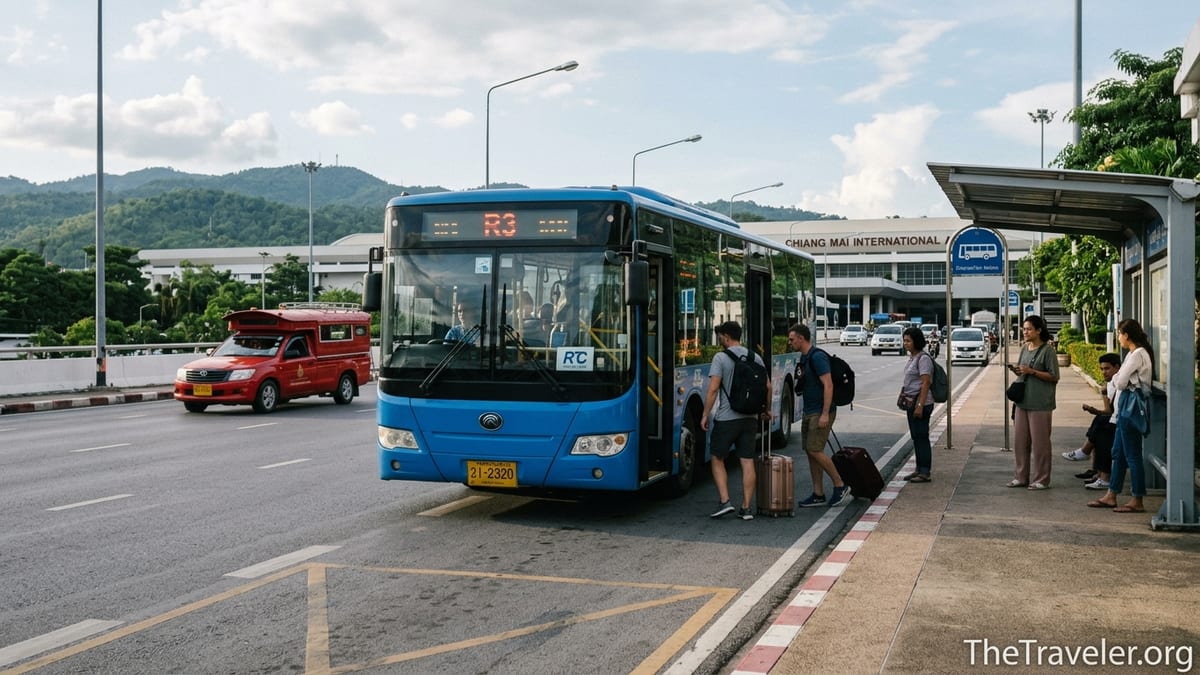
The backbone of Chiang Mai’s airport bus options is the RTC Chiang Mai City Bus network. The most useful routes for new arrivals are the circular R3 loops, usually described by their colors rather than just the route number. The R3 Red (often called the left loop) and the R3 Yellow (right loop) both start and end at Chiang Mai International Airport and circle the city in opposite directions. Along the way they serve the Old City moat, Tha Phae Gate, Nimmanhaemin Road and nearby Maya mall, as well as several major shopping centres and residential districts.
As of 2026, the standard fare on the RTC city buses is around 20 to 30 baht per ride, paid as a flat fare regardless of distance. Payment is usually made in cash to the driver or conductor, and it is wise to carry small notes or coins. On a typical R3 Red journey, a visitor might board at the airport, ride past Central Chiang Mai Airport mall, continue along the western side of the moat, and then either hop off near Chiang Mai University for Nimman or stay on until the bus curves round to the northeast corner near Tha Phae Gate. The R3 Yellow works the same circle in reverse, which can be faster or slower depending on traffic and exactly where your hotel is.
Beyond the R3 loops, planning documents from Thai transport authorities reference additional city bus routes linking the airport with Nimmanhaemin Road and the Night Bazaar area at fares that are broadly similar, typically around 30 to 40 baht. In practice, visitors will usually see a handful of coloured bus lines stopping at marked RTC bus stops around the city, with the R3 routes advertised as the airport connections. The system is still evolving, so exact line numbers and colours can change, but the pattern has remained consistent: frequent loops from the airport to the Old City, Nimman and the eastern market areas during day and early evening hours.
To use the R3 buses effectively, pay attention to stop names and obvious landmarks. For example, if your destination is near Maya Lifestyle Shopping Center, you would watch for the “Maya” or Huay Kaew Road stops and then walk a short distance to your hotel or hostel. If you are staying close to Tha Phae Gate, you would ride until the bus reaches the eastern side of the Old City moat near the gate and then continue on foot. The buses announce or display stops, but having a rough mental map, or at least knowing whether you are aiming for Mia mall, Tha Phae Gate or Chang Khlan Road, makes the ride smoother.
Airport to Nimman and Maya: Best Budget Routes
Nimmanhaemin Road, usually shortened to Nimman, is Chiang Mai’s hip neighbourhood of coffee shops, co-working spaces and boutique hotels. It sits just northwest of the airport, which means road distances are short but traffic can be heavy at peak times. Direct taxis and ride-hail normally take 10 to 20 minutes and cost about 100 to 200 baht depending on demand and whether you book through an app or at the official airport taxi desk. For budget travellers, the RTC bus and occasional shuttle options can drop that cost to a fraction.
The simplest low-cost approach from Chiang Mai airport to Nimman is to take the RTC R3 bus in the direction of Nimmanhaemin and get off near Maya Lifestyle Shopping Center at the northern end of Nimman. The ride typically takes around 30 minutes and costs roughly 20 to 30 baht. From the Maya bus stop, it is an easy five to ten minute walk down Nimmanhaemin Road to many popular hotels, such as Modena by Fraser, Kokotel Nimman, or smaller guesthouses tucked into side streets like Soi 3 and Soi 9. Travellers staying directly on or just off Huay Kaew Road, opposite Chiang Mai University, are also well placed to use this bus stop.
For a concrete example, imagine arriving on a mid-afternoon flight with just a carry-on backpack and a reservation at a budget hotel near One Nimman, the open-air mall at the central junction of Nimmanhaemin and Huay Kaew roads. Instead of walking straight to the taxi queue, you follow signs to the RTC city bus stand at the airport, board the R3 bus headed towards the Old City and Nimman, pay the flat fare and ride for about half an hour. You get off when you see Maya mall, walk past One Nimman’s courtyard, and reach your hotel having spent perhaps 30 baht rather than 150 to 200 baht.
Songthaews, the red shared pickup trucks, are another option but are less predictable from the airport itself. Drivers often propose charter-style fares to Nimman that can reach 100 to 180 baht for a small group, which narrows the savings compared with an airport taxi or Grab car. If you walk out of the airport grounds to the main road and flag down a passing red truck that is already running a city route, you may negotiate something closer to local rates, around 30 to 60 baht per person to Nimman, though this requires more confidence and flexibility. For most budget-conscious visitors with light luggage and daytime arrivals, the city bus to Maya remains the best-value, least ambiguous choice.
Airport to Old City & Tha Phae Gate: Using Buses and Shuttles
The Old City, a roughly square area surrounded by a moat and remnants of ancient walls, is where many first-time visitors base themselves. It hosts famous temples such as Wat Chedi Luang and Wat Phra Singh, plus scores of guesthouses, hostels and cafes. Many of these lie within a short walk of the eastern entrance known as Tha Phae Gate, which also serves as a hub for walking street markets and songthaew routes. Getting from the airport to this part of town on a budget is very feasible with the RTC buses.
From the airport, both R3 loops circle the Old City, but the direction and stop sequence differ. If your accommodation is close to the southwest or west of the Old City, such as Suthep Road or the area near Chiang Mai Gate, catching whichever R3 bus arrives first and getting off along the western moat can work well. For those staying nearer to Tha Phae Gate, it is usually better to take the R3 route that runs clockwise via the western side first and then turns toward the northeast corner of the moat. The flat fare is again around 20 to 30 baht, and the ride to the Tha Phae Gate area commonly takes 30 to 40 minutes depending on traffic.
A practical scenario: you land in the late morning, bound for a guesthouse near Rachadamnoen Road, which becomes the Sunday Walking Street market each week. With only a medium suitcase and a daypack, you board the RTC R3 bus at the airport, keep an eye out as the bus traces the moat, then alight near the east side of the Old City close to Tha Phae Gate. From there, you walk ten minutes down Rachadamnoen Road to your guesthouse. Your total on-the-ground cost is about 30 baht. The same journey by airport taxi from the official desk inside arrivals would reliably cost around 150 baht, which may still feel cheap, but the bus is five times cheaper.
That said, the bus is not ideal for every Old City destination. If your hotel is buried deep inside the Old City’s narrow lanes, dragging a heavy suitcase for 15 or 20 minutes in the midday heat might feel like false economy. In those situations, paying the extra 120 baht or so for a direct taxi or ride-hail that drops you at the door can be money well spent, especially after a long-haul flight. Similarly, if you are arriving after 21:00, you should assume buses may no longer be running and plan on taxis, hotel transfers or ride-hail services instead.
Airport to Night Bazaar & Chang Khlan Road: Cheap Options East of the Moat
The Night Bazaar area, centred along Chang Khlan Road on the east side of the city between the moat and the Ping River, is another classic base for visitors. Large hotels such as Le Meridien Chiang Mai, boutique guesthouses and endless stalls and food courts make this one of the city’s liveliest neighbourhoods after dark. The distance from the airport is only slightly farther than the Old City, so direct taxis and ride-hail typically cost around 150 to 200 baht and take 15 to 25 minutes.
City buses serving the east side of town continue to expand, and public-transport plans identify routes linking the airport to the Night Bazaar at flat fares roughly in the 30 to 40 baht range. In practice, travellers may find that the RTC R3 loop plus a short walk or connection is the most reliable low-cost method. One common strategy is to ride the R3 bus from the airport to the eastern moat area near Tha Phae Gate, then either walk 10 to 15 minutes along Tha Phae Road and Chang Khlan Road to the Night Bazaar or transfer onto a short red songthaew ride if you prefer not to walk with luggage.
For example, if you are staying at a mid-range hotel on Chang Khlan Road and arrive in the early evening with a backpack and small roll-aboard, you might board the R3 bus at the airport, get off near Tha Phae Gate, and then walk along the main road past souvenir stalls until you reach the Night Bazaar. You will spend perhaps 30 baht on the bus and nothing more. If you are tired or have heavier bags, flagging down a red songthaew from the Tha Phae Gate area to Chang Khlan Road usually costs in the region of 30 to 40 baht per person when shared with others, which still keeps your total below 80 baht.
Late at night, especially after the markets close or if your flight lands after normal bus operating hours, the equation changes. At that point you are unlikely to find city buses, and red songthaews on the street may shift to charter-like pricing, such as 150 to 300 baht for a private ride. In that scenario, the flat-rate airport taxi or ride-hail car is often the simplest and safest route to your Night Bazaar hotel, even if it costs more than a daytime bus would. Budget travellers should consider their arrival time just as carefully as the nominal ticket price when deciding whether to look for a bus.
Fares, Tickets, Luggage and Onboard Experience
On Chiang Mai’s city buses, fares are deliberately simple. The RTC network typically uses a flat fare in the 20 to 30 baht range, collected in cash when you board. You usually pay the driver or a conductor and receive a small paper ticket. There is no need to pre-buy cards or passes for short stays, and there is no surcharge for starting or ending at the airport compared with other city stops. Having small bills, such as 20 and 50 baht notes, makes boarding smoother and avoids delays if the driver has limited change.
Luggage rules are fairly relaxed, but you should be considerate. A small or medium suitcase and a backpack are generally fine; you keep them by your seat or in the aisle if the bus is not crowded, taking care not to block doors or exits. Very large or multiple suitcases can be awkward on a city bus, especially during commuter peaks when students and workers fill the seats. In those situations, you may be asked to stand near the front with your bags or to wait for the next less crowded bus. If you know you will be arriving with two checked bags and a large carry-on, it may be kinder to yourself and others to budget for a taxi instead.
The buses themselves are modern, air-conditioned and reasonably comfortable, though they are designed for short city hops rather than long-distance comfort. Seats are basic plastic or padded benches, and there are often handholds and standing spaces. Digital displays or posters near the front usually indicate the route and major stops. While you may not find detailed English announcements for every stop, enough signage is bilingual that most visitors can piece together when to get off, especially if they look out for distinctive landmarks like the moat, Maya mall or major gates.
In contrast, the red songthaews feel much more local and informal. You climb into the covered back of a pickup with two facing benches, pay a small fare to the driver, and ring a buzzer when you want to hop off. This works well if you are carrying a backpack and heading somewhere along an established route, such as from the Tha Phae Gate area to Nimman. With suitcases, you will often end up holding them on your lap or wedging them between knees and the tailgate, which can be uncomfortable on bumpy roads. Unlike the bus, songthaew fares are partially negotiable, so you should always confirm the price before the driver starts moving.
When the Bus Is Worth It (and When It Is Not)
Using city buses from Chiang Mai airport makes the most sense when three conditions line up: you are arriving during daytime or early evening while buses are running, you are travelling light, and your accommodation sits within an easy walk of a major bus stop. A solo backpacker heading to a hostel near Maya mall, One Nimman or Tha Phae Gate fits this profile perfectly. Spending perhaps 30 baht to ride the R3 bus and then walking 5 to 10 minutes is both cheap and straightforward, particularly if you enjoy getting an early feel for the city.
The bus is also attractive for travellers staying longer who expect to move around the city frequently. If you know you will be commuting between Nimman, the Old City and the Night Bazaar across several days, learning the R3 loops on your first airport ride can repay itself quickly. You might use the bus from Nimman to the Old City for temple visits in the morning, then from the Old City to the Night Bazaar in the evening, paying the same low fare each time. Compared with using Grab or taxis for every hop, this can save several hundred baht over a week.
On the other hand, there are clear situations where the bus is not worth the hassle. Late arrivals after around 21:00 or very early-morning departures before 06:00 almost always require a taxi, hotel transfer or ride-hail. Families with young children, travellers carrying large or multiple suitcases, and anyone arriving exhausted from a long-haul flight may also value the simplicity of a door-to-door ride. Spending an extra 120 to 170 baht to avoid wrestling luggage on and off buses and navigating unfamiliar streets in the dark is a good investment in those cases.
Finally, if your hotel is far from main arteries or on quiet residential streets, it may be impractical to rely solely on buses. For example, a riverside boutique hotel several blocks east of Chang Khlan Road or a homestay in the back lanes near Wat Phra Singh might require a long, awkward walk from the nearest bus stop. In those scenarios, a hybrid approach works well: take the bus for long legs between major hubs like Nimman, Old City and Night Bazaar during the day, then use short songthaew hops or ride-hail rides to bridge the final stretch to your door.
Practical Tips for Navigating Chiang Mai’s Airport Buses
To get the most out of Chiang Mai’s airport bus options, it helps to prepare a little before you land. First, confirm your accommodation’s exact location relative to obvious bus landmarks. Look at a map and see whether your hotel is nearer to Nimmanhaemin Road, Maya Lifestyle Shopping Center, the Old City moat or Tha Phae Gate, or Chang Khlan Road and the Night Bazaar. Knowing this in advance lets you decide quickly at the airport whether a bus makes sense or if a taxi is better value once you factor in walking distances.
When you exit the terminal, follow signs or ask airport information staff for the RTC city bus stop. Staff at the information desk are generally familiar with the R3 loops and can tell you which direction to take for Nimman, Old City or Night Bazaar areas. If in doubt, asking “bus to Maya?” or “bus to Tha Phae Gate?” usually gets you steered to the correct loop. Have small cash ready, and if the bus is crowded, stand near the exit so you can get off without struggling past other passengers with your luggage.
Keep an eye outside the window instead of relying solely on announcements. When you see the distinctive moat and brick corner bastions, you know you are skirting the Old City. Tha Phae Gate is marked by a large open square and reconstructed brick gate, usually busy with pedestrians and street performers in the evening. Maya mall is a large glass-fronted shopping centre at the intersection of Huay Kaew and Nimmanhaemin roads, with a skywalk leading to One Nimman. Recognising these features helps you judge when to press the stop button or move to the door.
Lastly, stay flexible. If a bus is delayed or full, it may be more comfortable to switch to a red songthaew or a ride-hail for that particular leg, especially in the midday heat or in heavy rain. Chiang Mai’s transport ecosystem is varied, and most locals mix and match options: a bus one way, a songthaew back, and a ride-hail after dark. As a visitor, adopting the same flexible mindset ensures you keep costs down without sacrificing too much comfort or convenience.
FAQ
Q1. Is there a direct airport bus from Chiang Mai airport to Nimman?
Yes, the RTC Chiang Mai City Bus R3 loop connects the airport with the Nimmanhaemin area. In practice, most travellers ride the R3 to the stop near Maya Lifestyle Shopping Center and then walk a few minutes down Nimman Road to their accommodation.
Q2. How much does the airport bus cost compared with a taxi?
The RTC city bus fare is typically around 20 to 30 baht per ride, including from the airport. An official airport taxi to the Old City is usually about 150 baht, to Nimman around 200 baht, and to Night Bazaar or riverside hotels around 200 to 250 baht.
Q3. Can I take the bus from the airport to Tha Phae Gate and the Old City?
Yes. Both directions of the R3 loop circle the Old City and stop near the moat. If you are heading to Tha Phae Gate, ride until you reach the eastern side of the moat close to the gate, then walk to your hotel or guesthouse.
Q4. Are the airport buses suitable if I have a large suitcase?
A single medium or large suitcase plus a backpack is usually manageable if the bus is not too crowded, but very bulky luggage can be inconvenient. If you are carrying multiple large bags or travelling with children, a taxi or ride-hail may be more comfortable.
Q5. What are the operating hours of the airport buses in Chiang Mai?
Typical city bus services run from around 06:00 or 07:00 in the morning until roughly 21:00 or 22:00 at night. Exact times can vary by route and season, so if you have an early or late flight you should plan on using taxis, hotel transfers or ride-hail instead of the bus.
Q6. How do I pay for the bus from Chiang Mai airport?
You pay the driver or conductor in cash when you board. The system uses a simple flat fare per ride, so you do not need a special card. It is best to carry small notes or coins, such as 20 or 50 baht bills.
Q7. Is the bus faster than a taxi or Grab from the airport?
No. Taxis and ride-hail cars are usually faster, taking about 10 to 20 minutes to reach Nimman, the Old City or the Night Bazaar in normal traffic. Buses can take 30 to 40 minutes once you include waiting and walking to and from stops. The bus is about saving money rather than time.
Q8. Are there airport buses late at night for arrivals after 22:00?
City buses generally stop running by around 21:00 or 22:00, so you should not rely on them for late-night arrivals. For flights landing after that, plan to use the official airport taxi, a pre-booked transfer or a ride-hail service.
Q9. Can I use the airport bus to go to the Night Bazaar area?
Yes, but usually with a short walk or connection. A common approach is to take the R3 bus from the airport to the Tha Phae Gate area, then walk 10 to 15 minutes along Tha Phae Road and Chang Khlan Road to the Night Bazaar or take a quick red songthaew ride for a modest extra cost.
Q10. When is it worth paying extra for a taxi instead of using the bus?
It is often worth paying extra when you arrive very early or late, when you have heavy or multiple bags, when travelling with young children, or when your accommodation is far from main roads. In those cases, a direct taxi or ride-hail that drops you at your door can be far more comfortable and only costs a few dollars more than the bus.