


More news on this day
Thousands of passengers were stranded across China on Friday as more than 1,500 flight delays and over 100 cancellations rippled through Beijing, Shanghai, Changsha, Chengdu and other key hubs, affecting operations at carriers including Air China, China Eastern, 9 Air and Dalian Airlines.
Get the latest news straight to your inbox!
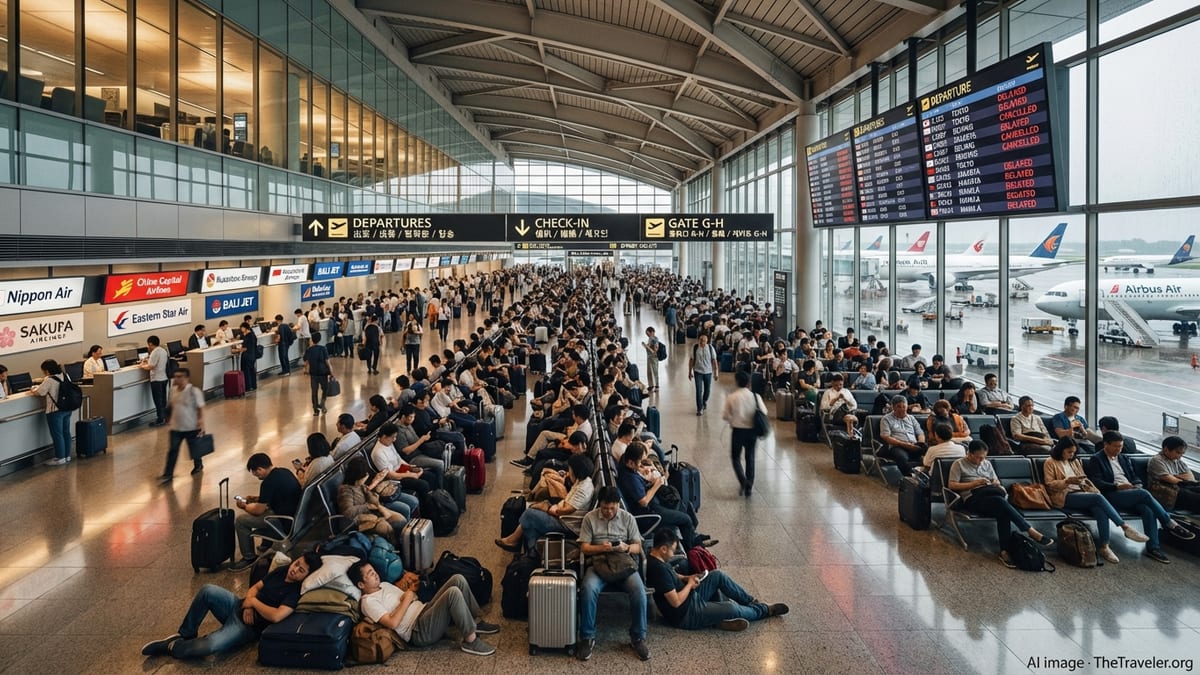
Severe Disruptions Across Beijing, Shanghai and Inland Hubs
Operational data compiled from live flight-tracking dashboards and aviation analytics platforms on 5 June indicate a total of 1,572 delayed departures and 116 outright cancellations across China’s domestic network, with the bulk concentrated at Beijing and Shanghai’s dual-airport systems and at fast-growing inland gateways such as Changsha and Chengdu.
At Beijing Capital and Beijing Daxing, rolling departure pushes of 45 to 120 minutes became common across trunk routes to Shanghai, Guangzhou, Shenzhen and Chengdu. Shanghai’s Pudong and Hongqiao airports, already among the busiest in Asia, saw departure banks bunching into narrow time windows as delayed inbound aircraft arrived late, creating a knock-on effect across later flights.
Secondary but strategically important hubs including Changsha Huanghua and Chengdu Tianfu reported dense clusters of delayed services on short- and medium-haul routes. These airports serve as key connectors between China’s coastal megacities and interior provinces, meaning schedule disruption there quickly propagates outward to smaller regional fields.
A combination of summer-convection weather cells, air-traffic-flow controls and tight aircraft rotations contributed to the turbulence in the schedule. Publicly available meteorological and aviation-planning information points to intermittent storms over eastern and central China, coupled with temporary flow restrictions in crowded air corridors feeding Beijing and Shanghai.
Major Chinese Carriers Bear the Brunt
China’s largest state-controlled airlines were among the hardest hit by the latest wave of disruption. Aggregated tracking feeds show Air China and China Eastern together accounting for a substantial share of the 1,572 delayed flights, reflecting their dominant presence at Beijing Capital, Beijing Daxing and Shanghai Pudong.
Air China, which operates an extensive domestic and international network anchored in Beijing, experienced rolling delays on key north–south and east–west trunk routes. Flights linking the capital with Shanghai, Chengdu, Chongqing and Kunming featured prominently among services departing behind schedule as aircraft and crews were repositioned.
China Eastern, the primary operator at Shanghai Pudong and Hongqiao, also encountered heavy disruption across its dense web of short-haul flights. Routes from Shanghai to Changsha, Wuhan, Xi’an, Dalian and other high-demand cities saw departure boards peppered with revised times as ground handling and slot management teams attempted to compress late-running operations into constrained runway capacity.
Smaller and low-cost players, including 9 Air and regional operator Dalian Airlines, were likewise ensnared in the system-wide slowdown. With leaner fleets and fewer spare aircraft, such carriers typically have less flexibility to recover when a single delay cascades into subsequent rotations, leaving some passengers facing multi-hour holds or same-day cancellations.
Knock-on Effects for Domestic and International Passengers
The disruption has had outsized consequences for both domestic travelers and international passengers relying on Chinese hubs for onward connections. In Beijing and Shanghai, long security and check-in queues formed as travelers tried to adjust plans in real time, particularly on routes feeding early-summer tourism destinations and key business cities.
Domestic itineraries with tight connections were especially vulnerable. A late-arriving feeder flight from inland hubs such as Changsha or Chengdu often meant missing onward services to coastal cities, forcing same-day rebooking or overnight stays. For travelers originating outside China and transiting via major hubs, delayed domestic segments risked misaligned long-haul departures, with some connections reportedly re-routed through alternative Asian gateways.
Publicly available guidance from travel-compensation and passenger-rights platforms underscores that protections in China differ from regimes in Europe or North America. While some airlines provide meal vouchers, hotel accommodation or free rebooking during severe operational disruptions, the level of assistance can vary widely depending on the cause, the length of the delay and the specific airline policy.
For business travelers, the timing of the disruption is particularly challenging. Early June is a peak period for conferences, factory visits and supply-chain inspections across China’s manufacturing belt, and missed meetings or rescheduled plant tours are likely to have downstream effects on project timelines and logistics planning.
What Is Driving the Latest Wave of Flight Delays
Aviation analysts point to a mix of structural and short-term factors behind the current disruption. China’s post-pandemic recovery has sharply increased travel demand, with domestic passenger volumes in 2026 tracking near or above pre-2020 levels on many routes. That rebound has come on top of already tight airspace constraints in eastern China, where civilian and non-civilian traffic must share limited corridors.
Weather remains a recurring trigger. Early-summer conditions frequently bring rapidly developing thunderstorms over the Yangtze River Delta and North China Plain. When convective systems form near busy hubs such as Beijing, Shanghai, Changsha or Chengdu, air-traffic managers often impose temporary flow restrictions or ground stops, slowing the pace of departures and arrivals and compressing schedules into narrower time windows later in the day.
At the airline level, dense scheduling and high aircraft utilization can leave limited slack to absorb shocks. When a single rotation runs late, subsequent legs on the same aircraft quickly follow. This is especially pronounced for carriers operating hub-and-spoke structures centered on Beijing and Shanghai, where banks of inbound flights are timed to feed onward departures within short connection windows.
Industry data published throughout 2026 also suggest that staffing levels, from pilots and cabin crew to ground handlers and air-traffic technicians, are still in the process of rebalancing after the pandemic-era slump and rapid rebound. Any local shortage or last-minute crew re-assignment can further compound weather and airspace pressures.
How Travelers Can Respond and Prepare
Travel advisory platforms and aviation-focused legal services recommend that passengers dealing with the current wave of disruption in China adopt a proactive approach. Checking flight status repeatedly in the 24 hours before departure, using both airline apps and independent tracking tools, can provide early warning of developing issues and create more time to adjust plans.
At airports, passengers facing long delays are often advised to keep boarding passes, written delay notices and receipts for meals or accommodation. Such documentation can be important when requesting reimbursement or demonstrating that a disruption was beyond the traveler’s control in the context of travel insurance claims or employer expense policies.
For those planning upcoming trips involving Beijing, Shanghai, Changsha, Chengdu or other busy Chinese hubs, routing strategies can help reduce risk. Booking slightly longer connection windows, avoiding the most congested afternoon and evening peaks, or considering itineraries that route through less-saturated airports within China may make itineraries more resilient when large-scale delays occur.
As China’s aviation sector continues to scale up capacity and refine congestion-management tools, episodes like the 1,572 delays and 116 cancellations recorded this week highlight the importance of flexibility for travelers, as well as transparent, easy-to-access disruption policies from airlines operating across the country’s increasingly crowded skies.