


Christchurch has become the natural starting point for South Island adventures, combining a well‑connected international airport, a compact and walkable city center, and fast road links to the Southern Alps. From here it is straightforward to pick up a rental car, stock up on supplies, and be among snow‑capped peaks or turquoise lakes within a few hours’ drive. This guide sets out how to plan a South Island road trip with Christchurch as your base, including practical car hire details, suggested routes, and realistic driving times to the mountains.
Get the latest updates straight to your inbox!
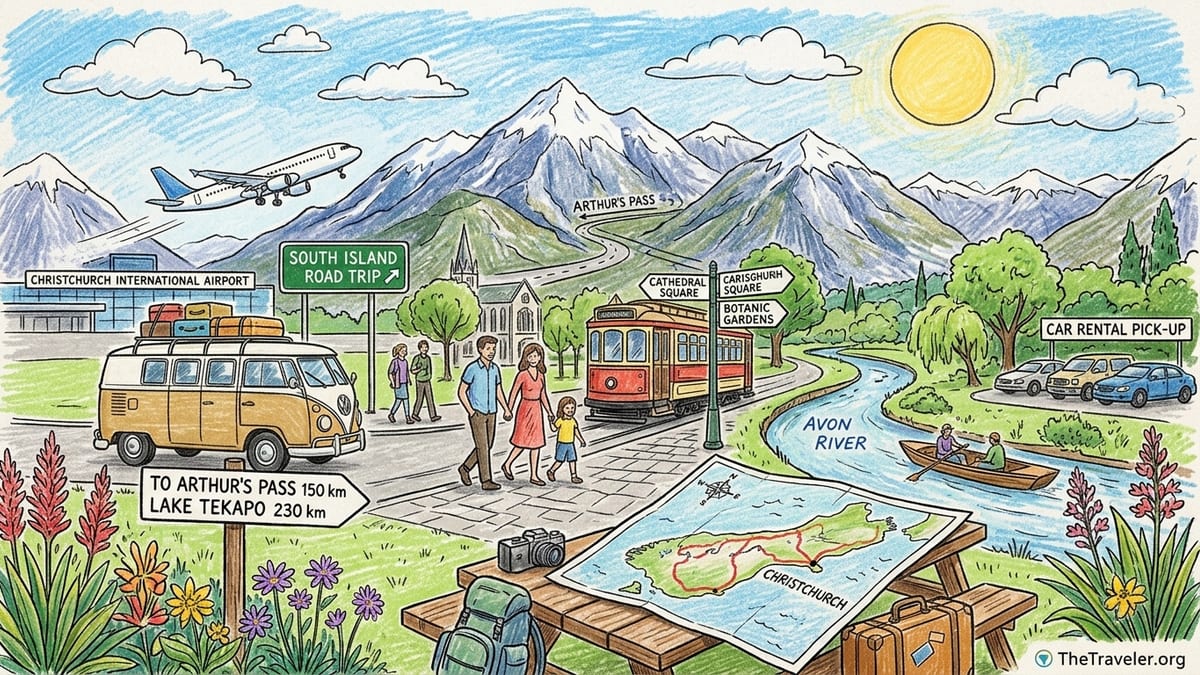
Christchurch today: gateway to the South Island
Christchurch is the largest city in the South Island and one of New Zealand’s main long‑haul gateways. The international airport sits on the northwest edge of town, roughly a 15 to 20 minute drive from the city center outside peak traffic. For road trippers that means you can land in the morning, clear formalities, collect a car at the airport precinct, and be checking into a central hotel or apartment by lunchtime.
The compact city core is easy to navigate on foot. The Avon River curves past the Christchurch Botanic Gardens, the Canterbury Museum redevelopment, and the new Te Pae convention center. The retail heart runs along Cashel and Colombo Streets, with mid‑range hotels and apartment‑style properties in the blocks around Cathedral Square and the Terrace dining precinct. This is where many visitors using Booking.com choose to base themselves for one or two nights before or after a road trip, since you can walk to restaurants and pick‑up points for day tours.
Recent years have seen a steady growth in tourism infrastructure. New accommodation has continued to open and many properties now bundle secure parking into room rates, a small but important detail for anyone traveling with a rental car full of luggage. For example, several mid‑range hotels within ten minutes’ walk of the riverfront quote overnight parking fees in the range of 20 to 30 New Zealand dollars, while some motels on Riccarton Road and Papanui Road include parking in the room price.
Public transport and rideshare options make it simple to move between the airport, central city, and suburbs if you prefer to delay picking up your car. Airport shuttles, buses, and services from operators like Uber and Ola typically quote airport‑to‑city fares that are competitive with one day of rental for a smaller car, so some travelers sleep off their jet lag in town first and only start driving once they feel rested.
Booking accommodation in Christchurch with Booking.com
Booking.com highlights Christchurch as a logical hub for exploring the wider Canterbury region and the South Island. When you search dates between November and March, you will usually see a mix of modern hotels, classic motels, and self‑contained apartments close to Cathedral Square, Hagley Park, and the riverside restaurant district. In high summer it is common to find central double rooms in recognizable international chains advertised from roughly 180 to 260 New Zealand dollars per night, with local motels and guesthouses often coming in a little lower.
Travelers planning a road trip often filter for free parking and kitchen or kitchenette facilities. Motels along Bealey Avenue, Riccarton Road, and Papanui Road frequently provide on‑site parking directly outside the unit doors, which makes loading and unloading gear fast. Apartment‑style properties near Manchester Street and the Terrace sometimes list secure underground parking with lift access to rooms, something to watch for in the property description on Booking.com when you expect to carry bulky ski or hiking equipment.
Christchurch also works well as a one‑night stop at both the start and end of a loop. A common pattern is to reserve a central hotel through Booking.com for the arrival night, another for the final night before flying home, and then leave the middle of the itinerary flexible, booking rural motels and alpine lodges a few weeks before arrival once weather forecasts become clearer. Because Christchurch has a relatively large bed base compared with smaller South Island towns, it is usually possible to find last‑minute rooms outside peak holiday periods, though late December, January, and Chinese New Year can still book out early.
Families and small groups should pay attention to bedding configurations and maximum occupancy rules listed for each property. Two‑bedroom apartments and family suites in Christchurch often allow four or five guests in existing beds, which can keep costs lower than booking two separate hotel rooms. When in doubt, contact the property directly through the Booking.com messaging system to confirm whether a sofa bed or rollaway is included in the quoted nightly rate.
Renting a car in Christchurch: prices, policies and practicalities
Christchurch Airport is one of the best supplied car hire hubs in New Zealand, with both international brands and local companies operating from on‑airport and nearby depot locations. According to a 2026 price comparison from a major aggregator, average daily rates for a small car in Christchurch sit around 35 to 40 New Zealand dollars outside the busiest weeks, with occasional deals dropping closer to 15 dollars per day when demand is low. Larger SUVs and all‑wheel‑drive vehicles suitable for alpine roads usually start somewhere in the 70 to 120 dollar per day range depending on the season and inclusions.
Most international travelers arrive on full‑to‑full fuel policies and unlimited kilometer allowances. Standard excesses on collision damage can be significant, commonly well over 3,000 New Zealand dollars for basic cover. You can either reduce this by paying a higher daily rate to the rental company or rely on excess insurance provided by a credit card or a standalone policy. At the counter you should expect staff to ask whether you want to add an excess reduction package; it helps to have already checked your card benefits so you can make a quick decision.
Seasonal factors matter. Between late June and early October, when ski fields such as Mt Hutt operate, some rental firms specify that their vehicles must not be taken onto ski access roads without chains. Many will supply chains for an additional daily fee if you request them in advance. In summer, the main concern is not snow but gravel roads. Rental contracts often prohibit driving on certain unsealed backcountry routes, such as sections of the road beyond Raspberry Creek near Wānaka, while still allowing short stretches of gravel to reach accommodation or trailheads. Take a few minutes to read the restricted roads list before you set off.
To pick up a car, most visitors walk from the arrivals hall to the desks in the airport terminal, complete paperwork, and then take a short walk or shuttle ride to the parking lots. Off‑airport companies near the airport precinct often send a branded van to collect customers at no extra charge. From a timing point of view, it is sensible to allow 60 to 90 minutes from landing to driving away, particularly at busy times in January and February when queues at popular counters can build up.
Classic South Island road trip routes from Christchurch
Road trip planning usually starts with deciding between a loop and a one‑way itinerary. From Christchurch, one of the most popular loops runs inland through Lake Tekapo and Aoraki Mount Cook to Wānaka and Queenstown, then south to Te Anau and Milford Sound, and back up the east coast through Dunedin and Oamaru before returning to Christchurch. A typical seven to fourteen day version of this loop covers around 1,500 to 1,800 kilometers, which is manageable if you keep individual driving days to four or five hours.
Another well established circuit focuses on the West Coast and the Southern Alps. Drivers head west from Christchurch over Arthur’s Pass to Greymouth and Hokitika, then continue south through glacier country at Franz Josef and Fox Glacier before crossing Haast Pass into Wānaka and Queenstown. From there you can either loop back north through the Mackenzie Country and Tekapo or continue to Te Anau and Fiordland if time permits. This route combines some of the most dramatic alpine scenery on the island with wild coastline and temperate rainforest.
Shorter itineraries are also viable. With five to seven days you might start in Christchurch, spend one night in Lake Tekapo, continue to Aoraki Mount Cook for at least one night of alpine hiking, then carry on to Wānaka and Queenstown before returning to Christchurch by a more direct inland route. Others prefer a coastal focus: two nights in Kaikōura for marine wildlife watching, followed by time in Nelson or the West Coast before completing the loop back through Arthur’s Pass or Lewis Pass.
When looking at these options, remember that South Island roads are scenic and often slower than equivalent distances in Europe or North America. Online itinerary examples that suggest Christchurch to Queenstown in a single day are technically possible, but most experienced travelers now recommend breaking that distance with at least one overnight stop in Tekapo or Twizel so you can enjoy the landscapes rather than racing past viewpoints.
Driving into the Southern Alps: Arthur’s Pass and beyond
The quickest way to feel immersed in the Southern Alps from Christchurch is to drive west toward Arthur’s Pass. The alpine village sits on State Highway 73 roughly 150 kilometers from Christchurch, with official driving time estimates of around two and a half hours in good conditions. The road climbs across the Canterbury Plains, passes Castle Hill and the rock formations of Kura Tawhiti Conservation Area, then threads into Arthur’s Pass National Park, where steep hillsides, viaducts, and deep river valleys announce your arrival in the mountains.
For many visitors, this is an ideal first full day in New Zealand. After a relaxed start from a Christchurch hotel, you can stop in the small town of Springfield for coffee and fuel, walk among the limestone boulders at Castle Hill, and still reach Arthur’s Pass in time for a short afternoon hike before checking into a local motel, lodge, or holiday park. The Department of Conservation maintains several well marked trails, from easy walks to Devils Punchbowl Falls through to more demanding alpine routes for experienced hikers, giving flexibility for changing weather.
The same highway continues west through the Otira Gorge to Kumara Junction and Greymouth on the West Coast. Driving all the way from Christchurch to Greymouth via Arthur’s Pass is roughly a three and a half hour journey without stops, but most road trippers allow a full day so they can photograph viewpoints and take short walks. Those who prefer not to drive often book the TranzAlpine scenic train between Christchurch and Greymouth, then collect a rental car on the West Coast to continue south toward glacier country.
Closer to Christchurch, the Inland Scenic Route threads through the foothills via small towns such as Methven. From there a well signposted access road climbs to the Mt Hutt ski area, around 113 kilometers and roughly one and a half to two hours’ drive from Christchurch Airport in clear conditions. The final 14 kilometers are on an alpine road that can be snowy or icy in winter, so chains and a cautious driving style are essential during the ski season. Outside winter, these same roads provide quick access to river gorges, hot pools, and rural walking tracks.
Sample one‑ and two‑week itineraries using Christchurch
A realistic one‑week itinerary in summer might begin with an arrival night in Christchurch, followed by a drive to Lake Tekapo on day two, a night or two around Aoraki Mount Cook, then onward to Wānaka and Queenstown before a flight out of Queenstown or a long but scenic return drive to Christchurch. This concentrates your time in the central Southern Alps and Mackenzie lakes region, where short walks like the Hooker Valley Track and Roys Peak deliver big mountain views without technical skills.
With ten to fourteen days you can afford to add the West Coast and Fiordland. One popular pattern is to depart Christchurch for Arthur’s Pass and Hokitika, continue south to Franz Josef or Fox Glacier for glacier walks or scenic flights, cross Haast Pass to Wānaka, then spend several nights in Queenstown and Te Anau to visit Milford Sound or Doubtful Sound. From there you can loop back through Aoraki Mount Cook and Tekapo before returning to Christchurch for your final night.
Travelers arriving and departing Christchurch on different days sometimes book open‑jaw tickets, flying into Christchurch and out of Queenstown or vice versa. One‑way car rentals between these two cities are widely offered, although a one‑way fee may apply. This approach eliminates the need to backtrack, which is particularly valuable in winter when daylight hours are shorter and you may want to keep driving days conservative.
If your schedule is tight, consider keeping your radius smaller. For example, a long weekend from Christchurch can focus on the Southern Alps alone: drive to Methven and Mt Hutt, then continue to Tekapo or back via Rakaia Gorge. Alternatively, pair Christchurch with Kaikōura, around two and a half hours’ drive north, for a mix of city time and whale or dolphin watching before returning along the same highway.
Navigation, safety and seasonal considerations
Road tripping from Christchurch requires a little more planning than urban driving at home, mainly because conditions can change quickly in the Southern Alps. Before you leave, it is worth checking the official road conditions website or local radio for updates on closures, slips, or high wind warnings, particularly in winter and early spring. The combination of alpine passes and narrow river gorges means that a single incident can temporarily block a highway, which may force detours through alternative passes such as Lewis Pass or a return to Christchurch to re‑plan.
Drivers from North America and continental Europe must adjust to driving on the left and to local speed limits. Open road limits are typically 100 kilometers per hour, but many visitors find they naturally sit lower than this on twisty sections, especially when encountering one‑lane bridges or strong crosswinds. The police and rental companies emphasize not driving when jet lagged; a common piece of local advice is to spend your first night in Christchurch city and begin longer drives only on day two.
Seasonal weather shapes what is realistic. Between December and March, long daylight hours and mostly clear roads make it easier to cover larger distances, though heavy rain can still affect passes and the West Coast. From May through September the South Island experiences colder temperatures, early sunsets, and regular snow or ice on higher roads. If you plan to visit ski areas such as Mt Hutt or drive over Arthur’s Pass in winter, choose a vehicle with modern safety features, carry chains where required, and build extra time into your itinerary in case roads open late or close temporarily.
Fuel availability is generally good on main routes, but there can be longer gaps between service stations on alpine stretches. Practical examples include filling up around Christchurch or Darfield before tackling Arthur’s Pass, and again in larger West Coast towns like Greymouth, Hokitika, or Franz Josef. In the Mackenzie Country it is sensible to keep your tank healthy when passing through Tekapo, Twizel, and Omarama, especially after dark when smaller stations may close for the night.
Making the most of Christchurch before and after the road trip
Building time in Christchurch at the start or end of your itinerary helps smooth out international travel fatigue and gives you a buffer against unforeseen delays. Many travelers now schedule at least one full day in the city before returning a rental car and flying out, both to enjoy Christchurch’s evolving urban scene and to allow for any last‑minute changes caused by weather further afield.
Within the city, recent additions such as the Riverside Market, new galleries, and riverside bars provide a gentle transition between remote alpine days and the flight home. Families appreciate the open spaces of Hagley Park and the Botanic Gardens, while those with an interest in Antarctic history often visit the Antarctic museum complex near the airport, which can be a convenient final stop before dropping off a car.
Christchurch also offers practical services that are harder to find in smaller South Island towns. Outdoor retailers in and around the central city stock hiking gear, waterproof layers, gas canisters, and maps, allowing travelers to replace worn equipment or top up supplies mid‑trip. Supermarkets and large shopping centers make it easy to provision for self‑catering road trips, particularly if you have booked apartments or holiday homes through platforms such as Booking.com.
On your last night, it is prudent to stay within a short drive of the airport, especially for early morning departures. Many hotels along Memorial Avenue and around the airport precinct provide park‑and‑stay packages or free shuttles to the terminal. Returning your rental car the afternoon before an early flight can reduce stress; you can then rely on hotel transfers to reach the terminal while watching the Southern Alps recede behind you, already planning the next time you will point a car west from Christchurch and back into the mountains.
Conclusion: why Christchurch works so well for road trips
Christchurch combines practical infrastructure with immediate access to some of New Zealand’s most dramatic scenery. Its international airport, concentration of rental car providers, and broad range of accommodation options highlighted on Booking.com make it an efficient starting point for South Island road trips of almost any length. Within a few hours’ drive you can be in the heart of the Southern Alps at Arthur’s Pass, beside the turquoise lakes of the Mackenzie Country, or carving turns above the Canterbury Plains on Mt Hutt.
By understanding car hire policies, choosing realistic daily distances, and allowing time for weather and rest, you can shape an itinerary that feels adventurous without being rushed. Whether you opt for a full two‑week loop taking in Fiordland and the West Coast or a shorter circuit focused on Christchurch, Tekapo, and the nearby mountains, using Christchurch as your hub gives you flexibility. It is a place where city comfort and alpine wilderness sit only a few hours apart, joined by roads that invite slow travel and unhurried exploration.