


The United Arab Emirates offers a highly urbanized environment in a hyper-arid desert climate that is increasingly shaped by extreme heat, humidity, and recurrent dust and sandstorms. For potential long-term residents, these climate characteristics are not a background detail but a core relocation factor that influences health risk, mobility, working patterns, and daily living conditions for much of the year. Understanding how temperature, airborne dust, and climate variability interact with modern infrastructure is essential for assessing whether a move to the UAE is personally and professionally sustainable.
Baseline Climate Profile and Seasonal Extremes
The UAE has a hot desert climate characterized by very long, intensely hot summers and short, mild winters. From roughly May to September, daytime maximum temperatures in many inland areas often exceed 40°C, with peak summer afternoons frequently rising towards or above 45°C in some locations. Coastal cities such as Dubai and Abu Dhabi combine high temperatures with elevated humidity from the Arabian Gulf, amplifying perceived heat stress even when air temperatures are similar to inland zones.
Relative humidity along the coast can climb beyond 70 percent during the hottest months, resulting in very high heat indices and wet-bulb temperatures that limit the body’s ability to cool through sweating. International occupational health research increasingly identifies the Gulf as one of the regions where combined heat and humidity are reaching or approaching physiological limits for extended outdoor exertion, especially in poorly shaded or unventilated environments.
Winters, roughly December to February, are generally dry and mild, with daytime highs commonly between the low 20s and high 20s Celsius. However, the seasonal contrast should not obscure the fact that, on an annual basis, the UAE is among the world’s hotter populated regions, with a trend of gradual warming over recent decades associated with broader climate change signals in the Middle East.
Local microclimates also matter. Rapid urbanization has created pronounced urban heat island effects in major cities, where built-up areas can remain several degrees warmer than nearby less-developed zones, particularly at night. This can mean that even after sunset, outdoor conditions remain uncomfortable or stressful for prolonged activity, increasing reliance on air conditioning as a basic living necessity rather than a comfort feature.
Occupational Heat Stress and Daily Time Patterns
For relocating professionals, the practical impact of UAE heat depends heavily on work setting. Office-based roles predominantly occur in climate-controlled environments, where indoor temperatures are managed, yet commuting, site visits, and any outdoor responsibilities are shaped by strict diurnal patterns. Outdoor activity, including exercise, errands, or site inspections, tends to move into early morning or late evening hours for much of the year to avoid peak heat and sun exposure.
For residents whose work involves outdoor tasks, the heat presents a more structural challenge. UAE authorities operate a recurring summer “midday break” system for outdoor workers, typically from 15 June to 15 September, restricting work under direct sunlight from approximately 12:30 p.m. to 3:00 p.m. This framework is now a long-established feature of the labor calendar and is backed by inspections and financial penalties for non-compliance. While these measures reduce exposure at the most hazardous hours, they do not remove substantial heat exposure in the surrounding morning and late-afternoon periods, which still frequently occur above 40°C.
Employers in construction, logistics, landscaping, and similar sectors are expected to adapt scheduling, hydration policies, and rest break design to manage chronic heat stress. Technical guidance from authorities emphasizes shaded rest areas, provision of cool drinking water, and worker education on recognizing heat exhaustion. For relocating professionals who will manage teams or oversee operational sites, developing robust heat management protocols is a practical requirement and a factor in assessing whether the role is viable and compliant in the UAE context.
Even for residents working indoors, the midday break illustrates a broader pattern: outdoor appointments, school activities, and non-essential errands are commonly avoided at mid-afternoon in peak summer. Over time, this produces a climate-driven reconfiguration of daily routines, where evenings and nights assume greater importance for socializing, recreation, and non-work errands, and where air-conditioned mobility becomes a default assumption.
Sandstorms, Dust Events, and Air Quality
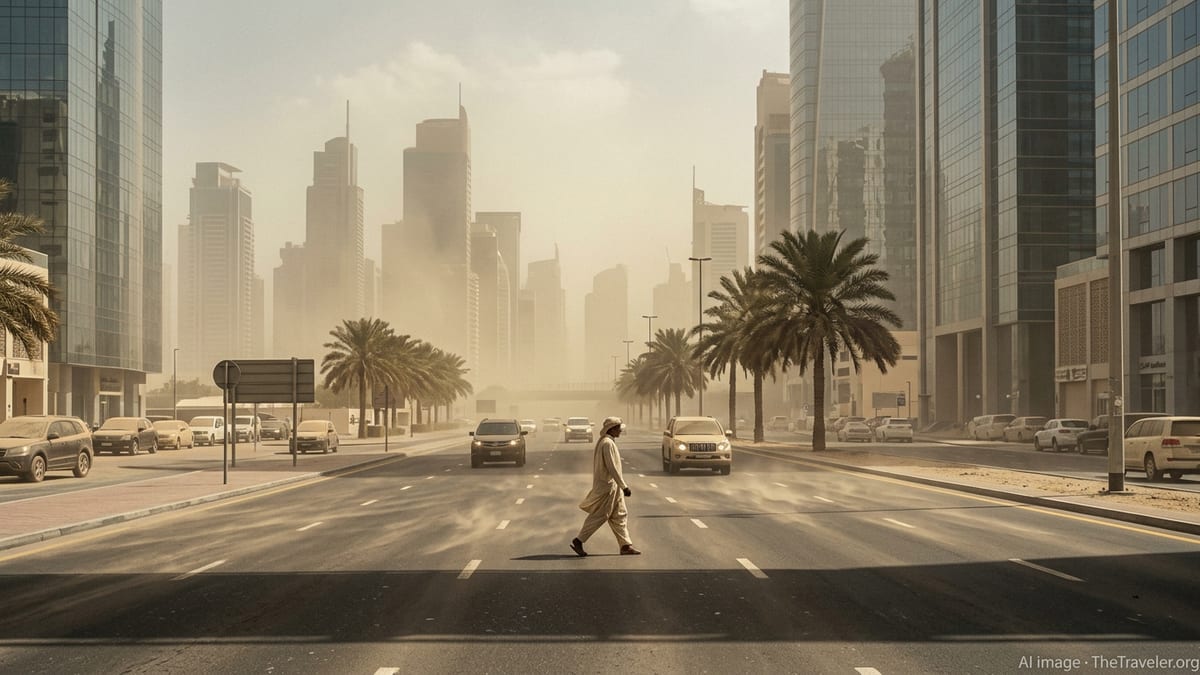
In addition to heat, the UAE experiences periodic dust and sandstorms driven by strong desert winds. These events can arise from local source areas or be transported across borders from larger desert regions. Historical analyses of meteorological data suggest that the Emirates see a mixture of mild dust events and more severe storms that can sharply reduce visibility, sometimes to a few kilometers or less, when wind speeds surpass moderate thresholds. While not daily occurrences, such events recur seasonally, particularly in the late winter to early summer period.
Sand and dust storms have direct implications for air quality. Fine particulate matter carried in these plumes can aggravate asthma, chronic obstructive pulmonary disease, and other respiratory and cardiovascular conditions. Local health professionals routinely advise vulnerable residents, including children, older adults, and people with pre-existing heart or lung disease, to stay indoors with windows closed and air conditioning running in “recirculation” mode during heavy dust episodes. For potential relocators with significant respiratory sensitivities, the frequency of dust events represents a material factor in assessing suitability of long-term residence.
Operationally, dust storms affect visibility for driving and aviation and can interrupt or slow outdoor work and logistics operations. Road transport authorities occasionally introduce speed limits or cautionary advisories during especially dusty conditions. Public messaging encourages drivers to use headlights, maintain increased following distances, and avoid sudden lane changes when visibility is reduced. For residents, this can translate into disrupted school runs, delayed deliveries, and rescheduled meetings on days with severe storms.
From an infrastructure perspective, dust intrusion is a chronic maintenance issue. HVAC filters, vehicle air filters, and exposed mechanical systems require more frequent servicing than in less dusty climates. Residents in low-rise housing often contend with fine dust accumulating on balconies, window sills, and outdoor furnishings after even moderate events. Budgeting time and cost for more frequent cleaning and filter replacement is a practical lifestyle consideration connected directly to the local climate.
Indoor Environmental Control and Building Adaptations
Given the combined stressors of heat, humidity, and dust, indoor environmental control is central to life in the UAE. Air conditioning is effectively universal in residential and commercial buildings, with many properties using centralized systems and others relying on split units. For relocators, system reliability, insulation quality, and building orientation relative to solar exposure can significantly influence comfort, energy consumption, and noise levels.
In poorly insulated or older buildings, cooling systems must work harder and longer during summer, sometimes struggling to maintain comfortable indoor temperatures at peak afternoon heat. The result can be significant variability in environmental comfort between properties, even within the same neighborhood. Prospective residents typically benefit from inspecting properties during warmer months if possible, or at least querying building age, recent retrofits, and air conditioning capacity as part of their relocation due diligence.
Dust management intersects with building design and maintenance. Properties with adequate window sealing, well-maintained air filters, and effective ventilation control generally provide better indoor air quality during sandstorms. In contrast, buildings with leaky windows or infrequent filter changes can allow dust penetration that undermines respiratory comfort and requires regular interior cleaning. High-rise towers may experience less direct blown sand than low-rise structures but are still exposed to fine particulate matter carried aloft by strong winds.
For many residents, the net effect is a strong dependence on building systems. Extended power outages, while not frequent, pose a more significant comfort and health risk than in temperate climates, particularly for those living on upper floors or in less shaded districts. Relocators evaluating neighborhoods and buildings may wish to consider backup cooling options, window shading, and access to shaded outdoor areas that remain usable in early mornings or evenings.
Health, Wellbeing, and Personal Adaptation Strategies
Long-term exposure to high heat and recurrent dust requires deliberate personal adaptation. New residents often underestimate how quickly unacclimatized individuals can develop heat exhaustion when walking even short distances outdoors at midday in summer, especially when combined with high humidity. Hydration must be actively managed, with residents commonly carrying water and electrolytes during outdoor periods and ensuring children and older family members drink adequately across the day.
Clothing choices shift towards lightweight, loose-fitting, and light-colored fabrics that enhance evaporative cooling and reduce heat absorption. Sun protection is a non-negotiable daily habit for much of the year, including high-SPF sunscreen, hats, and sunglasses during any significant outdoor exposure. For physically active residents, much exercise migrates to indoor gyms, shaded tracks, or very early morning and late-night outdoor sessions, particularly between June and September.
Dust and sandstorms introduce a different set of health-protection behaviors. During high-dust days, many residents limit outdoor exposure, especially for vigorous activity. People with asthma or allergies may use masks or respirators with particulate filters when movement outside is unavoidable. Medical practitioners in the UAE frequently highlight the importance of adherence to maintenance inhaler regimens during dust seasons and encourage keeping rescue medications readily accessible.
Mental wellbeing can also be indirectly affected by climate constraints. For several months each year, daytime outdoor leisure is significantly curtailed, which can feel confining to individuals who value outdoor recreation in daylight hours. Awareness of this seasonal pattern allows relocating families to plan alternative activities, such as indoor sports, cultural venues, and evening social routines, to reduce the sense of limitation imposed by the climate.
Climate Change Trends and Future Risk Outlook
Climate projections for the Gulf region indicate a continuation of warming trends, with the UAE expected to face higher average temperatures, more frequent heat waves, and potential intensification of humidity episodes. Scientific studies of the Arabian Gulf show notable sea surface temperature increases over recent decades, which may contribute to more extreme humid heat along coastal corridors. For long-term residents, this suggests that what is now experienced as “exceptional” extreme heat may become more common within future decades.
Dust storms and sandstorm dynamics are also influenced by climate and land-use changes. Some research points to potential shifts in the frequency and intensity of dust events in arid regions, although local patterns can be complex, depending on wind regimes, precipitation variability, and vegetation cover. The UAE’s continued urban expansion and infrastructure development can both mitigate and amplify dust sources, depending on how surfaces are stabilized and landscaped.
At the same time, the country is witnessing emerging climate-related phenomena beyond heat and dust. Recent years have seen episodes of unusually intense rainfall and flash flooding, including record-breaking rainfall events that significantly disrupted transport and daily life. While such events are relatively infrequent compared with heat extremes, they add another layer of climate variability that relocating professionals should recognize as part of a broader shift in regional climate behavior.
Government initiatives in areas like urban greening, district cooling, and improved building codes aim to moderate some of these climate stressors, but they operate against a backdrop of underlying warming. For individuals considering multi-decade residence, factoring in an incremental increase in heat stress and potential changes in air quality and extreme weather frequency is a prudent component of relocation planning.
Lifestyle Adjustments and Practical Planning for Relocators
For prospective residents, the climate challenges in the UAE translate into a set of practical adjustments rather than an insurmountable barrier, provided expectations are realistic and planning is proactive. A key consideration is the seasonal restructuring of daily routines. Many residents adopt an early-morning pattern for outdoor chores and children’s play, a mid-day focus on indoor work or home activities, and an evening and night window for social engagements and errands once temperatures begin to fall.
Transport choices are influenced by heat exposure. Private cars, taxis, and ride-hailing services with air conditioning are often preferred for all but very short trips, particularly in summer. Walking and cycling remain possible but are heavily time-of-day dependent and most viable in cooler months. Prospective relocators who anticipate relying on public transport and walking should assess the availability of shaded or air-conditioned walkways and station infrastructure along likely routes.
Household planning incorporates climate resilience at a micro level. Residents commonly invest in blackout curtains or reflective blinds to reduce solar gain, portable air purifiers to address indoor dust on storm days, and multiple sets of air conditioning filters for regular replacement. For families with school-age children, awareness of how schools manage outdoor activities and recess during high heat and dust is relevant, as is understanding policies on heat or dust-related schedule changes.
On the professional side, employers with global workforces increasingly integrate UAE-specific climate considerations into remote-work policies, travel schedules, and health and safety training. Relocators taking leadership roles may be expected to participate in or oversee heat-stress risk assessments and to support team members in adapting working patterns when severe heat or dust alerts are issued. Recognizing these responsibilities in advance can shape negotiations around role design and resource allocation.
The Takeaway
Evaluating relocation to the UAE requires treating climate as a primary operational variable rather than a background characteristic. Extreme heat, high humidity, and recurrent dust and sandstorms shape work schedules, transport choices, building performance, and health-risk management for much of the year. For many residents, these conditions are manageable through a combination of robust indoor environmental control, time-of-day scheduling, and personal protective behaviors. However, the requirements are continuous and intensify during the long summer season.
Individuals and families who thrive in highly air-conditioned, urban environments and are comfortable restructuring routines around early mornings and evenings often adapt well to the UAE’s climate profile. Those with significant respiratory vulnerabilities, strong preferences for daytime outdoor recreation in hotter months, or limited ability to control their indoor environment may find the adaptation more challenging. Given projected regional warming and potential shifts in dust and extreme rainfall patterns, prospective relocators should assume that climate stressors are more likely to increase than diminish over the medium to long term and plan their relocation decisions accordingly.
FAQ
Q1. How many months of the year is the UAE uncomfortably hot for regular outdoor activity?
For most residents, roughly four to five months, typically from late May to late September, are considered too hot and humid for prolonged midday outdoor activity without significant discomfort or heat-stress risk.
Q2. Are sandstorms in the UAE a daily occurrence?
No. Sand and dust storms occur seasonally and intermittently. Some months may pass with only mild dusty days, while certain periods see multiple storms in a short span, especially in late winter and spring.
Q3. How do sandstorms affect daily commuting and transport?
During stronger events, visibility can drop enough to slow traffic, prompt speed reductions on major roads, and cause short delays. Most routine commuting continues but with heightened caution and occasionally longer travel times.
Q4. Is air conditioning available everywhere, or is it a premium feature?
Air conditioning is effectively standard in residential, commercial, and public buildings across the UAE. The key differences lie in system quality, maintenance, and building insulation, which influence comfort and energy use.
Q5. How serious are the health risks from UAE heat for otherwise healthy adults?
For healthy adults who follow precautions such as hydration, time-of-day planning, and sun protection, risks are manageable. Problems arise primarily with intense exertion at peak heat, inadequate fluid intake, or lack of shade and cooling.
Q6. Do people still exercise outdoors in the UAE summer?
Yes, but with adjustments. Many residents move vigorous activity indoors or to very early morning or late evening hours. Daytime outdoor endurance exercise in peak summer is generally avoided by most people.
Q7. How does the climate affect families with young children?
Families must limit children’s midday outdoor exposure in summer, emphasize hydration and sun protection, and rely more on indoor play spaces. Outdoor parks are used mainly in cooler months or during early mornings and evenings.
Q8. Are respiratory conditions like asthma a significant concern during sandstorms?
Yes. Dust and fine particles can aggravate asthma and other respiratory conditions. Residents with such conditions often stay indoors on high-dust days and keep medications, masks, and air filtration readily available.
Q9. Is climate change expected to make living conditions in the UAE substantially worse?
Projections suggest higher average temperatures, more frequent extreme heat events, and possible changes in dust and rainfall patterns, indicating that climate-related stresses are likely to increase rather than diminish over time.
Q10. Can someone who dislikes heat adapt successfully to the UAE climate?
Adaptation is possible but depends on tolerance for spending much of the year in climate-controlled indoor spaces and accepting seasonal limits on daytime outdoor activity. Personal preference and flexibility play a decisive role.