


Few places in Europe lodge themselves in travelers’ memories quite like Pisa’s Piazza dei Miracoli. Officially known as Piazza del Duomo, this walled green square with its tilted bell tower has been pulling visitors back for centuries, from 17th‑century grand tourists to today’s weekend city‑breakers. The Leaning Tower may be the headline act, but most repeat visitors will tell you it is the atmosphere, the layers of history, and the surprising calm that keep them returning, year after year.
Get the latest updates straight to your inbox!
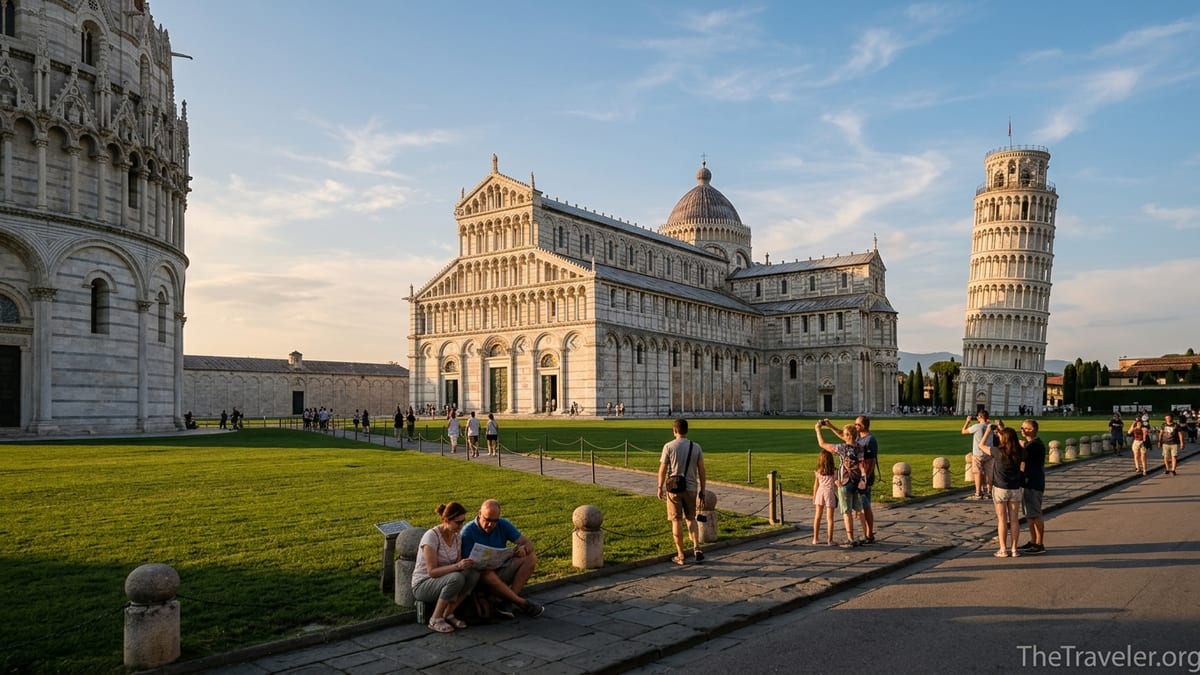
An Iconic Skyline That Never Stops Surprising
However many times you have seen it in photos, stepping into Piazza dei Miracoli and seeing the Leaning Tower rise beside the white‑marble cathedral still feels unreal. The entire complex, inscribed as a UNESCO World Heritage Site in 1987, gathers four monumental buildings on a single rectangle of vivid lawn: the cathedral, the Leaning Tower, the Baptistery and the Camposanto Monumentale cemetery. Their pale stone seems to glow even on an overcast day, and on a bright June afternoon the contrast between grass, sky and marble can make the whole ensemble look freshly carved.
Part of the reason travelers keep coming back is that the square looks and feels slightly different with every visit. Arrive on a winter weekday and you may find mist curling around the tower, with only a scattering of school groups and local residents crossing the grass. In high summer, cruise‑ship excursions and day‑trippers fill the paths between the monuments, creating a kinetic scene of cameras, sunhats and families posing for the famous “holding up the tower” photo. Many visitors return in a different season just to experience that shift in mood.
Even within a single day, the piazza transforms. Early in the morning, long shadows fall across the grass and the tower’s tilt is especially dramatic when seen from the Baptistery side. By late afternoon, as the sun moves behind the cathedral, the tower’s white arc turns a subtle honey color, and the crowds thin enough that returning travelers often sit on the low stone wall with a takeaway espresso from a nearby bar to watch the light change. After dark, floodlighting outlines the monuments against the sky, so a second or third evening visit can feel almost like a different destination.
For photographers, these variations are a powerful reason to revisit. Many serious amateurs plan multiple trips to Pisa just to catch the piazza with fresh snow, a summer thunderstorm rolling in from the Tyrrhenian coast, or the soft pink skies that sometimes follow spring rain. Shooting from the city walls walkway, reopened and heavily promoted in recent years, also offers a perspective that frequent visitors did not have a decade ago and makes repeat stops especially rewarding.
Living Medieval Masterpieces in One Compact Space
If the tower draws travelers to Pisa, the architecture of the whole square usually brings them back. The cathedral, begun in the 11th century, is one of the defining examples of Pisan Romanesque, with blind arcades, striped marble and bronze doors that signal how powerful the maritime republic once was. Inside, the coffered ceiling catches the afternoon light in gold, and many returning visitors make time to stand in front of Giovanni Pisano’s intricately carved pulpit, noticing new details in the figures with each visit.
Next door, the Baptistery adds another layer of fascination. Completed in the 14th century with a Gothic upper section perched on a Romanesque base, it is famous among repeat travelers for its unusual acoustics. Staff periodically demonstrate the echo by singing a few notes, which seem to hang in the air and harmonize with themselves. Many people who first encountered this by chance on a rushed day trip later return to Pisa specifically to hear that sound again, this time lingering on the upper gallery that circles the interior.
The Camposanto Monumentale, the long cloister along the northern edge of the square, tends to be quieter and is one of the discoveries that often turns a first‑time visitor into someone who comes back. Inside, fragile frescoes line the walls, and there are Roman sarcophagi and medieval tombs set into the floor. Travelers who enjoy art history frequently plan a second trip just to walk its corridors at a slower pace, after learning how much was damaged during bombing in the Second World War and painstakingly restored over decades.
One of the practical reasons the piazza inspires repeat visits is its compactness. All four monuments stand within moments of each other, so a traveler on an Italy rail itinerary can revisit from Florence or Lucca on a short regional train ride and still see everything they missed the first time. It is common to meet people on guided tours who first came on a hurried bus excursion years earlier and are now back for longer, this time with pre‑booked tickets that let them climb the tower, visit the cathedral and spend quiet time in the Camposanto at their own rhythm.
The Thrill of Climbing the Leaning Tower Again
For many travelers, climbing the Leaning Tower once is exhilarating enough. Yet more and more visitors treat a second ascent, perhaps years later, almost like revisiting a favorite hike. The official tower ticket for 2026 is around 20 euros for adults for a 30‑minute slot, and a popular all‑monuments combo that bundles the tower with access to other sites in the square hovers in the high‑20‑euro range. The cost is not negligible, but returning climbers often describe it as one of the best single experiences in Tuscany for the price.
The climb itself feels different on each visit. The tower’s 294 narrow steps spiral upward and the tilt is unmistakable underfoot: at certain points you feel oddly pushed toward the inner wall, and a few steps later as though you are climbing slightly downhill. On a first ascent, nerves and excitement can make that sensation overwhelming. When travelers come back a second time, they tend to notice more of the details, from the worn marble grooves where centuries of feet have passed to the views of the cathedral roof tiles from the landward side.
At the top, the panorama over Pisa rewards repeat visits as the city evolves. In recent years, the reopened stretch of medieval walls that runs from the river toward the piazza has become a firm favorite, and from the tower you can trace its line above the rooftops. Returning visitors who have already ticked off the standard selfie often spend their time identifying new landmarks, such as the small Romanesque churches along the Arno or the greenery of the university quarter. Seasonal changes also matter: on a clear winter afternoon, the snow‑tipped Apuan Alps are more sharply visible than in the summer haze, giving frequent visitors a fresh backdrop.
Another reason climbers return is the challenge of timing. Busy months from roughly April to October can see midday slots sell out days in advance, and many first‑time visitors only manage a crowded mid‑afternoon ascent. On a repeat trip, they might invest in an early morning or late evening slot through a flexible ticket option that allows advance reservation and sometimes costs a bit more via international resellers but adds free cancellation. Those quieter moments at the top, with fewer people and softer light, convince many that the second climb was worth the effort and expense.
A Place Where Practical Travel Logistics Actually Work
Piazza dei Miracoli draws repeat visitors partly because it is easy to integrate into real‑world travel plans. The square lies about a 20‑minute walk from Pisa Centrale station, and local buses shorten that to less than 10 minutes for travelers with luggage or mobility concerns. Budget airlines serve Pisa’s airport just a short train ride away, so many international travelers discover the piazza on a quick stopover and later return for a dedicated city break.
On a practical level, the site’s ticketing system rewards those who come back with more time and planning. Entry to the grassy square itself remains free and open at all hours, so anyone can wander in for sunrise or a late‑night stroll without a ticket. Access to the monuments is controlled by timed slots, and the official booking platform and vetted resellers offer different combinations: tower‑only tickets around 20 euros, or packages in the mid‑20s that include the cathedral, Baptistery, Camposanto and sometimes the museum. Travelers who rushed their first visit often return knowing exactly which combination suits them, avoiding long ticket‑office queues in high season.
Accommodation choices also make repeat visits appealing. Hotels and guesthouses within a five‑ to ten‑minute walk of the piazza allow guests to experience the square early in the morning and late at night, when day‑trip crowds have vanished. A couple from the United States might first see the tower on a four‑hour bus tour from Florence, then, a few years later, book a small family‑run hotel near Via Santa Maria so they can slip back into the square after dinner, gelato in hand. That second experience, unhurried and quieter, is often what turns Pisa into a place they talk about returning to again.
Costs on the ground also play a role. While restaurant prices immediately around the piazza can reflect its status as one of Italy’s best‑known sights, travelers who come back learn quickly that walking five to ten minutes toward the river brings them to trattorias with more local customers and moderate prices. A simple plate of cacio e pepe or a seafood pasta along Borgo Stretto will not be a bargain by global standards, but it often costs noticeably less than a tourist‑menu pizza directly facing the tower, making longer and repeat stays more affordable.
Atmosphere Beyond the Selfie: Grass, Silence, and Night Light
Despite its fame and crowds, Piazza dei Miracoli offers something that keeps reflective travelers returning: the possibility of quiet. The broad lawns, framed by medieval walls, act as a visual buffer from the rest of the city. Even when tour groups cluster in front of the Leaning Tower, a few steps toward the Camposanto or the rear of the cathedral can feel remarkably peaceful, especially outside peak midsummer weekends.
Many visitors discover this almost by accident. They arrive expecting a quick walk around, a staged photo and perhaps a rushed climb, then find themselves lingering on the grass, watching clouds drift behind the Baptistery or listening to the muffled sounds of the city beyond the walls. It is common to meet solo travelers or university students who return regularly just to sit with a book or sketchpad; for them the piazza becomes less a box to tick and more a familiar open‑air living room.
Nighttime is another revelation that fuels repeat trips. The monuments are gently lit after dark, and since the outer square remains open, travelers can stroll in long after the last tower entry. A couple who first came on a day excursion might return years later, this time staying overnight, specifically to walk through the piazza at 11 p.m., when only a scattering of locals and photographers remain. In cooler months, the combination of silence, soft lighting and the tower leaning into the sky is often described as eerie in the best possible way.
Seasoned visitors also talk about the changing soundscape. On busy spring afternoons, you may hear a mix of languages, street musicians near the gates and the occasional horn from city traffic outside the walls. On a January morning, the dominant sound might be footsteps on gravel and the distant calls of pigeons on the cathedral roof. This subtle shift in mood with weather and time makes the piazza feel fresh even on a third or fourth visit.
A Gateway to a Walkable, Underestimated City
Another reason travelers find themselves back at Piazza dei Miracoli is that they realize, often belatedly, that Pisa is more than a single square. On a first visit, many people spend less than two hours in the city, shuttled in from Florence or a cruise port. Those who return usually do so because they want to connect the piazza to the rest of Pisa: the Arno riverfront, the student‑filled streets and the less‑visited churches.
In recent years, the elevated walkway along Pisa’s medieval walls has become an especially attractive link between the square and the wider city. The 3.5‑kilometer path starts near Piazza dei Miracoli and winds above rooftops toward the river and residential neighborhoods. A ticket to the walls, which costs a modest sum compared with major monuments in larger Italian cities, offers repeat visitors a new way to approach the piazza from above, watching the Leaning Tower slowly come into view as they walk.
Once travelers discover how compact Pisa’s historic center is, many plan a second or third trip using the piazza as a base. They might spend the morning revisiting the cathedral and Camposanto, then wander down to the Arno to see the tiny Gothic church of Santa Maria della Spina from the outside, or explore the cafés of Borgo Stretto, where students from the University of Pisa mix with visitors. The ability to stitch these experiences together in a single, walkable day encourages people who previously treated Pisa as a stopover to return for a long weekend.
Because regional trains connect Pisa easily to Lucca, Florence and the Tuscan coast, the piazza also becomes a familiar landmark at the beginning or end of broader trips. Travelers who fall in love with the square often find themselves routing future itineraries through Pisa, building in a few free hours around arrival or departure flights to sit on the grass once more, take a last look at the Leaning Tower and feel that their time in Tuscany has properly begun or ended.
The Takeaway
Piazza dei Miracoli is one of those rare places where global fame does not exhaust the experience. The Leaning Tower may be the image that fills postcards and social media feeds, but travelers who return year after year do so for a richer mix of reasons: the shifting play of light on marble, the echo under the Baptistery dome, the chance to climb the tower at a quieter hour, the slow discovery of the Camposanto’s frescoes, and the way the square connects seamlessly to a livable, walkable Italian city.
Practical factors matter too. Reliable transport links, clear ticketing options and a range of nearby accommodation make it easy to turn a hurried first look into a deeper second or third stay. Budget‑conscious travelers learn to balance splurges like a tower climb with simple, satisfying meals a short stroll away from the crowds. Families return as children grow older and can finally tackle the tower steps, while solo travelers come back to sketch, photograph or simply sit on the grass and watch the shadows move.
In the end, what keeps people coming back to Piazza dei Miracoli is a feeling that the place repays attention. Each visit reveals a new angle or detail: a sculpted figure in the cathedral pulpit you had not noticed before, a different skyline beyond the tower, or a quieter corner of the lawn where the medieval walls seem to hold the modern city at bay. For many, it becomes not just a once‑in‑a‑lifetime sight, but a recurring chapter in their personal travel story.
FAQ
Q1. Is entry to Piazza dei Miracoli itself free?
Yes. Access to the grassy square and exterior views of the Leaning Tower, cathedral, Baptistery and Camposanto is free at all hours, though you pay to enter the monuments.
Q2. How much does it cost to climb the Leaning Tower of Pisa?
In 2026, the official adult ticket to climb the tower is around 20 euros for a timed 30‑minute slot, with separate or combo tickets available for the other monuments.
Q3. Do I need to book Leaning Tower tickets in advance?
Advance booking is strongly recommended, especially from spring through early autumn and on weekends, when popular times of day can sell out several days ahead.
Q4. How much time should I plan for Piazza dei Miracoli?
For a relaxed visit that includes climbing the tower and entering at least two other monuments, many travelers find that three to four hours works well; repeat visitors often spend longer.
Q5. What is the best time of day to avoid crowds?
Early morning and late afternoon to evening are usually quieter. Mid‑morning to mid‑afternoon is busiest, especially when cruise excursions and bus tours arrive together.
Q6. Can I visit the square at night?
Yes. The piazza remains open, and the monuments are externally lit after dark. Interiors close in the evening according to seasonal hours, but nighttime walks outside are popular.
Q7. Is Pisa worth more than a quick day trip?
Many travelers discover on a first visit that the city deserves at least one night. Staying nearby lets you enjoy the piazza at quieter times and explore the Arno riverfront and old streets.
Q8. Are there dress‑code rules for the cathedral and Baptistery?
As active religious sites, they expect respectful clothing: shoulders and knees roughly covered. Casual attire is fine, but beachwear and very revealing outfits may be refused.
Q9. How far is Piazza dei Miracoli from the train station and airport?
Pisa Centrale station is about a 20‑minute walk or short bus ride away. The airport connects to the station by frequent trains or shuttles, making the piazza easy to reach in under an hour.
Q10. Is Piazza dei Miracoli suitable for visitors with limited mobility?
The square itself and the cathedral area are mostly flat, though surfaces are uneven in places. The Leaning Tower involves a steep stair climb with no lift, so it is not accessible to many with mobility challenges.