


Few names in art pull travelers in like Picasso. From Barcelona’s medieval mansions to Malaga’s Andalusian palace and Paris’s grand townhouse in the Marais, museums dedicated to him attract everyone from hardcore art historians to people who mainly came for the tapas or the Eiffel Tower. But if your time and budget are limited, you may wonder: is a Picasso museum really worth it for you, or is it something only serious art fans will appreciate?
Get the latest updates straight to your inbox!
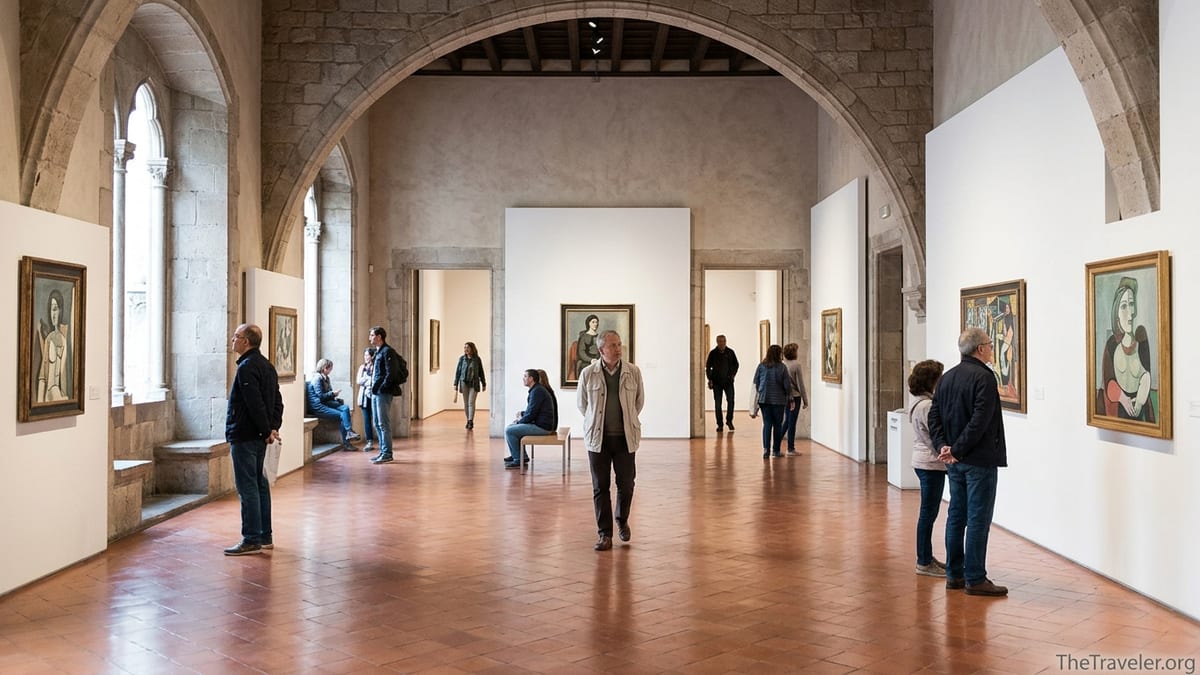
Which Picasso Museum Are We Talking About?
When travelers say “the Picasso Museum,” they usually mean the Museu Picasso in Barcelona, but there are three major museums that come up repeatedly in European itineraries: the Museu Picasso in Barcelona, the Museo Picasso in Malaga, and the Musée Picasso in Paris. Each has a different character and appeals to slightly different travelers.
In Barcelona, the Museu Picasso is set across several linked Gothic palaces in the atmospheric El Born quarter. It focuses strongly on Picasso’s early years and his close relationship with the city. Expect classrooms full of Blue Period works, student drawings, and his famous series of playful variations on Velázquez’s “Las Meninas.” Standard tickets bought online are around 14 to 15 euros for the permanent collection plus temporary exhibitions, with prices varying slightly between online and on-site purchase.
In Malaga, Picasso’s birthplace, the Museo Picasso occupies the 16th-century Palacio de Buenavista in the historic center, a short walk from the cathedral and the Roman Theatre. The collection traces Picasso’s career across multiple styles in a more compact way. General entry tends to be just under or around 12 euros for the main collection, with a few extra euros when a blockbuster temporary show is on. For many visitors who are not art obsessives, this museum strikes a good balance between depth and digestibility.
Paris’s Musée Picasso holds one of the largest Picasso collections in the world, housed in the elegant 17th-century Hôtel Salé in the Marais. Ticket prices hover in the mid-teens in euros for full-price entry. Here, the experience is as much about the building and Parisian context as it is about Picasso’s works. The museum is currently preparing a major “Picasso 2030” renovation and expansion project, which will gradually reshape the visitor experience while staying open, another factor to consider if you are planning a trip in the late 2020s.
What You Actually See Inside: A Quick Reality Check
Whether a Picasso museum feels worth it depends on what you expect to see. Many travelers arrive dreaming of the most famous posters and textbook images, then feel disoriented when they walk into rooms lined with sketchbooks, ceramics, and moody student portraits instead. Understanding the focus of each museum can help you decide whether it matches your interests.
Barcelona’s Museu Picasso is largely about Picasso before he became “Picasso.” You move chronologically from academic realism and portraits of family and friends to early experiments in Symbolism and the Blue Period. The blockbuster moment here is typically the room with dozens of variations on “Las Meninas,” which shows his late, playful deconstruction of a Spanish masterwork. If you are fascinated by how artists learn, borrow, and break rules, this progression can be gripping. If you mostly know Picasso from a single Cubist poster on your dorm wall, it may feel like a lot of homework before you get to the fun part.
In Malaga, the narrative is more panoramic rather than tied to one phase. You might go from an early academic portrait to a small Cubist still life, then to surreal figures and late ceramics, all within a single visit of 60 to 90 minutes. Reviews from casual visitors often highlight that the information panels are concise and that you can grasp the “Picasso story” without needing an art history degree. For example, after spending a morning at the Alcazaba and a beach lunch on La Malagueta, many travelers easily fit in the museum in the late afternoon without feeling mentally overloaded.
Paris’s Musée Picasso leans into the idea of Picasso as a giant of 20th-century art. Expect rooms that juxtapose major paintings with sculptures, photographs, and letters. Here, you may see not only the finished works but also the process behind them, including personal archives and studio materials. It is the closest of the three to a “deep dive,” particularly appealing to travelers who want to understand Picasso’s influence across many media and decades, and who do not mind dense displays and occasional thematic exhibitions that require slow looking.
Who Will Love These Museums, and Who Might Be Underwhelmed?
If you are a serious art fan or even mildly obsessed with modern art, all three museums can be deeply rewarding, though you might enjoy them for different reasons. Someone who has read about the Blue Period will likely savor the early works in Barcelona. A traveler who has visited the Reina Sofía in Madrid for “Guernica” and wants to fill in the gaps will appreciate Malaga’s compact overview. And a fan of 20th-century avant-garde movements will find Paris’s museum rich in context and cross-references.
For casual travelers whose main goal is to “see something cultural,” the calculus is more nuanced. Imagine a long-weekend visitor to Barcelona who has already booked Sagrada Família, Parc Güell, and a food tour in Sant Antoni. With museum tickets at around 14 to 15 euros and queues that can stretch down the street at peak times, the Picasso museum can feel like an obligation rather than a highlight if you are not particularly drawn to painting. These travelers often report that a single striking room, like the “Las Meninas” series, stands out, while the rest blurs together.
Families with children or teens often find Malaga’s museum more manageable. The visit is shorter, the palace architecture offers visual variety, and it is easier to combine with an ice cream stop on nearby Calle Larios or a sunset walk by the port. In contrast, Paris’s museum, with its dense galleries and more cerebral temporary shows, is better suited to older teens or adults who already have some curiosity about modern art and are prepared to engage with wall texts and audio commentary.
For travelers on very tight budgets or those who are ambivalent about Picasso’s style, the money and time might be better spent on other experiences: a local food market, a neighborhood walking tour, or a smaller, less crowded museum that matches your tastes more closely, such as the Museum of the History of Barcelona (MUHBA) for city history or the Museum of Malaga for a broader survey of local art and archaeology.
Money, Time, and Crowds: Practical Value for Travelers
Ticket prices at the main Picasso museums sit in roughly the same bracket as other major European art institutions. Barcelona’s standard online ticket is around 14 euros for combined access to the collection and temporary show, with the price a bit higher if you buy at the ticket office. Malaga typically charges slightly less for its permanent collection, often around 12 euros, and adds a few euros when a major temporary exhibition is included. Paris lands in a similar mid-teens range, comparable to many Parisian museums.
On a tight itinerary, the real “cost” is often time and energy rather than the ticket price. Barcelona’s museum, for example, frequently reaches capacity; same-day slots can sell out in high season, and lines can build up along Carrer de Montcada. To maximize value, it is worth booking a timed entry online or taking advantage of less popular hours. Some travelers splurge on skip-the-line guided tours that bundle the museum with a walking tour of El Born; prices for these start around several dozen euros and can be worthwhile if you know you engage better when someone is telling stories in real time.
Free or reduced entry options can shift the equation but come with trade-offs. In Barcelona, there are limited free entry periods that must be reserved in advance, and these tend to book out quickly and feel crowded once inside. In Paris, the museum sometimes participates in city-wide free days or special evening openings, which attract heavy local traffic. The savings can be appealing if your budget is tight, but if you dislike packed rooms, paying for a quieter slot may provide better value in terms of actual enjoyment.
Crowds also affect how long you will want to stay. In Barcelona, hyper-congested conditions during peak hours mean that many visitors rush through in under an hour, barely glancing at pieces except to snap a quick photo. In contrast, someone who books an early-morning slot in Malaga outside summer weekends often reports a more relaxed experience, lingering in front of key works and exploring the palace courtyard without feeling jostled. If you are on the fence, plan for an off-peak visit; the same art can feel entirely different when you are not craning over a sea of phones.
Comparing the Experience to Other Local Highlights
Another way to decide if a Picasso museum is worth it is to compare it directly with other nearby attractions. In Barcelona, a morning spent at the Picasso museum could alternatively be used to see the rooftop of La Pedrera, explore the bunkers above the city, or take a deep dive into Catalan cuisine on a market tour. For many first-timers, Gaudí’s architecture and the sea views leave a stronger impression than any single painting. That does not mean the museum is not worthwhile, but it is rarely the emotional high point of a short visit unless you are already engaged with art.
In Malaga, the equation tilts more in Picasso’s favor. The city has fewer blockbuster attractions than Barcelona or Paris, and the Picasso museum sits at the center of a pleasant cultural cluster. It is easy to combine a visit with the Alcazaba fortress, the Roman Theatre, and a coffee in Plaza de la Merced where Picasso was born. On a two-day stay, carving out 60 to 90 minutes for the museum usually feels natural, even for travelers who would not call themselves art lovers.
In Paris, the Picasso museum competes with a daunting list: the Louvre, Musée d’Orsay, Centre Pompidou, and dozens of smaller museums. A visitor with three days in the city might get more out of a broad survey of Impressionism and 19th-century painting at the d’Orsay than a focused survey of Picasso alone. However, for repeat visitors or those staying longer, the Picasso museum offers a chance to escape the long Louvre lines while still seeing world-class art in a historic building, followed by a stroll through the Marais’s side streets and cafés.
This comparison also applies at night. Many travelers in Barcelona and Malaga prefer to devote evenings to tapas bars, live music, or seaside walks rather than museum late openings. In Paris, an evening visit to a smaller museum like the Picasso, followed by dinner at a neighborhood bistro, can be a particularly pleasant way to experience the city with fewer daytime crowds.
How to Decide if a Picasso Museum Fits Your Travel Style
Before you automatically book tickets, it helps to ask yourself a few concrete questions. First, how do you generally feel in art museums? If you have enjoyed places like the Tate Modern in London, the Pompidou in Paris, or contemporary art spaces in your home city, there is a good chance you will appreciate the structure and storytelling at a Picasso museum. If you tend to feel restless after 20 minutes in any gallery, you may want to prioritize other activities and save Picasso for a future trip or a rainy day backup plan.
Second, consider how tight your schedule is. A weekend visitor to Barcelona trying to fit in Sagrada Família, Parc Güell, the beach, and a day trip to Montserrat may find that adding the Picasso museum causes unhealthy rushing. In that case, buying a postcard of a favorite Picasso work or briefly popping into a commercial gallery in El Born might be a more relaxed way to acknowledge the artist without committing to a full museum visit.
Third, think about who you are traveling with. A solo traveler or a couple who enjoy reading labels and listening to audio guides will probably find more value than a mixed group where some members are mainly interested in shopping or nightlife. If you are with friends or family who are unsure, it may be worth letting only the most interested members visit the museum while others linger at a nearby café or explore the neighborhood’s boutiques.
Finally, reflect on whether Picasso himself genuinely interests you. If your curiosity has been sparked by a biography, a documentary, or even the controversies around his personal life and attitudes, seeing his works in person can add nuance. But if you feel indifferent or put off by his style, forcing a visit because a guidebook labels it a “must” is unlikely to create a memorable experience.
The Takeaway
So, is a Picasso museum worth visiting or better left to serious art fans? The answer depends far more on your interests and itinerary than on the museums themselves. Objectively, all three major institutions in Barcelona, Malaga, and Paris hold important collections, are housed in characterful buildings, and are professionally curated. It is not a question of quality, but of fit.
For travelers who already enjoy art museums or who are specifically curious about Picasso’s evolution, any of these museums can be a highlight and justify both the ticket price and the time. Barcelona offers a focused insight into his formative years, Malaga provides an accessible overview in his hometown, and Paris delivers a rich, archive-heavy portrait in a grand setting. In each city, pairing the museum with a walk through the surrounding neighborhood and a relaxed café stop can turn the visit into a satisfying half-day experience.
For casual travelers with limited days on the ground, the Picasso museums are optional rather than essential. If your heart is set on architecture, food, or city views, you will not “miss” the destination by choosing other experiences instead. In that case, consider keeping a Picasso museum as a flexible option: pre-book only if you are sure, otherwise remain open to deciding on the spot based on your energy level, the weather, and how much you have already seen.
Ultimately, these museums reward curiosity more than obligation. If you find yourself wondering how a young artist from Malaga ended up reshaping 20th-century art, stepping into a Picasso museum is likely to feel like time well spent. If not, you can walk past the ticket line, enjoy the façades, and know that your trip can still be rich and complete without setting foot inside.
FAQ
Q1. Is the Picasso Museum in Barcelona worth it for a first-time visitor to the city?
For a first-time visitor with limited days, the Barcelona museum is worthwhile mainly if you already enjoy art or are curious about Picasso’s early years; otherwise, you may prefer to prioritize Gaudí sites and the seafront.
Q2. How long should I plan to spend at the Picasso Museum in Barcelona?
Most visitors spend between 60 and 90 minutes inside, longer if they use an audio guide or take a guided tour, and less if the galleries feel crowded.
Q3. Is the Picasso Museum in Malaga suitable for people who are not art experts?
Yes, Malaga’s museum is often recommended for non-experts because it is compact, clearly explained, and easy to combine with nearby sights in the historic center.
Q4. How does the Picasso Museum in Paris compare to the Louvre or Musée d’Orsay?
The Paris Picasso museum is smaller and more focused, offering depth on one artist rather than a broad survey; it suits repeat visitors or those specifically interested in modern art.
Q5. Are the Picasso museums very crowded?
Barcelona can be extremely busy in peak season and during free entry periods, while Malaga and Paris are usually more manageable, especially outside weekends and holidays.
Q6. Do I need to book tickets in advance for a Picasso museum?
Advance booking is highly recommended in Barcelona and advisable in Paris during busy periods; in Malaga, you can often buy tickets on the day except at peak holiday times.
Q7. Are Picasso museums a good idea for children?
They can be, especially in Malaga where the visit is shorter; however, younger children may get restless, so it helps to choose a quiet time and keep expectations modest.
Q8. Is there a dress code for visiting Picasso museums?
No formal dress code applies; comfortable clothing and shoes are best, and you may be asked to check large backpacks or umbrellas at the cloakroom.
Q9. Can I take photos inside the Picasso museums?
Policies vary, but many rooms allow non-flash photography for personal use; staff or signage will indicate any no-photo zones, especially in temporary exhibitions.
Q10. If I only have time for one Picasso museum, which should I choose?
Choose Barcelona for early work and a strong local story, Malaga for an accessible overview in his hometown, or Paris for the deepest, most archive-rich experience.