


Few cities wear a cowboy hat as comfortably as they wear a glass-and-steel skyline, but Calgary does exactly that. Perched on the prairie edge of the Canadian Rockies, Alberta’s largest city combines ranch culture, ambitious architecture and rare same-day access to world-famous mountain scenery. For travelers, it is this three-way tension between past and future, city and wilderness, boots and briefcases, that makes Calgary feel different from anywhere else in Canada.
Get the latest updates straight to your inbox!
A Prairie City With a Cowboy Soul
Calgary’s personality begins with the open prairie that surrounds it. Unlike many North American cities framed by forests or coastline, Calgary rises abruptly from rolling grasslands. The railway and ranching brought early settlers here in the late 19th century, and that frontier identity still shapes how the city sees itself. You notice it in the wide streets, the relaxed small-town manners in a city of well over a million people, and the fact that downtown offices often keep a spare pair of cowboy boots under the desk for July.
That is when the Calgary Stampede takes over the city. For ten July days, office towers empty into pancake breakfasts in surface parking lots, executives commute in denim, and chuckwagon races lead the evening news. Even if you do not step inside the Stampede grounds, you feel it walking along Stephen Avenue at lunch as pop-up stages host country bands and food trucks serve brisket and smoked corn. Hotels across the city are packed, so visitors book months in advance or choose to stay in nearby neighborhoods like Kensington or Inglewood to be within an easy CTrain ride of the grounds.
Cowboy culture shows up year-round in quieter ways. There are western wear shops on Macleod Trail selling felt hats sized and steamed while you wait, and downtown bars where business lunches stretch into after-work line-dancing lessons. Heritage Park Historical Village lets families step into a recreated frontier town, with costumed interpreters explaining how cattle ranching shaped the region’s growth. For many visitors, riding at a nearby ranch east of the city or attending a small-town rodeo in places like Strathmore is as memorable as the Stampede itself.
Yet this is not a museum version of the West. In modern Calgary, you are just as likely to find a country singer sharing a bill with an indie rock band, or a craft brewery releasing a limited-edition “Stampede stout” as a nod to the season. The cowboy image has evolved from a narrow stereotype into a broader expression of prairie pride and hospitality, something visitors pick up on quickly when strangers strike up friendly conversations in coffee shop lines.
A Skyline That Signals Big-City Ambition
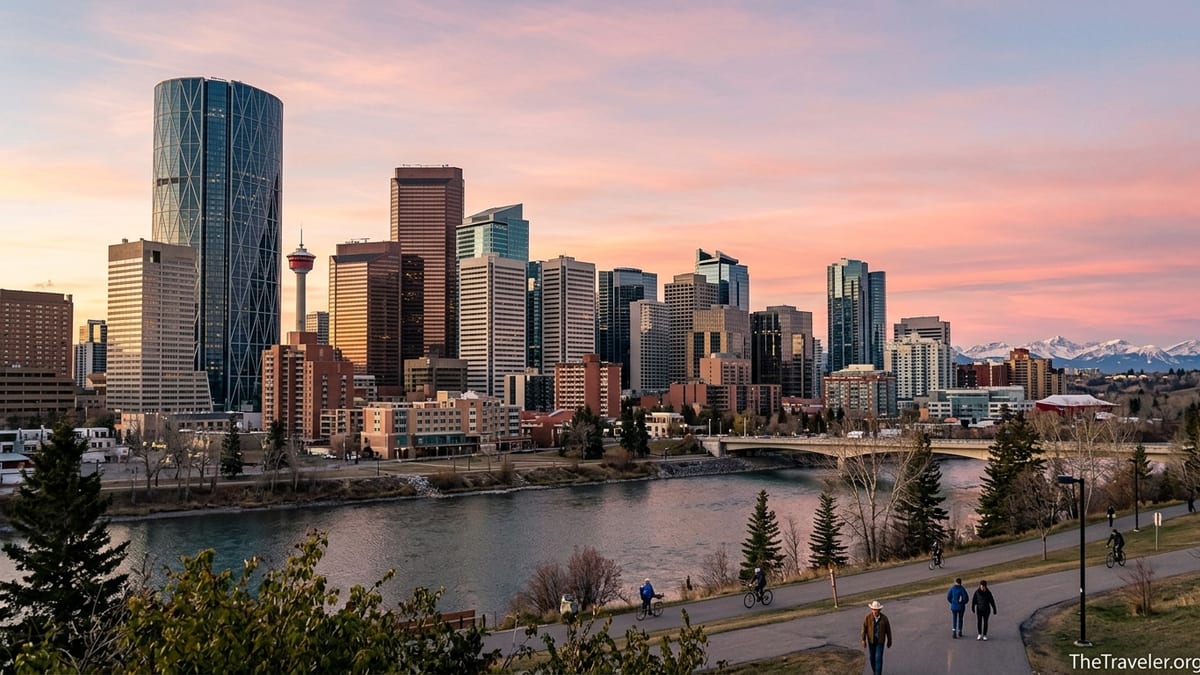
If Calgary’s spirit is shaped by the ranch, its silhouette is defined by skyscrapers. Calgary has more high-rises than any other city in Western Canada, a legacy of decades as an energy and corporate hub. The skyline is instantly recognizable from airplane windows, with towers arranged along the Bow River and the thin needle of the Calgary Tower still punctuating the center. Completed in the late 1960s, the tower’s 190-metre height once dominated the city; today, it serves as a nostalgic landmark and an accessible observation deck, with glass floor panels that let visitors peer straight down to the streets below.
More recent architecture points to a different chapter. The Bow, a curved glass tower that sweeps toward the river, reshaped the skyline when it opened and remains one of the most distinctive office towers in the country. Outside its base, a giant human head sculpture has become a de facto downtown meeting spot and selfie backdrop. Nearby, Brookfield Place’s east tower reaches roughly 247 metres, making it the tallest building in Calgary and the tallest in Canada outside Toronto. For travelers, these towers are not just statistics. They create canyon-like streets along 3rd Avenue and 6th Avenue, where sunlight glints off mirrored façades and lunchtime crowds flow through the Plus 15, an elevated walkway system that lets pedestrians cross downtown without stepping outdoors in winter.
Staying downtown puts this architecture at eye level. Hotels clustered near the core give guests short walks to the business district, Prince’s Island Park and the river paths. On weekday mornings, you can sit in a café along 8th Avenue and watch a river of suited office workers and tech employees stream by, a reminder that Calgary’s economic base now stretches beyond oil and gas into fields like logistics, film and technology. The city’s streetscape is changing as well, with new residential towers in districts like the East Village adding thousands of people who live, rather than just work, in the city center.
Dusk is when the contrast becomes most vivid. As office workers head home, the glass towers catch the last prairie light while the Rockies fade to a purple silhouette on the horizon. Rooftop bars and restaurants along 10th Avenue and in the Beltline flip on their patio heaters. You might find yourself sipping a locally brewed IPA, watching commuter trains slide past and realizing that this is as much a contemporary metropolis as it is a frontier outpost.
Neighborhoods Where Old West Meets New Urban
Beyond the core, Calgary’s neighborhoods express the city’s balancing act between heritage and reinvention. East Village, once a neglected industrial district, now presents a walkable blend of sleek condo towers, riverside parks and restored brick warehouses. A stroll along the RiverWalk here links grassy plazas and public art, with benches that look across to the downtown skyline. In summer, you often see office workers in rolled-up sleeves eating lunch on the steps, while cyclists and joggers cruise past on the pathway network that follows the Bow River for kilometres.
A short walk away, Inglewood shows a different side of Calgary’s evolution. As the city’s oldest neighborhood, it still holds rows of historic brick storefronts that now house record shops, cocktail bars and independent boutiques. You can buy locally made leather goods that nod to western style, then step into a contemporary gallery showing Indigenous and prairie-inspired art. In the evening, small venues host live music ranging from country and folk to jazz and rock, drawing a mix of long-time residents and visitors staying at nearby downtown hotels.
On the opposite side of the river, Kensington feels almost like a small separate town. Cafés spill onto sidewalks, bike racks are busy and patios fill quickly on sunny evenings. Locals pop in after work for ramen, tacos or plant-based dishes, reflecting how international Calgary’s food scene has become. Yet even here, you might see cowboy hats hanging on a chair or a horse trailer parked on a side street during Stampede week, a reminder that the ranch is never too far away.
South of the tracks, the Beltline and the emerging Culture and Entertainment District around the BMO Centre add another layer. Here, converted warehouses share blocks with new residential towers, and the streets come alive with people heading to hockey games, concerts and conventions. The expansion of the BMO Centre has turned this area into Western Canada’s largest convention hub, bringing in major events that spill visitors into nearby restaurants and bars late into the night. For travelers, choosing accommodation in the Beltline offers a livelier, more nightlife-oriented base than the traditional business hotel core.
Mountains at Your Doorstep
One of Calgary’s strongest draws is how quickly city streets give way to mountain peaks. From downtown, it is roughly a 90-minute drive to Banff along the Trans-Canada Highway, with the landscape shifting from prairie to foothills to full-on Rocky Mountains in a single morning. Many visitors land at Calgary International Airport, pick up a rental car and find themselves pulling into Canmore or Banff by lunchtime, a convenience that shapes how they plan their trips. It is common to spend a couple of nights in Calgary, then head west for hiking, skiing or sightseeing in the national parks.
Even shorter escapes are possible. Canmore sits about an hour and fifteen minutes from the city, making it an easy day trip for locals and travelers alike. The drive itself becomes part of the experience, with mountain silhouettes growing larger through the windshield and frequent viewpoints where you can safely pull over to photograph the changing horizon. On arrival, visitors might stroll Canmore’s compact main street, grab a sandwich from a bakery, then head out to walk along the Bow River or tackle a half-day hike before returning to Calgary for a late dinner.
Those who prefer quieter, less developed landscapes often head to Kananaskis Country, accessible via a turn south off the Trans-Canada. Here, provincial parks offer alpine lakes, forested trails and fewer crowds than the national parks. Many Calgarians treat Kananaskis as an after-work playground in summer, driving out for evening hikes or picnics on long northern evenings. Travelers who stay in Calgary for a week or more can realistically mix workdays in the city with multiple outings west, turning the trip into a combined urban and outdoor holiday.
Seasonality shapes these excursions. In winter, day trips might revolve around downhill skiing at resorts such as Sunshine Village or Mount Norquay near Banff, or cross-country skiing and snowshoeing in Kananaskis. In summer, the same roads lead to trailheads for popular hikes, lake cruises and viewpoints. Because the mountains are so close, locals think in terms of “mountain weather” as well as city forecasts and plan spontaneously when sunny weekends appear. Visitors who build some flexibility into their itineraries can take advantage of those same last-minute opportunities.
From Stampede Grounds to Culture and Entertainment District
Calgary’s Stampede grounds, just southeast of downtown, symbolize both tradition and reinvention. For more than a century, this has been the stage for the city’s biggest annual event, with rodeo arenas, exhibition halls and a midway drawing visitors from across Canada and abroad. In recent years, significant investment has reshaped the area into a year-round Culture and Entertainment District rather than a single-purpose festival site. The expanded BMO Centre now anchors the zone as Western Canada’s largest convention facility, attracting major trade shows, corporate gatherings and cultural events.
For travelers, that shift is tangible. On a random week in spring or autumn, you might find yourself in Calgary for a conference or comic expo at the BMO Centre, then walking minutes to restaurants along 17th Avenue or the nearby riverside. The new convention spaces are designed with large windows, public art and plazas that encourage people to linger outside rather than treating the district as a sealed bubble. When no events are scheduled, locals use the grounds as a shortcut between neighborhoods or a place to stroll and watch the evening light reflect off downtown’s towers.
The surrounding streets are gradually filling with new residential buildings, hotels and entertainment venues. This creates the kind of mixed-use district that many travelers appreciate: lively enough to feel energetic after dark, but with day-to-day services like grocery stores and cafés that keep prices and menus grounded in local demand rather than pure tourism. During the Stampede itself, staying nearby puts the entire spectacle within walking distance, from early-morning agricultural shows to late-night concerts, but you can also slip away to quieter side streets when you need a break from the crowds.
This transformation also reflects Calgary’s broader effort to reposition itself on the world stage. By combining its reputation for hospitality with modern infrastructure and a walkable entertainment core, the city is courting more international events and repeat visitors. Travelers arriving for a convention increasingly add extra days on either side to explore neighborhoods, sample the food scene or make quick trips west to the mountains, blurring the line between business and leisure travel.
Everyday Life: River Paths, Winter Sun and Local Flavors
Beyond its big-ticket attractions, Calgary wins people over with everyday experiences that reflect its geography and climate. The Bow and Elbow rivers cut through the city, lined by an extensive network of paved pathways used by commuters, joggers and families. On a summer morning, you might join locals cycling from inner-city neighborhoods into downtown, crossing pedestrian bridges with skyline views and glimpses of the Rockies in the distance. By afternoon, inflatable rafts drift down the Bow, a favorite warm-weather pastime that feels almost like a lazy urban safari.
Winters are cold but often sunnier than visitors expect. Chinook winds can raise temperatures dramatically in a single day, turning icy sidewalks into slush and drawing people back onto patios bundled in parkas and sunglasses. Many cafés and restaurants accommodate this with outdoor heaters and sheltered seating, so you can sip a hot drink while watching steam rise from the towers’ rooftops. Indoor attractions, from the Glenbow’s evolving art and history exhibits to live performances at arts venues around Olympic Plaza, give travelers cultural options when winds pick up on the river.
The city’s food and drink scene mirrors its mix of ranch heritage and global influences. Steak houses still do brisk business, serving Alberta beef to business travelers and families celebrating special occasions. At the same time, neighborhoods like the Beltline and 17th Avenue are lined with spots offering Vietnamese pho, Indian curries, Korean fried chicken and inventive vegetarian dishes. Craft breweries, cideries and cocktail bars lean into local ingredients, sometimes incorporating prairie grains or mountain-inspired botanicals. During Stampede, menus across the city add one-off items that nod to midway food but executed with more finesse, from smoked brisket tacos to maple-infused cocktails.
Calgarians themselves are part of the appeal. The city’s rapid growth has drawn people from across Canada and around the world, creating a population that is both proud of its western roots and comfortable with change. For visitors, this translates to easy conversations with Uber drivers about favorite mountain hikes, bartenders who will sketch out three-day itineraries on napkins, and families happy to offer directions on the CTrain. It is a city where you rarely feel like an outsider for long.
The Takeaway
Calgary’s uniqueness lies in its intersections. It is where a century-old rodeo runs in the shadow of glass skyscrapers, where commuters can leave their desks at five and be walking beside a mountain lake before sunset, and where historic main streets sit a short bike ride from newly built cultural districts. Travelers do not need to choose between an urban city break and a mountain escape; by using Calgary as a base, they can have both in a single trip.
Whether you come for the Calgary Stampede, a major convention at the BMO Centre, or simply as a gateway to Banff and the Rockies, it is worth leaving room in your schedule to explore the city itself. Wander the East Village river paths, linger over dinner in the Beltline, watch the sunset from a downtown rooftop and listen for the ever-present undercurrent of cowboy stories and mountain plans. In Calgary, the trailhead often begins at the office door, and that blend of grit, glass and granite peaks is what keeps many visitors coming back.
FAQ
Q1. How far is Calgary from the Rocky Mountains?
Calgary sits about 130 kilometres from Banff, roughly a 90-minute drive on the Trans-Canada Highway in normal conditions, with mountain views for much of the route.
Q2. Is Calgary worth visiting if I am mainly going to Banff?
Yes. Many travelers add one or two nights in Calgary to explore neighborhoods, restaurants and the river paths before or after time in Banff or Canmore.
Q3. When is the best time to experience Calgary’s cowboy culture?
July, during the Calgary Stampede, offers the most concentrated cowboy atmosphere, but western wear shops, ranch experiences and small rodeos operate at other times of year.
Q4. Do I need a car to enjoy both Calgary and the mountains?
A car offers the most flexibility for day trips, but shuttle services, tours and seasonal bus routes connect Calgary with Canmore and Banff for visitors who prefer not to drive.
Q5. Which Calgary neighborhoods are best for first-time visitors?
Downtown and the Beltline suit those who want easy transit and nightlife, while Kensington, Inglewood and East Village appeal to travelers who prefer walkable, character-filled streets.
Q6. How cold does Calgary get in winter, and can I still visit?
Winter temperatures often drop well below freezing, but frequent sun and occasional warming Chinook winds make outdoor activities and city exploration manageable with proper clothing.
Q7. What makes Calgary’s skyline special compared with other Canadian cities?
Calgary has one of the largest collections of skyscrapers outside Toronto, including notable towers like The Bow and Brookfield Place, set against visible prairie and mountain horizons.
Q8. Is it possible to take a day trip from Calgary to the mountains and back?
Yes. Many locals drive to Canmore, Kananaskis or even Banff for hiking, skiing or sightseeing and return to Calgary the same day, weather and daylight permitting.
Q9. Are there family-friendly activities in Calgary beyond the Stampede?
Families can enjoy river pathway cycling, Heritage Park Historical Village, zoo visits, science and history museums, and seasonal rafting or skating depending on the time of year.
Q10. How many days should I plan in Calgary on a longer Alberta trip?
On a one to two week Alberta itinerary, spending two to three full days in Calgary allows time to explore key neighborhoods, sample local food and take at least one mountain outing.