


For millions of travelers, Calgary is little more than a flight code on a boarding pass and a blur of prairie outside the rental car window. They land at YYC, grab a coffee in the arrivals hall, and within an hour are speeding west on the Trans Canada Highway toward Banff. Yet the very city they are bypassing is one of Canada’s most interesting urban destinations: a place where a former oil boomtown has reinvented itself as a creative, food-loving, park-filled metropolis at the doorstep of the Rockies.
Get the latest updates straight to your inbox!
Why Calgary Becomes a Gateway Instead of a Destination
Calgary’s geography works against it. YYC Calgary International Airport sits about 17 kilometers northeast of downtown, and the silhouette that greets arriving visitors is more skyline and flyover ramps than postcard peaks. Many itineraries are built around the global fame of Banff and Lake Louise, so travelers simply treat the city as a transfer point between long-haul flights and mountain lodges. Tour desks at the airport are stacked with brochures for glacier walks and gondola rides, not for the Beltline’s restaurant patios or Inglewood’s indie shops.
Infrastructure habits reinforce this mindset. There is no train station attached to the terminal and no dramatic airport-to-downtown tram. Instead, most visitors roll their bags straight to the taxi queue or rental car counters and point their wheels west. Even budget travelers who take Calgary Transit’s Route 300 airport bus, which links YYC to downtown in about 45 to 55 minutes, often do it only to connect to an onward shuttle to Banff or Canmore rather than to explore the city itself.
Tour operators and travel agencies rarely help. A typical western Canada package from North American or European resellers includes “1 night Calgary (arrival)” on the itinerary, usually with instructions to “rest after your flight.” That tends to mean a chain hotel near the airport, a quick walk to a nearby casual restaurant, and an early departure in the morning. Travelers leave believing they have “seen Calgary,” when in reality they have only seen a freeway interchange and a hotel lobby.
What gets lost in this rush is how much the city has changed in the last decade. Neighborhoods that were once sleepy or strictly business-oriented now hum with independent cafes, craft breweries, and public art. The city has invested in pedestrian-friendly streets, urban parks, and river pathways that make it easy to explore without a car, especially if you base yourself in the Beltline or downtown for a night or two.
First Impressions: From Airport Tarmac to Downtown Streets
Your experience of Calgary starts shaping your opinion the moment you land. At arrivals, you have a few choices to reach the city. Taxis and rideshares line up outside the main terminal, with a typical fare to downtown hovering in the range many travelers would expect for a 20 to 30 minute ride in a major Canadian city, especially at rush hour when traffic can add noticeably to the meter. It is straightforward and comfortable, which is exactly why so many visitors take this path of least resistance and continue straight to the highway the next morning.
Budget-conscious travelers and solo visitors should consider the Route 300 Airport / Downtown bus, run by Calgary Transit. It is designed with tourists and commuters in mind, running frequently through most of the day and stopping just a short walk from the downtown CTrain light rail line. The fare is higher than a standard city ticket because it includes an all-day transit pass, which means you can ride the CTrain and local buses for the rest of the day without paying again. In practice, this can turn your transfer into an impromptu city tour if you hop off to explore areas like the East Village or Kensington before checking in.
If your ultimate goal is the Rockies, shuttles such as Brewster Express and other regional operators pick up at both YYC and downtown hotels for direct services to Canmore, Banff, Lake Louise, and even Jasper. Many people assume that staying near the airport will make that shuttle connection easier, but in reality several companies now depart from central locations as well. That means you can book your first night downtown or in the Beltline, enjoy an evening in the city, and still catch a morning bus west without any added hassle.
This is where the mental shift happens. Instead of thinking of Calgary as a neutral transfer zone between your home city and the mountains, think of the airport transfer as your ticket into a separate urban destination. Choosing a downtown or inner-city hotel, even for one night, opens up walkable streets, riverfront parks, and a nightlife scene that most hurried travelers never realize exists.
Downtown & Beltline: Calgary’s Walkable Core
Many visitors are surprised by how compact and walkable central Calgary feels once they drop their bags. Downtown proper is a grid of glass towers, historic sandstone buildings, and the airy pedestrian corridor of Stephen Avenue, home to some of the city’s most established restaurants and after-work patios. A short stroll brings you to the Bow River pathway, where cyclists and joggers pass by year-round and office workers eat lunch on benches overlooking the water.
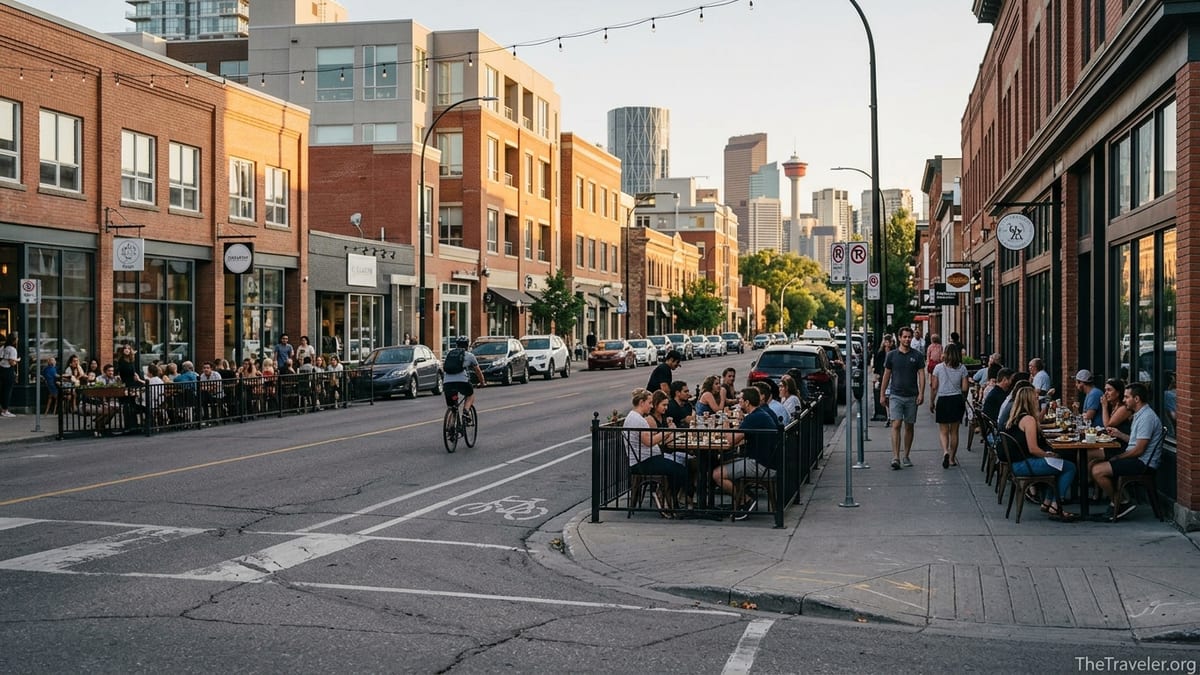
Just south of downtown lies the Beltline, one of Calgary’s densest and most vibrant neighborhoods. Locals flock here on summer evenings to stroll 17th Avenue Southwest, a lively main street lined with independent boutiques, ice cream shops, casual pubs, and restaurants serving everything from Mexican street food to handmade pasta. On a warm July night, patios spill onto the sidewalk and lineups form outside popular cocktail bars, giving the area a buzz that visitors often associate more with Montreal or Vancouver than with an Alberta prairie city.
Calgary’s recent shift from a strictly corporate dining culture to a more experimental, chef-driven scene is most visible here. You might start your evening with a locally roasted coffee at a minimalist cafe, move on to a casual spot for Korean fried chicken or tacos, and finish with craft cocktails made using Alberta rye or small-batch gin. Prices are roughly in line with other large Canadian cities: expect to pay a moderate amount for a main course at a sit-down restaurant and a similar price for a specialty cocktail, with cheaper options at pubs and fast-casual spots.
Staying in this central belt is what transforms Calgary from a layover into an experience. Many mid-range and boutique hotels are within a 10 to 15 minute walk of both downtown offices and Beltline hotspots, allowing you to see a surprising amount of the city in just 24 to 48 hours. On a short visit, you can check into your room, drop your bags, and be sitting on a 17th Avenue patio with a local craft beer within half an hour.
Character Neighborhoods: Inglewood, Kensington, and Beyond
Beyond the core, several inner-city neighborhoods offer a sense of the independent, creative Calgary that most pass-through visitors never encounter. Inglewood, just southeast of downtown where the Bow and Elbow rivers meet, is one of the city’s oldest districts. Its main street is lined with brick heritage buildings that now house vinyl record stores, small galleries, vintage shops, and cafes decorated with reclaimed wood and local art. On a Saturday, you might find a pop-up market in a side lot, live music drifting out of a bar, and locals queuing at a bakery for sourdough loaves and cinnamon buns.
Across the river to the northwest lies Kensington, centered around Kensington Road and 10th Street. Once primarily a local shopping strip, it has evolved into a compact hub of cinemas, bookstores, clothing boutiques, and casual dining. Visitors often compare it to a small-scale version of Toronto’s Annex or Vancouver’s Commercial Drive. It is an easy walk or short CTrain ride from downtown, making it a convenient neighborhood to wander on your first afternoon, coffee in hand, as you adjust to the time zone.
Mission and the Fourth Street corridor provide a different energy again, with leafy residential streets intersecting a busy commercial strip. Here you can find everything from Japanese ramen bars and plant-based cafes to wine bars with extensive by-the-glass lists. On warm evenings the sidewalks fill with people heading to dinner or meeting friends for dessert and a drink, giving the area a sociable feel that contradicts Calgary’s outdated reputation as a quiet, early-closing corporate town.
These neighborhoods are where Calgary’s local culture feels most accessible. Instead of curated souvenirs at a mountain gift shop, you are browsing locally made ceramics and prints. Instead of eating every meal inside a hotel restaurant, you are chatting with a barista about which nearby park has the best sunset view of the skyline. For many travelers, even a single afternoon in Inglewood or Kensington provides the sense of “being in Calgary” that a night at an airport hotel never will.
Rivers, Parks, and Skyline Views Within City Limits
Calgary’s outdoor appeal does not start at the Banff park gate; it starts at the city’s own rivers and parks. The Bow and Elbow rivers carve wide, green corridors through the urban grid, connected by kilometers of paved multi-use pathways. Rental e-bikes and scooters are common sights on sunny days, and several local companies offer guided rides or walking tours that trace the riverbanks from downtown into residential neighborhoods. Even without a guide, following the flat riverside paths is one of the easiest ways to stretch your legs after a long-haul flight.
Prince’s Island Park, just off downtown in the Bow River, is a favorite first stop. A short pedestrian bridge leads to lawns, picnic areas, and small wooded sections where you can forget you are in the center of a major city. In summer, outdoor events and festivals are common, and office workers spill out for lunchtime picnics. A loop walk around the island at sunset, with the skyline glowing to the south, is a reminder that Calgary can deliver city views and nature at the same time.
For a more expansive panorama, many visitors head to viewpoints such as Scotsman’s Hill or Crescent Heights. From these ridges you can take in the full sweep of the downtown towers, the Calgary Tower needle, and on clear days, the faint blue outline of the Rockies on the western horizon. It is a striking perspective for photographers who want to capture Calgary as more than a random cluster of high-rises glimpsed from the highway.
Even in winter, Calgary’s parks remain active spaces. Locals bundle up to walk dogs along the riverpaths, cross-country ski tracks sometimes appear after heavy snow in larger parks, and outdoor firepits or seasonal lights add atmosphere to central plazas. Visitors who come only in July for a quick overnight before the mountains often miss this cold-weather side of the city, where clear, sunny days and crisp air give the downtown skyline an almost alpine clarity.
Food, Drink, and Culture: Calgary’s Soft Power
Calgary’s dining scene has matured rapidly, drawing on Alberta’s agricultural strengths while looking outward for inspiration. Beef still appears prominently on menus, from classic steakhouses to modern bistros serving grass-fed ribeye with seasonal sides, but the city is no longer just about grills and potatoes. You will find Vietnamese street food, Syrian bakeries, sushi bars, and vegan kitchens in the same few blocks, reflecting the city’s diverse population.
Travelers who stay at least one proper evening in the city can sample this variety without venturing far. In the Beltline, for example, one block might hold a taco spot popular for its house-made salsas, a pasta restaurant known for hand-rolled gnocchi, and a small cocktail bar pouring drinks made with Canadian rye and prairie botanicals. Nearby, a casual brunch cafe might specialize in eggs Benedict and pancakes piled with local berries, while a neighboring spot focuses on coffee and pastries roasted and baked on-site.
The craft beer and distilling scene is equally busy. Several small breweries operate taprooms in industrial pockets close to downtown, inviting visitors to sample tasting flights of pale ales, IPAs, and seasonal releases. Many serve simple but satisfying food such as pizzas, pretzels, or sandwiches, making them good low-key dinner options after a day of sightseeing. Spirits lovers can seek out distilleries producing small-batch gin, vodka, and whisky, some of which offer tours and tastings by reservation.
Culturally, Calgary’s calendar reaches far beyond the famous 10-day Stampede in July. Year-round there are theater productions, contemporary art exhibitions, live music shows in venues ranging from intimate bars to mid-size halls, and seasonal festivals highlighting everything from film to folk music. Even if your visit does not align with a marquee event, chances are good that on any given weekend you will find a performance or gallery opening happening within walking distance of central hotels.
Building Calgary Into Your Rockies Itinerary
The easiest way to stop treating Calgary as a blur outside the shuttle window is to deliberately assign the city real time in your trip plan. For many visitors, one full day and one or two nights is a comfortable addition that does not significantly lengthen an overall Rockies itinerary. For example, you might land at YYC in the late morning, ride the airport bus or a taxi to a downtown hotel, spend the afternoon exploring the river pathways and Stephen Avenue, then head to the Beltline for dinner on 17th Avenue. The next morning, after brunch in Mission or coffee in Kensington, you can catch a midday shuttle to Banff and still arrive with hours of daylight remaining.
Travelers who prefer a slower pace can add an extra night and use Calgary as a way to buffer jet lag before driving into the mountains. Two full days are enough to combine neighborhood wandering with a couple of organized experiences, such as a guided city bike tour, a visit to a major museum, or a food tour that highlights local producers. This approach can be particularly helpful for families, who may appreciate spending the first day in a city with easily accessible services and playgrounds before continuing to more remote mountain towns.
Even road-trippers with rental cars can benefit from a short Calgary stay. Instead of navigating unfamiliar roads and highway traffic immediately after a long flight, you can collect your vehicle from a downtown location a day later, when you are rested and oriented. Some travelers also find better rental deals away from the airport, and parking in central hotels is often comparable in price to airport lots when you factor in convenience.
Importantly, giving Calgary dedicated time does not mean sacrificing the Rockies experience. The drive or shuttle ride from downtown to Banff typically takes about an hour and a half, depending on traffic and weather, which still leaves you with most of the day to settle into your mountain accommodation, stroll along the Bow River in Banff, or ride a gondola. The trade-off is minimal; the reward is an additional Canadian city experience that deepens your understanding of the region.
The Takeaway
Calgary will likely remain a major gateway to the Canadian Rockies for the foreseeable future. The airport is efficient, the onward road and shuttle connections are excellent, and travelers will always feel the pull of alpine peaks and turquoise lakes to the west. Yet those same travelers are increasingly discovering that the city at the heart of this network is worth their time in its own right, thanks to revitalized neighborhoods, a flourishing food scene, and easy access to riverfront parks and skyline viewpoints.
If you treat Calgary only as a transfer point, your memories of it will probably match your time there: a blur of baggage carousels and highway signs. If you slow down long enough to walk its downtown streets, linger over a meal in the Beltline, or browse the shops of Inglewood and Kensington, a different city emerges. It is urbane without being overwhelming, proud of its western heritage yet open to global influences, and filled with small, everyday moments that help balance the drama of the mountains.
On your next trip to Alberta, consider shifting one night from a chain hotel just off the highway to a character stay in Calgary’s inner core. Give yourself a full day to see the Bow River at sunset, sample local craft beer, and share a conversation with a barista or bartender who calls the city home. In doing so, you transform Calgary from a line item on a flight itinerary into a place you have genuinely visited, not just passed through.
FAQ
Q1. Is Calgary worth visiting if my main goal is Banff and Lake Louise?
Yes. Even one full day and one or two nights in Calgary lets you experience walkable neighborhoods, riverfront parks, and a strong food scene without significantly cutting into your mountain time.
Q2. How long should I stay in Calgary before heading to the Rockies?
A practical minimum is one full day and one night, though two nights allows you to explore multiple neighborhoods, visit a museum or gallery, and adjust to jet lag before driving into the mountains.
Q3. What is the easiest way to get from Calgary Airport to downtown without a car?
Calgary Transit’s Route 300 airport bus connects the terminal to downtown and the CTrain light rail system, while taxis and rideshares provide a faster but more expensive door-to-door option.
Q4. Which neighborhoods are best for first-time visitors to stay in?
Downtown and the Beltline work well for short stays, offering walkable access to major sights, restaurants, and transit. Inglewood, Kensington, and Mission are great for those who enjoy more local, neighborhood-focused experiences.
Q5. Can I explore Calgary without renting a car?
Yes. Central Calgary is compact and walkable, supplemented by the CTrain light rail, buses, and widely available bikes and scooters. Many key sights, restaurants, and riverfront paths are reachable on foot from downtown hotels.
Q6. How does Calgary’s cost of dining compare to other Canadian cities?
Prices are broadly similar to other large Canadian cities. Mid-range restaurants in areas like the Beltline or 17th Avenue typically charge a moderate price for main courses, while casual spots and food halls offer more budget-friendly options.
Q7. Is Calgary safe for visitors staying downtown or in the Beltline?
Central neighborhoods popular with visitors are generally considered safe, especially during the day and early evening. As in any city, it is sensible to stay aware of your surroundings at night and follow local advice from hotel staff.
Q8. What can I do in Calgary during winter if I am just passing through?
Winter visitors can walk along the Bow River pathways on clear days, visit museums and galleries, enjoy cozy cafes and restaurants, and take in skyline views from accessible viewpoints. The dry, sunny winter weather often makes city walks surprisingly pleasant with proper clothing.
Q9. Are there direct shuttles from Calgary to Banff and Canmore?
Yes. Several companies operate scheduled shuttle services between YYC, downtown Calgary, Canmore, and Banff, with some also continuing to Lake Louise and other mountain destinations. These services allow you to visit the Rockies without renting a car.
Q10. How many days do I need to see both Calgary and the Rockies on one trip?
For first-time visitors, a week to ten days works well, with one or two nights in Calgary at the start or end of the trip and the remaining time split between Banff, Lake Louise, and possibly other mountain towns like Canmore or Jasper.