


More news on this day
Traffic on Interstate 205 near Northeast Airport Way in Portland slowed to a crawl after a series of crashes disrupted lanes and snarled access to Portland International Airport, leaving drivers facing extended delays and prompting renewed focus on a corridor already known for congestion and collision risks.
Get the latest news straight to your inbox!
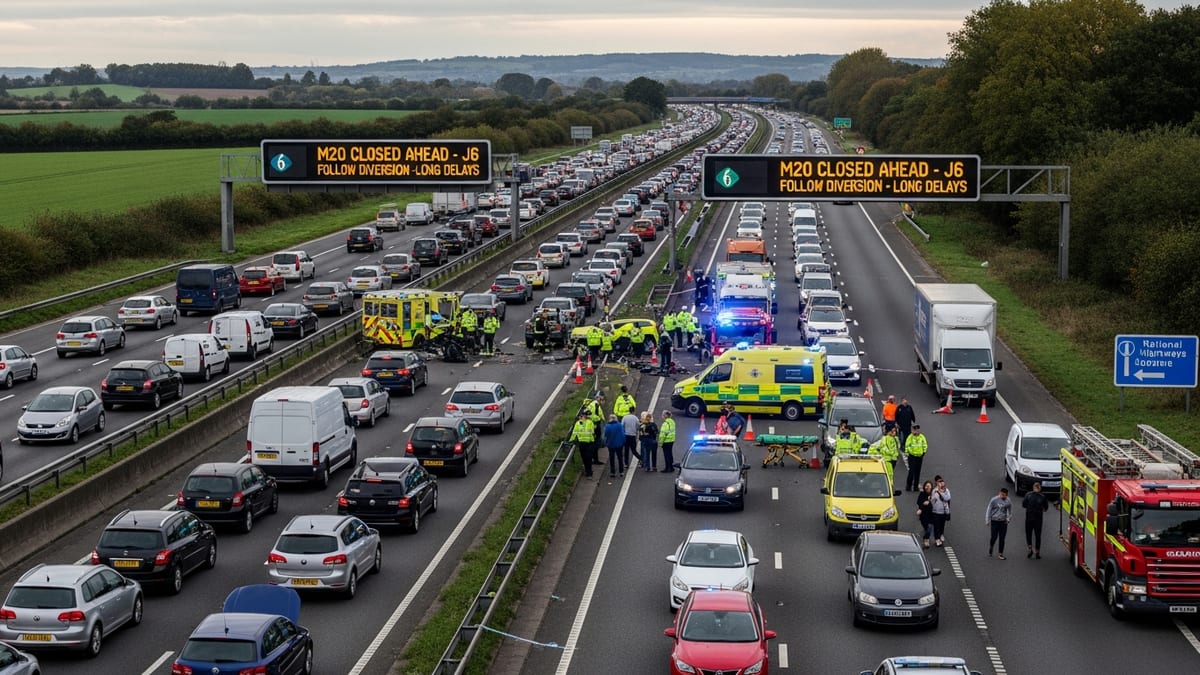
Chain-Reaction Crashes Snarl Key Airport Corridor
Reports from transportation agencies and local media describe several collisions affecting both the mainline of Interstate 205 and connecting ramps near Northeast Airport Way, a primary approach route to Portland International Airport. The incidents were concentrated around the Glenn Jackson Bridge and the airport interchange, a busy stretch where heavy commuter traffic, freight movement and airport trips converge.
Initial information indicates that separate crashes occurred within a short distance of one another, leading to partial lane closures and intermittent traffic holds while damaged vehicles were cleared. Southbound lanes experienced the longest slowdowns, with backups extending well beyond the airport exit and adding significant time to already busy peak-period travel.
Publicly available traffic condition reports show that delays varied over the course of the morning, at times falling under 20 minutes before worsening again as new incidents or secondary fender-benders were reported in the same general area. The stop-and-go pattern created a difficult environment for drivers attempting to change lanes for exits or to merge from nearby on-ramps.
As crews worked to remove vehicles and debris, message boards and traffic alerts urged motorists to use caution through the crash zone and prepare for slower-than-normal travel. Some drivers diverted to alternate routes, including surface streets paralleling Airport Way, but those corridors quickly grew congested as well.
Impact on Portland International Airport Travelers
The crashes near Northeast Airport Way quickly translated into travel headaches for passengers and airport workers trying to reach Portland International Airport. Airport Way is the primary surface connection feeding the terminal complex, and disruptions on I-205 can create a bottleneck that is felt across the broader access network.
Travel advisories circulated through navigation apps and traffic services encouraged anyone heading to the airport to build in extra time, with some guidance suggesting leaving at least 30 minutes earlier than usual during the height of the incident response. For early flights and morning shift changes, that margin made a difference between a stressful dash to the gate and a more manageable check-in process.
Airport parking and commercial vehicle areas also felt the effects, as shuttles, taxis, ride-hail services and hotel courtesy vans navigated clogged approach roads. With freeway traffic periodically at a standstill near the airport exit, some operators shifted pickup and drop-off plans or rerouted via secondary access points to keep vehicles moving.
For travelers unfamiliar with Portland’s road network, the situation underscored how closely airport reliability is tied to a single interstate corridor. Even short-lived freeway crashes can complicate tight connections, especially for those arriving from Washington across the Columbia River or from eastern parts of the metro area that rely on I-205 as the most direct link.
High-Crash Segment Under Fresh Scrutiny
The stretch of I-205 near Airport Way has long been identified in regional transportation studies as a high-crash and high-delay segment. Analyses of corridor performance highlight recurring bottlenecks around the Glenn Jackson Bridge, the weaving movements created by closely spaced interchanges, and the mix of passenger vehicles and heavy trucks using the route for both airport access and regional freight movement.
Recent technical reports on traffic performance in the Portland region list I-205 among the corridors with elevated crash frequencies and regular peak-period congestion. In particular, the area where Airport Way, I-84 and I-205 interact has been flagged as complex for drivers, with multiple decision points and heavy volumes that can magnify the effects of even minor incidents.
Transportation planners have pointed to this corridor as a priority for safety and operations improvements, examining options such as auxiliary lanes, ramp modifications and updated traffic management tools. While many of these concepts remain in study or funding stages, the latest round of crashes near Airport Way provides a fresh example of the vulnerability of the system when incidents line up at the wrong time of day.
Publicly available crash histories show that rear-end and side-swipe collisions are common in this segment, patterns often linked to sudden speed changes and aggressive lane changing in congested conditions. Today's delays fit that broader trend, illustrating how a single slowdown can cascade into multiple secondary incidents along a constrained stretch of freeway.
Commuter Experience and Regional Ripple Effects
The congestion on I-205 near Northeast Airport Way rippled well beyond airport-bound traffic, affecting everyday commuters traveling between east Portland, Clark County and inner-ring suburbs. During the height of the disruption, northbound and southbound travelers reported extended queueing to reach key interchanges, with some choosing to abandon freeway routes altogether in favor of local streets.
As vehicles diverted, nearby arterials such as Sandy Boulevard and Columbia Boulevard saw heavier-than-normal volumes, with signals and intersections not always able to absorb the sudden surge. Freight operators, including those serving logistics and warehouse clusters near the airport and along Airport Way, faced schedule pressures as trucks became caught in the same congestion as passenger vehicles.
The incident also highlighted how dependent the region remains on a limited number of Columbia River crossings. With delays on I-205, some drivers shifted to I-5, increasing strain on that corridor and contributing to a broader slowdown across the north-south freeway spine. The resulting conditions underscored the interconnected nature of the metro area’s road network.
For transit riders using services that operate in the I-205 corridor or intersecting routes, slower traffic translated into delayed bus arrivals and longer travel times. Real-time tracking tools showed vehicles running behind schedule as they attempted to navigate the same traffic choke points that were stalling motorists.
Guidance for Drivers and Next Steps for the Corridor
Transportation agencies and traffic services are emphasizing several recurring pieces of guidance for drivers who regularly use I-205 near Northeast Airport Way. Allowing additional travel time during peak periods, avoiding last-second lane changes approaching the airport interchange, and maintaining safe following distances in heavy traffic are among the measures recommended to reduce the risk of secondary crashes.
Travelers heading to Portland International Airport are encouraged to monitor real-time traffic maps and incident alerts before departing, particularly when weather or high travel demand increase the likelihood of slowdowns. When conditions on I-205 deteriorate, alternative paths using I-84 and surface streets may offer more reliable travel times for some origins, though these routes can also become congested during major incidents.
On the planning side, ongoing studies of the I-205 and Airport Way corridor continue to evaluate longer-term fixes aimed at improving safety and reliability. Concepts under discussion include targeted interchange upgrades, refined ramp configurations and enhanced incident management strategies to clear crashes more quickly and reduce the chance of follow-on collisions.
While no single project can eliminate congestion on such a critical regional spine, transportation analyses suggest that a combination of operational improvements and infrastructure investments could help smooth the flow of traffic near Airport Way. For now, the latest sequence of crashes serves as a reminder to drivers to approach this busy segment with caution and patience, especially during the busiest travel hours.