


Walk a few blocks in Manhattan and you can feel as if you have crossed not just a neighborhood line, but an entire universe. One moment you are in the glow of Times Square, half-expecting a superhero to swoop between billboards. Ten minutes and one subway stop later, you are on a shaded side street in the Lower East Side or looking back at the skyline from Roosevelt Island, surrounded by dog walkers and grocery carts instead of camera flashes. For travelers, this split personality is what makes Manhattan so fascinating: some corners are pure cinema, while others feel like a parallel city hiding in plain sight.
Get the latest updates straight to your inbox!
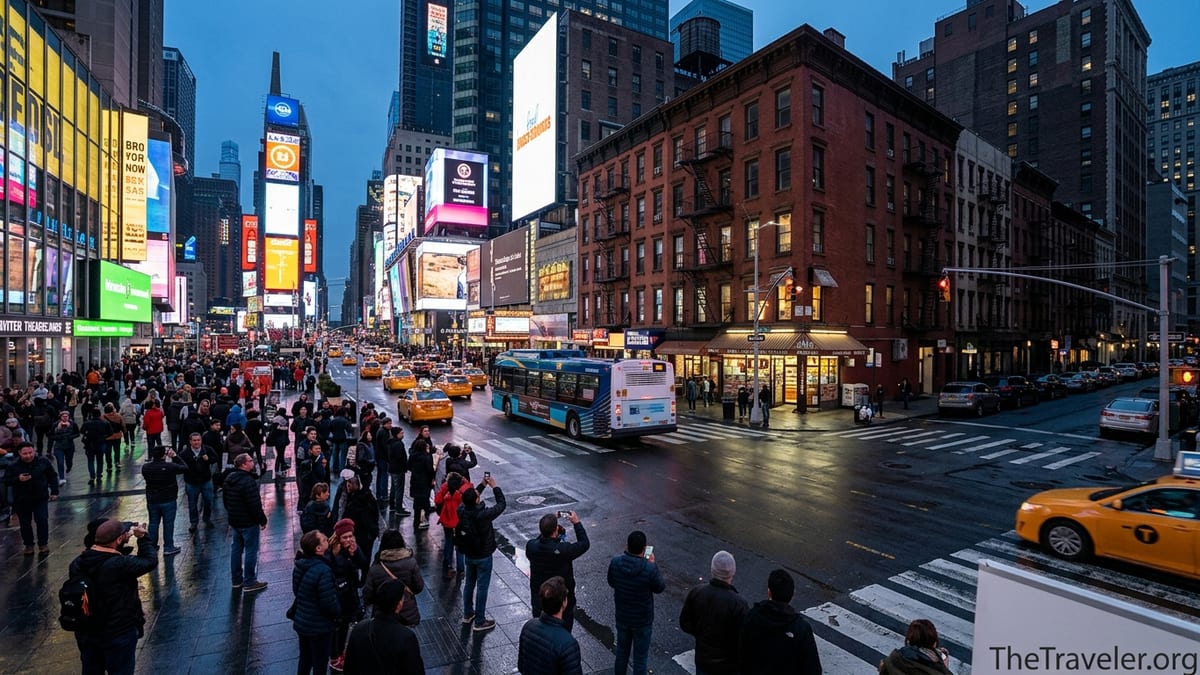
The Manhattan Of The Movies: Times Square And Midtown
For many visitors, the Manhattan that lives in their imagination is really a tight band of Midtown. Times Square, Broadway, and the canyons of glass along Sixth Avenue are where New York looks most like it does on screen. When you emerge from the subway at 42nd Street and step into Times Square at night, the scene feels almost unreal: LED billboards several stories tall, costumed characters jockeying for photos, and a crush of people staring upward as taxis edge through the intersection. It can be disorienting, like walking onto a movie set that has been left running around the clock.
This is also where Manhattan feels most choreographed. The red TKTS steps at the south end of Times Square are packed with people posing for skyline photos; the Disney and Broadway marquees glow over the sidewalks; street performers time their acts to the changing lights. Even everyday rituals feel cinematic here. Grabbing a slice of pizza for around 4 dollars at a Broadway corner shop or weaving between tour groups speaking five languages becomes its own montage. For some travelers, this is the New York they came to see, and it delivers exactly what the movies promised.
Just a few blocks away, the skyscraper corridors of Midtown add a different filmic note. Stand at the corner of Sixth Avenue and 50th Street during morning rush hour and you watch a river of office workers with coffee cups and ID badges, hemmed in by mirrored towers. The plaza at Rockefeller Center, the flags around it, and the golden statue above the ice rink or summer café seating have appeared in countless films and television shows. Being there in person, especially during the holidays when the tree is up and the rink is open, can feel like accidentally walking into the background of a shoot.
Yet even in this most familiar version of Manhattan, it only takes a small detour to find a street that feels surprisingly low-key. Slip west toward Ninth Avenue or east toward Second Avenue and the density of neon drops. You still get the hum of traffic and occasional sirens, but suddenly the world narrows to delis with handwritten signs, corner laundromats, and regulars bringing home plastic bags of groceries. The cinematic New York starts to loosen, and another city edges in.
Lower Manhattan: From Skyscraper Drama To Side-Street Realism
Head downtown on the subway to the Financial District and you find another flavor of movie Manhattan. The streets around Wall Street and the New York Stock Exchange are walled by stone and steel. On weekday mornings, there is a brisk tide of suits and laptop bags that feels straight out of a corporate thriller. The narrowness of the streets and the way skyscrapers block the sky can make the area feel dramatic, even a bit claustrophobic, especially around Broad Street or in the shadow of Federal Hall.
But venture just a few minutes away and the tone changes. South Street, which curves along the East River, offers wide views toward Brooklyn and the bridges. At South Street Seaport, a cluster of cobblestone lanes, boutiques, and waterside bars feels almost like a different town that happens to borrow the Manhattan skyline as its backdrop. Eating a casual lunch at a pier-side table, looking back at the skyline’s glass and steel, you become an onlooker to the city rather than part of its hustle. It is hard to believe that the floor of the Stock Exchange is less than a ten-minute walk away.
Farther west, around the World Trade Center and the Oculus transit hub, the mood shifts again. The gleaming white ribs of the Oculus, the pools of the 9/11 Memorial, and the vertical lines of One World Trade Center have a solemn grandeur that feels closer to an architectural film than a street-level story. Travelers who come here often find themselves whispering without quite knowing why; the space carries its own gravity. Step into the shaded side streets of Tribeca a few blocks north, however, and the tempo drops. Here, cast-iron buildings with fire escapes, corner cafes with strollers parked outside, and small neighborhood parks suggest a lifestyle that feels miles away from the global financial center just south.
This downtown patchwork highlights one of Manhattan’s defining traits for visitors: almost every dramatic, hyper-recognizable scene has a quieter counterpart close by. Knowing where to pivot from one to the other lets you experience both the rush of the movie city and the relief of the everyday one in a single afternoon.
Hudson Yards And The High Line: A Futuristic City Above A City
Walk west from Midtown and you eventually arrive at one of Manhattan’s most surreal transitions: Hudson Yards. Built on platforms over working rail yards, this relatively new neighborhood on the far West Side feels like it was airlifted from another metropolis. Sheer glass towers frame a polished plaza, and the copper-colored honeycomb of the Vessel structure rises at the center. The Edge observation deck, jutting out from one of the towers more than 1,000 feet above the ground, reinforces the sense that this is not the mid-century city of most movies but a speculative future version, made real.
Visiting Hudson Yards can feel like stepping into a high-budget sci-fi film set, especially if you arrive at dusk when the glass towers catch the last light over the Hudson River. Inside the mall complex, global luxury brands, sleek food halls, and high-design interiors sit above rumbling trains. Even sitting with a coffee by a floor-to-ceiling window, watching commuter trains snake into the yard below, gives you the strange sensation of being suspended between city layers. It is still Manhattan, but not the one of yellowed brick walkups and familiar stoops.
And yet, just steps away, the High Line introduces another personality entirely. Climb the stairs from street level and you are suddenly walking on a narrow park built over former freight tracks, with wild grasses, public art and benches tucked between repurposed industrial buildings. On one side you may see a boutique hotel with outdoor terraces, on the other an old brick warehouse covered in ivy. The High Line has become one of Manhattan’s most photographed spaces, but walking it feels more like moving through an elevated village than navigating a major city.
This contrast between Hudson Yards and the High Line is a powerful example of how quickly Manhattan’s mood can swing. One minute you are in a glass-and-steel experiment in urban planning, framed by global corporate logos and mirrored lobbies. A short walk later, you are weaving past painted murals and converted lofts, watching locals sun themselves in deck chairs, and hearing only the rumble of traffic below instead of right beside you. Travelers who explore both in one outing often leave with the feeling that they have visited two different cities that somehow share the same block.
The Villages And The Lower East Side: A Different City In Low-Rise Form
If Midtown and Hudson Yards are where Manhattan acts like a blockbuster, the neighborhoods collectively known as the Village and the Lower East Side are where it becomes an indie film. Step out at West 4th Street and walk into the West Village, and the first thing you notice is the scale: townhouses instead of towers, leafy side streets instead of eight-lane avenues. Washington Square Park, with its arch framing a view up Fifth Avenue, has appeared in countless films, but the real appeal for travelers is the everyday life unfolding there: buskers testing out new songs, chess players slamming pieces, NYU students reading on the grass.
Wander east of the park and the grid dissolves into a tangle of angled streets, small corner restaurants, and bars tucked into basement spaces. Here the city looks far less like a set piece and far more like a lived-in neighborhood. You might pass a quiet wine bar where locals are catching up over after-work glasses, a bodega with cats sprawled in the window, or a narrow bakery line where the conversation is more about last night’s show than about sightseeing. It feels like a continuation of the city you saw in movies, but the camera has moved closer and the extras are now the main characters.
Cross Houston Street and the Lower East Side offers a strikingly different mood from Midtown’s polish or Hudson Yards’ futurism. This is one of Manhattan’s most historically layered areas, a place of old tenement buildings, fire escapes, and small storefronts. In the space of a single block you might see a classic bagel shop that has served locals for generations, a gallery opening with people spilling onto the sidewalk, and a late-night noodle spot that stays busy until the small hours. The neighborhood has undergone waves of change, with luxury apartments and trendy cocktail bars arriving alongside long-established bakeries and delis, which is exactly why it feels so unlike the postcard image of New York.
For visitors, the Lower East Side is a chance to feel Manhattan at human scale. Streets are narrower; buildings are lower; conversations drift from open windows on summer nights. At a small neighborhood bar, a drink might cost less than in a glossy Midtown lounge, but the stories you overhear are often richer. Many travelers leave this part of the city with the sense that they have glimpsed the “real” New York, even if that reality is every bit as constructed as the movie version. It simply wears its seams more openly.
Across The River Without Leaving Manhattan: Roosevelt Island
One of the strangest experiences for first-time visitors is taking the Roosevelt Island Tram from East 60th Street and Second Avenue. In a few minutes you glide over the East River, shoulder to shoulder with commuters and day-trippers, as midtown’s towers slide past the cabin windows. It is the kind of elevated, sweeping shot that directors love, except you are living it for the cost of a standard transit fare. As you descend toward Roosevelt Island, the noise of traffic falls away and the city’s concrete spine is replaced by water and sky.
Stepping off the tram, many people are surprised to realize they have not left Manhattan at all. Roosevelt Island is legally part of the borough, yet it feels like a world apart. Long promenades run along both shores, dotted with park benches where locals read or watch joggers pass, and residential towers stand in orderly rows rather than crowding the sidewalks. From the southern tip, at Franklin D. Roosevelt Four Freedoms State Park, the skyline unfurls in a wide panorama from Midtown to Lower Manhattan. It is a view that looks like a glossy travel spread, but the atmosphere on the ground is more small-town than blockbuster.
Spend an hour here and you begin to understand how fractured Manhattan’s identity can be. Families push strollers down quiet paths; seniors chat outside apartment entrances; teenagers gather around public basketball courts. There are no Times Square billboards, no honking traffic jams, and relatively few tourists compared with the crowds across the river. Sitting on a bench with a simple takeout lunch from a local deli, watching the Queensboro Bridge arc overhead and the city flicker across the water, you could easily forget you are technically still in the same Manhattan that fuels global stories and stock markets.
For travelers, Roosevelt Island offers a concise lesson in how to step outside the movie without leaving the frame. The tram ride gives you the cinematic shot, while the island itself delivers something subtler: a sense of how ordinary life looks when it is surrounded, but not swallowed, by one of the world’s most photographed skylines.
Practical Ways To Experience Both Manhattans In One Trip
To really feel the contrast between Manhattan’s movie scenes and its quieter alter ego, it helps to plan your days around deliberate juxtapositions. One simple approach is to pair iconic sights with nearby neighborhoods that have a very different rhythm. For example, start your morning in Times Square, where you can absorb the neon and maybe step into a Broadway theater box office to check same-day ticket options. After an hour of soaking in the chaos, walk west along 42nd Street and drift down Ninth Avenue, where small restaurants, corner markets, and apartment balconies remind you that this is also a place where people live, shop, and get their laundry done.
Another useful pairing is Hudson Yards with the West Village. Ride the subway to the sleek glass concourse of 34th Street–Hudson Yards, explore the plaza and shopping center, then join the High Line heading south. As you walk, watch how the scenery shifts from new towers to converted warehouses and older brick buildings. Exit near 14th Street and keep going into the West Village. By the time you reach a shaded café on a side street or a small bookshop on a quiet corner, you will have traveled from science-fiction skyline to intimate neighborhood in less than an hour, all on foot.
Downtown, you can do something similar by visiting the World Trade Center site and then continuing into Tribeca or the Lower East Side. Take in the memorial and museum, spend time in the reflective plaza, then wander north into streets lined with loft buildings and understated storefronts. Later, cross east toward the Lower East Side, where the architecture shrinks and the street life grows more improvisational. Planning days around these transitions makes your trip feel like a continuous story rather than a series of disconnected snapshots.
Finally, reserve a half day for Roosevelt Island as a reset. Combine it with a Midtown visit: see Rockefeller Center or the Museum of Modern Art in the morning, then walk to the tram and cross the river in the afternoon. Back on the Manhattan side, you might finish your day in a classic diner on the Upper East Side, comparing how each stop made you feel. That contrast, more than any single landmark, is what most travelers remember long after they have flown home.
The Takeaway
Manhattan’s power lies in how many versions of itself it can contain. The neon canyon of Times Square, the mirrored towers of Hudson Yards, the low-rise charm of the West Village, the layered streets of the Lower East Side, and the calm promenades of Roosevelt Island are all part of the same island, separated more by mood than by miles. For travelers, recognizing that duality is essential. If you only chase the scenes you already know from movies, you will find them, but you may miss the quieter chapters unfolding a few blocks away.
The most rewarding trips treat Manhattan not as a single destination but as a series of overlapping cities. Build your itinerary to capture both the cinematic and the everyday. Stand in the glare of a giant billboard, then listen to a busker under a park arch. Ride an aerial tram over skyscrapers, then sit on a bench across the river watching office lights blink on at dusk. In those moments of contrast, you stop being just an audience member and start feeling like a temporary resident of a place that can change character as fast as you can walk.
FAQ
Q1. Which parts of Manhattan feel most like the movies?
Times Square, Rockefeller Center, the World Trade Center area and the glass towers of Hudson Yards most closely match the iconic cityscapes seen in films.
Q2. Where can I go in Manhattan to experience a quieter, more local vibe?
The West Village, East Village, Lower East Side and side streets on the Upper West and Upper East Sides offer calmer, more residential atmospheres.
Q3. Is the Roosevelt Island Tram worth it for visitors?
Yes. The tram offers sweeping skyline views for the price of a regular transit fare and delivers you to a peaceful riverside neighborhood that feels far from Midtown.
Q4. How can I easily combine “movie” Manhattan with more everyday areas in one day?
Pair Times Square with a walk along Ninth Avenue, Hudson Yards with the High Line and West Village, or the World Trade Center with an afternoon in Tribeca or the Lower East Side.
Q5. Are there specific times of day when Manhattan feels more cinematic?
Evenings, especially around sunset and just after dark, make areas like Times Square, Midtown, and the World Trade Center feel particularly dramatic due to lighting and crowds.
Q6. Do locals ever visit the tourist-heavy, movie-like areas?
Many locals work in Midtown or downtown offices and pass through Times Square or the Financial District daily, but they tend to socialize in quieter neighborhoods and side streets.
Q7. Is it safe to explore less touristy neighborhoods like the Lower East Side at night?
These areas are generally busy with nightlife and dining, but as in any big city, stay aware of your surroundings and stick to well-lit, active streets.
Q8. What is a good neighborhood to stay in if I want both convenience and a local feel?
Areas around the West Village, Union Square, or the Upper West Side balance easy subway access to major sights with a more residential, everyday atmosphere.
Q9. Can I see a lot of different “versions” of Manhattan without using taxis?
Yes. The subway, buses, walking, and the Roosevelt Island Tram make it easy to move between Midtown, downtown, waterfronts, and village-like streets in a single day.
Q10. How many days do I need to appreciate Manhattan’s contrasting sides?
With three or four days you can comfortably experience both the famous cinematic landmarks and several neighborhoods that feel like a completely different city.