


Few places in England pack as much coastal drama into such a small area as the Isle of Wight. Two viewpoints in particular compete for the title of the island’s finest panorama: Culver Down on the east coast and The Needles at the far west. Both deliver sweeping cliff-top scenery, layered history and classic seaside atmosphere, yet they feel strikingly different on the ground. Whether you are planning a long-distance hike along the England Coast Path or a single daytrip from the mainland, choosing where to spend your limited time matters. This guide compares Culver Down and The Needles in practical detail so you can decide which viewpoint is better for your style of travel.
Setting the Scene: East vs West Coast Drama
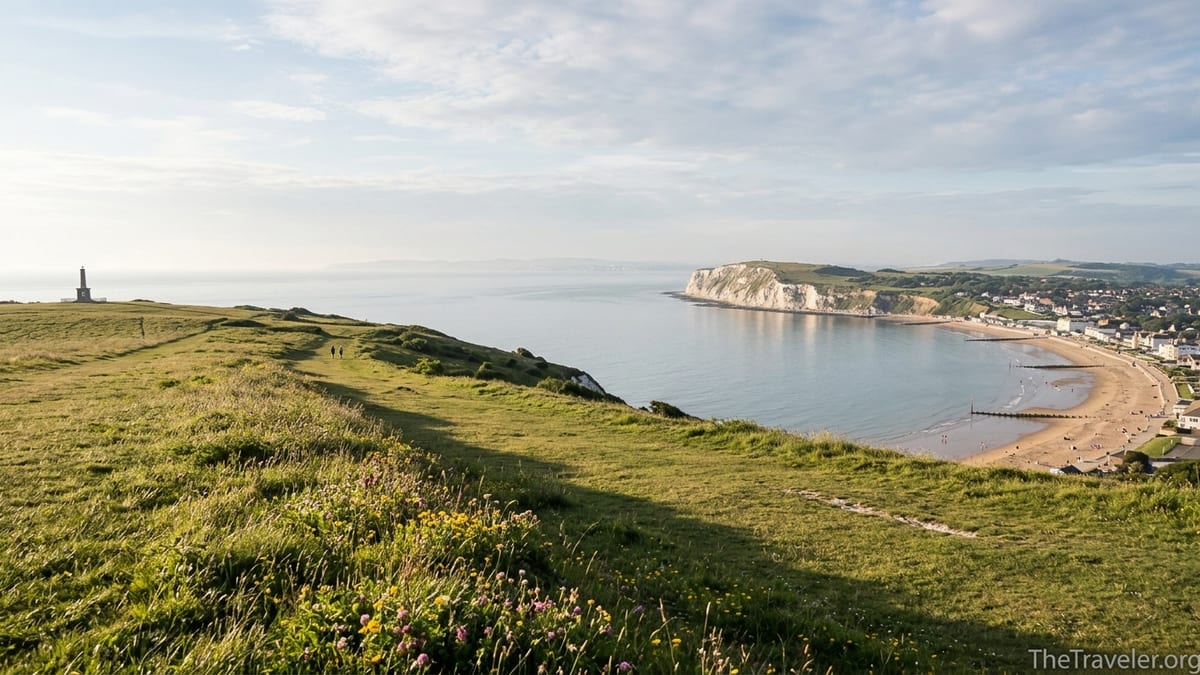
Culver Down rises above the broad arc of Sandown Bay on the island’s east side, a chalk ridge managed largely by the National Trust that tops out roughly 100 metres above sea level. From the Yarborough Monument and the nearby topograph, you look south over an 8‑mile sweep of sand running from Yaverland past Sandown and Shanklin, and north towards Bembridge Harbour and across the Solent to the Spinnaker Tower in Portsmouth on clear days. It feels open and airy, with skylarks, rough grass and a constant sense of sky.
The Needles, by contrast, sit at the extreme western tip of the island, beyond Alum Bay. Here the land drops in rugged steps towards the famous chalk stacks and lighthouse at sea level. The National Trust’s Old Battery and New Battery occupy the headland, facing the English Channel and the Solent, and the scenery is more enclosed and vertical. From the ramparts you peer straight down to the white cliffs and across to Dorset’s Jurassic Coast on a good day.
In simple terms, Culver Down gives you a gigantic bay and big horizons, while The Needles offers a more concentrated, iconic landmark view. Many visitors will have seen postcards of the coloured sands at Alum Bay or the serrated line of chalk stacks, so The Needles often feels familiar before you arrive. Culver Down, although less internationally famous, surprises many people with how wide and cinematic the landscape feels when you are actually standing on the ridge.
The character of the surroundings also differs. Culver Down merges quickly into quieter farmland, small caravan parks and the low‑key resort towns of Sandown and Shanklin. The Needles is attached to a full‑scale visitor attraction at Alum Bay, with amusement rides, shops and a chairlift, so the approach is more commercial and busy, especially at weekends and during English school holidays.
Views, Photography and When the Scenery Really Shines
If your main goal is unforgettable coastal views and photography, both locations deliver, but at slightly different times of day and in different moods. Culver Down looks particularly impressive in early morning or late afternoon when low light skims across the chalk cliffs of Sandown Bay. Local photographers often set up at Yaverland beach looking back towards Culver Cliff at sunrise, but walking up onto the Down itself gives a grandstand angle over the bay, especially in winter when the sun rises over the distant horizon out to sea.
The Needles, sitting on the island’s western edge, is a classic sunset spot. On long summer evenings you can watch the sky colour over the Channel while the white chalk stacks glow warm gold. From the Old Battery’s gun emplacements or the paths along the cliff top towards the New Battery, you can frame the lighthouse at the end of the rocks with a wide‑angle lens, or pick out detail in the cliffs with a short telephoto. Many visitors combine a daytime chairlift ride to Alum Bay’s beach with a late afternoon stroll up to the viewpoints above.
In terms of variety, Culver Down arguably offers more angles in a single walk. A short circular loop from the National Trust car park by Bembridge Fort can give you three contrasting panoramas in under an hour: south across Sandown Bay, east towards Whitecliff Bay and the English Channel, and north over Bembridge Harbour and the Solent. On a clear day you can pick out ferries running between Portsmouth and Fishbourne, tiny against the water far below. Spring and early summer, when the downs are dotted with wildflowers and the sea is a deep steel blue, are especially photogenic.
The Needles’ strength is the drama of its single, iconic view. From many points along the western cliffs, the chalk stacks line up neatly with the lighthouse. Even in grey or windy weather the scene is striking, with white water crashing against the rocks. However, mist and low cloud can limit long‑range visibility. In such conditions, some walkers find Culver Down more rewarding because its primary interest is the sweep of the bay immediately below rather than distant horizons.
Walking, Coast Paths and How Each Spot Fits into a Bigger Day Out
Walkers are spoiled for choice at both locations, but the nature of the walking is different. Culver Down is at the heart of several moderate National Trust trails and is also a key high point on the Isle of Wight Coastal Path and a newly opened stretch of the King Charles III England Coast Path that runs for roughly 12 miles from Culver Down through Sandown, Shanklin and Ventnor. Many visitors drive to the National Trust car park by Bembridge Fort, then follow a 2 to 3‑mile loop along the ridge and back via Yarborough Monument, with only one main climb and mostly gentle gradients.
Experienced hikers often incorporate Culver Down into a full‑day section of the coastal path between Bembridge and Sandown. This route starts near Bembridge Lifeboat Station, passes the harbour, climbs steadily to Culver Down, then drops to Yaverland beach and into Sandown, giving a satisfying mix of cliff, beach promenade and small seaside town. Public buses run hourly between Sandown and Bembridge, making logistics relatively simple for car‑free travelers.
At The Needles, the most popular walks connect Alum Bay, the Old Battery and the windswept plateau of Tennyson Down. From the Alum Bay car parks, it is about a mile’s walk up a steady gradient to the National Trust entrance at the Old Battery, with views of the coloured sands below. Ambitious walkers can continue across the high ground to Freshwater Bay and Tennyson Monument, making a half‑day or full‑day loop that stacks several of the island’s star views into one outing. The paths are well‑trodden but can be exposed in bad weather, with strong winds common along the ridge.
For families with younger children or travelers who prefer short, gentle strolls, Culver Down tends to be easier. Several of the best viewpoints are only a few minutes’ walk from the car park, and the terrain is relatively even once you are on the ridge. The Needles requires more uphill walking from Alum Bay and involves more steps around the Old Battery, although a seasonal tourist bus runs up to the headland for those who do not want to tackle the climb on foot.
Access, Transport and Practicalities
Getting to Culver Down is straightforward by car. A narrow road climbs from Sandown and Yaverland up to the National Trust car park near Bembridge Fort. In high season this small car park can fill in the middle of the day, but because there are no amusements or big commercial attractions on the ridge, turnover is reasonably steady. Parking is typically pay‑and‑display for non‑members, while National Trust members can usually scan their cards. The road is steep but sealed, so standard rental cars have no difficulty.
Public transport users can reach Culver Down by taking the Southern Vectis route that links Ryde, Sandown and Bembridge, then walking roughly 20 to 30 minutes from Bembridge village up to the ridge. This final section is uphill and may feel long if you are carrying beach gear as well as daypacks, so many walkers prefer to visit Culver Down as part of a linear hike, starting at sea level and climbing once, rather than making a separate detour.
The Needles has more complex access but also more services. Most visitors arrive via the main road to Alum Bay, where a large private car park serves The Needles Landmark Attraction. Parking charges are set by the attraction rather than the National Trust, and visiting the Old or New Battery is a separate decision from using the chairlift or amusements below. In peak summer a dedicated open‑top bus, often branded as a “Breezer” service, connects key west‑coast highlights, including Freshwater Bay and the Needles headland, which is helpful if you are hiking across Tennyson Down and do not want to walk back the same way.
One practical difference is that the National Trust can close the Needles Old Battery during periods of very high wind for safety, which happens from time to time in autumn and winter. When this occurs, cliff‑top paths may still be accessible but some formal viewpoints and facilities are shut. Culver Down, being an open ridge without buildings perched right on the edge, is less prone to closure, although any exposed chalk downland can feel uncomfortably windy in poor weather.
Costs, Facilities and How Long to Spend at Each
Culver Down is, in effect, a free open‑access landscape. There is no entrance fee to walk the ridge, visit the Yarborough Monument or explore the grassland. You only pay for parking if you arrive by car and possibly for refreshments at the local pub near the monument, which has outdoor seating with spectacular bay views on fine days. This makes Culver Down appealing for budget‑conscious travelers or repeat visitors who like to return for multiple short walks during a week’s stay in Sandown or Shanklin.
The Needles, on the other hand, tends to be a higher‑spend outing even if you only care about the view. You may pay for parking at the Alum Bay site, for National Trust entry to the Old Battery (unless you are a member), and separately for any rides, chairlift trips or boat excursions you choose to add. While exact prices change from season to season, families typically find that a full afternoon at The Needles, with chairlift rides and perhaps a short boat trip around the stacks, can become one of their more expensive days on the island.
Facilities reflect that difference in commercial focus. At Culver Down, services are essentially limited to the pub and the relatively simple National Trust car park. Toilets are usually available for customers at the pub, and in peak walking months the National Trust may open small information points or have rangers on patrol, but you should not expect souvenir shops or entertainment. At The Needles, by contrast, there are multiple food kiosks, souvenir shops, a sweet factory, children’s rides and structured experiences at Alum Bay, plus a National Trust tearoom at the Old Battery.
In terms of time, many walkers feel satisfied with 1 to 2 hours at Culver Down, including a circular walk and a drink at the pub. The Needles can easily absorb half a day or longer if you combine the cliff‑top viewpoint with Alum Bay, the chairlift and perhaps a bus‑supported walk over Tennyson Down. If your Isle of Wight itinerary is tight and you only have a couple of hours spare, Culver Down is simpler to slot in.
Atmosphere, Crowds and Seasonal Differences
Atmosphere may be the single strongest reason to favour one viewpoint over the other. Culver Down generally feels informal, spacious and local. On a weekday evening in June, you might share the ridge with a few dog walkers, a small group of hikers and maybe a paraglider or two riding the updrafts above the cliffs. Even at peak season the ridge spreads people out, so it rarely feels congested, and you can often find a quiet patch of grass to sit and watch the ferries moving back and forth across the Solent.
The Needles, in contrast, can be extremely busy in summer and at weekends, especially around the Old Battery and the narrow paths that lead to the principal viewpoints. During August, queues sometimes form at the best photographic spots and at the tearoom. The adjacent Alum Bay amusement area adds background noise and a theme‑park flavour that some families enjoy but others find at odds with the wild coastal scenery. Visiting outside school holidays or arriving early in the morning can make a big difference to the feel of the place.
Seasonally, both locations have merits. In winter, Culver Down’s open grass and sweeping bay can look stark and beautiful, and the lack of trees means the scenery is not diminished by bare branches. Storm watchers sometimes head for the ridge to watch waves pound the bay below from a safe distance. The Needles in winter can be exhilarating on a clear, cold day, with crisp long‑range views, but the cliff‑top exposure makes it uncomfortable in strong wind, and some facilities operate shorter hours or close entirely outside the main season.
In spring and early summer, Culver Down’s chalk grassland supports wildflowers and birdlife, with swallows, kestrels and skylarks common along the paths. The Needles’ surrounding downs also come alive at this time, but the stronger focus on built attractions means some visitors report that the natural atmosphere is more pronounced if you walk further away from the main site, for example between the New Battery and Tennyson Down.
History, Heritage and Stories in the Landscape
Both Culver Down and The Needles offer layers of history for those who like their scenery with a side of heritage. On Culver Down, the most obvious landmark is the Yarborough Monument, a tall column built in memory of Charles Anderson‑Pelham, Lord Yarborough, a prominent figure in early 19th‑century yachting and founder of what became the Royal Yacht Squadron at Cowes. Nearby sits Bembridge Fort, a Palmerston‑era coastal defence built in the 1860s to guard the eastern approaches to the Solent. The fort, now managed by the National Trust, is usually accessible on limited guided tours rather than as a free‑roaming site, and these tours delve into Victorian military engineering and the fort’s later uses.
The down itself bears traces of even earlier history. In the mid‑16th century, French forces landed at Whitecliff Bay below Culver Down during an attempted invasion of the Isle of Wight. Local levies fought them back over the downs towards Sandown. Today little is visible on the ground from that skirmish, but interpretive boards and local guidebooks sometimes reference it as you walk the ridge, adding an extra dimension to what might otherwise be simply a pretty view.
The Needles’ story is more obviously imprinted on the landscape. The Old Battery is a Victorian fort perched dramatically on the cliff edge, with gun emplacements, underground tunnels and observation posts still very much in evidence. Later, during the Cold War, the nearby New Battery became a secret rocket‑testing site, and visitor exhibits now explain how British missiles were once trialled here above the Channel. For many visitors, the combination of heavy coastal defences and advanced mid‑20th‑century technology in such a wild location is a major part of the fascination.
In terms of interpretive depth, The Needles usually wins. The National Trust operates the Old Battery as a full heritage attraction, with staff on hand, displays, family trails and a tearoom integrated into the old buildings. Culver Down’s history is more scattered, with the fort on one side, the monument on another and relatively little signage on the open grass in between. Walkers who like to explore under their own steam, guided by OS maps and their imagination, often enjoy this looser feel. Visitors who prefer clear narratives, guided tours and structured educational content may find The Needles more satisfying.
Which Viewpoint Is Better for You?
Choosing between Culver Down and The Needles ultimately comes down to your priorities, travel style and the kind of day you want to have on the Isle of Wight. If your ideal outing is a peaceful walk on open downland with big skies, a pub with a terrace and a constant sense of sea and sand laid out below, Culver Down is likely to be your better match. It suits independent travelers, walkers on a budget, families who prefer low‑key settings and anyone staying nearby in Sandown, Shanklin or Bembridge who wants a quick, high‑impact viewpoint without complex logistics.
If, on the other hand, you are visiting the island once and want to see its most famous postcard view, The Needles is hard to skip. The chalk stacks and lighthouse are genuinely impressive in person, and the combination of the Old Battery, New Battery, Alum Bay and the chairlift gives you a full menu of activities in one place. First‑time visitors with older children, history buffs who enjoy forts and Cold War stories, and photographers chasing dramatic sunset shots will all find strong reasons to head west.
Time and transport are also key considerations. Travelers based in Ryde or the east of the island often find Culver Down quicker and cheaper to reach, tucking it into a day that might also include the beaches of Sandown Bay or a visit to Bembridge Windmill. Those staying in Freshwater, Yarmouth or at the western end of the island may find The Needles an obvious focal point, perhaps linked with a walk across Tennyson Down or a swim at Freshwater Bay. Car‑free travelers relying on buses can reach both, but the frequency and connections differ, so checking current timetables before committing to a tight schedule is wise.
In a perfect world, you would visit both viewpoints on a single Isle of Wight trip: Culver Down for an early‑evening wander and drink overlooking Sandown Bay, The Needles for an afternoon of heritage and a sunset over the stacks. If you truly must choose one, Culver Down edges ahead for walkers seeking space, tranquillity and low cost, while The Needles leads for iconic scenery, in‑depth history and families looking for a fully packaged day out anchored around an unforgettable view.
The Takeaway
Culver Down and The Needles encapsulate the two faces of the Isle of Wight coast. Culver Down is broad, calm and panoramic, its chalk ridge floating above the long sands of Sandown Bay and the quiet inlets around Bembridge. The Needles is compact, dramatic and instantly recognisable, its white stacks and lighthouse drawing visitors from across Britain. Neither is objectively “better,” but each excels for different kinds of traveler.
If you value tranquillity, free access, simple but satisfying walking and the feeling of discovering a viewpoint that still feels mainly local, Culver Down is likely to leave the stronger impression. If you are happy to pay for parking and attraction entry in exchange for a full day of world‑class coastal scenery, detailed heritage sites and family‑friendly facilities, The Needles is more likely to fit the bill. Whichever you choose, give yourself enough time not just to take the classic photo but to sit, watch the changing light over sea and cliffs, and let the slower rhythm of the Isle of Wight sink in.
FAQ
Q1. Which has the better overall view, Culver Down or The Needles?
The Needles offers a more iconic, concentrated view of chalk stacks and lighthouse, while Culver Down provides a wider, more panoramic sweep over Sandown Bay and the Solent. Many walkers feel Culver Down delivers a bigger sense of space, but first‑time visitors often find The Needles more instantly striking.
Q2. Which is easier to reach without a car?
Both are reachable by bus plus a walk, but Culver Down usually involves a longer uphill section from Bembridge or Sandown. The Needles can be reached by regular buses to Alum Bay and, in season, a dedicated coastal service to the headland, though the final approach is still uphill unless you use a shuttle.
Q3. Is either viewpoint suitable for people with limited mobility?
Culver Down has relatively level sections once you are on the ridge, but the paths are mostly grass and chalk rather than paved. At The Needles, some viewpoints near the New Battery and sections of the headland are more accessible by shuttle bus, but the Old Battery itself involves steps and narrow passages. Checking the latest National Trust access statements before visiting is advisable.
Q4. Can I visit both Culver Down and The Needles on the same day?
Yes, it is possible to visit both in a single day by car, allowing roughly 40 to 50 minutes’ driving between them, plus time for walks and breaks. A realistic plan is to start with a morning walk at Culver Down, drive across the island after lunch and spend the afternoon and early evening at The Needles, finishing with sunset if the weather is clear.
Q5. Which is better for families with young children?
For very young children, Culver Down’s open grassland and short, flexible walks can be easier to manage, especially if you combine it with beach time at Yaverland or Sandown. The Needles offers more structured entertainment, including the Alum Bay attractions and chairlift, which older children tend to enjoy, but it can also be busier, more expensive and more tiring.
Q6. Are there good places to eat near each viewpoint?
Near Culver Down, a pub close to the Yarborough Monument offers food and drinks, often with outdoor seating overlooking the bay, and more options are available down the hill in Sandown and Bembridge. At The Needles, you will find multiple food kiosks at Alum Bay plus a National Trust tearoom at the Old Battery, as well as cafes and pubs in nearby Freshwater Bay and Totland.
Q7. When is the best time of day to visit for photography?
Culver Down works especially well in early morning and late afternoon, when low sun brings out the curves of Sandown Bay and casts long shadows on the downs. The Needles is a classic sunset viewpoint, with the chalk stacks and lighthouse catching the evening light and the sky colouring over the Channel.
Q8. Do I need to book in advance to visit either place?
You do not usually need to book simply to walk at Culver Down or to access the public paths around The Needles. However, during peak holiday periods, pre‑booking parking or National Trust entry slots for the Old Battery, if offered, can help avoid queues. Boat trips from Alum Bay around The Needles sometimes advise booking ahead in very busy weeks.
Q9. Which viewpoint is better if the weather is windy or unsettled?
Both locations are exposed, but The Needles is particularly vulnerable to strong winds and the Old Battery can close for safety in severe conditions. Culver Down remains open more often and its broad ridge can feel slightly less intimidating in gusty weather, although you should still take care near the cliff edges and be prepared for sudden squalls.
Q10. If I only have time for one, which should I choose?
If you are a first‑time visitor to the Isle of Wight and want the island’s most famous view, choose The Needles. If you prefer quieter walking, wide horizons and minimal cost, or if you are staying in the eastern resorts, Culver Down is likely to be the more rewarding option. Ultimately, both offer superb coastal scenery, so you will not be disappointed whichever you pick.