


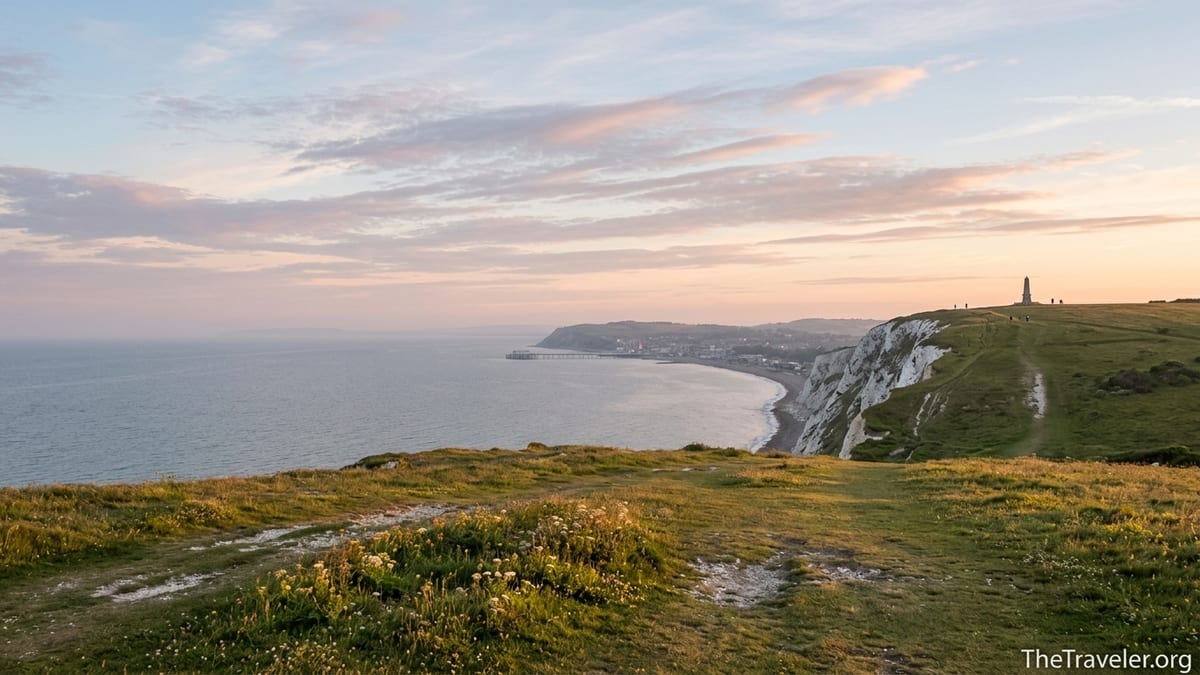
High above Sandown Bay on the Isle of Wight, Culver Down offers some of the island’s most expansive sea views, with rolling chalk grassland dropping to sheer white cliffs and a broad sweep of beach curving away below. Time your visit right and this exposed headland becomes a spectacular natural viewing platform for both sunrise and sunset, whether you are a photographer chasing golden light, a walker finishing a coastal hike, or a couple unrolling a picnic blanket beside the Yarborough Monument.
Understanding Culver Down’s Light and Landscape
Culver Down is a chalk ridge at the north-eastern end of Sandown Bay, on the Isle of Wight’s east coast. Managed largely by the National Trust, the open downland looks south across Sandown and Shanklin and north over Bembridge Harbour and the Solent. On a clear day you can see as far as the Spinnaker Tower in Portsmouth to the north and the dark line of the Undercliff coast towards Ventnor to the south.
The headland’s orientation is what makes it so good for sunrise and sunset. Culver Down curves from northeast to southeast and then back round towards the south, with several different vantage points. At dawn the sun lifts out of the water somewhere between Whitecliff Bay and the open English Channel, depending on the time of year. In the evening, sunset does not drop directly into the sea here, but the low western sun washes warm light across the white cliffs, Sandown Bay and the pastures above Bembridge, creating long shadows and glowing skies.
Because Culver Down is relatively high and uncluttered by buildings, you get a long, low horizon. Even on days when there is haze over the mainland it is common to see light bands of orange and pink stretching across the entire sky. This big-sky effect can be more dramatic than a conventional “sun dropping into the sea” sunset and is why photographers based on the island often recommend Culver Down and nearby Yaverland for early-morning shoots.
The headland is exposed to the prevailing weather, which matters for light. After a storm front clears, the air over the Isle of Wight can be crystal-clear, giving very sharp visibility along the cliffs and deep color at sunrise and sunset. In high summer the marine haze from warm, humid air can soften the scene, producing pastel-toned sunsets that are gentler but still atmospheric.
Season by Season: When the Views Are at Their Best
On the Isle of Wight, the light and weather shift noticeably through the year. The island has a milder, sunnier climate than many parts of mainland Britain, but winter storms and summer heat both shape what you will see from Culver Down and how comfortable you will be while watching it.
From late March through May, sunrise moves rapidly earlier and sunset later. In this spring shoulder season the downs start to green up, with cowslips and other chalk grassland flowers appearing around the paths. Early mornings can still be chilly, yet skies are often clear between passing fronts. A 6.30 am sunrise in April, for example, can coincide with dew on the grass, sharp visibility towards Bembridge, and relatively few people in the car park at Bembridge Fort.
June to August bring the longest days and the busiest visitor numbers. Around the summer solstice in late June, the Isle of Wight has sunrise shortly after 4.45 am and sunset close to 9.20 pm, and those timings are a useful guide for Culver Down too. In practice, that means civil dawn light from roughly 4.10 am and usable golden-hour light from about 8.30 pm onwards. This is the best period for lingering sunsets, warm evenings and picnics on the grass, but expect more dog walkers, families from Sandown, and visitors driving up for a look after dinner at the Culver Haven Inn.
September and October are often the sweet spot for photographers. Sea temperatures remain relatively warm, the weather can be stable for days at a time, and sunrise and sunset fall at more sociable hours. Around the autumn equinox, sunrise is close to 6.45 am and sunset near 7 pm on the island. In real terms, you can leave a B&B in Shanklin shortly after 6 am, drive or bus to Yaverland, walk up to the Yarborough Monument and still be in place 20 minutes before the sun appears. The low angle of the autumn sun can ignite the chalk cliffs at Culver and throw long shadows across the down.
Winter brings the shortest days and the rawest weather, but also some of the clearest light. In December and early January the island’s sunrise is around 8 am and sunset before 4.15 pm. Storm systems off the Channel can deliver dramatic cloud formations, beams of light through gaps in the clouds, and intense but brief color bursts right after the sun dips. On calm, high-pressure days the air feels almost alpine, with ice-blue skies over Sandown Bay. The trade-off is strong wind exposure on the ridge and sometimes muddy paths, so good boots and a windproof jacket are essential.
Sunrise on Culver Down: Timing, Spots and Practical Tips
For sunrise, Culver Down is one of the Isle of Wight’s headline locations. The coastline bends so that from certain points the sun comes up roughly over the open sea, while from others it appears above Whitecliff Bay and the chalk cliffs. Your experience will differ slightly according to where you stand and the time of year.
One popular approach is to park in the National Trust car park near Bembridge Fort at the top of Culver Down Road and walk the short distance to the Yarborough Monument. From here you have almost 360-degree views, but the key sunrise direction is east and southeast, where Sandown Bay curves away and the sea meets the sky. Photographers often set up on the grassy slope north of the monument so they can include the trig point or the curve of the bay in the foreground.
If you prefer to combine the dawn light with beach textures, consider starting at the Yaverland car park on the eastern edge of Sandown and walking along the beach towards the base of Culver Cliff. At very low tide the wet sand reflects the color in the sky, and gentle waves create leading lines into the frame. In summer, sunrise will feel far out to your left as you face the sea, while in winter it tracks closer to the headland. Allow at least 20 to 30 minutes before the published sunrise time for the best pre-dawn color.
Practicalities matter on dark mornings. In April, when sunrise can be around 6.15 am, a visitor staying in Ryde might leave at 5.30 am, drive the 25 minutes to Yaverland, and have enough time to walk out onto the beach. A small head torch or phone flashlight is useful for the stony sections of path near Bembridge Fort before the sky lightens. Temperatures on the exposed top can feel several degrees cooler than in Sandown, so even in June and July pack a light insulated layer if you plan to stand still for half an hour with a camera on a tripod.
Sunset on Culver Down: Where to Go and What to Expect
Although the east coast of the Isle of Wight is not the place for the classic sun-into-the-sea sunset, Culver Down still delivers superb evening light. The highlight at this time of day is the view west and southwest along the length of Sandown Bay, with the cliffs and townscape catching the last low-angle sun and the sky glowing behind you in the east.
One of the simplest sunset experiences is to arrive an hour before sunset at the Bembridge Fort car park and walk along the coastal path that runs close to the cliff edge towards Sandown. Every few hundred metres you get a slightly different angle on the bay: one spot frames the pier and the lines of the esplanade; another looks down on the golden strip of Yaverland Beach with the white chalk of Culver Cliff receding behind it. As the sun drops behind the inland hills, the cliffs themselves remain bright while the bay falls into shadow, creating a strong contrast that works well in photographs.
Evenings are also ideal for casual visitors who simply want to sit on the grass near the monument or by the Culver Haven Inn and watch the sky change. On warm July nights you will see islanders spread out on picnic rugs or finishing a circular walk from Bembridge. Families who have spent the day at Sandown often drive up for the last light, buying takeaway fish and chips in town and eating them in the car with the panoramic view below.
If your priority is a sun-disc sunset rather than the light on the cliffs, you could combine Culver Down with a short drive to the island’s west coast later in your trip, where Compton Bay, Freshwater and Headon Warren face closer to due west. For this specific article’s focus, though, the best use of Culver Down at sunset is to treat the cliffs, monument and bay as subjects illuminated by the setting sun rather than as a silhouette against it.
Typical Sunrise and Sunset Times: What the Numbers Mean
Published sunrise and sunset times for nearby Newport or Sandown provide a good guide for Culver Down, since the island is small and shares the same time zone and daylight saving rules. Around the height of summer, expect sunrise close to 4.50 am and sunset just after 9.10 pm. At the depth of winter, sunrise can be near 8.00 am and sunset around 4.10 pm. Spring and autumn sit between those extremes, with roughly 12 hours of daylight around the equinoxes in late March and late September.
For trip planning, what matters most is not only the exact moment the sun crosses the horizon but the broader windows of soft light. Photographers talk about golden hour, roughly the first and last hour of sunlight each day. On Culver Down in June, that means soft, warm light from about 5.00 am to 6.00 am and again from roughly 8.15 pm until sunset. In January, the same quality of light might occur from around 8.00 am to 9.00 am and from about 3.00 pm to 4.00 pm, giving relatively short but intense daily windows for dramatic skies.
For casual visitors, it can be easier to think in terms of “arrive 30 to 40 minutes before” and “stay 20 minutes after.” If sunset is due at 7.30 pm on a late-September evening, plan to be parked at Culver Down by 6.45 pm. That way you see the color build as the sun descends and do not miss the afterglow that often occurs 10 to 15 minutes after the sun has technically set. The same logic applies in reverse for sunrise: being in place half an hour before the time listed on a weather app will usually reward you with the richest pre-dawn color.
Because the Isle of Wight’s weather is changeable, check a local forecast service on the day. Many islanders use detailed marine or coastal forecasts to judge cloud cover and visibility. A high but broken cloud layer can produce intense striped color at both sunrise and sunset over the Channel, while a solid grey blanket will mute the scene. If you have several days on the island, keep your Culver Down plans flexible and use the clearest evening or morning for your visit.
Practical Access: Getting to Culver Down for Golden Hour
Reaching Culver Down is relatively straightforward by car, on foot or by bus plus a short walk. The main access road is Culver Down Road, which climbs steeply from near Yaverland on the B3395 Sandown to Bembridge road. At the top, close to Bembridge Fort, there is a National Trust car park that is usually free during the day. A smaller parking area lies closer to the Culver Haven Inn and the Yarborough Monument, and visitors commonly park there in daylight hours for walks and picnics.
If you are staying in Sandown without a car, a practical example would be to take the coastal path from the eastern end of the town, near the Isle of Wight Zoo, and walk up towards Culver Cliff. This route involves a steady climb but rewards you with unfolding views over the bay and takes about 45 to 60 minutes for a reasonably fit walker. Time your departure so you arrive at the top around sunrise or an hour before sunset. In the opposite direction, walkers based in Bembridge often use the Culver Trail or National Trust circular walks to reach the headland, combining heathland, old military sites and coastal views.
Public transport users can take the hourly Southern Vectis bus that runs between Ryde, Bembridge and Sandown and get off on the B3395, then walk roughly 15 to 20 minutes up Culver Down Road to reach the Fort car park. In practice, this makes sunrise visits in midwinter tricky without a car, but autumn and spring sunsets are easy to reach before darkness falls. Check the latest timetables and allow a buffer so you are not hurrying up the hill as the light peaks.
If you are visiting in a campervan or taller vehicle, be aware that some island car parks have height barriers; reports from visitors indicate that the Culver Down top car parks are generally open during the day, but overnight parking is discouraged and some signage warns against staying after dark. For early sunrise visits in summer, aim to arrive after the official opening times and avoid blocking gateways or access tracks. Always check current local regulations and be prepared to adjust if conditions or signage change.
Weather, Safety and Local Etiquette
The open nature of Culver Down means you are exposed to wind, sun and any sudden weather changes. In winter, wind chill can make temperatures feel several degrees below what your weather app suggests. A December sunrise might technically be at a mild 6 or 7 degrees Celsius in Sandown, but on the ridge that can feel close to freezing once you factor in wind. Gloves, a beanie hat and a windproof layer will make the experience much more comfortable, especially if you are standing still with a tripod or sitting on cold ground.
In summer, the main issues are intense sun and dehydration. There is very little natural shade on the downland, so if you arrive early for a late-evening sunset in July, wear sunscreen and bring water. The Culver Haven Inn is a convenient place for a drink or meal before or after your viewing window, but do not rely on it being open at very early or very late hours. As with any clifftop, stay well clear of the edge, keep children close, and avoid walking on overhanging sections after heavy rain when erosion can accelerate.
Respecting the local environment and community is straightforward but important. Much of Culver Down is managed as grazing land and nature-rich chalk grassland, so keep dogs on a lead near livestock and follow any National Trust signs. Take litter home with you; unfortunately, busy summer evenings can leave the car park and popular picnic spots with discarded bottles or food wrappings, which spoil the atmosphere and damage wildlife. If you are using a drone to film the sunrise, check current regulations and consider that livestock, ground-nesting birds and other visitors may not appreciate close passes.
Mobile reception is generally good on the ridge, especially towards Bembridge and across the Solent, but can be more patchy on the lower paths. For peace of mind on early or late walks, tell someone your route, especially in winter when paths can be slick with mud. A simple torch is a useful backup if sea mist drifts in unexpectedly and visibility drops during your walk back to the car or bus stop.
The Takeaway
The best time to visit Culver Down for sunrise and sunset depends on what you value most. If you want long, balmy evenings and the social buzz of other visitors spread out on the grass, aim for late spring through early autumn, when sunsets stretch well past dinner and the bay glows gold for an hour or more. For quieter, more dramatic skies and crisp views across the Solent, late autumn and winter reward early risers and those willing to wrap up warm.
In practical terms, think in terms of light rather than just clock times. Arrive 30 to 40 minutes before the scheduled sunrise or sunset, stay a little after, and pick a spot that frames both the sky and the sweeping curves of Sandown Bay, Whitecliff Bay or Bembridge Harbour. Whether you choose the high vantage point by the Yarborough Monument, the cliffside path towards Sandown, or the reflective sands of Yaverland below, Culver Down will repay the effort of an early alarm or a later-than-usual dinner with some of the Isle of Wight’s most memorable views.
FAQ
Q1. What months are generally best for sunrise and sunset at Culver Down?
Late April to early October usually offers the best balance of clear skies, comfortable temperatures and convenient sunrise and sunset times, with particularly attractive light and manageable hours around May, June and September.
Q2. How early should I arrive before sunrise?
Plan to be in position at least 30 minutes before the published sunrise time so you can watch the color build in the sky during nautical and civil twilight and adjust your viewpoint before the sun appears.
Q3. Where is the easiest spot to watch sunrise if I have limited mobility?
The National Trust car park near Bembridge Fort and the nearby area around the Yarborough Monument are the most practical, as they involve only short, relatively gentle walks from level ground to panoramic viewpoints.
Q4. Can I see the sun setting over the sea from Culver Down?
From Culver Down you mainly see the sunset light falling across Sandown Bay, the cliffs and inland hills rather than the sun dropping directly into the sea, but the sky and landscape colors can be spectacular.
Q5. Is Culver Down suitable for sunrise and sunset photography?
Yes, it is a favorite with local photographers thanks to its high vantage points, sweeping coastal curves, chalk cliffs and open sky, with varied compositions available from the monument, cliff paths and Yaverland Beach.
Q6. Do I need a car to visit Culver Down for golden hour?
A car is the most convenient, especially for early sunrise or midwinter visits, but you can also reach the area using Southern Vectis buses to the B3395 and walking up Culver Down Road, or on foot via coastal and downland trails from Sandown or Bembridge.
Q7. Are there facilities open early or late near the viewpoints?
Facilities are limited; the Culver Haven Inn serves food and drinks at normal pub hours, but there are no public toilets or kiosks open at very early sunrise or late evening, so bring water, snacks and any essentials with you.
Q8. Is it safe to visit Culver Down in winter for sunset?
It can be very rewarding but demands preparation: arrive in daylight, wear warm, windproof clothing and sturdy footwear, keep clear of cliff edges, and allow time to get back to your car or bus stop before full darkness.
Q9. Can I combine a Culver Down visit with a day on the beach?
Yes, many visitors spend the day on Sandown or Yaverland beaches and then head up to Culver Down by car or on foot in late afternoon to watch the sunset light over the bay before returning to town for dinner.
Q10. Do I need to pay to park for sunrise or sunset?
The main National Trust car park at the top of Culver Down has traditionally been free during daytime, but policies can change, so check current local information and signage on arrival and avoid parking overnight where it is not permitted.