


Get the latest updates straight to your inbox!
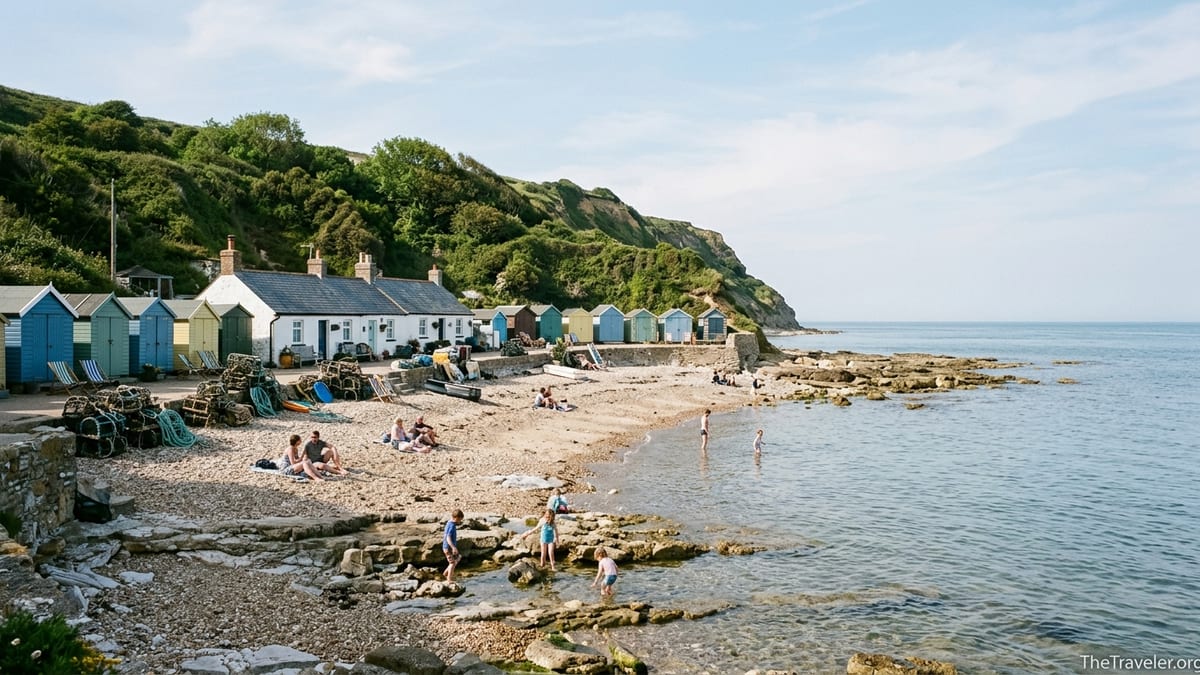
Hidden beneath crumbling cliffs on the south coast of the Isle of Wight, Steephill Cove does not behave like a normal British beach. There is no road, no car park pressed against the shingle, no amusement arcade or neon-lit chippy. Instead, after a short walk along the coast path or a descent past a cricket pitch and Ventnor Botanic Garden, you arrive at a tiny, time-warped fishing hamlet where the loudest sounds are waves on shingle and cutlery on crab shells. It feels, in almost every way, like the opposite of the classic British resort, and that is exactly why travellers fall in love with it.
A Cove You Cannot Drive To
Most British beaches begin in a car park. At Steephill Cove, your visit starts with a walk. The hamlet is one of the few coves in England with no vehicular access, tucked just west of Ventnor beneath the Isle of Wight’s Undercliff. To get there you either follow the coastal path from Ventnor Esplanade, passing beach huts and the low seawall, or drop down from the lane by Ventnor cricket club or the Botanic Garden. The approach is short, usually 10 to 15 minutes, but steep enough to filter out casual crowds.
This small effort completely changes the mood on arrival. Because there is no road, you never share the cove with the usual ring of queues and engines. Day-trippers wheel cool boxes and pushchairs by hand, and locals trundle crates of freshly caught crab on trolleys along narrow paths. It feels more like reaching a little Mediterranean cala on foot than stepping off a British promenade. On peak summer days, you may still share the cove with plenty of other people, but the absence of vehicles keeps the atmosphere notably calm.
The lack of direct access also affects how long people stay. Rather than popping down for ten minutes between errands, most visitors commit to half a day or more, timing their walk with the tide and building their plans around a swim, a seafood lunch and the slow amble back. That sense of intention makes the experience feel more like a small coastal pilgrimage than a casual detour.
A Living Fishing Hamlet, Not a Resort
On many UK beaches, the seafront is dominated by holiday flats, pub chains and identikit ice-cream kiosks. Steephill Cove, by contrast, reads as a working hamlet first and a holiday spot second. A line of low fisherman’s cottages and chunky stone walls runs along the back of the beach. Lobster pots and coils of rope sit beside doorways, and traditional wooden deckchairs are stacked among the fishing gear rather than in front of a souvenir shop.
This is not an open-air museum. A handful of families still work the local waters, and the crab landed here appears directly on plates at the cove’s small eateries. At The Crab Shed, a modest wooden café right behind the shingle, you might pay somewhere around 12 to 15 pounds for a crab pasty with salad and a drink, served on simple outside benches facing the water. A few doors along, another shack might offer grilled mackerel or a crab sandwich with local leaves, handwritten on a chalkboard that changes with the catch and the weather.
Self-catering cottages in the cove, some converted from old fishermen’s houses or boathouses, preserve the feeling of a place that still belongs to working islanders. A couple can expect to pay a premium for this rarity, often several hundred pounds for a long weekend in high summer, but what they are really buying is the right to wake up to the rattle of halyards and the smell of seaweed instead of traffic. This fusion of living community and low-key tourism is increasingly rare on the British coast, and it gives Steephill a grounded, unfussy feel that contrasts sharply with large resorts just a short drive away.
The Undercliff Microclimate and a Hint of the Mediterranean
Steephill Cove sits within the Isle of Wight’s Undercliff, a peculiar band of ancient landslip running along the south coast between Niton and Bonchurch. The cliffs behind the cove and the south-facing aspect create a sheltered pocket of air that is often noticeably warmer and less windy than more exposed UK beaches. Ventnor, the nearest town, is known locally for its microclimate; on some spring days it can feel several degrees warmer than mainland resorts at the same time of year.
This warmth is not just something locals boast about. Just above the cove, Ventnor Botanic Garden grows exotic plants from Mediterranean and subtropical regions in open air that would struggle elsewhere in Britain. Visitors can stroll through terraces of olive trees, agapanthus and even some palm species, then follow a path down to the cove in less than 15 minutes. The link between the garden’s lush planting and the mild air on the shingle makes Steephill feel geographically displaced, as if a corner of the Channel Islands has drifted closer to the English mainland.
On a good summer day, this microclimate shapes everything about the experience. Children paddle in clear, gently shelving water without the teeth-chattering shock common elsewhere, and adults sit in light jumpers long after the sun has gone behind the cliffs. In early autumn, when other UK beaches are packing away deckchairs, Steephill often still sees swimmers and picnics on calm, bright afternoons. The warmth is not guaranteed, but when it arrives it deepens the sense that this is a pocket of the coast playing by its own rules.
Rock Pools, Tides and the Rhythm of a Small Cove
Steephill Cove is not a huge arc of sand like Sandown or a wide surfing bay like Compton. Its modest size is one reason it feels different. The beach itself is a mix of shingle, sand patches and rocky ledges that reveal intricate rock pools as the tide falls. Families come armed with inexpensive nets from Ventnor shops, plastic buckets and a sense of mission, stooping over pools to look for shore crabs, blennies and anemones among the weed-covered stones.
The smallness of the cove makes visitors acutely aware of the tide. At high water in spring tides, the sea can almost swallow the beach, leaving only a narrow strip of shingle and a few front-row deckchairs. At lower states of tide, broad rock shelves appear, creating natural paddling areas that warm in the sun. Parents often plan their visit around these lower tides, arriving mid-morning so that younger children can explore the pools in the afternoon when the water is shallower and calmer.
Because the cove is tucked under cliffs and part of a protected stretch of coast, the sea here is usually gentle compared with Atlantic-facing UK beaches. There are no surf schools or jet-ski hire outlets, just people wading, bobbing about on inflatables and, in calm weather, confident swimmers heading out a short distance along the bay. Lifeguards are not always present, so visitors pay more attention to conditions and to each other. It feels communal in a way that crowded resorts sometimes do not.
Simple Food, Slow Days and Small-Scale Hospitality
Steephill’s hospitality scene is tiny but distinctive. Instead of a line of branded outlets, there are just a couple of seasonal cafés and kiosks serving seafood lunches, coffee and ice cream. Menus are short and tend to follow the boats and the weather. On a busy, bright Saturday in August, you might queue for a crab linguine or dressed crab salad at lunchtime, the portion price reflecting the reality of fresh shellfish and a minute kitchen, rather than a standardized chain offering.
This simplicity reshapes the pace of the day. Many visitors time their walk to arrive around late morning, secure a table or a good spot on the shingle, and then let the meal dictate the rhythm of their afternoon. Instead of cramming in attractions, the itinerary becomes pleasingly narrow: swim, eat, nap, wander up to the Botanic Garden, then amble back to Ventnor for a drink on the esplanade. In a travel era obsessed with ticking off sights, Steephill quietly encourages travellers to do far less, but to notice more.
Accommodation choices in and above the cove reinforce this feeling. A self-catering cottage right on the waterfront suits couples or families who want to fall asleep to surf noise and wake to the clink of masts, while character B&Bs and small hotels in Ventnor offer more amenities within a 20-minute coastal walk. Nightly rates vary widely with season, but there is no large-scale resort hotel looming over the cove. Instead, hospitality is scattered, personal and small enough that staff often recognize returning guests year after year.
How Steephill Compares With Better-Known UK Beaches
To understand why Steephill Cove feels so unusual, it helps to compare it with a few of the UK’s classic seaside experiences. In many English resort towns, such as nearby Shanklin or larger mainland destinations, visitors arrive directly onto a prom lined with amusement arcades, large pubs, chain cafés and multi-storey car parks. The atmosphere can be lively and nostalgic, but also dominated by noise and commercial signage.
By contrast, the approach to Steephill is quiet and semi-rural. From Ventnor, the coast path runs along low cliffs with views of the sea, past a cricket ground and a scattering of villas. Instead of slot machines and mini-golf, your first impressions are of gardens, allotments and clifftop vegetation. When you finally step onto the shingle, there are no flashing signs, just hut fronts, chalkboards and the occasional hand-painted nameplate on a cottage.
Other UK coves share some of Steephill’s qualities but often differ in key ways. Some Cornish inlets have no car access, for instance, but can still feel heavily commercialized once you arrive. Remote Scottish and Welsh bays may have minimal development, yet the cooler climate and wilder seas create a brisk, elemental mood rather than Steephill’s soft, summery one. That combination of mild air, working hamlet, walk-in access and human scale is what gives this Isle of Wight cove its unusually gentle personality.
Planning a Visit: Practical Realities on the Ground
Although Steephill Cove has a dreamlike quality, visiting it involves a few practical quirks. Because you cannot drive to the seafront, most travellers park in Ventnor, where typical summer rates in pay-and-display car parks reflect those of a popular English seaside town, then walk along the signed coast path. The route is mostly straightforward but involves some gradients and uneven surfaces, so sturdy shoes are helpful, especially if the path is damp.
There are basic facilities but not the full suite you might expect in a big resort. Public toilets are available a short walk away, and the cafés provide additional restrooms for customers, but you will not find large shower blocks or lockers. It is wise to bring what you need for the day in a small rucksack: water, a light windproof layer, sun protection and simple beach shoes to handle pebbles and rock pools. Mobile reception is generally reasonable but can dip in some corners of the cove, which only adds to the sense of having stepped away from daily life.
Because much of the seating at the cafés is outdoors, opening hours can be weather-dependent. On a calm, sunny Saturday in July, everything is likely to be open from late morning through the afternoon. On a cool, wet weekday in early spring, you may find just one kiosk serving hot drinks and cake. Planning a flexible day, with the option of continuing your walk along the coastal path or heading back to Ventnor for a more substantial meal, helps make the most of whatever conditions you encounter.
The Takeaway
Steephill Cove feels different from other UK beaches because it resists many of the usual patterns of British seaside development. There is no road, no sweeping promenade, and no corporate architecture. Instead you find a small, lived-in hamlet sitting beneath warm, south-facing cliffs, accessible only by foot and shaped more by tides and crab boats than by car parks and arcades.
For travellers, that difference translates into a slower, more intimate coastal experience. The effort of walking in, the simple seafood lunches, the rock pools and the mild air all encourage you to stop counting attractions and start paying attention to tiny details: the way sunlight catches a line of deckchairs, the shout of a fisherman greeting a neighbour, the sudden silence when the last day-trippers file up the path at dusk.
In a country full of memorable beaches, Steephill offers something rarer: the feeling of having stumbled into a place that still belongs first to itself, and only second to its visitors. If you are willing to trade convenience for character, and entertainment for atmosphere, this little cove on the Isle of Wight may feel less like one stop on an itinerary and more like the quiet highlight of your entire trip.
FAQ
Q1. Is Steephill Cove suitable for young children? Yes, families regularly visit with young children. The gently shelving water at lower tides and numerous rock pools make it appealing, though parents should supervise closely as there are rocks and no permanent lifeguard presence.
Q2. How long does it take to walk to Steephill Cove from Ventnor? Most visitors allow about 10 to 20 minutes each way from Ventnor Esplanade, depending on pace and the exact route. The walk involves some slopes and uneven ground, so it may take longer with very young children or limited mobility.
Q3. Can you drive or take a taxi directly to the beach at Steephill Cove? No, there is no road access to the cove itself. Taxis and private cars can drop you near the top of the paths by the Botanic Garden or cricket ground, but everyone has to walk the final stretch down to the beach.
Q4. Are there places to eat at Steephill Cove? Yes, there are usually one or two small seasonal cafés and kiosks serving dishes such as crab sandwiches, pasties, cakes and hot or cold drinks. Menus and opening hours depend on the time of year and the weather.
Q5. Do I need to book ahead to eat at the cafés? For casual daytime food, advance booking is rarely required. However, on busy summer weekends and during school holidays, arriving early for lunch is wise, as outdoor tables can fill quickly and popular dishes may sell out.
Q6. Is Steephill Cove dog friendly? Dogs are often seen on the paths and in the cove, but any seasonal restrictions or on-lead requirements can change. It is best to check local signage when you arrive and follow the current guidance, especially during peak summer months.
Q7. What should I wear and bring for a day at Steephill Cove? Comfortable walking shoes, layers suitable for coastal weather, swimwear, a towel, sun protection and a small bag for drinks and snacks are practical. Simple beach shoes help with pebbles and rock pools, and a light waterproof is useful in changeable conditions.
Q8. Is Steephill Cove accessible for people with limited mobility? Access can be challenging for visitors with limited mobility or those using wheelchairs or mobility scooters, because all routes involve slopes and uneven paths. Some people manage with assistance, but others may find nearby Ventnor beach easier to reach.
Q9. When is the best time of year to visit Steephill Cove? Late spring to early autumn tends to offer the most comfortable conditions, with warmer air and sea temperatures. The cove’s sheltered setting can also make bright winter days surprisingly pleasant, though fewer facilities may be open.
Q10. Are there lifeguards or water sports at Steephill Cove? Lifeguard cover is not guaranteed and is often absent, so swimmers should take sensible precautions and stay close to shore. There are no major water-sports hire outlets; most visitors simply swim, paddle or explore the rock pools rather than take part in organized activities.