


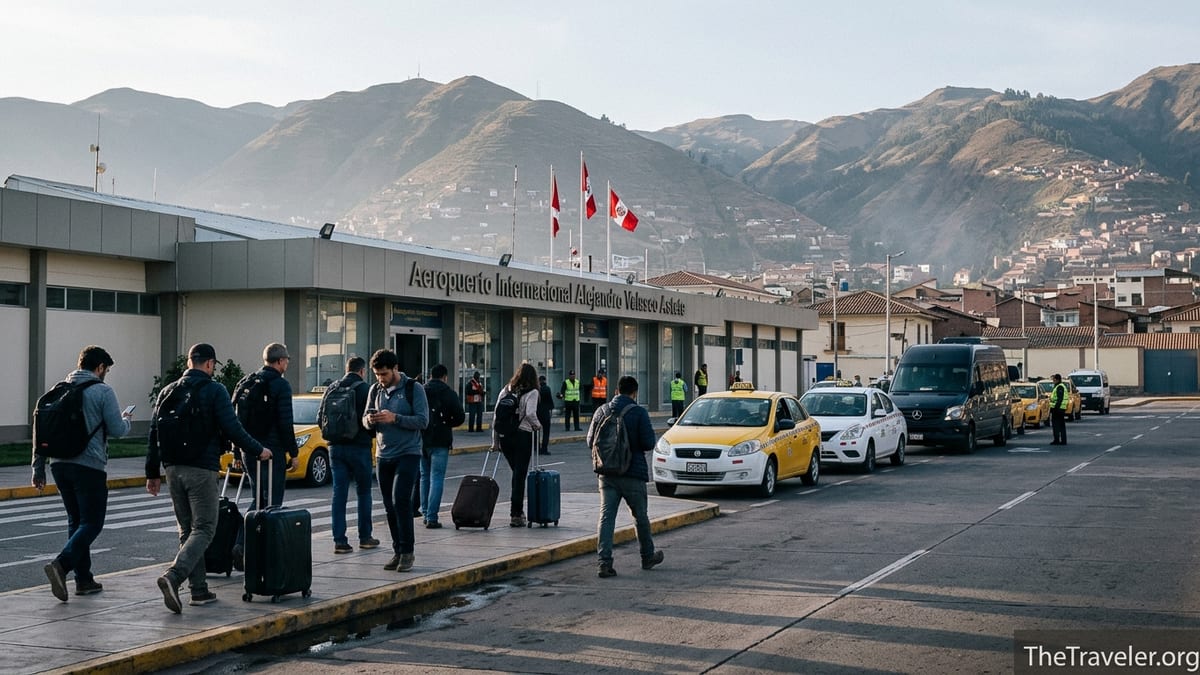
Arriving at Cusco’s Alejandro Velasco Astete International Airport can feel intense: you step off the plane at 3,300 meters, the air is thin, and eager taxi touts wait just outside arrivals. The good news is that Cusco is small, the airport sits only about 5 kilometers from the historic center, and you have several reliable ways to reach your hotel. The key is understanding which transfer option fits your budget, luggage, safety comfort level, and hotel location.
Get the latest updates straight to your inbox!
Understanding the Route: From Runway to Plaza de Armas
Cusco’s Alejandro Velasco Astete International Airport lies in the southeast of the city, roughly 10 to 20 minutes by car from the Plaza de Armas, depending on traffic. The drive runs along Avenida Velasco Astete and Avenida de la Cultura or Avenida 28 de Julio, then winds into Cusco’s compact colonial core. Because the distance is short, you are paying as much for convenience and safety as for time in the vehicle.
Most visitors stay in or around three main areas: the Historic Center (Plaza de Armas, San Blas, San Cristóbal), the Avenida El Sol and Wanchaq district (near mid-range hotels and bus terminals), and the quieter neighborhoods of San Blas hillside or Santiago. Taxis and ride-hailing apps can easily reach the main streets of these areas, but for hotels on narrow cobblestone lanes, your driver may need to stop a short walk away and point you along a pedestrian alley. This is normal in Cusco and worth asking about when you book your hotel.
Because the airport is so close to town, transfers are relatively inexpensive compared with many big cities. As of mid 2026, visitors typically pay around 15 to 30 Peruvian soles (roughly 4 to 8 US dollars) for a straightforward ride to the center when using apps or street taxis, and from about 40 to 70 soles when using an official airport taxi counter or pre-booked private transfer for two people. Higher prices generally reflect better predictability, English support, and help with luggage rather than a significantly longer journey.
The altitude is another factor that makes a smooth transfer worth planning. After landing at approximately 3,300 meters, many travelers feel light-headed or short of breath. Choosing a simple, door-to-door option, rather than haggling in the street or waiting long for a car, can make your first hour in Cusco far more comfortable.
Official Airport Taxis: Easiest and Most Predictable
Inside the arrivals hall you will find desks for licensed airport taxi companies authorized by the airport operator. These official taxis are the most straightforward choice: you walk up to the counter, state your hotel name, agree the fixed fare, pay or receive a ticket, then a dispatcher walks you to your car. Drivers generally wait in the official taxi lane just outside the terminal. Vehicles are usually standard sedans or compact SUVs, clearly marked, and drivers are accustomed to dealing with visitors who may not speak Spanish.
Typical official taxi prices from Alejandro Velasco Astete Airport to central Cusco in 2026 range roughly from 40 to 60 soles for two passengers with standard luggage, depending on the company, time of day, and your exact destination. For example, a ride to a hotel on or near Plaza de Armas or Avenida El Sol will usually sit near the lower end, while a drop in the upper San Blas hills or the Santiago district might be a little more. Some counters may charge extra for very late-night arrivals or larger vehicles when you have several suitcases.
In terms of safety, official airport taxis are considered one of the most reliable options. The vehicles are registered with the airport, drivers are identified, and if there is a problem, you can report the company and approximate time of your ride. Travelers who have had issues with official taxis in Cusco describe contacting the airport or local transport authorities to report behavior, which is far easier when you have a receipt or company name. This traceability is a major advantage over unregistered street taxis hailed outside the gate.
Official taxis are a strong choice if you are arriving for the first time in Peru, landing late at night, traveling alone, or carrying expensive camera gear or multiple bags. You will pay more than the cheapest alternatives, but in return you avoid immediate bargaining or confusion in the parking lot when you may still be adjusting to the altitude.
Street Taxis Outside the Airport: Cheapest, But Requires Savvy
Just beyond the terminal’s main exit, along the airport access road and on Avenida Velasco Astete, you will see a constant stream of yellow or white taxis. Many are informal or semi-formal, and almost none use the meter. Instead, you agree a price before getting in. For travelers comfortable with basic Spanish and haggling, this can be the cheapest way into town. For those unused to bargaining or arriving stressed or tired, it can feel overwhelming.
As of 2026, realistic negotiated prices with street taxis from the airport to the Historic Center often land between 15 and 25 soles for one or two people with light luggage, provided you are willing to walk a short distance beyond the immediate arrivals crush. For instance, a visitor might step out of the terminal, decline the first tout offering 40 soles, cross to the main road, and stop a passing taxi, agreeing on 18 or 20 soles for a ride to a hostel near Plaza San Francisco. With basic Spanish phrases such as “¿Cuánto al centro, por la Plaza de Armas?” you can quickly test what is reasonable.
The trade-off is safety and comfort. While many drivers are honest and friendly, the system is less regulated. It is wise to choose cars with visible taxi signage and a license plate, sit in the back seat, keep your luggage with you rather than in a wide-open trunk when possible, and avoid displaying valuables or phones out the window at traffic lights. Because Cusco’s airport area is busy but not particularly dangerous in daytime, most travelers who use street taxis during daylight report no issues, especially for such a short ride, but caution is still recommended.
Street taxis can be a good option for budget-conscious backpackers, Spanish speakers, or anyone familiar with Peru’s informal taxi culture. Families, solo travelers after dark, and those carrying expensive equipment may prefer to pay extra for official taxis or private transfers that offer traceability, pre-agreed prices, and clear company responsibility if something goes wrong.
Uber, InDrive and App-Based Rides: Flexible, But Sometimes Patchy
Ride-hailing apps nominally operate in Cusco, but their reliability varies. Uber lists Cusco as an active city and allows you to request pickups at Alejandro Velasco Astete Airport and around town. In practice, however, travelers and even university programs that send students to Cusco report that Uber availability can be inconsistent, especially very early in the morning, late at night, or in less central neighborhoods. Drivers may also cancel if traffic to the airport is heavy or if they dislike the destination.
Another major player is InDrive, a global ride-hailing app popular in Latin America where passengers propose a fare and nearby drivers accept or counter-offer. In Cusco, many visitors in 2025 and 2026 have found InDrive more responsive than Uber for city rides, including trips to and from the airport. For example, travelers using InDrive in Cusco describe being able to request a car from the airport access road and agree on a fare around 20 to 30 soles to the Plaza de Armas, roughly similar to a negotiated street taxi but with the advantage of app-based driver profiles and trip records.
Prices through apps fluctuate with demand, but recent real-world examples give a sense of cost. For an afternoon arrival on a weekday, a standard app-based ride from the airport to the historic center might be quoted at the equivalent of 8 to 10 US dollars for a regular car and slightly more for a larger vehicle suitable for four or five passengers plus luggage. At quieter times, some users report lower costs, in line with 20 to 30 soles. Because these services operate on dynamic pricing, it is wise to check the fare estimate once you have your luggage and then briefly compare it with an official taxi quote inside.
One limitation in Cusco is that some drivers hesitate to enter very narrow colonial streets or steep lanes in San Blas, particularly in rain or at night. Even when using Uber or InDrive, you may be dropped on a main street and need to walk uphill or along a pedestrian alley to your hotel. It helps to have your hotel address saved, download an offline map, and ask your accommodation in advance for the name of the nearest vehicle-accessible point. Overall, apps are a flexible mid-priced option that work best for confident smartphone users who are not arriving at the most chaotic times.
Private Transfers and Hotel Pickups: Stress-Free, Especially With Luggage
Pre-booked private transfers, often arranged through local companies or your hotel, are the most comfortable but usually most expensive way to get from Cusco airport into town. These services send a named driver to meet you at arrivals holding a sign, help with luggage, and escort you directly to your vehicle. This can be especially valuable if you are arriving with young children, elderly relatives, oversized trekking gear, or multiple backpacks and suitcases.
Prices vary widely by provider, vehicle type, and language support. As a broad guide, private transfers from Alejandro Velasco Astete Airport to a central Cusco hotel for two people tend to start around 60 to 80 soles when booked with local agencies, and can reach 120 soles or more for larger vans, English-speaking guides, or bundled packages that include an initial city tour. For a group of four or five splitting the cost, a private van can quickly become competitive with taking two separate official taxis, while offering more space for luggage and the assurance that everyone travels together.
Some hotels in Cusco, particularly mid-range and upscale properties near Plaza de Armas or along Avenida El Sol, offer their own transfer services. These are often more expensive than booking directly with an independent provider but have the advantage of being integrated with your reservation. For example, a hotel might charge around 80 to 100 soles for a one-way pickup for two from the airport to a room near the cathedral. The front desk staff can also give the driver precise instructions on the best access route, which is helpful in the maze of one-way colonial streets.
Private transfers make the most sense when predictability and ease matter more than shaving a few soles off the fare. If your flight lands very late at night, if you are traveling with heavy luggage or after a long international journey, or if you simply prefer to have everything arranged in advance, paying the premium for a named driver waiting in arrivals can turn your first hour in Cusco from a logistical challenge into a gentle glide.
Luggage, Group Size and Safety: Matching the Option to Your Needs
Because the airport is so close to town, most transfers use compact sedans and small hatchbacks. With light luggage, two or three people can fit comfortably in almost any taxi or app car. Challenges arise when groups of four or more arrive with full-size suitcases, trekking backpacks, and perhaps equipment for photography or climbing. In these cases, an official taxi may need to tie a bag partly open in the trunk or stack luggage on laps, which is not ideal at altitude on winding streets.
When you know you will arrive with multiple bags or a group of four or five, consider booking a larger vehicle. Some official taxi companies offer minivans or SUVs at the counter if you ask. App-based services sometimes list larger categories where available, though in Cusco the fleet is smaller and you may wait longer. Private transfer companies routinely use minivans and can guarantee enough space. Splitting a 100-sol van among five travelers works out to about 20 soles per person, often only slightly more than individual taxi fares while giving everyone a seat and room for luggage.
Safety concerns in Cusco are usually more about petty theft and scams than serious violent crime, especially around the airport. Whichever option you choose, keep your small bag with passport, money, and electronics on your lap, close the doors properly, and avoid placing valuables on the seat next to an open window at traffic lights. Decline unsolicited offers of taxis inside the terminal pretending to be ride-hailing drivers, and always confirm the license plate and driver details in the app before you get in.
For solo travelers or those arriving after dark, err on the side of official or pre-booked options. A late-evening official taxi at 50 soles that takes you directly to the lobby of a hotel near Plaza de Armas or San Blas buys a lot of peace of mind on your first night at altitude. Once you are settled and have a feel for the city, you can experiment with cheaper or more flexible alternatives for later trips.
Best Options by Hotel Area: Where You Stay Matters
If you are staying right in the Historic Center near Plaza de Armas, Calle Plateros, or Calle Procuradores, nearly every transport option will work. Official airport taxis and private transfers will drop you as close as traffic allows, often at a corner near the plaza. App-based rides and street taxis can do the same, though they may prefer to leave you on a slightly wider street such as Calle Palacio or Avenida El Sol during busy hours. For central hotels, choose based on your budget and desire for convenience more than access, since the area is the most straightforward to reach.
Travelers staying in San Blas, especially on the steep cobbled streets above Calle Tandapata or near Plaza San Blas itself, should consider that many streets are too narrow or too steep for cars. In this case, an official taxi or private transfer that knows San Blas well can be worth the extra cost. For instance, a driver may drop you at the San Blas church or the intersection of Cuesta San Blas and Choquechaca, from where it is a short but uphill walk to many guesthouses. It can be helpful to ask your accommodation to send a message with the best drop-off point name to show your driver.
If your hotel is in the Wanchaq or Avenida de la Cultura area, near mid-range business hotels and bus terminals, road access is easier and streets are wider. App-based rides and street taxis become more attractive here, often costing less than to the cramped historic core because drivers know they will not be stuck in narrow alleys. For example, a ride from the airport to a hotel near the Wanchaq train station or along Avenida El Sol might cost around 20 soles via an app or street taxi during the day, compared with 40 to 50 soles through the official airport counter.
Those staying further out, such as in the Santiago district or on the outskirts along the road to the Sacred Valley, should strongly consider private transfers or at least app-based rides with clear GPS routing. Informal taxis may not know your exact area and could become lost in residential streets. A pre-booked transfer that has your address in advance, or an app driver following a map, reduces the risk of confusion at altitude and after a long journey.
The Takeaway
From Alejandro Velasco Astete International Airport to central Cusco, you are dealing with a short but important journey. With options ranging from inexpensive street taxis to comfortable private transfers, the best choice depends on your budget, arrival time, hotel location, and comfort level with Spanish and bargaining. While it can be tempting to focus only on the cheapest fare, remembering that you are arriving at high altitude after a flight makes convenience and safety worth a small premium.
For first-time visitors, late-night arrivals, solo travelers, and those hauling serious luggage or camera gear, official airport taxis and pre-booked private transfers stand out as the most stress-free options. You can step out of arrivals, meet a known driver or company representative, and be on your way to Plaza de Armas, San Blas, or Wanchaq in minutes. Expect to pay in the range of 40 to 80 soles depending on vehicle size and service level, which is modest by international standards for a guaranteed door-to-door ride.
For budget travelers arriving in daylight and comfortable using Spanish or smartphone apps, negotiated street taxis or InDrive-style services deliver excellent value, often between 15 and 30 soles to central areas. These require a little more local savvy and caution around safety, but thousands of backpackers and independent travelers successfully use them every year. Checking a live fare estimate in an app and then comparing it with a quote from an official taxi counter is a simple way to calibrate what is fair before you decide.
Whatever you choose, plan your transfer before you land, write down your hotel address and nearest car-accessible landmark, and keep a small amount of local currency handy for the ride. By matching your transfer option to your circumstances and hotel area, you can turn what might have been a confusing first hour into a smooth, confident arrival in the heart of the Andes.
FAQ
Q1. How much should I expect to pay from Cusco airport to the city center?
For most travelers in 2026, realistic one-way prices range from about 15 to 30 soles with street taxis or ride-hailing apps, and from roughly 40 to 60 soles with official airport taxis for two people. Private transfers arranged in advance typically start around 60 to 80 soles, depending on vehicle size and hotel location.
Q2. Are official airport taxis in Cusco safe?
Official airport taxis are generally considered one of the safest options. They operate with authorization from the airport, you book at a desk inside the terminal, and vehicles and drivers are registered. This makes it much easier to report any problem and is a key reason many first-time visitors and solo travelers choose them, especially at night.
Q3. Is Uber reliable at Alejandro Velasco Astete International Airport?
Uber technically operates in Cusco and can be requested at the airport, but availability is uneven. Some travelers find cars quickly during the day, while others report repeated cancellations or long waits, especially very early or late. It works best as a backup option rather than something you rely on completely for time-sensitive transfers.
Q4. What about InDrive or similar apps in Cusco?
InDrive is widely used in Cusco, and many visitors report better response times compared with Uber for city rides, including airport trips. With InDrive you propose a fare and drivers accept or counter. For airport to center, successful offers often fall roughly between 20 and 30 soles, similar to a negotiated street taxi but with the added benefit of app recording and driver profiles.
Q5. Can I walk out of the airport to catch a cheaper taxi?
Yes, some travelers choose to walk from the arrivals area to the main road just outside the airport to avoid higher quotes near the terminal doors. There they flag down passing street taxis and negotiate fares, often saving 10 to 20 soles compared with initial offers. If you choose this, keep luggage close, avoid isolated spots after dark, and agree the price clearly before getting in.
Q6. What is the best transfer option if I am staying in San Blas?
For San Blas, particularly higher up the hill, consider an official taxi or pre-booked private transfer, and tell them you want to be dropped at a specific accessible landmark such as the San Blas church or a named corner. From there you may walk a few minutes uphill. App-based rides and street taxis can also work, but some drivers are reluctant to tackle the steep, narrow streets, especially in heavy rain or traffic.
Q7. How should I handle luggage in Cusco taxis and apps?
With one suitcase and a carry-on, most sedans are fine. For more bags or groups of four or five, request a larger vehicle or private van in advance so luggage is not stacked unsafely or held on laps. Always keep your small valuables bag on your lap, avoid putting important items in an open trunk if you are concerned about quick snatch theft, and load and unload bags where you can see them.
Q8. Do I need to pay in cash, or can I use a card?
Official airport taxis and many private transfer companies may accept card payments, but it is still common to pay in cash. Street taxis almost always expect soles in cash. App-based rides may charge your card directly, though some also allow cash payments. To avoid stress, withdraw or exchange a modest amount of soles before you leave the airport so you can cover your first transfer even if cards are not accepted.
Q9. What is the safest option for a solo traveler arriving at night?
For a solo traveler landing after dark, the safest and simplest options are official airport taxis booked at the arrivals counter or a pre-arranged private transfer through a reputable company or your hotel. Both provide clear identification of your driver and vehicle, predictable pricing, and direct drop-off at your accommodation, which is especially reassuring on your first evening at altitude.
Q10. How long does the drive from the airport to the center usually take?
In normal traffic, the drive from Alejandro Velasco Astete International Airport to the Plaza de Armas takes about 10 to 20 minutes. During peak times, especially late afternoon and early evening, it can stretch toward the upper end of that range as local commuters share the same main avenues. Even then, the relatively short distance means you will be at your hotel long before you would in many larger cities.