


Landing at Alejandro Velasco Astete International Airport in Cusco and reaching Machu Picchu sounds straightforward on a map: airport, road to the Sacred Valley, train to Aguas Calientes, bus up the mountain. In reality, altitude, traffic, ticket rules, train schedules, luggage limits, and weather can all derail a tight plan. This guide walks you step by step through each segment of the journey, with realistic timings, current price ranges, and concrete examples so you can judge for yourself whether a same-day airport-to-Machu Picchu attempt is worth the risk.
Get the latest updates straight to your inbox!
Understanding the Route From Cusco Airport to Machu Picchu
Alejandro Velasco Astete International Airport (CUZ) sits on the edge of Cusco city at about 3,300 meters above sea level. It is the main air gateway for visitors heading to Machu Picchu and the Sacred Valley. From here you do not go directly to Machu Picchu by train or bus. Every standard route involves a road segment to the Sacred Valley, usually to Ollantaytambo, and then a train to Aguas Calientes, also called Machu Picchu Pueblo.
Door to door, the classic route looks like this: taxi or shuttle from Cusco airport to Ollantaytambo (roughly 1.5 to 2.5 hours depending on traffic and roadworks), train from Ollantaytambo to Aguas Calientes (about 1.5 hours on PeruRail or Inca Rail), then a shuttle bus up the switchback road to the Machu Picchu entrance (25 to 35 minutes). In pure travel time this can be as little as about 3.5 hours, but you need to add buffers for ticket checks, check-in cutoffs, baggage handling, and inevitable delays. In practice most travelers should budget at least 6 to 8 hours from flight landing to Aguas Calientes, and more if they intend to actually enter Machu Picchu the same day.
Because the site has timed entry tickets and strict capacity controls, you must plan your arrival in Aguas Calientes around your Machu Picchu ticket time, not the other way around. As of mid-2026, entrance tickets are sold in specific circuits and slots, and last-minute availability is unpredictable. Many travelers now build in at least one night in Aguas Calientes or the Sacred Valley before their visit so they are not at the mercy of a delayed flight or a blocked road between Cusco and Ollantaytambo.
From Alejandro Velasco Astete Airport to Ollantaytambo
Once you clear baggage claim at Cusco airport, your first logistical decision is how to get to the Sacred Valley. The vast majority of visitors travel to Ollantaytambo, which has the main train stations for Machu Picchu services. The drive is about 60 to 65 kilometers. With clear roads and a private car it can be done in roughly 1 hour 40 minutes, but current reports from transfer operators and travelers suggest that 2 hours is more typical and 2.5 to 3 hours is not unusual when there are roadworks, landslides, or evening traffic.
The simplest option is a private taxi or prebooked transfer. In 2026, travelers report paying between 150 and 200 soles (about 40 to 55 US dollars) when hailing at the airport, and around 70 to 80 US dollars each way when booking a private van online with English-speaking drivers and door-to-door service. One couple arriving on a domestic afternoon flight in March 2026 paid 150 soles for a direct ride to Ollantaytambo and arrived in just under two hours. Another group landing in the early evening during road works reported a three-hour journey and airport taxi quotes of 65 to 80 US dollars. Private transfers can usually be scheduled from early morning until late night, and are the most realistic option if your flight lands after about 3 pm and you still hope to catch an evening train.
Budget travelers can look for colectivos or shared vans from Cusco to Ollantaytambo. These typically leave from specific streets or small terminals in town rather than from the airport itself, so you would first take a city taxi from the airport to the colectivo departure point. Recent travelers quote fares around 15 soles per person, with departures as long as there are passengers. Shared vans are cheaper but less predictable; it may take 20 to 40 minutes for a vehicle to fill and depart, and comfort standards vary. If you are carrying large luggage or arriving after dark, a direct private transfer is usually worth the extra cost for safety, space, and timing.
Whatever you choose, build in a realistic buffer between your flight arrival and your train departure. If your flight is scheduled to land at 10:00, a cautious plan for a 15:30 or 16:00 train from Ollantaytambo is reasonable in normal conditions. Booking a 13:00 train would give you almost no margin for delayed baggage, airport taxi negotiations, or slow traffic leaving Cusco.
Train From Ollantaytambo to Aguas Calientes: Schedules, Classes, and Luggage
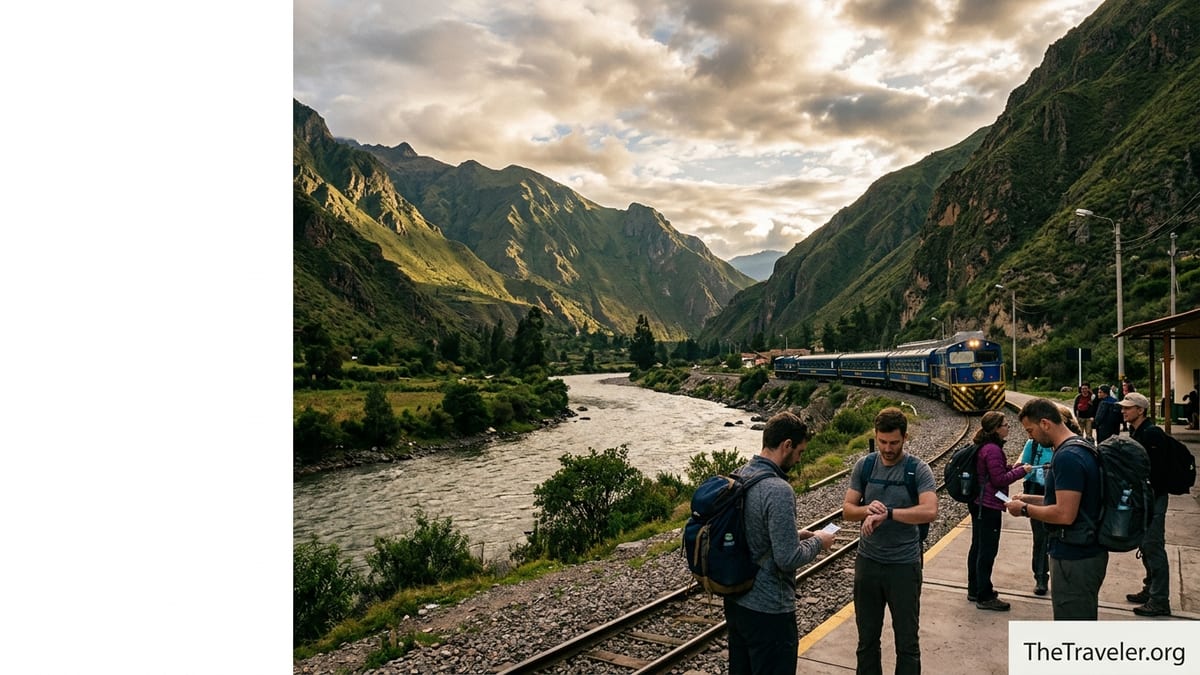
From Ollantaytambo, you board a train operated by either PeruRail or Inca Rail to reach Aguas Calientes. Both companies run multiple departures daily, particularly in the peak May to September season. According to PeruRail’s May to December 2026 timetable, a typical Expedition service leaves Ollantaytambo at 05:05 and arrives in Machu Picchu Pueblo around 06:37, with other departures spread through the day and evening. Inca Rail quotes a similar journey time of about 1.5 hours.
Trains offer several classes. On PeruRail, the Expedition is the standard option with large windows and basic snacks for sale, while the Vistadome and Vistadome Observatory add bigger panoramic windows and some onboard entertainment at a higher fare. Inca Rail offers categories such as The Voyager and The 360, again with more or less panoramic glass and service depending on price. In practice, service levels are broadly comparable. Recent traveler comments suggest that Inca Rail’s standard cars can feel a bit tighter in legroom than PeruRail’s equivalent, while others appreciate Inca Rail’s large side windows. Fares vary widely with season and departure time, but it is common to see Ollantaytambo–Aguas Calientes one-way tickets in the range of 60 to 120 US dollars per person in high season for standard classes, and more for premium services.
Luggage limits catch many travelers by surprise. Both operators state that you may bring only one small bag, roughly in the 5 to 8 kilogram range, plus a personal item. One major Peruvian hotel group reminds guests heading by train that large suitcases must be stored in Cusco or the Sacred Valley, since the narrow platforms and limited luggage racks are not designed for big checked bags. In practice, enforcement can vary, but you should assume that a large hard-shell suitcase will not be welcome. The most straightforward approach is to leave big bags at your Cusco or Sacred Valley hotel and travel to Machu Picchu with a small backpack and perhaps a soft overnight duffel. If you plan to fly out soon after returning from Aguas Calientes, speak with your Cusco hotel in advance; many will store luggage for returning guests at no charge or for a modest fee.
Another detail is check-in time. Train operators typically ask passengers to be at the station at least 30 minutes before departure to allow for ticket checks and boarding. In busy months the station area can be congested, especially given temporary traffic modifications announced for access roads into Ollantaytambo. In April 2026 PeruRail advised that alternative access routes and adjusted schedules would be in place for several months, which means transfer times from the highway into the station can stretch unexpectedly. Aim to arrive at the station at least 45 minutes before your train to absorb queues, road detours, or a slow line at the ticket office.
From Aguas Calientes to Machu Picchu: Buses, Tickets, and Timing
The train deposits you in Aguas Calientes, a compact town squeezed along the river valley below the citadel. From here, a separate shuttle bus runs the steep, zigzag road to the Machu Picchu entrance. These green buses, operated under a concession, depart from early morning until late afternoon, generally matching the operating hours of the site. The ride itself takes roughly 25 to 35 minutes, depending on traffic and road conditions.
Bus tickets can be purchased at a small ticket office in Aguas Calientes. As of mid-2026, travelers commonly buy their tickets either the afternoon before their visit or on the same morning, presenting their passports and Machu Picchu entrance details so that staff can assign an appropriate time band. One recent visitor in June 2026 reported arriving by train, walking directly to buy both Machu Picchu and bus tickets in town, then checking into a hotel, all within about an hour. Another traveler described buying bus tickets on arrival in Aguas Calientes for use early the next morning without issue, though they noted a line at the counter.
In the early morning peak, especially between about 5:00 and 7:30, the queue for the bus can be long, stretching along the riverfront. People with 6:00 or 7:00 entry slots for Circuit 2 often line up before dawn to be sure of reaching the gate on time. During the day, however, lines tend to ebb and flow. A realistic estimate is to allow 30 to 50 minutes from the time you join the bus queue to the time you pass through the site entrance in busy season, and maybe 20 to 30 minutes in quieter periods. For a 9:00 entrance ticket, for example, a safe plan might be to be at the bus stop by about 7:45 or 8:00, allowing for a ticket check, possible line, the ride up, and another brief queue at the top.
Some travelers choose to hike up instead of taking the bus. The trail is steep, made up of stone steps that cut across the bus road, and typically takes 1.5 to 2 hours for reasonably fit visitors who are acclimatized to the altitude. In the context of an airport-to-Machu Picchu day, this is rarely an efficient or realistic choice. For a tight schedule, the bus is the only practical option.
Machu Picchu Entrance Tickets and Why Same-Day Attempts Are Risky
The biggest change in the logistics of visiting Machu Picchu in 2026 is the ticketing system. The Peruvian authorities now sell entrance tickets in timed slots and by circuit, such as Circuit 1, 2A, or 2B. Each circuit follows a set walking path through the site. Popular circuits and early morning slots can sell out weeks in advance online, especially in June, July, and August. At the same time, recent reports from travelers show that it is still sometimes possible to buy tickets in person in Aguas Calientes for a visit a day or two later, or even same day, but availability depends on the circuit and the date.
In June 2026, one traveler who had mistakenly booked their ticket for the wrong day described arriving in Aguas Calientes and realizing that their original entrance had already passed. They assumed the trip was lost. After visiting the ticket office, however, they were able to purchase a new ticket for the following morning, though they did not get their preferred circuit. Another report from the same month noted that the ticket booth opens at 6:00 each morning and that keen visitors line up from 4:30 or 5:00 to secure specific circuits like 2A. While people arriving later in the morning were still able to get in for that day during shoulder periods, no one can guarantee that this will always be the case, especially in peak weeks.
These examples illustrate why trying to go from a midday or afternoon flight arrival at Cusco directly to a same-day Machu Picchu visit is high risk. Imagine a 10:30 landing at Alejandro Velasco Astete, 45 minutes to clear the airport and meet your driver, two hours to reach Ollantaytambo, 30 minutes to check in for a 14:30 train, 1.5 hours on the train, and 30 minutes for the bus and entrance queue. You might reach the gate around 17:00 if everything goes perfectly, leaving limited time before closing and no margin for a delayed flight, a blocked road, or a missed train. If your Machu Picchu ticket is for an earlier slot, you would lose it entirely.
A more realistic plan is to either spend your first night in Ollantaytambo or Aguas Calientes and visit Machu Picchu the next morning, or to fly into Cusco at least one full day before your desired visit and stay in the Sacred Valley. Many travelers now choose to do exactly this. For example, a family arriving in Cusco at 13:00 might take a prebooked transfer to Ollantaytambo, check into a hotel there, enjoy a relaxed evening walking the cobbled streets, then catch a 07:20 or 08:00 train the next day, arriving in Aguas Calientes in time for a late morning or midday entrance to the citadel. This approach also builds in much-needed time to adjust to the altitude before serious walking.
Sample Itineraries and Realistic Door-to-Door Timings
To turn the logistics into concrete plans, it helps to look at sample timelines. Take an early domestic arrival, for instance: you land at Cusco at 07:30. With a smooth arrival, you might exit the airport by 08:15, meet a prebooked driver, and be on the road by 08:30. If traffic is moderate, you could reach Ollantaytambo around 10:15 or 10:30. That allows time for a coffee and an 11:15 or 12:00 train departure, arriving in Aguas Calientes around 12:45 or 13:30. If you already hold a Machu Picchu ticket for a 15:00 entrance, you could walk straight to the bus stop, ride up, and enter with a modest buffer.
Now consider a midday arrival. Your flight is scheduled to land at 12:45. If baggage takes a while and the taxi line is long, you might not leave the airport before 13:45. Add two hours to Ollantaytambo and you arrive around 15:45. Realistically the earliest train you could comfortably catch is about 16:30 or later, which would get you to Aguas Calientes sometime after 18:00. At that point, even if you could find a late entrance ticket in theory, you would be pushing into closing time with tired legs and fading light. The more sensible move is to stay overnight and visit the next morning.
As another example, some travelers aim for an evening train and next-morning visit. One common pattern in 2026 is to land in Cusco in the afternoon, say at 15:00, take a private transfer to Ollantaytambo arriving around 17:00, then board an evening train around 18:00 or 19:00. This puts you in Aguas Calientes around 20:00 or 21:00, in time for dinner and an early night, followed by a dawn bus and a 07:00 or 08:00 slot at Machu Picchu. This strategy reduces the stress of every delay cascading into a missed entrance time and works well if you can secure train tickets for the evening and accommodation in Aguas Calientes.
The reverse journey back to Cusco airport also needs careful planning, especially if you have an international flight. From the Machu Picchu gate, you should allow at least 3 to 3.5 hours to get to Cusco city and 4 hours or more to be comfortably at the airport. For example, a 10:00 train departure from Aguas Calientes might reach Ollantaytambo around 11:30. With a waiting driver, you could arrive at Cusco airport between about 13:15 and 14:00, assuming normal traffic. If your flight leaves at 16:00, that is reasonable. Attempting to take a later train and tighter transfer window introduces significant risk, especially in the rainy season when road disruptions are more common.
Luggage Strategies, Acclimatization, and Practical Tips
Packing light for the Machu Picchu portion of your trip unlocks much easier logistics. Train operators’ small-bag rules, the narrow streets of Aguas Calientes, and the general hassle of carrying a large suitcase up steep hotel staircases all point in the same direction. The ideal setup is a small backpack with essentials such as a rain jacket, warm layer, water bottle, snacks, and camera, plus perhaps a soft overnight bag with a change of clothes and basic toiletries. Everything else stays in storage at your Cusco or Sacred Valley hotel.
Altitude is another factor. Cusco is significantly higher than Machu Picchu and the Sacred Valley, and many travelers feel short of breath, headachy, or fatigued on their first day. Jumping directly into a long road transfer, train ride, bus, and extended site visit immediately after landing at this altitude is physically taxing, even for otherwise fit people. This is one more reason why staying a night in the Sacred Valley or Aguas Calientes before your visit is a sensible choice. A gradual approach, such as spending a night in Ollantaytambo, which sits lower than Cusco, can help your body adapt while you explore local ruins and streets at a more relaxed pace.
For on-the-ground payments, you will find that taxis and small vendors often prefer cash in soles, while train companies, larger hotels, and official ticket offices generally accept major credit cards. ATMs are available in Cusco and Ollantaytambo, and a few exist in Aguas Calientes, though machines in the latter can occasionally run out of cash or charge higher fees. Carrying a modest amount of local currency, such as 200 to 300 soles, can smooth smaller transactions like snacks, tips, and short taxi hops.
Finally, always keep a close eye on changing regulations and local news in the weeks before you travel. Train timetables shift seasonally, access roads into Ollantaytambo can be rerouted for construction, and ticketing rules for Machu Picchu have already been adjusted multiple times in recent years. Booking core elements like entrance tickets and long-distance trains as early as you can, then confirming exact times again a few days before departure, is the best defense against unwelcome surprises.
The Takeaway
Reaching Machu Picchu from Alejandro Velasco Astete International Airport is a multi-step journey that almost always takes longer and involves more variables than it first appears. You need to coordinate an airport-to-Ollantaytambo transfer, a specific train departure, a bus ride from Aguas Calientes, and a timed entrance ticket that cannot easily be changed at the last minute. Each step has its own schedules, queues, and potential delays, especially during the busy dry season.
While it is technically possible, in ideal conditions, to land in Cusco in the morning and walk through the gate at Machu Picchu that same afternoon, the margin for error is slim. A more resilient plan is to separate the journey into stages: arrive in Cusco, move to the Sacred Valley or Aguas Calientes, rest and acclimatize, then visit Machu Picchu on a dedicated day with a morning or midday slot. This approach gives you time to absorb minor disruptions without losing a coveted entrance ticket and lets you enjoy both the journey and the destination instead of racing the clock.
If you remember one rule when planning, make it this: let your Machu Picchu entrance time dictate your train, and let your train dictate your airport transfer. Start from the time printed on that ticket and work backward step by step, adding realistic buffers at each stage. Doing so will turn what could be a stressful dash from gate to gate into the highlight of your trip through the Peruvian Andes.
FAQ
Q1. Can I realistically go from Cusco airport to Machu Picchu and back in one day?
It is technically possible only with a very early arrival, perfect connections, and a late-night return, but it is not recommended. Most travelers would spend over ten hours in transit with little time at the site and heavy exposure to flight, road, or train delays. A one-way airport-to-Machu Picchu day with an overnight in Aguas Calientes is far more realistic.
Q2. What is a safe minimum layover between my flight landing and my train from Ollantaytambo?
In normal conditions, plan at least four to five hours between scheduled landing and train departure. This allows about 45 minutes to leave the airport, up to 2.5 hours for the road transfer, and extra margin for traffic, check-in, and small delays. In rainy season or during known roadworks, add at least another hour.
Q3. How much should I expect to pay for a taxi from Cusco airport to Ollantaytambo?
As of 2026, typical quotes at the airport range from about 150 to 200 soles for a private car or small van, which is roughly 40 to 55 US dollars. Prebooked, English-speaking transfers with door-to-door service and larger vehicles can cost around 60 to 80 US dollars or more, depending on time of day and group size.
Q4. Are colectivos from Cusco to Ollantaytambo safe and reliable?
Colectivos are widely used by locals and budget travelers and are generally considered safe during daylight hours. They are cheaper, often 15 soles per person or less, but they do not run on fixed schedules and may wait to fill before leaving. They are not ideal if you are carrying bulky luggage, arriving late at night, or need to catch a specific train.
Q5. Do I need to buy my train tickets before I arrive in Peru?
In high season from roughly May to September, it is wise to book PeruRail or Inca Rail tickets several weeks in advance, especially for popular morning and late afternoon departures. Outside peak months you might still find seats a few days in advance, but relying on same-day availability is risky if your Machu Picchu entrance time is fixed.
Q6. How strict are the luggage limits on the trains to Aguas Calientes?
Both major train operators officially allow only one small bag or carry-on per person, roughly in the 5 to 8 kilogram range, plus a personal item. Enforcement varies, but large suitcases are actively discouraged and can be refused. The safest strategy is to store big bags in Cusco or the Sacred Valley and travel to Aguas Calientes with a small backpack and light overnight bag.
Q7. When should I line up for the bus from Aguas Calientes if I have a morning ticket?
In peak months, aim to be at the bus stop 60 to 90 minutes before your Machu Picchu entrance time. For a 7:00 entrance, many travelers start queuing between 5:30 and 6:00. For midmorning or afternoon slots, a 30 to 45 minute buffer is often enough, but it is better to err on the side of being early, especially if you like to take photos at the viewpoints.
Q8. Can I buy Machu Picchu entrance tickets when I arrive in Aguas Calientes?
Sometimes, but not always. Recent visitors in 2026 have reported being able to buy tickets a day ahead or even same day in Aguas Calientes, but options were limited for the most popular circuits and time slots. In busy weeks, there is no guarantee that same-day or next-day tickets will exist at all. Whenever possible, secure your ticket online well in advance.
Q9. What happens if my flight or train is delayed and I miss my Machu Picchu time slot?
If you miss your assigned entrance time, officials are not obligated to accommodate you in a later slot, and a refund is unlikely. Some travelers have managed to buy new tickets for the next day at the office in Aguas Calientes, sometimes for a less desirable circuit. This is another reason to plan an overnight and avoid scheduling your visit for the same day as your flight.
Q10. Is it better to stay in Cusco, Ollantaytambo, or Aguas Calientes before my visit?
Cusco offers culture and restaurants but sits highest in altitude and is farthest from the site. Ollantaytambo is lower, more relaxed, and on the train line, making it a good base for acclimatization. Aguas Calientes puts you closest to Machu Picchu and is ideal for a dawn visit, though it is more touristy and compact. Many travelers split their time, spending a night or two in the Sacred Valley, then one night in Aguas Calientes before or after their visit.