


Arriving in Cusco can feel intense. The altitude hits, the terminal is compact and the shouting taxi touts outside Alejandro Velasco Astete International Airport can be overwhelming. On top of that, rideshare apps like Uber and InDrive work a little differently here than in big North American or European hubs. This guide walks you through exactly how to get from the airport to the city safely and at a fair price, whether you prefer to use an app or jump in a taxi.
Get the latest updates straight to your inbox!
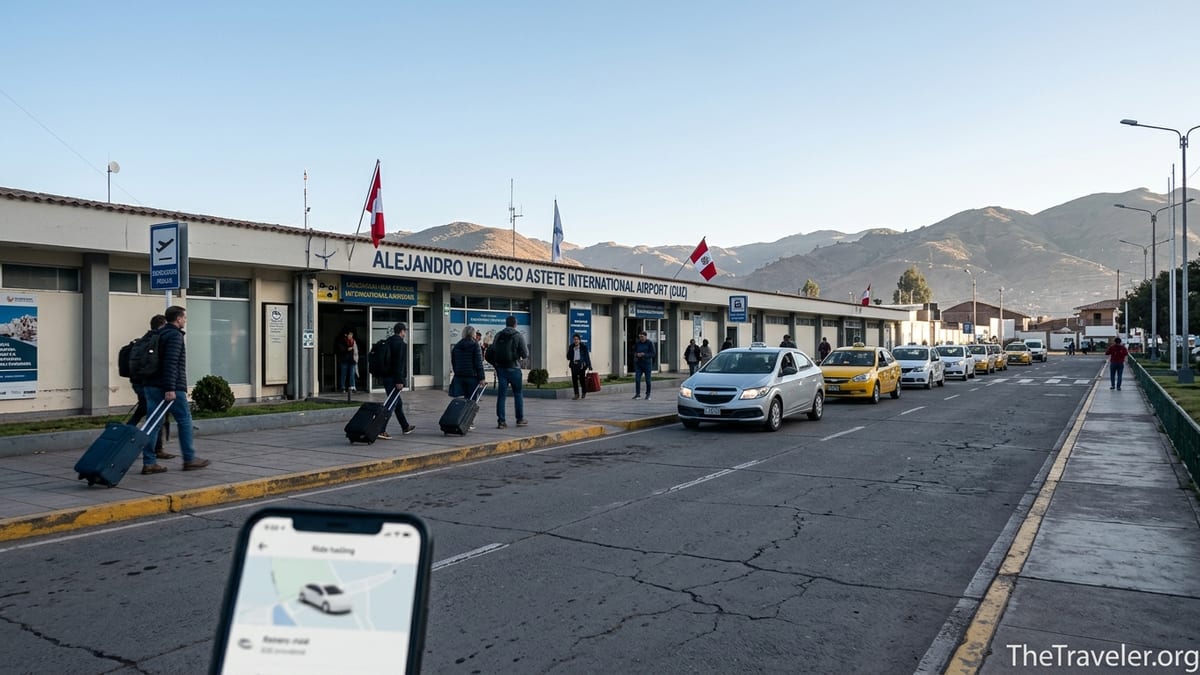
Do Uber and InDrive Actually Work at Cusco’s Airport?
Uber and InDrive both operate in Cusco, and travelers report using them regularly to move between neighborhoods like San Blas, Wanchaq and the historic center. That said, airport pickups are not as straightforward as in cities with clearly signed rideshare zones. Cusco’s airport is small, hemmed in by the city, and local taxi unions are influential. As a result, many app drivers avoid pulling directly into the short-term parking area where the official airport taxis wait, especially during busy morning and mid-afternoon arrival banks.
In practice, this means your Uber or InDrive driver might hesitate to collect you directly at the main exit doors. Some will accept the ride only if you walk a short distance outside the terminal area; others may cancel if they see uniformed airport security or a cluster of taxi drivers watching the pickup point. Travelers who have successfully used apps on arrival typically message the driver right after requesting, confirming whether they should meet on the perimeter road, near the Petrogas/Primax station, or by a nearby corner shop just beyond the main gate.
It is also important to understand that InDrive, which allows passengers and drivers to negotiate a price inside the app, has become particularly popular among locals in Peru. Recent travelers returning from Cusco in 2025 and 2026 frequently mention using InDrive rather than Uber for everyday rides, including to and from bus terminals and hotels, because the prices can be slightly lower and there are often more drivers logged in at peak times. This does not guarantee availability at every hour, but it means that having both apps installed gives you more options the moment you step out of the airport.
Because airport rules and local enforcement habits can change, it is always wise to open the app after landing, enter “Aeropuerto Alejandro Velasco Astete” as your pickup, and see if a car appears within 5 to 10 minutes. If you see long wait times or repeated cancellations, that is a strong signal that a regular taxi will be faster and only marginally more expensive for the short hop into town.
Pickup Basics: Where to Meet Your Driver and How Far to Walk
Cusco’s airport layout is simple: you exit the baggage hall into a compact arrivals area, then push past a row of tour agencies and hotel reps to reach the main doors. Immediately outside is a narrow driveway used by official airport taxis and short-term private car pickups. If your Uber or InDrive driver is happy to enter, you will meet them here, but many prefer to stay just outside the gate on the public street to avoid attention.
A common real-world scenario: you request an InDrive to “Plaza de Armas” from the arrivals curb. A driver accepts and quickly messages you in Spanish, asking “¿Puedes salir a la avenida, por favor?” or “Estoy en la puerta de salida, frente a la calle.” If you step out through the main gate, you will reach Avenida Velasco Astete in around two to three minutes on foot. From there, it is easy to describe your position using a landmark like the nearest gas station, a corner bakery or a visible street sign. Many travelers simply cross the street and wait on the sidewalk opposite the terminal entrance, where they blend in with local passengers being collected by family members.
If you prefer not to deal with any of this, official airport taxis wait right at the doors holding bright yellow or company-branded signs. You can walk straight to them without leaving airport grounds. The trade-off is cost and negotiation: you will almost always pay more than you would by app. For some visitors, especially those arriving late at night or feeling the effects of altitude, the convenience of not walking even a short distance is worth the extra soles.
One practical compromise is to walk just far enough that you are out of the most aggressive tout zone but still close to the terminal. For example, stepping 50 to 100 meters away from the sliding doors often reduces the pressure from drivers shouting prices and makes it easier to stand still, check your phone and coordinate with an Uber or InDrive driver without being constantly interrupted.
Typical Prices from CUZ: Apps vs Airport Taxis
The distance from Alejandro Velasco Astete International Airport to Cusco’s Plaza de Armas is only about 5.5 kilometers, so rides are short. Official airport taxis typically quote a flat rate to the historic center. In recent years, most travelers report paying somewhere around 20 to 30 soles for this route, though some have been quoted as high as 35 soles if they appear tired, disoriented or in a hurry. Drivers may initially ask for more, then quickly drop the price when you hesitate or begin to walk away.
By comparison, rideshare prices into central Cusco via Uber or InDrive often fall in the rough range of 12 to 20 soles for a standard car, depending on traffic, time of day and short-term demand. For example, at a typical mid-morning arrival, you might see an Uber fare estimate of around 15 soles to Plaza de Armas or San Blas. On a busy festival evening or in heavy rain when fewer drivers are online, the same ride might jump closer to 20 soles, still usually slightly cheaper than an on-the-spot taxi quote outside the arrivals hall.
Private transfer companies that you book in advance through a tour operator or hotel often sit at the top of the price spectrum, anywhere from roughly 50 to 100 soles per car for a pre-arranged pickup with a driver holding your name on a board. This can make sense if you are arriving with a family group, lots of luggage or limited Spanish, but for solo travelers and couples it is often more economical to rely on either an app ride or a normal taxi from the line outside.
Whichever option you choose, have small bills and coins ready. Many drivers do not carry enough change for larger notes freshly withdrawn from airport ATMs, and card payment through apps can be unreliable if your data connection is weak. If a driver asks you to cover the small parking fee that taxis pay when leaving the airport, remember that this is usually already baked into the fare they quoted. You are within your rights to politely decline any last-minute add-on that was not discussed upfront.
How to Negotiate and Communicate Effectively
Negotiation is an expected part of the experience with street taxis at Cusco airport, but it should feel like a short, firm conversation rather than a stressful confrontation. When you step outside and a driver approaches with “Taxi, amigo, centro, San Blas,” respond immediately with your destination and a proposed price: something like “Plaza de Armas, 20 soles, por favor.” If he counters at 30, you can either meet in the middle at 25 or politely step away and ask the next driver. Because there are usually several taxis waiting, you rarely need to accept the first offer, especially during daylight hours.
If you prefer using apps, communication is just as important, but moves into WhatsApp-style messaging inside Uber or InDrive. A typical InDrive flow involves you suggesting a fare when you request the ride, the driver rejecting or countering, and you deciding whether to accept the new amount. For example, you might offer 15 soles to San Blas; the driver counters at 18; you respond with “16, por favor,” and the driver either accepts or declines. These small increments are normal and can actually be part of the experience of traveling in Peru, as long as you keep the interaction friendly and clear.
Language is rarely a barrier for basic logistics. Most drivers in Cusco are used to tourists, and even if they are not fluent in English they recognize key words like “Plaza,” “hotel,” and “centro.” Still, typing short Spanish phrases in the app, such as “Estoy en la salida principal” (I am at the main exit) or “Estoy frente a la puerta de llegadas” (I am in front of the arrivals door), makes things smoother. Having your hotel’s name written exactly as it appears on its sign also helps, as many small properties share similar names.
If at any point a driver pressures you into a much higher fare than is reasonable for such a short distance, it is better to walk away politely than continue debating. You can simply say “No, gracias” and step back into the terminal for a moment to reassess, check the apps again or consider calling your accommodation for guidance on current typical prices from the airport.
Safety: Avoiding Scams and Staying Comfortable
Cusco is one of Peru’s most touristed cities, and both the airport and the routes into the center are well used. However, some risks are worth noting. The most common issues reported are not violent crime but small-scale scams: drivers inflating prices after departure, claiming the agreed fare was per person rather than per car, or insisting on extra fees for parking or luggage. The best protection is agreeing clearly on a total price for everyone before the car moves, and if you are using Uber or InDrive, confirming that the fare in the app matches what the driver expects.
Before getting into any vehicle, whether taxi or rideshare, double-check the license plate and the driver’s face against what your app shows if you booked digitally. If you negotiated on the street, take a quick photo of the car’s plate or mentally note it. This simple habit is standard travel practice and adds an extra layer of reassurance. Reputable drivers will not object to you checking their plates; the ones who seem irritated by this are generally best avoided.
Altitude is another practical safety factor. Cusco sits at around 3,400 meters, and many travelers feel lightheaded or short of breath upon landing. This makes it easier to feel flustered in the noisy arrivals area. If you start to feel unwell, step aside to a quieter corner of the terminal, sip water and give yourself a few minutes before engaging in negotiations or app coordination. You will make clearer decisions about pricing and safety once you have caught your breath.
At night, standard precautions apply. If you arrive on a late evening flight, using an app or an official airport taxi is generally safer than walking off into darker side streets in search of a cheaper car. Many hotels in the historic center can also arrange trusted drivers to meet you if you share your flight details in advance. In all cases, avoid unmarked vehicles that approach you away from the main taxi area and cannot show any identification or business card.
When a Traditional Taxi is Simply Easier
Although rideshare apps often provide better price transparency and a digital record of your trip, there are moments when a classic taxi at Alejandro Velasco Astete Airport is the path of least resistance. A common example is landing at sunrise after an overnight journey: your phone battery is low, airport Wi-Fi is spotty, and a crowd of other passengers is rushing to order rides at the same time. In this situation, spending an extra few soles on a waiting taxi can get you to your hotel faster so you can rest and recharge.
Another case is traveling with bulky luggage or sports gear. Not every Uber or InDrive driver in Cusco uses a large sedan or SUV, and the apps may not offer a dedicated “XL” category like in big cities. Airport taxis, on the other hand, often queue with a mix of hatchbacks and roomier vehicles. If you see a taxi with a bigger trunk, you can walk directly to that driver and agree a price before loading. This is particularly useful for travelers carrying trekking poles, big backpacks or gear for the Inca Trail or Ausangate treks.
Families with young children may also find taxis more straightforward. While neither taxis nor app drivers in Cusco commonly offer child seats, dealing with one driver face to face rather than negotiating in-app fares and pickup locations can reduce stress when you are managing tired kids, strollers and carry-on bags. If you have arranged a private transfer through your hotel that includes a child seat, this will almost always be the simplest and safest option, even if it costs notably more than a taxi or rideshare.
Finally, if strikes, demonstrations or sudden road closures affect Cusco, as occasionally happens in Peru, local taxi drivers waiting at the airport are often better informed than app drivers who are still at home or across town. They can tell you whether certain routes are blocked, how long detours are taking and whether certain city-center streets are currently closed to traffic, which can influence your choice of hotel drop-off point.
Practical Tips for a Smooth Arrival Experience
A bit of preparation goes a long way at Cusco airport. Before your flight, install both Uber and InDrive, add a working payment method and download offline maps of Cusco on your phone. Mark your accommodation on the map so that, even if the driver’s GPS struggles with narrow streets in San Blas or around the Plaza de Armas, you can show a clear visual of where you need to go. This reduces the risk of being dropped several blocks away at the nearest point the car can reach and then having to navigate steep lanes with your luggage.
Once you land, use the time in the baggage hall to check approximate app fares from the airport to your hotel. Even if you plan to take a taxi, this gives you a benchmark. If Uber suggests 16 soles to your hotel and the first taxi outside demands 35 with no room to move, you can either negotiate more confidently or wait for an app ride. Travelers often find that simply mentioning that you “know the price in the app” encourages taxi drivers to offer a more realistic figure.
Have some basic Spanish phrases ready for clarity. In addition to price negotiation, simple lines like “¿Puede usar el taxímetro?” (Can you use the meter?) or “¿Es el precio total por el carro?” (Is that the total price for the car?) help avoid misunderstandings. In Cusco, meters are rarely used for airport trips, but asking about them signals that you are not completely new to local transport norms.
Finally, keep your valuables secure and out of sight as you move through the arrivals area and load into the car. Use closed zippers on backpacks, keep phones in front pockets or crossbody bags, and avoid leaving bags unattended on the sidewalk while you negotiate. Pickpocketing is not rampant at the airport, but the mix of crowds, noise and distraction makes it an environment where simple precautions are worthwhile.
The Takeaway
Using Uber and InDrive at Alejandro Velasco Astete International Airport is possible and can save you a bit of money, but it requires more initiative than in cities with formal rideshare lanes. Drivers may ask you to walk slightly away from the terminal, and occasional cancellations or negotiation inside the app are normal. If you are arriving tired, short of breath from the altitude or late at night, stepping into a regular airport taxi and agreeing a clear fare to the historic center is often the simplest, safest solution.
The key is to know your numbers and options before you land. Expect official taxis to charge a bit more than app rides for the 10 to 20 minute journey into town, and be ready to counter unrealistic quotes. Install both Uber and InDrive, check their estimated prices and ride availability from inside the terminal, and then decide whether the savings are worth a short walk and some coordination by phone. With a calm approach and a few words of Spanish, getting from Cusco’s airport to your hotel should be straightforward, leaving you free to focus on acclimatizing and planning your first stroll through the Plaza de Armas.
FAQ
Q1. Can I reliably get an Uber from Alejandro Velasco Astete International Airport into central Cusco?
You can often get an Uber from the airport, but reliability varies by time of day and driver availability. Sometimes drivers hesitate to enter the main pickup area, so be prepared to walk a short distance to meet them on the public street if they request it.
Q2. Does InDrive work better than Uber at Cusco airport?
InDrive is very popular in Cusco and often has plenty of drivers, but it is not guaranteed to be faster or more reliable than Uber at the airport. Many travelers use both apps and choose whichever shows the closest car and most reasonable price at the moment they land.
Q3. How much should I expect to pay from CUZ airport to Plaza de Armas by taxi?
A typical negotiated fare with an airport taxi to the Plaza de Armas is roughly in the range of 20 to 30 soles per car, depending on your bargaining, time of day and how busy it is. If you are quoted significantly more, it is reasonable to politely negotiate down or ask another driver.
Q4. How do Uber and InDrive prices compare to regular taxis for the same route?
For the short ride into central Cusco, Uber and InDrive are often slightly cheaper than taxis, sometimes in the ballpark of 12 to 20 soles to popular areas like Plaza de Armas or San Blas. Taxis at the airport usually start higher but may come closer to app prices after brief negotiation.
Q5. Is it safe to walk outside the terminal to meet a rideshare driver?
During daylight and early evening, walking a couple of minutes to the perimeter road or across the street is generally considered safe and normal. Use the same precautions you would in any busy city, keep valuables secure and avoid wandering far from well-lit areas if you arrive late at night.
Q6. Do I need cash, or can I pay by card through Uber and InDrive?
Both apps support card payments, but connections and processing can sometimes be unreliable. Carrying local currency in small bills is strongly recommended, especially for taxis, and even for app rides in case the driver prefers cash or a problem arises with your card.
Q7. Are there common scams I should watch for with airport taxis?
The most common issues are drivers increasing the price mid-journey, claiming the fare is per person rather than per vehicle or adding small extra fees at the end for parking or luggage. Avoid this by clearly agreeing on a total price for everyone before you get in and confirming that no extra charges will be added.
Q8. Is it worth pre-booking a private transfer instead of using Uber or taxis?
Pre-booked transfers cost more but can be worthwhile if you are arriving very late, traveling with young children or carrying a lot of gear. A driver meeting you with a sign and fixed price removes negotiation and coordination stress, which some travelers prefer after a long international flight.
Q9. What should I do if my Uber or InDrive driver keeps canceling at the airport?
If you face repeated cancellations or very long wait times, switch strategies. Either try the other app, step back inside the terminal and re-request later, or walk out to the taxi line and negotiate a fair price. Do not stay standing at the curb endlessly trying the same app if it is clearly not working at that moment.
Q10. Is it better to arrange transport through my hotel in Cusco?
Many hotels and guesthouses in Cusco offer airport pickup for a fixed price that is usually higher than an app ride but in line with, or slightly above, a negotiated taxi. This can be a stress-free option, especially if your accommodation is in a harder-to-reach neighborhood or up steep streets where not every driver is willing to go.