


Landing in Cusco and heading straight to the San Blas neighborhood sounds romantic: cobblestones, artisan workshops, Andean views. In reality, your first journey from Alejandro Velasco Astete International Airport to San Blas can be exhausting if you underestimate the altitude, the steep streets, and the logistics of getting bags to your hotel. This guide explains the smartest routes into San Blas, what to expect from taxis and hotel drop-offs, and why walking with luggage is rarely a good idea on your arrival day.
Get the latest updates straight to your inbox!
Understanding the Route: From Runway to Rooftops
Alejandro Velasco Astete International Airport sits in a valley on the edge of Cusco, only about 5 to 6 kilometers from the historic center. In distance, San Blas is close. In effort, it can feel much farther because you gain height quickly as you climb from the relatively flat avenues near the airport up to the terraces above the Plaza de Armas where San Blas is perched. Taxis take around 20 to 30 minutes in normal traffic, but walking from the airport to San Blas with luggage would take well over an hour and involves navigating busy roads and long, steep stretches.
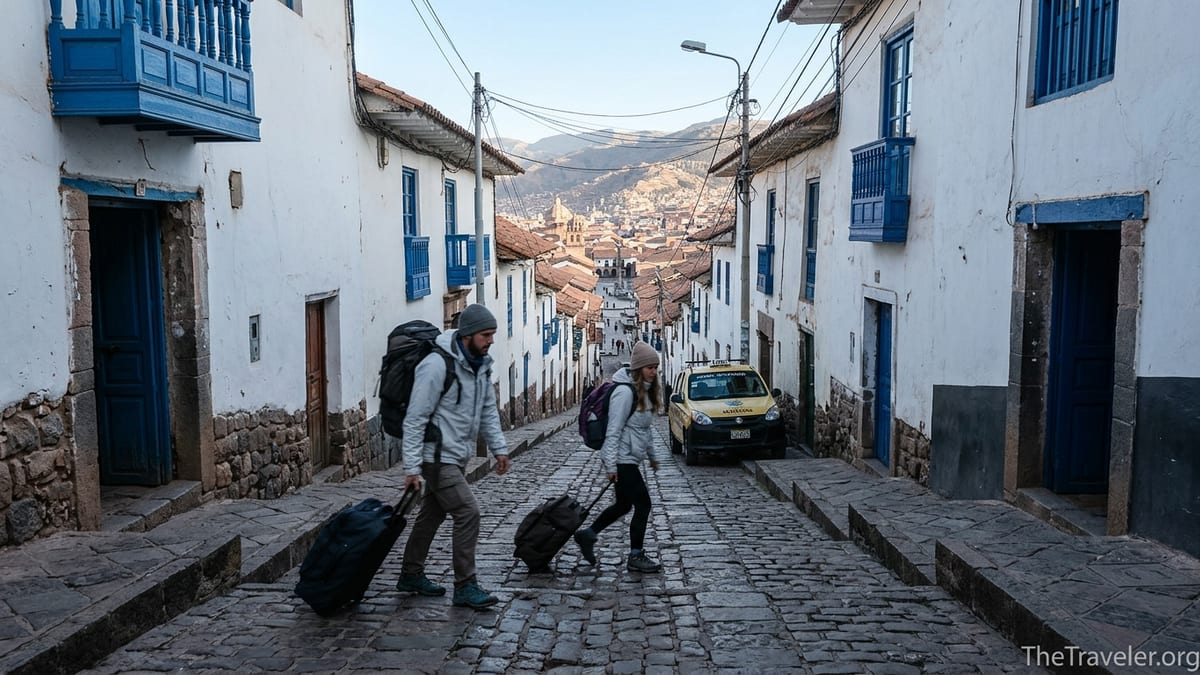
Most drivers will follow a similar pattern: exit the airport area onto Avenida Velasco Astete, continue along major arteries like Avenida de la Cultura or Avenida de la Paz, then feed into the historic center near the Plaza de Armas before tackling the narrow streets that zigzag up toward San Blas. This last section is where things get complicated. Streets such as Cuesta San Blas and Calle Carmen Alto are steep, cobbled, and partially pedestrianized, which limits exactly how close a taxi can get to many small hotels and guesthouses tucked into the hillside.
It helps to think of the journey in two segments: airport to historic center, which is straightforward for vehicles, and historic center up to San Blas, which may involve a taxi only to the nearest accessible corner and then a short but demanding uphill walk. Planning with this in mind allows you to choose a realistic drop-off point and avoid frustrating stand-offs with drivers who cannot get their cars up the last lane to your door.
To visualize the gradient, imagine walking from the Plaza de Armas up through Hatun Rumiyoc past the famous twelve-angled stone, then continuing into Cuesta de San Blas, one of the classic climbs that historically linked the main square to this artisan district. Even without luggage, many visitors pause to catch their breath on this ascent.
Taxi Options at Cusco Airport: What to Expect and What It Costs
Inside the arrivals hall at Alejandro Velasco Astete Airport you will find desks for authorized taxi companies. These counters are the safest and simplest option when you are jet-lagged and adjusting to 3,400 meters. Staff will quote a fixed fare based on your destination in the city and give you a ticket or send you directly to an assigned driver waiting just outside. Travelers commonly report airport-to-center fares in the ballpark of 25 to 40 soles per car, with the higher end more likely late at night or for larger vehicles. Prices fluctuate with fuel costs and demand, so treat these numbers as indicative, not guaranteed.
Compared with informal street taxis waiting outside the terminal fence, the official counters may cost a few soles more but remove much of the haggling and uncertainty. You pay for a regulated service, a licensed driver, and a traceable company if something is left in the vehicle. For a couple or a small group dragging duffel bags for a trek, this premium is usually worth it on arrival day.
Some hotels and guesthouses in San Blas arrange private transfers with trusted drivers. For example, a boutique hotel on Carmen Bajo might offer to send a driver holding a sign with your name, charging a flat fee similar to or slightly higher than the official taxi desks. This kind of pre-arranged pick-up is especially useful for late-night arrivals or families with children, since the driver will know exactly how close they can get to your property and where you will need to walk the final meters.
Ride-hailing apps operate intermittently in Cusco. Services like inDriver and similar local platforms are often used by residents to summon rides from San Blas down to the center. However, relying on an app the moment you land is less reliable, particularly if your mobile data is not yet active. For the very first leg from the airport, an official taxi desk or hotel-arranged transfer is still the most practical choice for most travelers.
Navigating San Blas Streets: Expect Stairs, Cobbles, and Limited Drop-Offs
San Blas is beloved precisely because it does not feel like a modern city grid. Its charm lies in narrow alleys, irregular staircases, and historic houses stacked against the hillside. The downside is that vehicles cannot reach many doors. Even small taxis struggle in certain sections, especially where the lane becomes entirely pedestrian or narrows to a single, stone-paved track. This is not a place where you can count on being dropped at the lobby of every guesthouse.
The more accessible heart of the district is Plazoleta San Blas, a small square with a church, fountain, and a cluster of cafes and artisan workshops. Many drivers will aim to drop passengers at or near this square if their accommodation is up the stairs behind it on streets like Tandapata or Carmen Alto. From Plazoleta San Blas, you might face one or two short but intense stair sections, sometimes at a gradient that feels closer to a staircase than a street.
Some streets are particularly challenging for arrivals with luggage. Cuesta San Blas, which connects the neighborhood to the main center, is steep, narrow, and paved with small cobblestones that become slick when wet. Other routes, like the steps of Resbalosa and the stairways that climb toward the San Blas viewpoint, are essentially stone staircases without ramped alternatives. Rolling a suitcase up or down these surfaces is noisy, awkward, and hard on both wheels and ankles.
When booking accommodation, it is wise to ask very specific questions by email or message: on which street is the nearest point a taxi can reach, and how many meters or stairs are there from that point to the entrance. A guesthouse might say, for instance, that a taxi can stop at Calle Choquechaka or at the base of Cuesta San Blas and that you should expect a 3 to 5 minute uphill walk with stairs. That kind of detailed information allows you to decide whether the view from a rooftop terrace is worth the climb with bags.
Altitude and Physical Strain: Why Walking With Luggage Is a Bad Arrival Plan
Cusco sits at roughly 3,400 meters above sea level. Many visitors fly in directly from Lima or even from low-altitude cities abroad, which means their bodies have not had time to acclimatize. At this elevation, the air contains less oxygen than at sea level, and even gentle exertion can cause shortness of breath, lightheadedness, or a throbbing headache. Add a heavy backpack or suitcase and a steep cobblestone ramp and the strain increases quickly.
Travelers sometimes assume that if they are fit and walk regularly at home, the uphill stroll to a San Blas hotel will be manageable. Yet real-world experiences suggest otherwise. Visitors report needing to stop every few minutes on the steps between Plaza de Armas and San Blas, even when carrying only a daypack. Others describe climbing a short stretch of Cuesta San Blas with a duffel bag and arriving at check-in sweaty, out of breath, and with the first signs of altitude discomfort that later turned into a full headache.
Dragging rolling luggage on cobblestones at altitude also increases the risk of slips and ankle twists. The stones are rounded and sometimes polished smooth by centuries of use. When it rains, gutters carry water right down the middle of sloping lanes. Combining jet lag, thinner air, and wet, uneven stones is a recipe for falls, particularly at night when lighting is patchy in some stairways and alleys.
For these reasons, using a taxi for the airport-to-San-Blas leg, and then minimizing how far you physically haul bags uphill, is not a luxury. It is a sensible health and safety decision, especially in the first 24 to 48 hours at altitude. Once you have rested, sipped coca tea, and slept, exploring San Blas on foot without luggage becomes far more enjoyable.
Choosing the Best Drop-Off Point for Your San Blas Hotel
The smartest approach is to separate your arrival route into “taxi-accessible” and “on-foot only” segments and then shrink the second segment as much as possible. In practice, that means asking your hotel which of the main access streets is best for a taxi drop-off. Common meeting points include Plazoleta San Blas, Calle Carmen Alto where it widens enough for vehicles, or connections along Choquechaka Street just below the steepest alleys.
For example, if your guesthouse is on a narrow stretch of Tandapata with only stairs, the property might advise the driver to stop at Plazoleta San Blas. From there, staff can sometimes come down to help with luggage, or you can make the short climb without struggling through the entire neighborhood. If your hotel is lower down, closer to Choquechaka or Cuesta San Blas, the taxi might be able to stop almost at the door, saving you a significant vertical ascent.
Hotels that frequently host trekkers to Machu Picchu or the Salkantay route are often well-practiced in explaining logistics. They might say something like: “Tell the driver to drop you beside the San Blas church, then walk 50 meters up the steps on the right; we are the blue door.” Taking a screenshot of such instructions in Spanish and showing it to your taxi driver at the airport can avoid confusion, especially if there is more than one property with a similar name in the area.
If you forget to ask in advance, do not hesitate to call or message your hotel from the airport. A quick phone conversation can clarify whether the driver should head for Plaza de Armas, take the climb via Cuesta San Blas, or approach from a parallel street. The few minutes spent clarifying this often save 15 or 20 minutes of circling narrow streets while the meter runs and everyone in the car gets frustrated.
Luggage Strategies: Packing, Storage, and Local Help
How you pack for Cusco can make the difference between a smooth arrival in San Blas and a grueling one. Hard-shell suitcases with small wheels are poorly suited to stairs and cobbles. If possible, use a backpack or duffel that you can carry on your shoulders for the final segment. If you must travel with a rigid suitcase, consider transferring your essentials into a soft bag before leaving the airport and leaving the larger case in the taxi if you are later continuing straight to the Sacred Valley and returning to the same hotel.
Many hotels in Cusco, including those in San Blas, routinely store luggage for guests heading out on treks or overnight visits to Machu Picchu. This service is often complimentary for a few days or charged at a modest daily rate. A common approach is to leave your big suitcase at a hotel near the Plaza de Armas or in San Blas and only carry a small backpack up and down the steps when changing rooms or returning late at night. This reduces the number of times you have to wrestle big bags through steep alleys.
In practice, this could look like arriving from the airport by taxi, checking into a San Blas guesthouse, and immediately repacking. You leave a large suitcase locked in the hotel’s storage room while you head to Ollantaytambo and Aguas Calientes with a small carry-on. When you return to Cusco, it is far easier to re-climb the short stair section to your San Blas room with a single small bag than to attempt it all over again with full long-haul luggage.
Where local assistance is available, use it. Some properties will send staff down to the closest car-accessible point to help you carry bags, especially if you contact them just before you arrive. Tipping a few soles in recognition of this effort is appreciated. For older travelers or anyone with knee issues, this small gesture from the hotel can be the difference between a comfortable arrival and an exhausting one.
Practical Safety and Comfort Tips on Arrival
Arriving in a new high-altitude city is when travelers are most vulnerable to small mistakes. Plan ahead to reduce both physical and logistical stress. Avoid scheduling an intense walking tour of San Blas immediately after the flight. Instead, focus on getting to your hotel in the simplest way, checking in, hydrating, and resting. Short, slow strolls on flatter streets around the Plaza de Armas or along Avenida El Sol are usually more manageable on the first afternoon or evening than long staircases.
Time of day matters. After dark, some stair lanes in San Blas have uneven lighting and slick stones, making them less ideal for a heavy-luggage climb. If your flight lands late, it becomes even more important that the taxi get you as close as legally and physically possible and that you keep the on-foot segment short. In these cases, pre-arranged transfers or clear written instructions from your hotel become more than a convenience; they are a genuine safety measure.
Have small change in soles ready. Official airport taxis and pre-booked drivers usually quote in soles, and paying with exact or near-exact amounts speeds up the process. Before set-off, confirm out loud that the price includes any airport parking fee and that the destination is San Blas, not simply “near the Plaza.” Drivers will often ask which street in San Blas, as there are several viable approaches. Showing your booking confirmation with the full address written clearly is extremely helpful.
Finally, listen to your body. If you step out of the taxi at Plazoleta San Blas and feel dizzy or overly breathless after a short climb with your bag, slow down, rest on a bench, and take a few minutes before continuing. There is no prize for rushing up the steps on your first day. A more gentle pace preserves your energy for the Inca sites and viewpoints that likely inspired your trip in the first place.
The Takeaway
San Blas is one of Cusco’s most rewarding neighborhoods, filled with workshops, views, and small hotels that feel a world away from the traffic below. Yet the very qualities that make it special also make arrivals more demanding. The combination of altitude, steep cobblestone lanes, and limited vehicle access means that walking all the way from the airport with luggage is unrealistic and even the final uphill stretch from the historic center requires thought.
The best strategy is to use a reliable taxi or hotel-arranged transfer from Alejandro Velasco Astete International Airport to the edge of San Blas and to carefully plan that last short walk. Choose luggage you can comfortably carry on stairs, ask precise questions about drop-off points before you travel, and be realistic about how altitude will affect your energy levels. If you do, your first glimpse of San Blas will be from a place of comfort rather than exhaustion, setting the tone for a far more enjoyable stay in Cusco.
FAQ
Q1. Can I walk from Cusco airport to San Blas with my luggage?
It is technically possible, but strongly discouraged. The route is long, traffic-heavy in sections, and finishes with steep climbs at high altitude. A taxi for this leg is a much safer and more comfortable choice.
Q2. How much should a taxi from the airport to San Blas cost?
Fares vary with time and demand, but many travelers report paying roughly 25 to 40 soles for a licensed taxi from the airport to the historic center or San Blas. Confirm the price at the official taxi counter or with your hotel before leaving the terminal.
Q3. Will a taxi drop me directly at my San Blas hotel door?
Not always. Some streets are too narrow or steep for vehicles, so drivers typically leave guests at the nearest accessible point, such as Plazoleta San Blas or a wider section of a nearby street, from where you walk a short distance.
Q4. Is it safe to take a street taxi outside Cusco airport?
Many visitors prefer authorized airport taxis or hotel-arranged transfers on arrival, as these are regulated services with fixed prices. Street taxis can be used in the city, but on your first day it is usually better to prioritize official options.
Q5. How hard is the walk from Plaza de Armas up to San Blas?
The distance is short, often 10 to 15 minutes, but the route is steep, mostly on cobblestones and stairs. At Cusco’s altitude, many first-time visitors find themselves out of breath and need to pause several times, even without heavy luggage.
Q6. What kind of luggage works best for staying in San Blas?
Soft bags, backpacks, or duffels that you can carry on your shoulders are best. Small-wheeled hard suitcases struggle on cobblestones and stairs and are more awkward to maneuver along narrow alleys.
Q7. Can my hotel store luggage while I visit Machu Picchu or trek?
Yes, many Cusco hotels, including those in San Blas, routinely store guests’ larger bags while they travel with a small pack to Machu Picchu or on multi-day treks. Always confirm storage policies and any fees in advance.
Q8. What should I tell the taxi driver as my destination?
Have your hotel’s full address ready and, if possible, a note in Spanish with the suggested drop-off point, such as “Plazoleta San Blas” or a specific nearby street. This helps the driver choose the best approach into the neighborhood.
Q9. Is it safe to arrive in San Blas late at night?
Many travelers arrive after dark without problems, especially when using a pre-arranged transfer or official taxi. The main concern is navigating steep, sometimes dimly lit steps with luggage, so try to minimize walking distances and move carefully.
Q10. How should I handle altitude when I first reach my San Blas hotel?
Once checked in, drink water or coca tea, avoid heavy meals and alcohol, and rest for a few hours. Keep initial walks short and slow, and only tackle steeper climbs around the neighborhood after your body has had some time to adjust.