

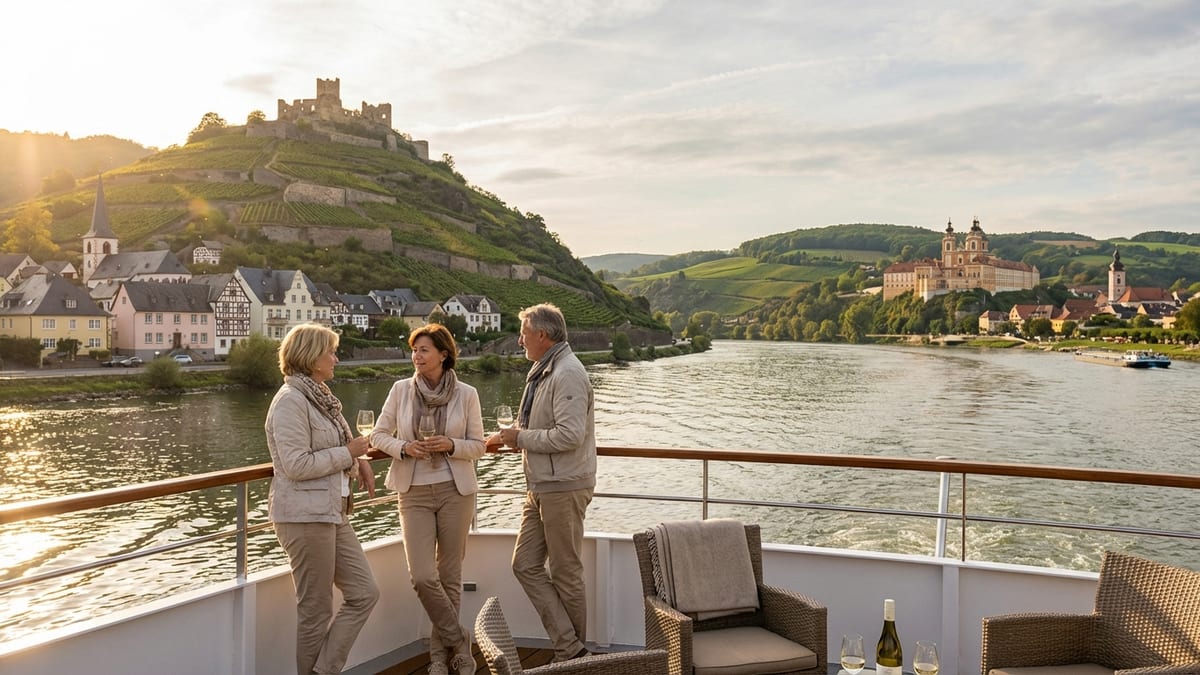
The Danube and the Rhine are the twin superstars of European river cruising, each promising castles on hilltops, baroque churches and nights on deck with a glass of wine as historic landscapes glide by. Yet when you look closely, these rivers deliver very different personalities.
Choosing between a Danube cruise and a Rhine cruise is less about which river is “better” and more about which one aligns with your travel style, interests, budget and timing. With new 2025 and 2026 itineraries now on sale, it is an ideal moment to take a clear-eyed look at how these two iconic waterways compare.
Big Picture: How the Danube and Rhine Experiences Differ
At first glance, Danube and Rhine cruises look similar. Most journeys last seven to ten nights, include full-board dining, guided excursions and comfortable cabins, and are run by many of the same lines, from value-focused brands to ultra-luxury operators.
The difference lies in what you see from the railings and how each river tells Europe’s story. The Danube, which runs from Germany to the Black Sea, feels like a grand narrative of empires and shifting borders, with a strong focus on imperial cities and Central and Eastern Europe.
The Rhine feels more like a classic storybook of Western Europe, with medieval castles, half-timbered towns and vineyard-clad hills lining its middle stretch. Those leaning toward the Danube should explore the most popular Danube cruise itineraries in more detail.
On a Danube itinerary, you are likely to move between grand capitals. Think Budapest’s riverfront parliament lit at night, Vienna’s palaces and opera houses, and Bratislava’s hilltop castle overlooking a compact old town. A realistic look at whether Danube cruises are worth it helps put this comparison into perspective.
In contrast, Rhine cruises lean heavily into atmospheric small and mid-sized cities anchored by the river, such as Cologne with its cathedral spires, Koblenz at the confluence of the Rhine and Moselle, and Strasbourg with its Franco-German blend of culture and architecture. Amsterdam and Basel often bookend Rhine itineraries, offering a cosmopolitan start or finish in the Netherlands or Switzerland.
Another big-picture difference is the emotional tone of each route. The Danube often feels more romantic and sweeping, moving through scenery that alternates between soft river valleys and powerful urban silhouettes, and through countries that many North American travelers are still getting to know.
The Rhine feels more immediately familiar, especially if your mental image of Europe includes hilltop ruins, terraced vineyards and villages with flower boxes and steep slate roofs. Neither river is better, but they offer distinct moods that appeal to different travelers.
Routes, Ports and Landscapes: What You Actually See
On the Danube, the classic route for first-timers runs between Passau in Bavaria and Budapest, typically over seven or eight days. You are likely to stop in the Wachau Valley, a UNESCO-listed stretch of vineyards and monasteries, where baroque Melk Abbey commands a high bluff above the water and the village of Dürnstein sits below castle ruins.
Vienna and Bratislava bring dense layers of imperial and Cold War history, while Budapest’s Chain Bridge and thermal baths give the river a memorable finale. Some itineraries extend upstream to Nuremberg or downstream into lesser-known reaches of Hungary, Serbia, Bulgaria and Romania for a more offbeat, multi-country experience.
Rhine routes most often link Amsterdam and Basel in about a week, zigzagging along the Middle Rhine Gorge. This is the image you see on postcards: precipitous slopes carved by the river, an almost improbable number of castles, and villages such as Bacharach and Rüdesheim hugging the waterfront.
Cologne’s Gothic cathedral towers over the river, while Koblenz offers cable car rides to Ehrenbreitstein Fortress and views across the Rhine-Moselle confluence. Near the southern end, Strasbourg’s canals and half-timbered houses underline the river’s role as a cultural bridge between France and Germany before you cruise into the Swiss city of Basel.
In terms of pure scenery, the Rhine Gorge delivers one of Europe’s most dramatic single days of river cruising. Guests typically gather on the top deck as the ship passes castle after castle and the fabled Lorelei Rock. The Danube, by contrast, offers more of a slow-burn charm, with particularly picturesque sections through the Wachau and certain narrower reaches in Slovakia and Hungary.
If your priority is a long, continuous stretch of jaw-dropping river scenery and fairytale fortresses, the Rhine has an edge. If you care more about combining strong scenery with marquee cities and a sense of geographic progression from German Bavaria into Eastern Europe, the Danube stands out. Once you choose the river, these are the best Danube cruises to book right now.
Cities, Culture and Shore Excursions
Both rivers are heavy on culture, but the flavor is different. Danube ports focus on imperial Habsburg heritage, Austro-Hungarian history and, on longer routes, the legacies of the Ottoman Empire and the Iron Curtain. In Vienna, shore excursions may include guided walks along the Ringstrasse, visits to Schönbrunn Palace or the Hofburg, and evenings at classical concerts. Budapest’s tours highlight Buda Castle, the neo-Gothic Parliament building and the city’s famous baths, while Bratislava offers cobbled streets, colorful facades and hilltop views.
On the Rhine, excursions lean into medieval trade history, wine culture and the region’s shifting borders. In Cologne, guided tours center around the twin-spired cathedral and the old town. Stops in smaller towns might include wine tasting in family-run cellars, visits to hilltop castles or walking tours through old quarters that survived or were carefully rebuilt after the Second World War. Strasbourg’s unique blend of French and German influences, and its role as a European political center, adds modern context to the historical narrative.
For travelers particularly drawn to classical music, baroque architecture and café culture, the Danube’s capitals can feel like a highlight reel. For those who enjoy smaller-scale experiences such as strolling through medieval alleys, listening to local folklore or tasting Riesling in a centuries-old cellar, Rhine itineraries often deliver more of those intimate moments. Both rivers now offer an increasing range of activity levels, from gentle walking tours to cycling excursions and “discovery” options that focus on food, wine or local crafts, so you can tailor each day according to your energy and interests.
Seasonality, Weather and Special Themed Sailings
When you go can be just as important as where you go. On both rivers, the main sailing season generally runs from March or April through late October, with a second burst of demand in late November and December for Christmas market cruises. Spring and fall are especially popular on the Danube, when temperatures are comfortable for sightseeing and river levels are usually stable. Cherry blossoms and fresh green hillsides in April and May give way to warm evenings and grape harvest activity in September and October.
On the Rhine, high summer between June and August showcases vineyards at their lushest, and long daylight hours mean extended time to enjoy the passing landscape from open decks. However, summer can also bring higher prices, more crowded ports and occasional heatwaves. December is a particularly atmospheric time on both rivers, but Christmas market cruises are where the Danube arguably shines, especially in cities like Vienna and Budapest with their grand squares and ornate seasonal decorations.
Water levels are a reality on all European rivers, and both the Danube and Rhine occasionally see high or low water that can disrupt itineraries. Lines have become more proactive in managing and communicating these issues, but if you are highly risk-averse about such disruptions, consider traveling in late spring or early fall, when conditions have historically been more stable. The good news is that the major river cruise lines are operating full Danube and Rhine schedules for 2025 and 2026, with a growing range of themed itineraries around wine, music, wellness, biking and Christmas markets, giving you considerable flexibility to match your interests.
Ships, Comfort Levels and Onboard Atmosphere
Because many of the same operators sail both rivers, the onboard experience can be remarkably similar whether you choose the Danube or the Rhine. Lines such as AmaWaterways, Viking, Avalon, Scenic, Emerald and others deploy near-identical ships on both waterways, with comparable cabin layouts, dining concepts and lounge designs. On mainstream lines, you can expect stylish but compact cabins, open-seating dining, and a mix of included and optional excursions. Premium and luxury brands add larger suites, higher staff-to-guest ratios, more inclusive pricing and touches like butler service or specialty restaurants.
There are some river-specific quirks. The Danube, thanks to its width in certain sections, can accommodate a few notably larger vessels that offer more spacious public areas and cabins. Ships like AmaWaterways’ AmaMagna, designed expressly for the Danube, provide extra restaurants and wellness facilities while still berthing in central locations. On the Rhine, ship sizes are more constrained in some stretches, particularly through the gorge and in older lock systems, so vessels typically conform to well-established dimensions that fit the river’s infrastructure.
In terms of onboard atmosphere, the route can influence the passenger mix. Rhine cruises that begin or end in Amsterdam tend to attract guests who appreciate easy flight connections and might combine the cruise with city breaks in the Netherlands, Belgium or Switzerland. Danube itineraries that feature Budapest and Vienna bring in travelers drawn to Central Europe’s cultural scene and those curious about emerging destinations farther east. However, the biggest determinants of onboard vibe remain the cruise line and ship, not the river itself. If you prefer a quiet, largely all-inclusive environment with an emphasis on service, pick your line accordingly and then choose the river that suits your sightseeing priorities.
Budget, Value and Practical Planning
From a purely financial standpoint, Danube and Rhine cruises are broadly comparable, but there are nuances that matter when you are budgeting. For a typical seven-night sailing in 2025 or 2026 with a mainstream line, entry fares for a lower-deck cabin often start in the low-to-mid four figures per person, with balcony cabins and suites pushing prices higher. As a rule of thumb, many travelers find that by the time you add flights, pre- or post-cruise hotel nights, optional excursions, gratuities and beverages not included in the base fare, a couple can easily invest a five-figure sum into a week-long European river cruise vacation.
Shoulder seasons in April, early May and late October often yield the best combination of value and experience, with slightly lower fares and fewer crowds compared with peak summer. Christmas market sailings, while shorter in daylight hours, can also provide good value relative to the intensity of the experience, especially along the Danube where large cities put on elaborate seasonal displays. Conversely, July and August departures on both rivers typically command higher prices and may sell out earlier, especially for balcony cabins and suites.
When comparing Danube and Rhine options, look closely at what is included. Some lines wrap excursions, drinks, Wi-Fi and gratuities into one up-front price, while others itemize more of these elements. The mix can differ slightly between rivers depending on competition and demand patterns. Also consider airfare: it may be easier and sometimes cheaper for North American travelers to reach Amsterdam than Budapest, though that is not a rule, and competitive transatlantic routes are available into cities like Vienna and Munich as well. Ultimately, the “better” value will be the itinerary that delivers the ports that excite you, on a ship that matches your comfort expectations, at a time of year when the experience will feel rich rather than rushed.
Who Should Choose the Danube and Who Should Choose the Rhine
If you are drawn to grand capitals, historic cafés, concert halls and a sense that your cruise is moving through the heart of Old World culture, the Danube is difficult to beat. First-time visitors to Central Europe often love the way a single Danube itinerary can introduce them to four countries in a week, each with its own language and cuisine yet linked by a shared imperial past. Travelers with an interest in Cold War history, or those curious about lesser-known cities in Hungary, Serbia or Romania, can opt for longer Danube journeys that press beyond the best-known stretches and deliver a more exploratory feeling.
The Rhine, in contrast, is ideal for travelers whose European dreams are full of half-timbered riverside towns, hillside fortresses and wine villages. It works especially well for those who want a strong focus on scenery along with manageable walking in compact towns rather than long days in large cities. The inclusion of Amsterdam on many Rhine itineraries also appeals to those who want to combine a cruise with world-class museums and the canals-and-bicycles charm of the Dutch capital. For families with older teens, or multigenerational groups, the Rhine’s mix of castles, cable cars and bike rides through vineyards can be particularly rewarding.
One useful way to decide is to think of your previous travels. If you have already spent time in Paris, London or Rome and now want to see a different side of Europe, the Danube’s route through Central and Eastern Europe may offer more novelty. If you have never been to Europe and want your first experience to match the iconic storybook photos you have seen for years, the Rhine may be the better introduction. Either way, both rivers are relatively gentle introductions to overseas travel, with structured days, easy logistics and a floating hotel that eliminates the need to pack and unpack between cities.
The Takeaway
There is no universal winner in the Danube versus Rhine debate. Instead, each river offers a distinct lens on Europe. The Danube strings together imperial capitals and evolving Eastern European cities, wrapping them in stretches of vineyard-draped valley and monastery-crowned cliffs. The Rhine, for its part, distills the continent’s medieval and early modern history into one continuous panorama of castles, cathedrals and villages, anchored by gateway cities like Amsterdam, Cologne and Basel. Understanding these differences will help you match the river to your personality, whether you lean toward cosmopolitan culture or fairytale landscapes.
If your ideal trip centers on exploring grand museums, attending concerts, lingering in coffee houses and contemplating the legacy of empires, the Danube is likely to speak your language. If your heart is set on gliding past ruined keeps and tasting wine where the grapes grow within sight of the river, while stepping ashore in compact towns steeped in centuries of trade and tradition, the Rhine will probably feel like home from the moment you board. Both rivers now benefit from mature cruise infrastructure, a wide range of ships and itineraries, and a long season stretching across spring, summer, fall and the holidays.
Ultimately, the best choice is the river whose ports you are most excited to circle on a map. Study a few sample itineraries, picture yourself on deck at sunset, and be honest about whether your imagination drifts toward a violinist in a Viennese palace or a glass of Riesling as the Lorelei Rock glides past. That moment of clarity is your answer. And if you still cannot decide, you have the finest problem in travel: you can always plan for one river now, with the other waiting just a season or two away.
FAQ
Q1: Is a Danube or Rhine cruise better for first-time visitors to Europe?
For a classic, storybook introduction with castles and small towns, the Rhine is often easier and more instantly recognizable. If you want your first trip to showcase grand capitals and Central European culture, the Danube is a strong choice.
Q2: Which river has more impressive scenery from the ship?
The Rhine’s Middle Rhine Gorge offers one of Europe’s most dramatic continuous stretches of river scenery, with dense clusters of castles and vineyards. The Danube has beautiful sections, especially the Wachau Valley, but its scenery is interspersed with longer, quieter stretches between major cities.
Q3: Are Danube cruises generally more expensive than Rhine cruises?
Base fares for comparable itineraries are broadly similar, with pricing driven more by cruise line, ship, season and cabin type than by the river itself. You may find small differences on specific dates, but budget planning should assume similar overall cost levels on both rivers.
Q4: Which river is better for Christmas market cruises?
Both rivers offer excellent Christmas market itineraries, but many travelers favor the Danube for the combination of Vienna, Budapest and smaller Austrian and German towns. The Rhine also has atmospheric markets in cities such as Cologne and Strasbourg, so your choice can reflect which cities you most want to see in winter.
Q5: Will I visit more countries on a Danube cruise or a Rhine cruise?
Standard seven-night Rhine itineraries usually focus on the Netherlands, Germany, a slice of France and Switzerland. Classic Danube cruises between Passau and Budapest visit Germany, Austria, Slovakia and Hungary, and longer Danube voyages can add several more countries as you move toward the Black Sea.
Q6: Which river is better if I love big cities and museums?
The Danube is generally stronger for big-city experiences, with Budapest and Vienna as major cultural highlights and Bratislava or sometimes Munich and Nuremberg as additional options. Rhine cruises include Amsterdam and sometimes Basel or Zurich extensions, but spend more time in small and mid-sized towns.
Q7: How do water levels affect Danube and Rhine cruises?
Both rivers can experience high or low water that occasionally disrupts itineraries, especially in late summer or during unusual weather patterns. Cruise lines typically mitigate this with ship swaps or modified routes, but if you are concerned, consider traveling in late spring or early fall when conditions are often more stable.
Q8: Are there differences in the onboard experience between the Danube and Rhine?
The onboard experience is largely determined by the cruise line rather than the river. Many operators use similar ships and service standards on both waterways. The main differences come from the ports visited and the mix of excursions rather than from day-to-day life on board.
Q9: Which river is better for active travelers who enjoy biking and walking?
Both rivers cater well to active travelers, with bike paths and guided cycling tours available on many itineraries. The Rhine’s compact towns and vineyard routes make for especially scenic rides, while the Danube’s stretches through Austria and Germany also offer excellent cycling along well-developed river paths.
Q10: If I can only do one river cruise, which should I choose?
If your dreams center on castles, vineyards and half-timbered villages, choose the Rhine. If you are more excited by imperial capitals, classical music and a deeper dive into Central Europe, choose the Danube. In the end, the right river is the one whose ports and landscapes you most look forward to experiencing in person.