


Immigration and residency administration in the United Arab Emirates is highly digitalized, but new residents still spend significant time interacting with immigration and residency offices. Understanding which authorities are involved, how applications move between them, and what typical processing and service experiences look like is essential for evaluating how practical it will be to establish and maintain legal residence in the UAE.
Institutional Landscape: Who Handles Immigration and Residency
Dealing with immigration and residency in the UAE involves two main families of public authorities. For Dubai, the General Directorate of Residency and Foreigners Affairs Dubai (GDRFA Dubai) is responsible for most residency, entry permit and status change services. For the other six emirates, the Federal Authority for Identity, Citizenship, Customs and Port Security (often referred to as ICP) manages immigration and residence services, including residence visa issuance and Emirates ID processing.
These core authorities work in tandem with service interfaces rather than traditional counters. Dubai residents commonly interact with Amer Centers, which are semi-government customer centers authorized by GDRFA to submit and manage residency and visa requests on behalf of individuals and companies. Across all emirates, applicants can also use licensed typing centers that submit applications into the ICP smart services system.
In practice, relocation candidates should expect a dual-layer interaction model. Strategic decisions and approvals sit with GDRFA or ICP, but the day-to-day experience is mediated through customer happiness centers, service kiosks, mobile apps and third-party typing centers. Evaluating relocation feasibility therefore requires understanding both the legal authorities and the service channels that front them.
Residents will also interact with the Emirates ID system, which is technically a federal identity function handled through ICP but tightly coupled with residency status. Many key life tasks, from opening a bank account to signing a lease, depend on a valid Emirates ID, so delays or issues in this segment of the process effectively extend time spent dealing with immigration-linked offices.
Channels of Interaction: Smart Services, Centers and Typing Offices
The UAE government has shifted heavily toward digital interaction. Most immigration and residency services can be initiated and tracked through two core online platforms: the ICP Smart Services portal and app, which serves all emirates except Dubai, and GDRFA Dubai’s smart services system and mobile channels. These platforms allow users to create accounts, submit applications, upload documents and pay fees, typically operating 24 hours a day.
Physical interaction occurs through several types of centers. “Customer Happiness Centers” are official government service halls where applicants can submit or follow up on immigration and residency requests directly with civil servants. Dubai also operates Amer Centers, which are franchised but supervised service points performing GDRFA transactions, often located in malls or commercial areas and generally operating extended hours. In other emirates, licensed typing centers and ICP customer happiness centers play a similar facilitation role.
For many expatriates, typing centers are the default interface. These centers review documents, enter data into government systems, generate applications and pay official fees on the applicant’s behalf for a modest service charge, often around AED 40 to 70 per transaction depending on the center. This reduces the risk of application rejection due to data entry errors, which can otherwise trigger delays of several days, additional fees or repeated visits.
The interaction model is therefore multi-channel. A typical resident will submit or track applications online, complete biometrics or complex issues at an ICP or GDRFA customer happiness center, and rely on a typing or Amer center for document preparation and troubleshooting. From a relocation planning perspective, this mix reduces the need for direct ministry visits but requires comfort with digital systems and coordination between multiple service points.
Core Processes: Residency, Visas and Emirates ID Workflow
Although visa types vary, most expatriates experience a broadly similar process flow involving multiple interactions with immigration and residency offices. For residence-based relocation, the sequence commonly includes entry permit issuance, medical fitness testing, residence visa stamping, Emirates ID application and biometrics, followed by card printing and delivery. Each step may require different offices or channels.
After the initial visa or entry permit is arranged by an employer or sponsor, the residency phase normally begins with data entry through a smart services portal or a typing or Amer center. For Emirates ID and residency, this data entry stage is typically completed the same day. Once captured, applicants receive an application number and, where required, an SMS directing them to complete biometric enrollment at a designated ICP customer happiness center.
Biometric capture for Emirates ID, which includes fingerprints, a facial photograph and signature, is handled at ICP centers. Reports for 2025 and 2026 indicate that biometric appointments, once booked, usually take 10 to 15 minutes on-site, although appointment availability can vary from next-day to several weeks depending on location and demand. After biometrics, security and residency checks by GDRFA or ICP generally take around 3 to 5 working days in straightforward cases, followed by 2 to 3 working days for card personalization and 1 to 2 days for courier delivery or collection, resulting in a typical total of roughly 7 to 12 working days for a first-time Emirates ID when documentation is complete and no clarifications are required.
Residency renewals largely follow the same pattern but may be faster if biometrics are already on file and biometric recapture is not required. However, any mismatch between residency validity and Emirates ID validity, or delays in one system updating the other, can force additional interactions with customer happiness centers to resolve status inconsistencies. From a planning standpoint, new arrivals should anticipate at least several weeks of intermittent engagement with immigration and residency offices during the first months in the country.
Service Standards, Processing Times and Volumes
The UAE publishes service commitments and open data that provide some insight into the scale and speed of immigration and residency operations. GDRFA Dubai data for 2025 indicate millions of residency transactions and tens of millions of passenger movements processed annually, illustrating a high-volume environment that still maintains relatively short official processing targets for standard services.
Many individual service cards on government portals reference completion targets of 24 to 72 hours for straightforward requests, such as issuing certain entry or exit statements or processing standard residency transactions when documents are in order. For Emirates ID, contemporary guides and customer reports in 2025 and early 2026 point to typical end-to-end processing times of approximately one to two weeks for first-time applicants, provided that biometric appointments are available quickly and there are no security clarifications.
It is important, however, for relocation candidates to appreciate the difference between official targets and real-world experiences. While a large proportion of applications appear to complete within published timelines, individuals who encounter data mismatches, name spellings that differ between passport and application, or changes in sponsor details may experience delays extending to several weeks. In such cases, follow-up through call centers, Amer or typing centers and physical visits to customer happiness centers are often required.
The emphasis on electronic communication also shapes expectations. Applicants generally receive SMS updates at key milestones, such as after application submission, biometrics completion and card printing, and can track status through ICP or GDRFA portals. This level of transparency is helpful for planning but can also generate anxiety when status screens remain unchanged for days. From a relocation risk perspective, the system is robust and broadly efficient, but time buffers should be built into start dates for employment and housing commitments to accommodate potential administrative slippage.
Customer Experience: What to Expect at Offices and Centers
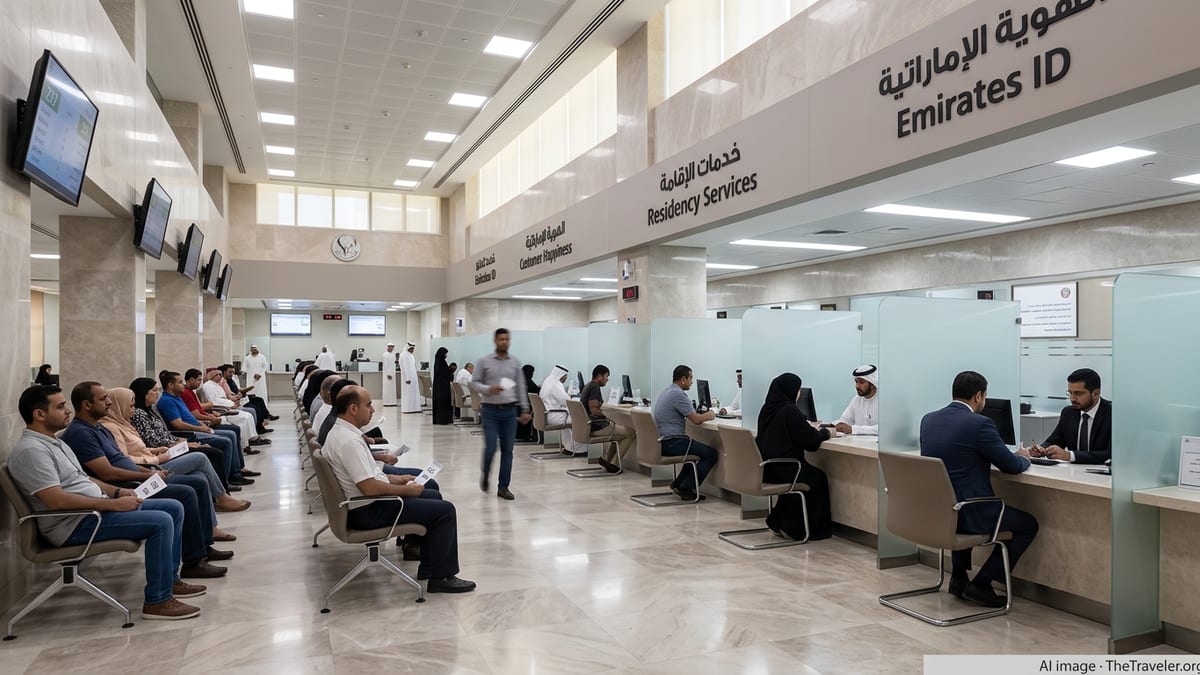
Customer experience at immigration and residency offices in the UAE is influenced by the government’s wider “customer happiness” agenda. Many physical centers are branded as Customer Happiness Centers and are designed with ticketing systems, electronic queuing, multilingual signage and separate counters for different types of transactions. Extended opening hours are common in large emirates, and at least one GDRFA Dubai customer happiness center at the main airport terminal operates 24 hours a day.
Applicants generally take a queue ticket, wait for their number to be called, and then transact at a counter where staff enter or verify data on-screen. For routine services at well-staffed centers, waiting times are often within 15 to 45 minutes, though peak periods can be longer. The use of rating systems and “happiness meters” is widespread, encouraging staff to resolve issues efficiently. Many centers also provide separate areas for biometrics, with dedicated fingerprint scanners and photography equipment, in order to keep throughput high.
Amer and typing centers vary more in layout and ambiance, as they are operated by private entities under authorization. Some function as small shopfronts with a handful of desks, while flagship Amer centers can resemble modern bank branches. Regardless of format, the key value they provide is familiarity with immigration and residency procedures, local requirements in each emirate, and current practice within the relevant authority. This practical expertise often compensates for the complexity of the underlying regulations and IT systems.
For relocation decision-making, the main implication is that most interactions are transactional rather than consultative. Staff at GDRFA, ICP and Amer centers typically process defined requests based on existing rules and system prompts rather than provide holistic advisory services. Expatriates needing scenario planning or unusual arrangements often rely on employers, relocation firms or specialized immigration advisors outside the government system, then use the official centers purely to execute chosen routes.
Common Pain Points and How to Mitigate Them
Despite extensive digitization, expatriates still encounter recurring bottlenecks when dealing with immigration and residency offices. One common issue is inconsistency of personal data across systems, for example different spellings of names between passport, visa and Emirates ID applications. Such discrepancies can trigger system flags and require manual review, extending processing times. Pre-checking that all documents carry identical English spellings and, where relevant, consistent transliteration of Arabic names reduces this risk.
Another pain point is appointment availability for biometrics, particularly during high-demand periods such as September and January when new hires and students arrive. Reports indicate that while some centers can offer appointments within one to two days, others may only have slots several weeks later. Applicants with tight timelines can often reschedule through the ICP smart services portal or by visiting an alternative center in a different district, but this requires awareness and proactive management.
Overstay fines and status gaps are also a concern. Federal authorities have standardized many overstay penalties, with common figures around AED 50 per day for certain categories in recent official guidance. While such fees are manageable in the short term, they accumulate quickly and can complicate future applications. Close attention to visa and residency expiry dates, and starting renewal procedures well before deadlines, is essential to avoid repeated, time-consuming visits to customer happiness centers to clear fines.
Finally, coordination between federal ICP systems and emirate-level GDRFA databases can occasionally produce mismatched records, for example an exit recorded in one system but not the other or a residency cancellation not fully propagated. Resolving these cases generally requires in-person visits with original passports and supporting documents, sometimes to both federal and local offices. For individuals with complex travel histories or multiple prior visas, factoring in extra lead time for such reconciliations is prudent.
Practical Strategies for Efficient Interaction
Several operational practices can significantly reduce friction when dealing with UAE immigration and residency offices. First, using authorized typing or Amer centers for all but the simplest requests minimizes data-entry errors and ensures that current document requirements and fee schedules are applied. The modest service charge is often offset by faster approvals and fewer rejected applications.
Second, applicants benefit from treating SMS notifications and portal status screens as triggers for action rather than passive updates. For example, once a message indicates that biometrics are required, booking the earliest available appointment, even at a more distant center, typically shortens the overall processing timeline by days or weeks. Similarly, if a status remains “under process” for significantly longer than the standard range, proactively visiting a center to inquire can surface missing documents or system issues that would not resolve automatically.
Third, maintaining a digital archive of key documents reduces the need for repeated visits. Immigration and residency offices frequently request passport copies, previous visas, tenancy contracts and sponsor documents. Having scanned, clearly labeled versions ready for upload or printing simplifies interactions both online and at counters. For families, centralizing these records in a shared repository can prevent misalignment of application timelines between spouses and dependents.
Finally, it is useful to recognize that many centers differentiate between standard and priority services. Some service cards reference expedited options at higher fees, particularly for Emirates ID production and certain residency transactions. While availability and pricing vary by emirate and over time, relocation candidates with urgent needs may wish to budget for these optional speed upgrades, while those on more flexible timelines can rely on standard processing and lower costs.
The Takeaway
Immigration and residency offices in the UAE operate within a sophisticated, high-volume administrative ecosystem that combines federal and emirate-level authorities with semi-government service channels. For most expatriates, the experience is shaped less by direct interaction with ministries and more by the effectiveness of digital platforms, customer happiness centers and authorized intermediaries such as Amer and typing centers.
Processing times for standard residency and Emirates ID procedures are generally competitive by global standards, often measured in days rather than months, provided that documents are accurate and applicants respond quickly to biometrics and clarification requests. At the same time, the system is unforgiving of data inconsistencies, lapsed validity and incomplete paperwork, which can lead to extended interactions with offices to resolve fines or reconcile records.
For individuals and companies evaluating relocation to the UAE, the key operational question is not whether it is possible to secure and maintain residency, but how much administrative effort and time must be allocated to doing so. With careful preparation, reliance on experienced service centers and proactive use of online tools, interactions with immigration and residency offices can usually be managed within predictable and manageable timelines.
FAQ
Q1. Which authority will I mainly deal with for residency in the UAE?
Most residents interact with GDRFA Dubai if they live in Dubai, and with the federal ICP system if they live in Abu Dhabi or the other emirates. In both cases, applications are usually submitted through smart services, Amer centers or licensed typing centers rather than directly at ministry counters.
Q2. How long does it usually take to get an Emirates ID after biometrics?
In straightforward cases, typical timelines reported for 2025 and early 2026 suggest around 3 to 5 working days for security and residency checks after biometrics, plus a few days for card printing and delivery, resulting in roughly one to two weeks end-to-end if there are no clarifications.
Q3. Do I have to visit immigration offices in person, or can everything be done online?
Most data entry and fee payment can be done online through ICP or GDRFA smart services, or via Amer and typing centers. However, first-time biometric enrollment for Emirates ID and certain complex issues still require in-person visits to customer happiness centers or ICP fingerprint centers.
Q4. What role do Amer and typing centers play in the process?
Amer and typing centers act as intermediaries between applicants and immigration systems. They check documents, complete online forms, submit applications and pay government fees for a service charge, reducing the risk of data errors and rejected applications when dealing with residency and Emirates ID offices.
Q5. How can I minimize delays when dealing with UAE immigration and residency offices?
Ensuring that names and personal details match exactly across all documents, booking biometric appointments at the earliest available slot, responding quickly to SMS or portal requests, and using experienced typing or Amer centers are practical ways to keep processing times close to official targets.
Q6. What happens if my application status shows “under process” for a long time?
If a status such as “under process” or “waiting for residency issue” persists significantly longer than the usual few working days, it often indicates that additional review or documentation is needed. Visiting an Amer, typing center or customer happiness center with your passport and application number can help identify and resolve the issue.
Q7. Are the customer happiness centers in the UAE foreigner-friendly?
Customer happiness centers typically offer multilingual staff, clear signage and ticket-based queuing systems. While they are primarily transactional, most expatriates find that staff are accustomed to dealing with foreign nationals and can manage basic communication in English for routine immigration and residency services.
Q8. How strict are UAE immigration offices about overstay and late renewal fines?
Immigration and residency offices apply standardized overstay fines that can accumulate daily once a visa or residency expires. These fines must usually be paid before new applications are approved, so staying within validity periods and starting renewals early is important to avoid repeated office visits and additional costs.
Q9. Can I use one center for all my immigration and residency needs?
Not always. While Amer or a trusted typing center can handle most application submissions, biometrics must be done at ICP-designated centers, and some specific residency or status issues may require attending particular customer happiness centers or, in rare cases, dedicated sections within GDRFA or ICP offices.
Q10. Is it realistic to manage UAE immigration procedures without a relocation agent?
For standard employment-based or family sponsorship cases, many residents successfully manage procedures themselves using smart services and Amer or typing centers. However, those with complex histories, multiple dependents or unusual visa categories may benefit from a professional relocation or immigration advisor to reduce the number of interactions needed with immigration and residency offices.