


Dealing with local government offices in Spain is a central operational question for anyone considering relocation. Municipal town halls, regional administrations and local branches of state agencies handle registration, documentation and many day-to-day formalities. Their procedures, capacity and digitalisation level significantly influence how practical it is to live and work in the country. This briefing explains how local government offices in Spain function in practice, what newcomers can expect in terms of access and response times, and which strategies are commonly used to manage the bureaucracy more effectively.
Overview of Spain’s Local Administrative Landscape
Spain’s public administration is highly decentralised, which shapes how residents interact with local offices. There are three primary levels: the central state, 17 autonomous communities plus two autonomous cities, and over 8,000 municipalities. Local residents typically deal with all three, often in the same city, but through different offices and channels. This fragmentation means that understanding “who does what” is critical before beginning any procedure.
In practical terms, newcomers interact most often with municipal town halls (ayuntamientos), regional administrations and local delegations of central agencies such as the tax authority, Social Security and immigration offices. Each maintains its own appointment systems, opening hours, digital portals and service standards. For many procedures, the only way to obtain service is to follow the specific workflow of the competent authority, which can differ significantly between regions and even between neighbouring towns.
For relocation planning, the key implication is that Spain does not offer a single front door for public services. Instead, residents navigate a mosaic of offices, some well resourced and highly digitalised, others still relying heavily on paper files and in-person attendance. The experience can vary sharply between large metropolitan areas and smaller municipalities, and between high-demand areas such as immigration desks and more routine civil registry functions.
Spain’s central administration has attempted to coordinate citizen-facing services through a common information network and shared standards of attention, but day-to-day delivery remains strongly conditioned by local staffing levels, political priorities and regional investments in e-government. As a result, anecdotal experiences reported by foreigners range from very efficient same-day attention to prolonged difficulty obtaining appointments for critical procedures.
Key Local Offices Newcomers Will Encounter
Although exact pathways differ by individual situation, several local offices consistently appear in the first months after arrival. Municipal town halls are responsible for population registration (padrón), local certificates and many basic services. This is usually the first interface with Spanish local government, since registration in the municipal census is a prerequisite for school enrolment, some social services and, in many municipalities, access to local benefits.
Regional administrations operate citizen service offices that centralise information and processing for devolved competences, which include education, health services administration and, in some communities, parts of labour and social policies. Many autonomous communities report target waiting times at these offices that are measured in minutes rather than hours, reflecting an effort to professionalise face-to-face attention, although actual performance still depends on staffing and local demand.
Local branches of central state agencies are also part of the everyday landscape. Social Security offices manage contributions and registrations, tax offices handle personal and corporate tax procedures, and provincial immigration offices process most residence card-related steps. Trade unions and staff associations in several provinces have repeatedly highlighted high workloads and tight attention windows in some of these offices, particularly where the same desk is handling multiple complex benefit or status procedures within a few minutes per user.
In addition, residents often interact with local police stations and traffic offices for identity documents, driving licences and vehicle registrations. These offices typically operate strict prior-appointment systems and, in periods of reform such as the rollout of new digital documentation, can experience backlogs and complaints about saturation of agendas and insufficient training for staff on new tools.
Appointment Systems and Access to Local Services
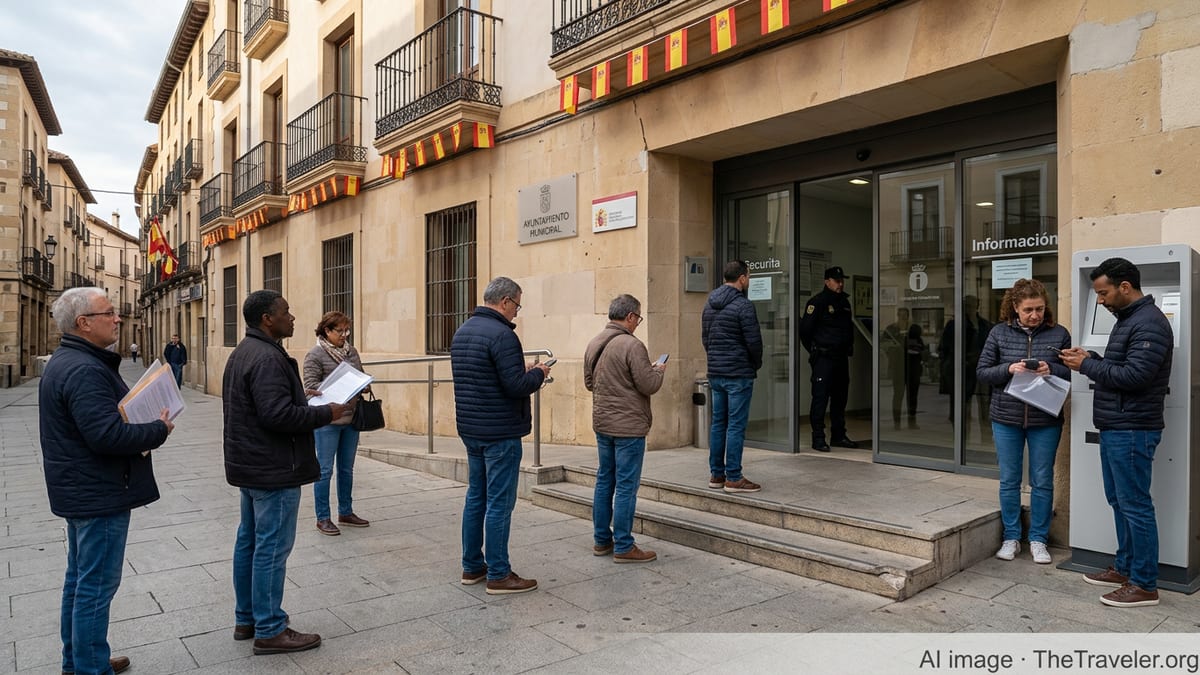
Access to many local government offices in Spain is controlled by prior appointment systems, known as cita previa. Originally introduced to reduce queues and improve planning, these systems now cover interactions with a wide range of offices, including Social Security, tax offices, traffic authorities, immigration desks and many municipal and regional service centres. National portals provide the front end for several central agencies, while municipalities and autonomous communities operate their own online or telephone-based systems.
The quality of the user experience is highly uneven. In some citizen service offices, internal quality commitments aim for average waiting times of under ten minutes for users with prior appointments, supported by queue management systems and information screens. In other areas, users and staff representatives report that appointment slots are scarce, portals are saturated and queues at office doors remain common, effectively shifting waiting time from physical lines to daily attempts at securing online appointments.
One recurrent issue for foreigners is scarcity of appointments in immigration-related offices. Reports from large cities and some smaller provinces describe portals displaying no available slots for extended periods, prompting repeated attempts at different times of day or reliance on intermediaries. Media and official statements over recent years acknowledge backlogs and efforts to reinforce staff, and in some regions digital submission of documents has partly bypassed the need for initial in-person appointments, though follow-up steps may still require physical presence.
Authorities at central level have publicly recognised the unpopularity of over-restrictive appointment requirements and signalled a gradual relaxation for basic information services in some agencies. Nevertheless, for many key procedures at local level, particularly those involving identification, biometrics or signature, prior appointment remains the standard access gate and must be factored into relocation timelines.
Digital Administration and Certificates
Digital transformation of public administration is a core policy objective in Spain, and residents increasingly encounter electronic channels instead of, or in addition to, local counters. Central and regional governments have invested in online portals that allow users to submit applications, download certificates and track the status of procedures. For many services, especially those with high transaction volumes, authorities encourage or demand electronic interaction as the default.
The cornerstone of this system is the digital certificate or electronic identification, which allows individuals to authenticate themselves securely and sign documents online. Foreign residents, including some non-residents who own property or have other ties, can obtain these credentials once they can prove their identity at designated registration points. Community feedback indicates that obtaining and using a digital certificate significantly improves access to services and reduces dependency on scarce appointment slots, since some portals reserve certain functionalities for authenticated users.
Despite progress, digital channels are not yet a complete substitute for local offices. Several high-volume areas, including parts of immigration processing and social benefits, remain partly or fully reliant on in-person steps, either for biometric capture, verification of originals or issuing physical cards. Furthermore, bandwidth limitations, system outages and usability flaws in specific portals can affect reliability. Some users report that websites may not function correctly if accessed from foreign IP addresses or older devices, which is relevant for people preparing procedures before arriving in Spain.
Local administrations are also experimenting with new technologies, including document automation and, in some pilot cases, artificial intelligence tools for routing or drafting responses. The explicit aim is to free staff from repetitive tasks and shorten processing times. However, implementation is uneven, and most residents should still expect a mix of traditional paper-based workflows and modern digital interactions, depending on procedure and location.
Service Quality, Waiting Times and Regional Variation
Spain does not publish a single consolidated indicator of waiting times across all local government offices, but available data and union reports provide a picture of significant variation. In well-resourced urban citizen service centres, internal targets may keep average waiting times for scheduled appointments within well under 15 minutes, and users can complete straightforward procedures in one visit. By contrast, in pressured offices such as some Social Security centres and immigration desks, staff organisations describe “unmanageable” workloads, with hundreds of thousands of users served in a year and limited time per consultation.
For residents, the most visible bottleneck is often not the time spent inside the office, but the delay to secure a slot in the first place. Accounts from employers and lawyers indicate that in major cities it is common for immigration-related appointments to involve waits of several weeks to several months, depending on the season and type of procedure. Provincial differences are notable, with smaller cities sometimes offering shorter delays, though this is not guaranteed and can reverse if staffing is low relative to demand.
Regional governments have responded to citizen dissatisfaction in different ways. Some have invested in additional staff and new service channels, such as video appointments and extended office hours on specific days. Others have prioritised simplifying procedures or delegating certain tasks to municipal offices closer to residents. Field reports suggest that where regional and municipal authorities actively coordinate, residents experience smoother handoffs between levels of administration; where coordination is weaker, users may be bounced between offices with limited guidance.
For relocation planning, the practical message is that service quality is highly context-specific. Experiences in one autonomous community, or even in one district of a large city, may not predict conditions elsewhere. Prospective movers should seek information on local office performance in the specific municipality and region under consideration, and build contingency time into any plan that depends on formal registrations, documents or benefits managed by local offices.
Use of Intermediaries and Local Support Channels
Given the complexity and occasional scarcity of appointments, many residents in Spain rely on intermediaries to deal with local government offices. These include gestores administrativos (licensed administrative agents), immigration lawyers, relocation consultants and non-profit organisations that specialise in supporting migrants. Intermediaries cannot circumvent legal requirements, but they are often more familiar with local office practices, digital submission routes and optimal times to secure appointments.
Some public bodies formalise cooperation with civil society and professional associations to manage demand. Examples include allowing authorised professionals to submit applications on behalf of multiple clients through dedicated electronic channels, or providing guidance sessions to NGOs so that they can assist vulnerable users more effectively. This institutionalised support can reduce the need for repeated visits by individuals and helps offices manage peak demand.
At the same time, Spanish media and officials have acknowledged the existence of informal markets for appointments in highly saturated systems, where individuals or groups capture free slots and resell them. Authorities have introduced technical measures against automated booking and, in some cases, have reconfigured processes to link appointments more closely to authenticated users. While these measures aim to protect equal access, they can also make manual booking more complex for legitimate users who lack digital certificates or fluent Spanish.
Relocation decision-makers should consider the cost-benefit of engaging reputable intermediaries, especially for time-critical procedures or when relocating multiple employees. The additional expense can be offset by reduced downtime and fewer failed attempts, particularly in jurisdictions where local offices are known to have chronic appointment shortages or intricate procedural expectations.
Practical Strategies for Interacting With Local Offices
Efficiently managing interactions with Spain’s local government offices requires an operational approach rather than ad hoc visits. First, it is important to map all required procedures and identify which level of administration is responsible for each. For example, municipal offices typically handle empadronamiento and local certificates, regional offices manage devolved services, and state delegations process Social Security registrations or immigration cards. Clarifying this in advance prevents time lost in the wrong office.
Second, residents should monitor appointment availability early. For any procedure that is time-sensitive, such as registration needed for work, school or permit conditions, it is prudent to attempt booking as soon as eligibility exists, knowing that slots in large cities may be released in batches and disappear quickly. Some residents report better success at certain times of day, although patterns can change without notice. Having all documentation prepared according to the relevant office’s checklist reduces the risk of rejection and the need to reenter the queue.
Third, acquiring a digital certificate or equivalent electronic identification soon after arrival can materially simplify dealings with local offices. Once in place, it often enables online submission of applications, access to personal files and, in some systems, priority appointment booking. Residents who lack these credentials typically depend more heavily on telephone lines or third-party support, which may have limited language options and operating hours.
Finally, newcomers should be prepared for procedural formality. Spanish local offices generally require original documents, official translations where applicable and, for many certificates, recent issue dates. Staff may not have discretion to overlook missing items even when the intent is clear. A methodical approach to document preparation, including keeping copies of all submissions and receipts, substantially reduces friction in subsequent visits and follow-on procedures.
The Takeaway
Dealing with local government offices in Spain is a manageable but non-trivial component of relocation feasibility. The system combines a dense network of municipal, regional and state offices with varying levels of digitalisation and capacity. For routine local procedures, particularly in well-resourced municipalities, residents can often expect professional attention and relatively short in-office waiting times when armed with a prior appointment and complete documentation.
Challenges are more pronounced in high-demand areas such as immigration, Social Security benefits and some documentation processes, where securing an appointment can be as difficult as resolving the underlying procedure. Digital channels are improving access but do not remove the need for in-person interaction in many cases, and regional as well as provincial differences remain significant. These factors translate directly into time and planning costs for individuals and employers.
Relocation planners evaluating Spain should therefore account for local administrative performance as a distinct operational risk. Choosing municipalities and regions with better-resourced service centres, budgeting for professional support where appropriate, and building realistic timelines around appointment-dependent procedures can substantially mitigate friction. For those who prepare strategically, Spain’s local government offices, while sometimes slow and formalistic, do not generally constitute an insurmountable barrier to a successful relocation.
FAQ
Q1. How difficult is it to get appointments at local government offices in Spain?
The level of difficulty varies widely. Routine municipal services in some cities offer appointments within days, while immigration-related or Social Security appointments in high-demand areas can require weeks or months of attempts to secure a slot.
Q2. Do I always need a cita previa to visit a local office?
Not always, but for many procedures at Social Security, tax, traffic and immigration offices a prior appointment is effectively mandatory. Some town halls allow walk-in visits for simple information requests, while more formal tasks typically require scheduling.
Q3. How important is registering with the municipal padrón for dealing with local offices?
Registration in the municipal padrón is fundamental. It serves as proof of address for many subsequent procedures, including school enrolment and some benefits. Without it, interactions with other local offices can be significantly delayed or blocked.
Q4. Can I handle most procedures online, or will I need to visit offices in person?
Many tasks, such as downloading certificates or submitting some applications, can be done online with a digital certificate. However, procedures involving identification, biometrics or physical documents, including various residence cards and ID renewals, still require at least one in-person visit.
Q5. How long do people typically wait at the office on the day of their appointment?
Where staffing is adequate and appointments are respected, in-office waiting times can be under 30 minutes for scheduled visits. In pressured offices or if schedules are overbooked, waits can extend significantly beyond the appointment time.
Q6. Is it common to use lawyers or gestores to deal with local offices?
Yes. Many residents and companies engage lawyers, gestores administrativos or relocation firms to navigate procedures, especially for immigration and complex social security or tax matters, due to their familiarity with local practices and digital channels.
Q7. What role does a digital certificate play when dealing with Spanish offices?
A digital certificate allows secure online identification and electronic signatures. It opens access to many e-government services, reduces the need for in-person visits and can ease appointment booking and document submission in several systems.
Q8. Are there big differences between regions and cities in service quality?
Yes. Larger, better-resourced municipalities and regions often offer more modern, efficient service centres and portals. Smaller or heavily pressured provinces can experience staff shortages, longer appointment waits and more limited digital options.
Q9. Can lack of Spanish language skills be a significant barrier at local offices?
It can be. Some frontline staff speak other languages, especially in major cities, but this is not guaranteed. Forms and portals are often only in Spanish, so many foreigners rely on interpreters, bilingual colleagues or professional intermediaries.
Q10. How should relocation planners factor local office performance into decisions?
They should research conditions in specific municipalities, allow generous time for appointment-dependent procedures, and consider budgeting for professional assistance where local offices are known to be saturated or heavily formalistic.