


Spain’s administrative environment combines comparatively advanced digital public services with fragmented regulations and chronic processing delays, especially for foreign residents. Understanding how complex Spanish bureaucracy is in practice is critical for relocation planning, corporate mobility programs, and individuals weighing Spain against alternative destinations.
Defining a Bureaucracy Complexity Score for Spain
For relocation purposes, a "bureaucracy complexity score" reflects how difficult it is in practice to complete essential official procedures: how many steps are involved, how predictable outcomes are, how long processes take versus legal targets, and how accessible systems are for non-citizens. In the case of Spain, this spans national, regional, and municipal levels, each with partly independent rules and offices.
Across comparative indicators, Spain sits in the middle of advanced economies in terms of regulatory and administrative burden. OECD Product Market Regulation and administrative burden metrics show Spain as more restrictive and procedurally heavy than the most flexible countries, but not an outlier among southern European peers. At the same time, Spain scores relatively well on digital government readiness, which moderates complexity for those able to navigate online systems.
From a relocation intelligence standpoint, the overall picture is a mixed one. Spain combines strong formal guarantees, reasonably clear legal frameworks and high digitalisation of many procedures with persistent practical bottlenecks: multiple layers of authority, inconsistent local implementation, and prolonged waiting times, particularly in offices that handle foreigners. Relocating individuals and employers should therefore expect a bureaucracy complexity score that is moderate to high, with significant regional variation.
The sections below break this assessment into specific dimensions relevant to relocation: structural features of the system, digital versus in-person processes, performance indicators and delays, and the specific experience of foreign residents whose documentation depends heavily on administrative efficiency.
Structural Drivers of Bureaucratic Complexity in Spain
Spain’s multi-level governance architecture is a primary source of bureaucratic complexity. Competences relevant to a new resident are divided among the central government, 17 autonomous communities, and thousands of municipalities. OECD analysis notes that divergent regional regulations and administrative requirements contribute to higher regulatory and administrative burden and discourage firms from scaling across regions, prompting current reforms aimed at harmonising minimum rules.([oecd.org](https://www.oecd.org/en/publications/oecd-economic-surveys-spain-2025_abc5c435-en/full-report/fostering-productivity-growth-in-small-and-medium-sized-enterprises_039acae9.html?utm_source=openai))
For individuals and relocating staff, this fragmentation manifests in overlapping procedures: a foreigner may deal with national police for residence cards, regional authorities for professional recognition or social services, and municipal offices for local registration. Each level can impose its own documentation formats, appointment systems, and processing practices. Even when the legal basis is national, implementation can differ significantly between, for example, Madrid, Barcelona, Valencia and smaller provincial capitals.
Spain’s historical reliance on formal documentation and notarisation also reinforces procedural density. Many processes still require official translations, authenticated copies, sworn declarations, and in some cases notary visits, even where other countries have adopted more fully digital or trust-based approaches. OECD product market regulation material for Spain emphasises that obtaining licences and permits remains relatively administratively intensive compared with best-practice benchmarks, although recent reforms aim to reduce ex ante authorisations and expand notification-based regimes.([oecd.org](https://www.oecd.org/content/dam/oecd/en/topics/policy-sub-issues/product-market-regulation/Spain_PMR%20country%20note.pdf?utm_source=openai))
On the positive side, Spain has been simplifying certain aspects of business creation and digital identification. New company formation procedures have been reduced and there is evidence of increased use of one-stop shops and simplified digital forms, contributing to a double-digit increase in new company formations in 2023 and 2024. These reforms signal gradual progress, but the legacy of complex, paper-heavy processes still shapes the day-to-day experience of many relocating households and employers.([oecd.org](https://www.oecd.org/en/publications/oecd-economic-surveys-spain-2025_abc5c435-en/full-report/fostering-productivity-growth-in-small-and-medium-sized-enterprises_039acae9.html?utm_source=openai))
Digitalisation and Its Impact on Perceived Complexity
Digital government performance is one of the main counterweights to Spain’s traditional administrative heaviness. In the European Commission’s Digital Economy and Society Index, Spain has been a consistent front-runner in digital public services and connectivity, ranking among the top EU countries for the availability of online government services and for broadband infrastructure. In DESI 2022 Spain placed fifth in the EU for digital public services, with around 73 percent of people using e-government, above the EU average.([en.wikipedia.org](https://en.wikipedia.org/wiki/Internet_in_Spain?utm_source=openai))
OECD’s Digital Government Index shows Spain performing slightly below the OECD average on some dimensions in 2022, but improving to a score of 2.6 out of 4 in the 2024 survey, above the OECD average of 2.3. This indicates a maturing digital administration that is increasingly capable of offering integrated online services, open data, and user-centric design, although gaps remain in areas such as interoperability and inclusive access.([oecd.org](https://www.oecd.org/en/publications/government-at-a-glance-2025-country-notes_da3361e1-en/spain_57f4ebd0-en.html?utm_source=openai))
For relocating professionals, this digitalisation translates into the possibility of completing many procedures online: social security registration, tax identification, some municipal registrations, appointments, and a growing number of certificates. However, practical barriers remain. Digital certificates and the Cl@ve identity system can be difficult to obtain for newcomers who lack a prior identification number, and much of the online interface is primarily tailored to Spanish speakers. In addition, the high reliance on mandatory online appointment systems (cita previa) for in-person visits can itself become a bottleneck when appointment slots are scarce.
In practice, Spain’s digitalisation reduces paperwork volume but does not always reduce overall complexity. Processes can still require multiple separate portals, uploads of certified scans, and in-person verification steps. For HR teams and global mobility managers, the key implication is that good digital readiness is an asset only when combined with local expertise in navigating portals and obtaining secure digital credentials early in the relocation process.
Processing Times, Backlogs and Administrative Performance
Processing speed and predictability are central components of any bureaucracy complexity score. In Spain, this is an area of persistent concern, particularly for procedures involving foreigners. Official legal time limits are often exceeded in practice, and significant backlogs have built up in certain regions and types of cases.
In Catalonia, for example, regional authorities reported that of more than 34,000 applications for residence and work permits in 2023, about 5,500 were still pending months into the following year. Initial authorisations for temporary residence and employment took up to seven months, more than double the legal maximum processing time. Local officials highlighted the need to manually transcribe data due to limited interoperability with central systems, illustrating how technical fragmentation directly contributes to delays.([catalannews.com](https://www.catalannews.com/society-science/item/7-month-backlog-for-foreigners-work-permits-with-5500-applications-pending?utm_source=openai))
Nationwide, unions representing staff at foreigners’ offices have repeatedly warned that extranjería departments are operating beyond capacity. In early 2026, union sources indicated that roughly 1,830 officers were handling a caseload initially designed for around three million foreigners, at a time when Spain hosts approximately 12 million foreign residents. The same sources described the planned regularisation of more than 500,000 undocumented migrants as “humanly impossible” to process on time without substantial new staffing, underscoring the systemic mismatch between workload and resources.([visahq.com](https://www.visahq.com/news/2026-02-24/es/immigration-officers-say-processing-spains-half-million-regularisation-drive-will-be-humanly-impossible-without-new-staff/?utm_source=openai))
These pressures lead to what relocation practitioners describe as a high-variance environment. Some straightforward procedures can be completed on or ahead of the official timeline when demand and staffing are aligned, while others, especially in major metropolitan areas, can take several months longer than published standards. For relocating employees, prolonged “in process” status can delay access to physical residence cards and certain rights that depend on documentary proof, even when legal status is technically secure.
Specific Pain Points for Foreign Residents and Employers
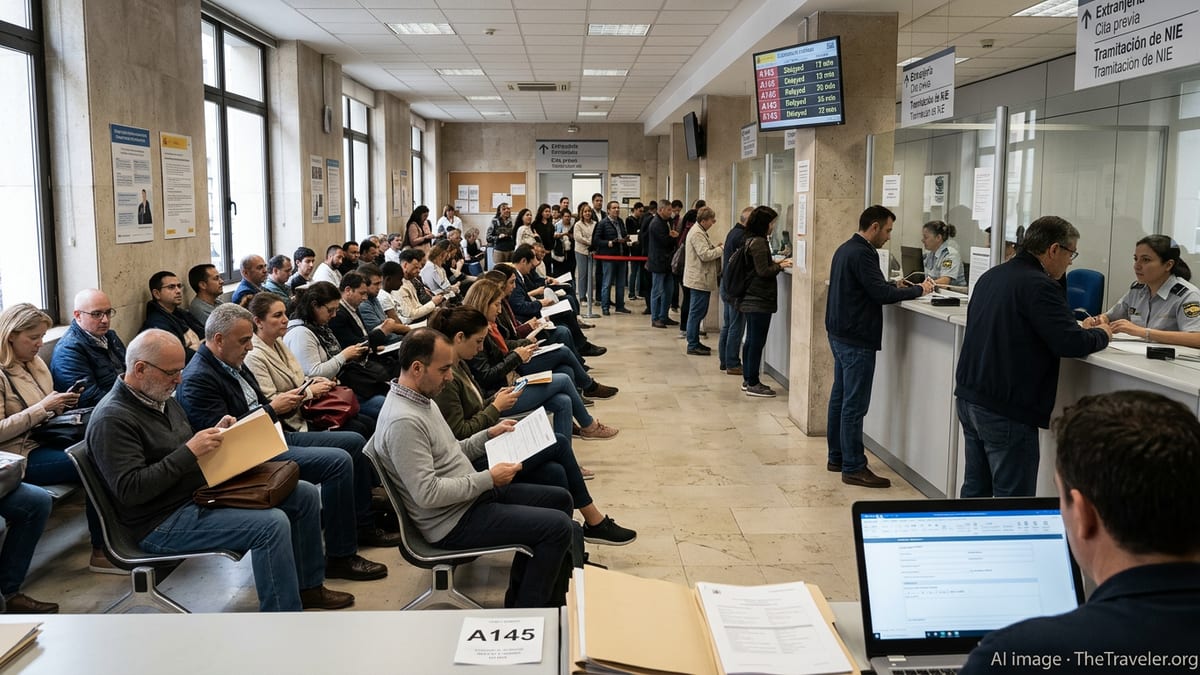
Foreign residents are disproportionately exposed to Spain’s bureaucratic complexity because key elements of their legal status depend on overburdened offices. Recent reports from civil society and professional associations highlight "months-long waits" or complete inability to secure appointments for renewing residence permits, applying for asylum, or regularising employment. Demonstrations in late 2025 drew attention to what participants described as systemic delays, lack of staff, and insufficient resources leaving residents in prolonged uncertainty.([euroweeklynews.com](https://euroweeklynews.com/2025/11/13/foreign-residents-call-spains-immigration-process-a-nightmare-of-endless-waits-and-digital-chaos/?utm_source=openai))
The appointment system itself is a recurring friction point. Most immigration-related procedures require a cita previa booked through online platforms that routinely show no availability in high-demand cities. Relocating professionals and employers often resort to checking the system repeatedly at off-peak hours, using third-party intermediaries, or travelling to less congested provinces to obtain appointments. Reports from relocation service providers in 2025 and 2026 describe these appointment shortages as a primary operational risk for onboarding international staff, as delays in fingerprinting or card collection can disrupt work start dates and complicate compliance monitoring.([jobbatical.com](https://www.jobbatical.com/blog/spain-immigration-crisis-appointment-delays?utm_source=openai))
Delays are not limited to first-time permits. Renewals, status changes, and family reunification processes are also affected. This creates complexity for mobility planning, because employees who are otherwise integrated and stable may face unexpected gaps in documentary validity if renewals are not processed before expiry dates. While Spanish law in some contexts protects rights during processing, employers and individuals still must manage travel restrictions, banking, and other activities that depend on up-to-date physical documents.
From a corporate mobility perspective, Spain’s bureaucracy complexity score is elevated by these immigration-related bottlenecks. They require additional planning buffers, more intensive case management, and closer coordination between HR departments, legal advisors, and local authorities compared with some alternative European destinations with more predictable processing pipelines.
Comparative Indicators and International Benchmarking
International benchmarking provides context for Spain’s bureaucracy complexity relative to peer countries. OECD Product Market Regulation and administrative burden indicators show Spain above the average level of regulatory restrictiveness among advanced economies, particularly in areas related to licences, permits, and administrative opacity, although not among the most restrictive globally. These indicators identify administrative and regulatory burden as a factor contributing to the high share of microenterprises and obstacles to firm growth.([oecd.org](https://www.oecd.org/content/dam/oecd/en/topics/policy-sub-issues/product-market-regulation/Spain_PMR%20country%20note.pdf?utm_source=openai))
At the same time, digital government and e-services indicators paint a more favourable picture. Spain’s strong performance in DESI for digital public services and connectivity places it ahead of many EU peers in the availability of online tools, which can partially offset regulatory complexity. The combination suggests that Spain’s challenge is less about the existence of clear rules and more about the cumulative effect of multiple layers of approval, variable local implementation, and limited administrative capacity in high-demand areas such as immigration.([en.wikipedia.org](https://en.wikipedia.org/wiki/Internet_in_Spain?utm_source=openai))
Relocation decision makers should therefore interpret Spain’s bureaucracy complexity score as differentiated by domain. For business registration and mainstream e-government interactions, Spain performs near or slightly above EU averages in terms of speed and user experience, especially when processes are fully digitalised. For foreigner documentation and interactions that depend on physical appointments in extranjería or police offices, Spain currently exhibits significantly higher complexity and uncertainty than its aggregate digital scores might suggest.
Against some alternative destinations that also face immigration backlogs, such as Portugal, Spain’s situation is challenging but not unique. Comparative reporting shows multi-hundred-thousand case backlogs in neighbouring countries as well. However, this does not reduce the practical impact for assignees and companies, who must still navigate Spain’s particular mix of appointment scarcity, region-by-region differences and evolving policy changes.
The Takeaway
Spain’s bureaucracy complexity score for relocation can be summarised as moderate to high, with clear strengths in digital public services counterbalanced by structural fragmentation and capacity constraints. The system is rules-based and increasingly digital, but not consistently user-friendly for newcomers who must interact with multiple offices across different levels of government.
For relocating individuals, the main challenges are not the absence of clear legal frameworks but the practical ability to move through them in a predictable timeframe. Appointment bottlenecks, processing backlogs, and regionally inconsistent practices mean that even simple procedures can take significantly longer than official guidelines suggest. Those with strong local guidance, language skills, and early access to digital credentials will experience lower effective complexity than those attempting to navigate the system alone.
For employers and global mobility teams, Spain remains a viable and attractive destination, but one that requires conservative lead times and careful process mapping. Incorporating realistic processing timelines, allowing for appointment scarcity, and budgeting for specialist support will materially reduce risk. In exchange, organisations benefit from a mature digital administration in many areas and a legal environment that, while complex, is generally stable and transparent.
Overall, Spain’s bureaucracy is evolving, with reforms aimed at reducing administrative burden and improving interoperability. Until these efforts fully translate into day-to-day experience, however, relocation planners should treat Spain as a country where bureaucracy is manageable but non-trivial, and plan accordingly.
FAQ
Q1. Is Spanish bureaucracy significantly more complex than in other Western European countries?
Spain’s bureaucracy is generally more procedurally dense and slower than the most efficient Western European systems, but comparable to several southern European peers and moderated by strong digitalisation.
Q2. Which bureaucratic areas are most problematic for foreign residents in Spain?
The most problematic areas are immigration related procedures that depend on foreigners’ offices and police appointments, including residence permits, card issuance, renewals, and some family reunification processes.
Q3. How much time should relocating professionals budget for key administrative steps?
While legal time limits are often shorter, practical experience suggests budgeting several extra months for residence related procedures, especially in large cities where appointment backlogs are common.
Q4. Does Spain’s advanced digital government make the bureaucracy easy to handle?
Digital tools reduce paperwork and allow many processes to be started online, but do not eliminate complexity arising from fragmented competences, inconsistent local practices, and the need for in-person verification in many cases.
Q5. Are there large differences in bureaucratic complexity between Spanish regions?
Yes, processing times, appointment availability, and administrative culture vary noticeably between autonomous communities and even between provinces, making local conditions a key factor in complexity.
Q6. How predictable are administrative timelines in Spain?
Timelines are moderately predictable for routine digital procedures, but considerably less predictable for immigration related or high-demand processes, where backlogs and staffing shortfalls lead to frequent overruns.
Q7. Can companies significantly reduce complexity for their assignees?
Companies can reduce effective complexity by planning well in advance, using experienced local providers, securing appointments early, and coordinating closely with employees on documentation and digital identity setup.
Q8. Does speaking Spanish materially change the bureaucracy experience?
Spanish proficiency generally improves outcomes by making it easier to navigate websites, complete forms accurately, communicate with officials, and resolve errors, thereby lowering the perceived complexity.
Q9. Is Spain actively working to reduce bureaucratic burden?
Yes, Spain is implementing regulatory simplification and digital government reforms, and there are signs of improvement in some areas, though immigration related offices remain under particular strain.
Q10. How should Spain’s bureaucracy complexity affect relocation decisions?
Spain’s bureaucracy should be treated as a manageable but non-negligible risk factor, requiring extra lead time and support, rather than a prohibitive barrier to relocation.