


More news on this day
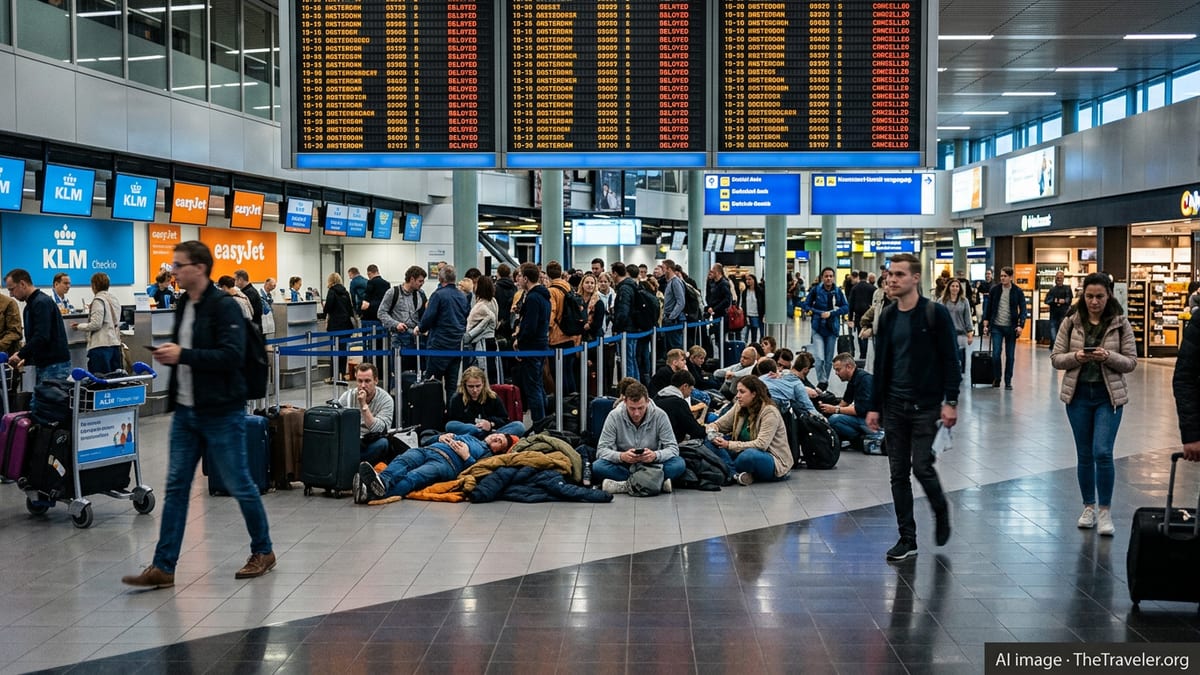
Amsterdam Schiphol Airport faced another difficult travel day as seven flight cancellations and 242 delays involving services operated by KLM, Transavia Airlines and easyJet disrupted key European routes, affecting passengers bound for London, Paris, Frankfurt, Barcelona, Rome and Dublin.
Get the latest news straight to your inbox!
Fresh Disruptions Hit a Major European Hub
The latest disruption at Schiphol adds to a season of operational strain across Europe, where flight-tracking data and recent travel reports show elevated levels of delays and schedule changes at leading hubs such as Amsterdam, London Heathrow and Paris Charles de Gaulle. Publicly available information indicates that Amsterdam was among several airports reporting high numbers of delayed departures on Friday 12 June, underscoring how quickly congestion can spread across the network when punctuality slips.
The seven cancellations reported at Schiphol are modest in absolute terms but significant in context, coming alongside more than two hundred delayed movements. That imbalance between relatively few outright cancellations and a large volume of late departures suggests airlines and the airport have been attempting to preserve as much of the schedule as possible, even at the cost of extended waiting times and tight connections.
The affected services involve three key players in the Dutch and broader European market. KLM remains the dominant carrier at Schiphol, while Transavia, part of the Air France KLM group, and low cost rival easyJet together handle a substantial share of leisure and point to point traffic on popular European city and holiday routes.
Recent analyses of jet fuel costs and airline operations in Europe have highlighted how carriers are already under pressure from sharply higher operating expenses and a busy summer travel season. In that environment, days with heavy delay volumes leave little slack in schedules, making any disruption more keenly felt by passengers.
Key Routes to London, Paris and Frankfurt Affected
The latest round of disruptions has had a particular impact on routes linking Amsterdam with other major European hubs, including London, Paris and Frankfurt. Traffic between these cities typically includes a mix of business travellers, transfer passengers using Schiphol as a connecting point, and short break tourists taking advantage of dense frequencies and competitive fares.
These corridors are among Schiphol’s busiest links, with London and Paris ranking near the top of the airport’s destination list in normal years. As a result, even a relatively small number of cancellations can translate into a large number of affected passengers, especially when combined with widespread delays that ripple through subsequent rotations on the same aircraft.
Schiphol’s role as a connecting hub means that missed onward flights are a particular concern. When services to London Heathrow or Paris Charles de Gaulle depart late or are cancelled, travellers may lose intercontinental connections operated by partner airlines from those airports, compounding the disruption. Reports from recent weeks across Europe show similar patterns at other hubs, where a single late inbound flight can cause knock on effects for the rest of the day’s schedule.
Frankfurt, another major European gateway, has also experienced waves of cancellations and delays in recent months, including an incident in May when dozens of departures from German hubs were removed from the schedule. Those events underline how closely interlinked the region’s air traffic flows have become and how quickly operational problems can transmit from one airport to another.
Leisure Routes to Barcelona, Rome and Dublin See Knock-On Effects
Beyond the big hub to hub sectors, the disruptions at Schiphol have also hit high demand leisure destinations such as Barcelona, Rome and Dublin. These routes are important for both KLM and Transavia, while easyJet competes strongly on city pairs like Amsterdam to Barcelona and various UK points, drawing large numbers of price sensitive travellers.
In the early stages of the summer season, flights to Mediterranean and city break destinations typically operate with high load factors, leaving limited spare capacity to re accommodate passengers when irregular operations occur. A single cancellation on a route like Amsterdam to Barcelona or Amsterdam to Rome can fill remaining seats on later services, sometimes forcing travellers to accept routings via other hubs or to postpone their trips.
Publicly available flight listings for recent days show heavy demand on Schiphol departures to these cities, with airlines in several cases operating closely timed waves of departures in the morning and late afternoon. When delays affect the first of those waves, aircraft and crew can quickly fall out of their planned sequence, increasing the risk that later flights will depart behind schedule or be consolidated.
Dublin, while smaller than some of the other hubs, serves as both a leisure and connecting point for transatlantic travel. Disruptions on the Amsterdam to Dublin corridor can therefore have secondary effects for travellers connecting onward to North America or regional destinations in Ireland and the United Kingdom.
Airlines Navigate Tight Capacity and Cost Pressures
The operational picture at Schiphol comes against a backdrop of tighter capacity and higher costs across the European airline industry. Industry figures published in recent weeks indicate that jet fuel prices in Europe remain significantly elevated compared with the previous year, prompting carriers to scrutinise their schedules and, in some cases, to reduce frequencies or withdraw marginal routes temporarily.
Reports on airline strategy show that some European carriers, including members of the Air France KLM group, have already announced targeted cancellations and frequency adjustments for the late spring and early summer period. These measures are described as efforts to manage fuel costs, address crew and aircraft availability, and maintain reliability on core routes by reducing operational strain.
Operational flexibility at Schiphol itself has also been a recurring theme over recent months. Previous episodes of adverse weather, staffing constraints and infrastructure limitations have occasionally led to reduced runway capacity and slot adjustments, requiring airlines to trim their flying programmes on specific days. While the current disruption is not publicly linked to a single cause, it fits within a broader pattern in which airports and airlines must balance demand with the practical limits of their systems.
For carriers such as KLM, Transavia and easyJet, the priority in such situations tends to be preserving connectivity on key markets while using tactical cancellations on less time sensitive flights to free up aircraft and crews. The resulting network wide knock on effects, however, can still be considerable when hundreds of flights operate from the same hub over the course of a day.
Passenger Options and What Travellers Can Expect Next
For passengers caught up in the latest disruptions at Schiphol, standard rebooking and refund mechanisms remain the primary tools for resolving travel plans. Airline self service platforms typically allow travellers whose flights are cancelled or heavily delayed to select new dates or alternative routings without additional fare costs, subject to seat availability on comparable services.
Publicly available guidance from airlines such as KLM describes options that may include moving travel to a later date on the same route, rerouting via other hubs within an alliance network, or, in some circumstances, requesting a refund when a delay or cancellation meets specified thresholds. Similar policies are in place at low cost carriers, although the precise conditions and entitlements can differ by airline and by fare type.
For those with onward connections from London, Paris, Frankfurt, Barcelona, Rome or Dublin, the current environment underscores the value of planning for potential irregular operations. Travel advisories and recent coverage encourage passengers to monitor their flight status frequently on the day of departure, allow extra time for transfers, and keep essential items in hand luggage in case checked baggage is delayed.
With the main European holiday period approaching, aviation analysts note that even relatively small operational disturbances can translate into significant queues and longer processing times when airports are running near capacity. The latest day of seven cancellations and 242 delays at Amsterdam Schiphol illustrates how quickly a busy schedule can come under strain, and suggests that travellers using major European hubs this summer should be prepared for occasional disruption alongside generally improving traffic volumes.