


More news on this day
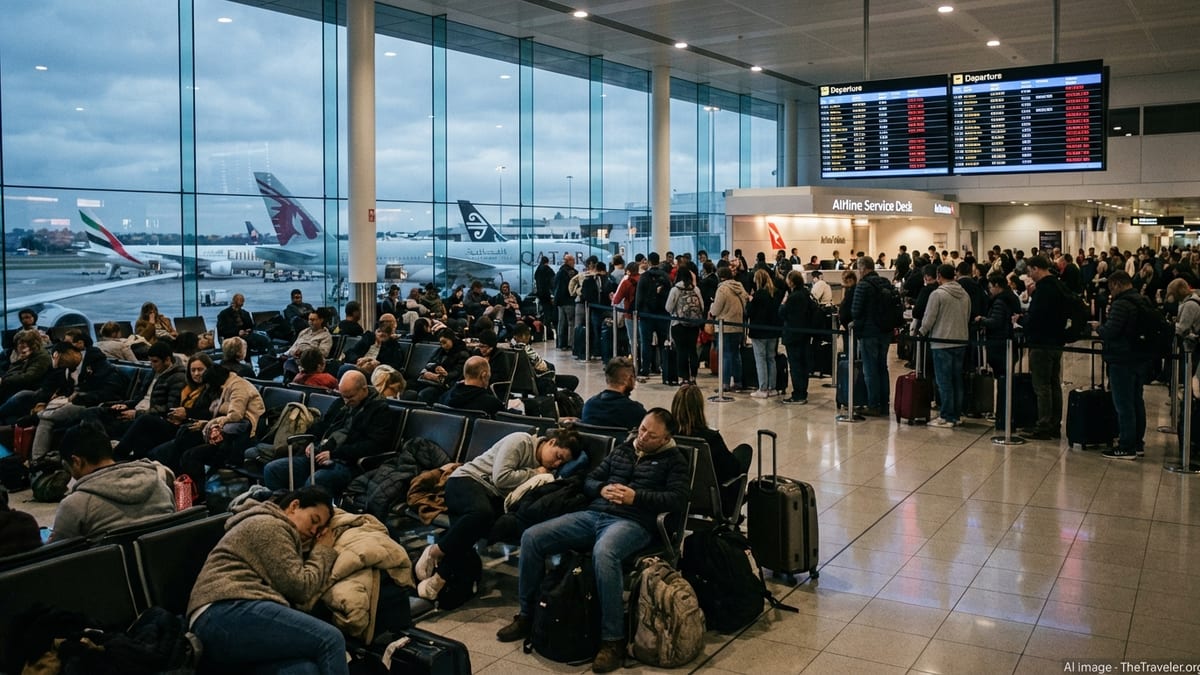
Passengers traveling between Australia and New Zealand are confronting widespread disruption, with operational data indicating 249 delayed flights and three cancellations affecting services in and out of Melbourne, Sydney and Auckland on Wednesday.
Get the latest news straight to your inbox!
Delays Ripple Across Major Trans-Tasman Gateways
Operational tracking platforms and airport information boards show that delays are affecting a high volume of services linking Melbourne, Sydney and Auckland, including key trans-Tasman and domestic feeder flights. The disruption is concentrated in peak travel banks, amplifying the impact on passengers attempting to connect between Australia and New Zealand.
Publicly available flight-status data indicates that carriers including Virgin Australia, Jetstar, Qantas and Air New Zealand are all experiencing schedule pressure across their networks. While the majority of flights are still operating, late departures and arrivals are accumulating, particularly on popular routes such as Sydney to Auckland, Melbourne to Auckland and domestic services that feed into those international departures.
Airport information pages for Auckland show more than a hundred scheduled movements today, with multiple services from both Australian east-coast hubs marked as delayed. Similar patterns are visible on flight-status trackers for Melbourne and Sydney, where trans-Tasman flights that normally operate tightly timed rotations are now departing behind schedule, sometimes by more than an hour.
The concentration of delays in these three hubs is creating a knock-on effect across the broader Australia–New Zealand network. Passengers connecting from secondary cities such as Wellington, Brisbane and Adelaide into Melbourne, Sydney or Auckland are experiencing additional uncertainty as airlines attempt to recover their timetables.
Weather, Congestion and Operational Constraints Combine
Reports from aviation data providers suggest that a mix of weather-related constraints, air-traffic congestion and routine operational issues is contributing to the disruption. Low cloud and reduced visibility have periodically slowed arrivals and departures at major airports, forcing ground controllers to space aircraft more widely and leading to short-term backlogs.
At the same time, peak-hour congestion in Sydney and Melbourne continues to place strain on airline schedules. When one flight in a tightly planned sequence departs late, subsequent rotations often inherit that delay, especially on short- to medium-haul sectors such as those across the Tasman Sea. These patterns are consistent with government statistics that show punctuality across Australasian routes is sensitive to both weather and traffic flows.
Recent aviation performance reports for Australia and New Zealand highlight that while average cancellation and delay rates across the industry remain within historical ranges, individual days with adverse operating conditions can produce significant spikes in disruption. Today’s tally of 249 delayed flights and three cancellations appears to reflect one such spike, concentrated on busy trunk routes linking the major hubs.
Ground operations are also under pressure as airlines manage aircraft turnarounds, crew availability and refuelling within constrained time windows. Even modest delays at the gate can snowball across a day’s schedule, particularly when aircraft are tasked with multiple return services between Australia and New Zealand.
Impact on Passengers in Melbourne, Sydney and Auckland
The immediate effect for travellers has been longer waits at departure gates, missed connections and the need to adjust onward plans. In all three cities, passengers on delayed services report extended time in terminal lounges as departure times are progressively pushed back in response to evolving operational conditions.
For those with tight domestic or international connections, the disruption is particularly challenging. Because trans-Tasman flights often feed into long-haul services to North America, Asia and Europe, late arrivals into Sydney, Melbourne and Auckland can jeopardize same-day onward travel. Some travellers are being rebooked onto later flights or rerouted through alternate hubs when connections become unworkable.
Families and business travellers are both affected, with school holidays and corporate travel combining to keep loads high on many of the disrupted services. Travel industry observers note that high seat occupancy limits the flexibility airlines have to redistribute passengers when flights are significantly delayed or cancelled.
Airport services such as car rentals, hotel shuttles and local public transport are also feeling secondary effects, as pick-up times shift and late-night arrivals become more common. In some cases, passengers arriving after midnight may find reduced local transport options compared with standard evening schedules.
How Airlines Are Responding to the Disruption
Public travel-update pages and airline advisories show that carriers are attempting to manage the disruption through schedule adjustments, rolling delays and a small number of cancellations. In some instances, flights have been combined or retimed to consolidate capacity, while others have been withdrawn from the schedule when recovery within the day appears unlikely.
Qantas and its low-cost rival Jetstar, as well as Virgin Australia and Air New Zealand, have issued general guidance in recent months on managing irregular operations, encouraging passengers to monitor their bookings through airline apps and online tools. These channels provide real-time information about departure times, gate changes and alternative options when flights are significantly delayed.
Where same-day reaccommodation is possible, passengers are being moved onto later departures, though high load factors on popular city pairs limit available seats. For the three cancellations recorded across the network today, affected travellers are being placed on subsequent services, subject to availability, or offered revised itineraries via different airports.
Operational data suggests that airlines are also adjusting aircraft rotations and crew pairings in an effort to restore schedule reliability over the coming days. This may involve temporarily reducing frequencies on certain off-peak services so that resources can be concentrated on core trunk routes between Melbourne, Sydney and Auckland.
Advice for Travellers Heading Across the Tasman
Given the scale of today’s disruption, travel specialists recommend that passengers flying between Australia and New Zealand build additional time into their itineraries. This is particularly important for those connecting to long-haul services or time-sensitive events such as cruises, conferences or family occasions.
Industry guidance commonly advises travellers to check in online as early as possible, monitor flight-status notifications closely and be prepared for gate or time changes right up until boarding. Passengers with flexible tickets may wish to consider moving to earlier flights in the day, where available, to reduce the risk posed by cumulative delays later in the schedule.
Those departing from or arriving into Melbourne, Sydney and Auckland are also encouraged to plan for possible transport changes on the ground, such as later-than-expected arrivals that affect train and bus connections. Keeping hotels and transfer providers informed of updated arrival times can help smooth onward travel, particularly in the case of late-night disruptions.
While today’s figure of 249 delayed flights and three cancellations stands out, historical performance data suggests that such peaks are sporadic rather than constant. Nevertheless, with busy winter travel periods approaching in both Australia and New Zealand, travellers may benefit from maintaining a cautious buffer in their plans when crossing the Tasman.