


More news on this day
Delta Air Lines says it has restored an automated system used to calculate aircraft weight and balance after a technical issue on November 22 caused hours of delays for flights to and from Hartsfield-Jackson Atlanta International Airport and disrupted operations across its U.S. network during one of the year’s busiest travel periods.
Get the latest news straight to your inbox!
What happened to Delta’s system in Atlanta
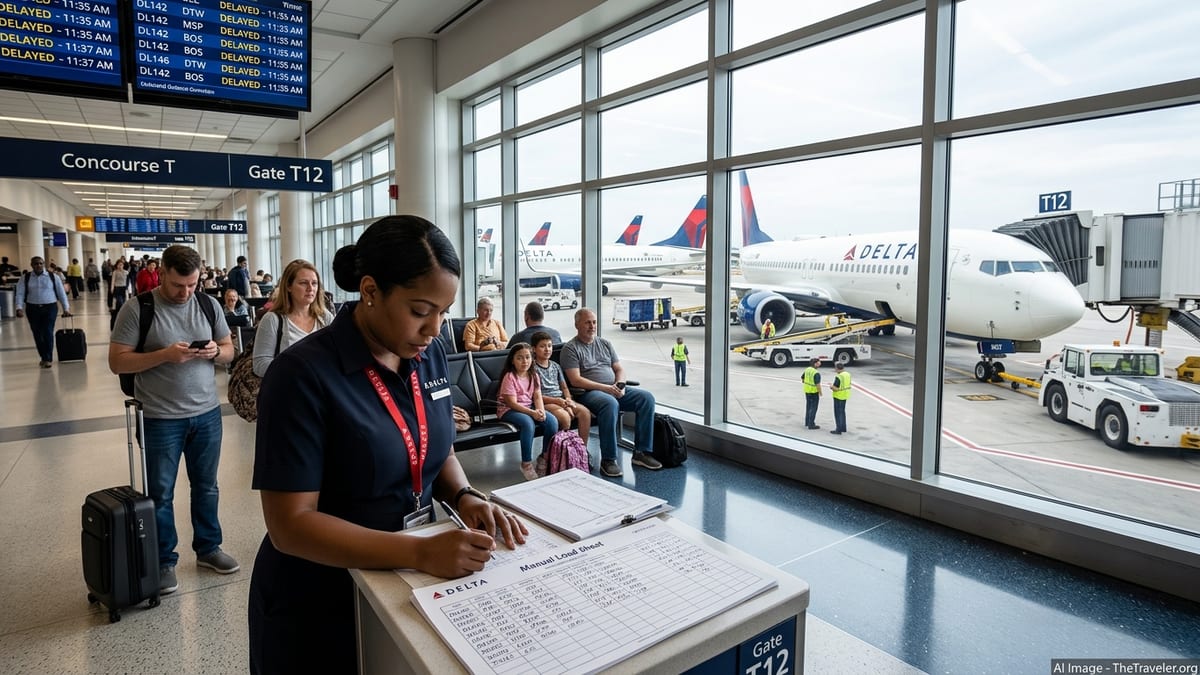
According to Delta and the Federal Aviation Administration, the disruption began on Sunday, November 22, when an automated system that calculates weight and balance figures for departing Delta flights malfunctioned. The system is a core part of flight planning, used to determine how passengers, baggage, cargo and fuel are distributed across an aircraft before takeoff. When the automation failed, the airline said it reverted to manual procedures to keep flights operating safely while engineers worked to restore normal service.
The problem primarily affected Delta flights at Hartsfield-Jackson Atlanta International Airport, the carrier’s largest hub and the world’s busiest airport by passenger volume. However, because the system supports flights across Delta’s network, delays were reported nationwide. Flight-tracking data compiled that day showed that a majority of Delta-operated services experienced some form of disruption, from modest schedule slips to multi-hour delays.
As the issue unfolded, Delta requested traffic management measures for its Atlanta hub. The FAA implemented a temporary ground stop for some Delta flights bound for Atlanta, pausing departures to prevent congestion on the ground while aircraft already at the airport were processed using manual weight and balance calculations. The ground stop was later downgraded to a ground delay program as operations slowly resumed, but schedule knock-on effects continued into the evening.
Scale of delays and how long the disruption lasted
The technical problem occurred at the start of the U.S. Thanksgiving travel week, when passenger numbers and aircraft utilization are both unusually high. On November 22, flight-tracking services reported that more than half of all Delta flights were delayed, with thousands of passengers facing late departures and missed connections. At Atlanta alone, a substantial share of Delta-operated departures and arrivals ran behind schedule as the airline worked through a growing queue of aircraft waiting for manual dispatch procedures.
Delta has said that a large majority of the day’s schedule changes were directly linked to the automation failure, with the remainder caused by weather-related constraints elsewhere in the network. Because the issue affected a system that feeds into flight release processes, many aircraft could not push back from the gate until manual calculations were completed and reviewed, a step that added time to each departure. At the same time, inbound aircraft faced arrival spacing controls into Atlanta while the ground operation worked with reduced efficiency.
The FAA’s ground stop affecting some Delta flights into Atlanta lasted on the order of an hour before being lifted once the airline’s manual workarounds were fully in place and traffic into the hub could be more predictably managed. Nonetheless, the operational impact extended well beyond that window. Delays built through the morning and early afternoon, and even after Delta announced that the automated weight and balance system had been restored, passengers reported that some flights were still being dispatched with manual calculations while the airline worked through the backlog and fully re-synchronized its operation.
How Delta resolved the issue and current status
By Sunday afternoon, November 22, Delta said the automation used for departing flight weight and balance calculations had been brought back online. In public statements, the airline emphasized that safety procedures were in place throughout the disruption and that dispatch and flight crews followed established manual processes in the absence of the automated system. Once engineers confirmed that the system was functioning correctly, Delta began transitioning flights back to the standard automated workflow.
The airline described operations as stabilizing on November 23, though some residual delays and irregularities persisted as crews and aircraft were repositioned and passengers were reaccommodated on new itineraries. For travelers, this meant that even after the underlying technology issue had been fixed, rebookings, crew duty-time limits and aircraft availability continued to affect schedules, particularly through connecting hubs like Atlanta, Detroit and Minneapolis.
As of late November 26, Delta and airport authorities are describing operations at Hartsfield-Jackson Atlanta International Airport as normal, with no continuing system issues related to the November 22 outage publicly reported. The incident is currently characterized as a resolved technology failure rather than an ongoing concern. However, the airline has not released detailed technical specifics about the root cause beyond identifying the affected system as its automated weight and balance calculation platform.
Why weight and balance systems matter for flight safety and timing
The weight and balance system at the center of this outage sits behind the scenes of every commercial departure. Airlines must calculate an aircraft’s total weight, including passengers, baggage, cargo and fuel, and determine how that weight is distributed along the fuselage. These figures feed into performance calculations for takeoff and landing, including required runway length and engine power settings. In normal conditions, airlines use automated tools that pull data from check-in, baggage handling and load control systems to generate final numbers before departure.
When such systems are unavailable, airlines can revert to manual methods that use predefined passenger and baggage weight estimates and hand-calculated distribution checks. These methods are designed to maintain safety margins, but they are slower and more labor intensive, particularly at a large hub handling hundreds of departures a day. Every additional few minutes required for calculations and verification at the gate can quickly add up to system-wide congestion, especially when aircraft are tightly scheduled and turnaround times are short.
The November 22 incident demonstrates how a single technology issue affecting a critical planning system can ripple through an entire airline network. Even though the failure did not affect aircraft in flight or basic air traffic control services, it limited Delta’s ability to dispatch flights at normal speed from its busiest hub. That, in turn, required the FAA and the airline to introduce flow-control measures into Atlanta to prevent gridlock on taxiways and at gates, amplifying the passenger impact beyond those flights directly waiting on manual calculations.
Implications for travelers and what to expect next
For travelers, the most immediate consequence of the outage was extended waits at gates and on concourses at Atlanta and other Delta stations on November 22, along with missed connections and, in some cases, overnight delays when onward flights could not be rebooked the same day. Because the incident coincided with a peak travel period, options for reaccommodation were more limited than they might be during a normal week, and some passengers found themselves rerouted through alternative hubs or shifted to later days.
Delta has said it is working through the residual effects of the disruption, including repositioning aircraft, rebalancing crews and handling baggage that was delayed or misconnected during the irregular operations. Customers whose travel was affected are being advised to monitor their booking in the Delta app or through the airline’s website and to watch for schedule adjustments that may be made as operations continue to normalize. At present, there is no indication of additional system outages connected to the November 22 event, but schedules around the Thanksgiving holiday remain tight across U.S. airlines, and relatively small disruptions can still cause noticeable knock-on effects.
Travelers flying with Delta through Atlanta and other hubs in the coming days should allow extra time at the airport, especially if they are connecting or checking baggage, and should pay close attention to gate displays and notifications. While the automated weight and balance system is now reported to be functioning and the FAA’s special traffic management measures for Delta flights into Atlanta have been lifted, occasional residual delays may appear as the airline finishes untangling its network. Anyone holding flexible plans may wish to check whether travel waivers or change-fee options are available for their specific dates, and all passengers should verify the latest flight status before leaving for the airport.