


More news on this day
Chicago O’Hare International Airport is moving into the heart of the 2026 Thanksgiving travel period with rolling flight delays and lingering schedule disruptions after multiple Federal Aviation Administration ground stops and an air-traffic equipment outage earlier in the week, affecting passengers across one of the nation’s busiest hubs.
Get the latest news straight to your inbox!
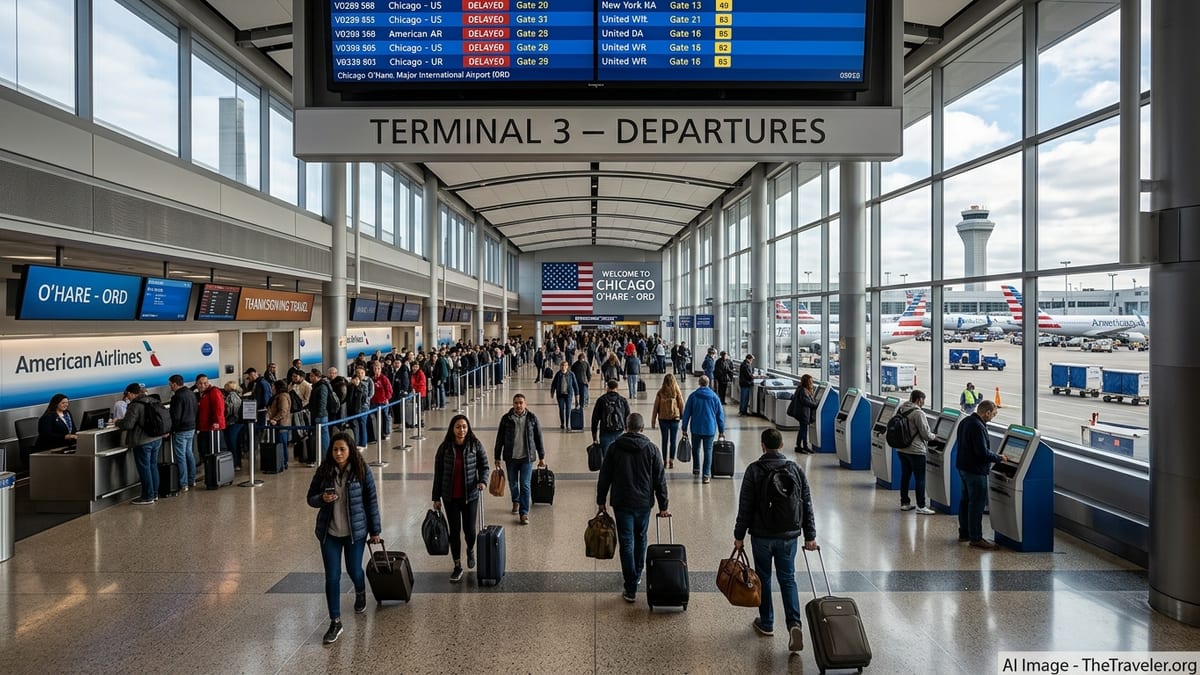
Ground stops and outage ripple into the Thanksgiving peak
O’Hare’s most serious disruption ahead of Thanksgiving occurred on Tuesday, 24 November 2026, when the Federal Aviation Administration briefly halted departures and arrivals while technicians worked to repair a piece of air traffic equipment serving the airport. The ground stop, which was later replaced by a ground delay program, continued to affect operations into the evening, leaving many flights operating behind schedule even after the formal halt was lifted.
Two days earlier, on Monday, 23 November, the FAA also ordered a separate ground stop at O’Hare linked to staffing issues in Chicago-area air traffic control facilities. That pause lasted around an hour and a half before being lifted, but it added to a patchwork of delays just as the holiday travel rush was building. Local television coverage and FAA statements indicated that average delays by Monday evening had fallen to under 15 minutes, although some individual flights were affected more heavily.
By Wednesday, 25 November, local and national outlets were reporting that operations at O’Hare and nearby Midway were largely stable, with only modest delays relative to typical pre-holiday traffic. However, the FAA’s use of a ground delay program following the Tuesday outage meant that many flights were rescheduled into slightly wider windows. That adjustment helped prevent congestion from building again but continued to create pockets of late departures and arrivals for passengers connecting through Chicago on the eve of Thanksgiving.
How operations look on Thanksgiving Day at O’Hare
As of Thursday morning, 26 November 2026, live tracking data from O’Hare showed a pattern of scattered delays rather than the systemwide gridlock seen during earlier disruptions. The Chicago Department of Aviation’s public flight-status tools indicated that most airlines were operating, but with a noticeable number of departures and arrivals running late, particularly during the early morning and mid-day banks tied to cross-country connections.
Major carriers with hubs at O’Hare, including United Airlines and American Airlines, have not reported a new outage or formal schedule reduction specific to Thanksgiving Day itself. Instead, the delays appear to be the combined result of residual impacts from earlier ground stops, aircraft and crew positioning challenges across the national network after recent technology-related disruptions at several U.S. airlines, and the sheer volume of holiday traffic moving through the airport.
Transportation officials have repeatedly emphasized that safety-related constraints will continue to take precedence over on-time performance as the long holiday weekend progresses. In practice, that means travelers at O’Hare may still see short-notice departure-time revisions or holding patterns on the tarmac at peak periods, even when skies over Chicago are relatively clear and no new formal ground stop is in place.
Weather, FAA rules and demand add pressure to the schedule
Weather has been another important variable for O’Hare heading into Thanksgiving. Forecasts from national meteorological services and private weather outlets over the last several days have highlighted the potential for rain and low clouds across parts of the Midwest during the holiday period. Even moderate reductions in visibility or ceiling height can force controllers to increase the spacing between aircraft on approach and departure at a tightly scheduled hub such as O’Hare, which in turn reduces the number of flights that can move per hour.
At the same time, recent FAA rules affecting operations at both O’Hare and Midway are shaping how airlines and air traffic managers handle peak periods. An order extending limitations on the number of scheduled operations at O’Hare through October 2027 remains in effect, designed to prevent the airport’s runway system and surrounding airspace from becoming oversaturated. In theory, such caps should reduce the risk that a single disruption cascades into hours of gridlock. In practice, this Thanksgiving week has shown that even constrained schedules can be vulnerable when staffing or equipment problems arise.
Demand patterns are also amplifying pressure on O’Hare’s schedule. Transportation and automobile clubs project that more than 80 million Americans will travel at least 50 miles from home between Tuesday, 24 November, and Monday, 30 November 2026, with nearly 6 million expected to fly over the same period. Chicago’s aviation authorities anticipate that around 2 million passengers will pass through O’Hare and Midway combined across the week. The heaviest days for air travel nationally are forecast to be the Wednesday before Thanksgiving and the Sunday after, both of which are historically prone to delays and missed connections at large hubs.
Impacts for connecting and departing passengers at O’Hare
For travelers, the operational picture at O’Hare translates into longer-than-usual connection times and additional uncertainty about arrival times, even when flights are not formally canceled. Historical data compiled from recent Thanksgiving periods show that O’Hare typically sees a higher proportion of disrupted departures during the holiday window than during surrounding weeks, with the Sunday after Thanksgiving consistently ranking as the most delay-prone day. That history, combined with this week’s ground stops and equipment outage, suggests that passengers should treat schedules as approximate and allow extra time for onward ground transportation.
On Thursday itself, some airlines serving O’Hare were still working through repositioning aircraft and crews that had been displaced by both the Chicago-area disruptions and other recent national issues, including computer glitches at major carriers earlier in the week. Even when O’Hare’s own operations are relatively smooth, knock-on delays from other hubs such as Atlanta or Newark can result in late inbound aircraft, which then push back departure times from Chicago.
Domestic passengers connecting through O’Hare may be particularly affected when their incoming flight originates in a region dealing with adverse weather or where local ground stops are in place. Because current FAA traffic management initiatives are often targeted at specific airports or airspace sectors rather than nationwide, a delay in one region can ripple unevenly into another. International services, especially overnight departures, can also be vulnerable if crews reach duty-time limits after earlier delays, forcing last-minute substitutions and potential schedule changes.
Ground access, transit options and what travelers should verify next
Conditions on the ground around O’Hare are also shaping the Thanksgiving travel experience. Regional transportation agencies have warned of heavy highway congestion on the approach roads to the airport through the long weekend, particularly on Wednesday evening and Sunday afternoon. The state tollway authority expects notably higher vehicle volumes across its system, which includes key corridors for drivers heading to O’Hare’s parking facilities and nearby hotels. This may lengthen the time required to reach the airport even if a passenger’s flight is operating close to schedule.
Public transport to the airport is running but not immune to delays. The Chicago Department of Aviation has encouraged travelers to consider rail options to avoid road backups around the terminals, while also noting that one commuter rail line serving a station near O’Hare does not operate on Thanksgiving Day or weekends. Local riders have additionally reported Blue Line delays during the early morning hours on some recent days, underscoring the value of building in a buffer when using public transit for airport access.
Looking ahead to the remainder of the Thanksgiving period, travelers using O’Hare are advised to monitor their flight status frequently through airline apps or official airport channels, particularly on Sunday, 29 November, when departure disruption rates are historically highest. Passengers should also check for any active travel waivers or flexible rebooking policies issued by their airline, especially if their plans are sensitive to arrival times or if they are connecting to cruises, long-distance rail services or fixed tour departures. While there is no indication of a new systemwide shutdown at O’Hare on Thanksgiving Day itself, the combination of elevated demand, unsettled weather patterns and recent air traffic control disruptions means that conditions can change quickly and schedules may continue to shift with limited notice.