


More news on this day
US aviation investigators now believe a misconfigured router at a Federal Aviation Administration radio site in Arkansas likely triggered the November 13 nationwide ground stop that disrupted tens of thousands of flights across the United States, highlighting vulnerabilities in the country’s aging air traffic communications network and the systems that oversee it.
Get the latest news straight to your inbox!
What investigators now think went wrong
The emerging technical picture, based on FAA explanations and briefings cited by senior US officials, centers on telecommunications work at a remote radio communications site near South Arkansas Regional Airport in El Dorado on Friday, November 13, 2026. L3Harris, the contractor that operates the FAA’s telecommunications network, was in the process of upgrading the facility from older copper wiring to fiber and bringing a new router online as part of a broader modernization of the National Airspace System’s communications backbone.
According to people briefed on the investigation, an overlooked configuration setting on the newly installed router caused it to interact poorly with older equipment that still forms much of the FAA’s nationwide network. Instead of integrating smoothly, the router began generating or relaying an unexpectedly high volume of traffic. That data surge overwhelmed legacy routers at multiple facilities, creating what officials have described as “instability” in radar feeds and radio links at 17 of the country’s 22 en route air traffic control centers.
The FAA has said in public question-and-answer material that its initial investigation pointed to two key locations as the origin of the network instability: the El Dorado radio site and a radar facility in Amarillo, Texas. While work at both locations is being reviewed, subsequent reporting indicates investigators have largely focused their reconstruction on what happened in Arkansas. Engineers working with the agency and its contractors have now reproduced the failure scenario in a laboratory environment, giving officials greater confidence that a specific router setting and its interaction with decades-old equipment were the root technical triggers.
The chain of events did not bring the entire system offline, but it created enough uncertainty about the reliability of communications and surveillance data that the FAA concluded it could not safely continue allowing normal flows of traffic. Some frequencies and radar feeds remained usable, allowing controllers to maintain contact with aircraft already in the air, but the agency moved quickly to halt most departures while trying to stabilize and then slowly rebuild its network.
From local failure to the longest ground stop in 25 years
The telecommunications problems began early in the afternoon of November 13 and swiftly cascaded across interconnected facilities. As the router-related traffic spike propagated, timing and routing issues developed on the FAA’s internal network, calling into question whether messages and radar data were reaching their intended destinations in real time. Within hours, the agency issued a rare nationwide ground stop, ordering all US departures holding at the gate to remain on the ground while technicians and controllers worked to contain the disruption.
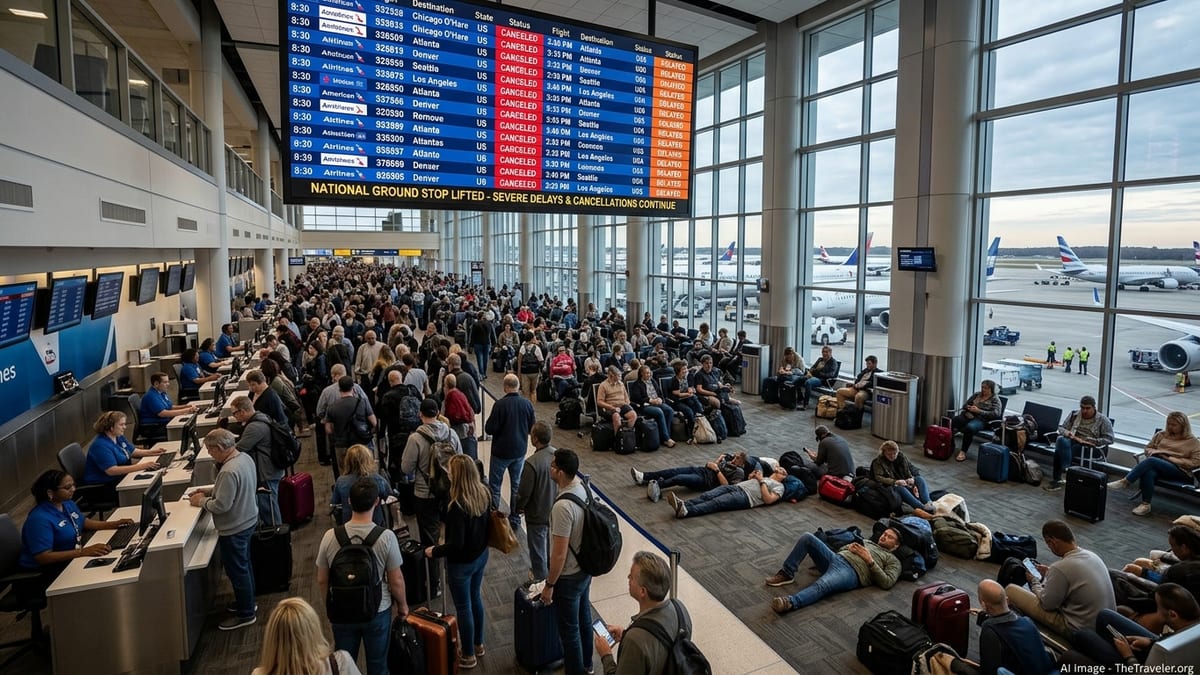
According to agency figures shared with lawmakers and in public Q&A material, the halt in departures lasted about four hours and 45 minutes before being lifted that evening, making it the most extensive ground stop imposed by the FAA since the aftermath of the September 11, 2001 attacks. During that period and the remainder of the day, airlines canceled more than 12,000 flights and delayed thousands more. Some carriers, including major US airlines, described it as an “extraordinary circumstances” event and warned customers that recovery would stretch into the weekend as aircraft and crews were repositioned.
Because en route centers handle high-altitude traffic over large swaths of territory, instability at 17 of the 22 such facilities had nationwide effects. Airports such as Chicago O’Hare, Atlanta, Denver and Dallas–Fort Worth saw departure boards quickly fill with ground-stop notices, followed by waves of cancellations as the duration of the disruption became clear. Passengers already in transit were often able to land, since controllers prioritized safely spacing and sequencing flights already in the air, but onward connections and evening departures were heavily affected.
Homeland security officials and the Transportation Secretary repeatedly stressed that there was no indication of a cyberattack or hostile intrusion. US intelligence agencies told the administration that, based on the information available, the event did not bear the hallmarks of an external hack. Investigators involved in the technical reconstruction have been quoted as saying they are highly confident the failure originated with configuration and compatibility issues during the router upgrade, although formal reports have not yet been published and the FAA continues to describe some aspects of the probe as ongoing.
Oversight of contractor maintenance under renewed scrutiny
Beyond the technical cause, the November 13 disruption has intensified scrutiny of how the FAA oversees private contractors responsible for key parts of its communications infrastructure. L3Harris provides and manages the telecommunications network that links many of the agency’s radar sites, radio facilities and air traffic control centers, and has been leading the multiyear effort to introduce new routers across that network as older devices are phased out.
In recent years, the FAA has streamlined its internal maintenance coordination structure, relying more heavily on a small number of liaison specialists who work with contractors on field upgrades and planned outages. Labor representatives say that where telecom changes once involved coordination from multiple FAA technical and operational staff, work like the El Dorado router replacement may now proceed with significantly fewer agency employees directly engaged in planning and sign-off.
The Professional Aviation Safety Specialists union, which represents many FAA technical employees, has criticized this evolution. Its president, David Spero, has argued that assigning just a handful of FAA liaisons to oversee telecommunications maintenance across the entire National Airspace System does not provide the depth of review such critical work requires. He has warned that shrinking the number of internal reviewers risks missing configuration risks and interactions between new and legacy equipment, especially in complex, partially modernized networks.
The FAA, for its part, has defended the overall framework, noting that it conducts ongoing risk assessments and that contractors such as L3Harris remain responsible for the design, deployment and day-to-day operation of their networks. The agency has emphasized that all work on operational systems is supposed to follow established engineering change and safety management processes. However, administrators have acknowledged that the ground stop has exposed vulnerabilities in both technical safeguards and governance, and they have pledged to cooperate with external reviews of how the El Dorado upgrade was planned, approved and executed.
Political, regulatory and traveler fallout
The ground stop’s timing, just ahead of the busy Thanksgiving travel period, ensured a rapid political response. Congressional transportation and commerce committees have demanded detailed explanations from the Department of Transportation and the FAA about how a maintenance task at a single radio site, involving a known interaction between new and old equipment, could cascade into a near-nationwide halt of flights. Lawmakers from both parties have requested documentation covering the router upgrade program, pre-deployment testing, change-control approvals and any contingency planning for failures.
In letters to the administration, members of Congress have questioned whether the event reflects deeper risks in the way the National Airspace System is being modernized. They have pointed to the age of many FAA systems, the growing complexity of integrating new digital infrastructure with legacy platforms, and the increasing role of outside vendors in day-to-day operations. Some have also drawn comparisons to earlier aviation IT disruptions, including the 2023 grounding related to the NOTAM system and airline-specific outages caused by software or data center problems, arguing that the sector’s resilience needs to be strengthened on multiple fronts.
For travelers, the November 13 failure translated into long lines, missed holidays, and in some cases, overnight stays in hub airports as airlines struggled to rebook passengers. The impacts were most severe for those traveling on the afternoon and evening of the outage, but knock-on effects continued into the weekend as aircraft were out of position and crew duty-time limits constrained how quickly schedules could be restored. While airports themselves remained open, ground transportation, hotels and car rental companies around major hubs reported surges in demand as passengers sought alternatives.
Consumer advocates have noted that because the disruption originated within federal infrastructure rather than an individual airline’s systems, options for compensation or statutory reimbursement were limited under current US rules. Several have suggested that future policy discussions around aviation reliability may need to consider how passengers are protected when system-wide infrastructure failures, rather than airline decisions, cause massive disruptions. For now, affected travelers have mostly had to rely on airline goodwill policies and travel insurance, where applicable, to recoup additional expenses.
What changes travelers can expect next
In the immediate aftermath of the ground stop, the FAA temporarily paused further installations of the same model of routers implicated in the failure, while allowing already-operational equipment to continue running under heightened monitoring. Investigators working with the router manufacturer and network operators have developed software and configuration changes designed to prevent any single device from flooding the wider system with traffic in the way the El Dorado unit apparently did. The agency has indicated that additional testing of those fixes is underway before any further rollout decisions are made.
Transportation officials have said they will provide a more detailed public accounting of the root cause once the technical investigation is formally closed, including any recommendations for procedural or architectural changes. The Transportation Secretary and the FAA Administrator are scheduled to testify before congressional panels, where they are expected to face questions about modernization funding, the balance between in-house expertise and contracted services, and what additional redundancy can be built into the network so that future localized failures do not require system-wide halts to ensure safety.
In practical terms, travelers are unlikely to see visible changes at airports in the near term as a direct result of the router failure. Air traffic control operations have largely returned to normal, and airlines are focused on managing routine weather and demand-related disruptions through the holiday period. However, passengers planning trips in the coming weeks may wish to build extra time into itineraries that involve tight connections, particularly when traveling through major hubs that felt the brunt of the November 13 disruption, and to keep an eye on airline and FAA communication channels for any updates related to ongoing modernization work.
Longer term, the incident is expected to influence debates over how quickly the FAA can and should replace aging infrastructure, how rigorously new systems are tested alongside legacy components, and what safeguards must be in place when maintenance or upgrades are performed on live networks. For now, the working conclusion from investigators is that the November 13 ground stop was the result of a preventable technical misconfiguration in a complex, partly modernized system rather than a deliberate attack, but formal findings and any mandated corrective actions will determine whether similar work can proceed without risking another nationwide halt to US air traffic.