


More news on this day
An overnight American Airlines flight from San Diego to Chicago was diverted to Phoenix early on November 25, 2026, after crew reported a serious onboard disturbance involving a passenger near an exit door, prompting an unscheduled landing and onward rebooking for the 160-plus travelers on board.
Get the latest news straight to your inbox!
What happened on American Airlines Flight 1494
American Airlines Flight 1494 departed San Diego International Airport late on Tuesday, November 24, 2026, on a scheduled red-eye service to Chicago O’Hare International Airport. The aircraft, operated by American on the San Diego–Chicago route, was carrying more than 160 passengers and crew when a disturbance broke out in the cabin during the cruise phase of the flight.
According to statements from the Federal Aviation Administration and Phoenix Police Department, the crew reported a passenger disturbance in the cabin shortly before 1:00 a.m. local time on Wednesday, November 25. Officials said the man left his seat and moved toward an exit door, where he attempted to manipulate the door handle before being stopped by crew members and nearby travelers. Authorities have not reported any injuries among passengers or crew.
The incident was classified as a security concern by air traffic controllers, who relayed reports of a “Level 3 threat” on board to Phoenix Sky Harbor International Airport. In aviation security guidance, such descriptions are used for serious disruptive behavior or threats that require immediate intervention and, in many cases, diversion to the nearest suitable airport.
Unscheduled diversion to Phoenix and police response
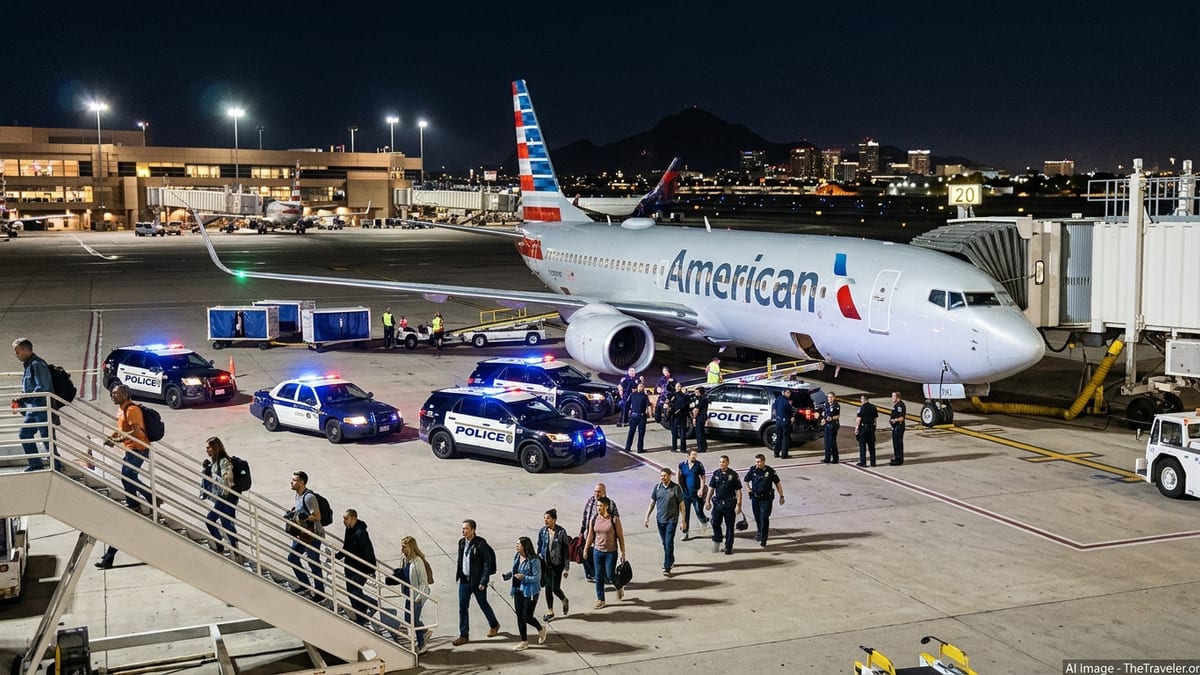
Following the disturbance, the cockpit crew elected to divert the flight to Phoenix Sky Harbor, the closest large airport with extensive emergency services and airline support facilities along the route. The aircraft landed safely at Sky Harbor at around 1:00 a.m. on November 25. Emergency services and law enforcement officers met the aircraft at a gate on arrival, a standard response for an in-flight security incident of this type.
The airline said in a written statement that Flight 1494 diverted to Phoenix “due to a disruptive customer” and confirmed that the aircraft landed without further incident. The passenger at the center of the disturbance was removed from the aircraft by Phoenix police officers. Police described the case as a passenger-related disturbance that began when the man ignored crew instructions to remain seated, moved toward the exit, and resisted attempts by staff to calm the situation.
Video recorded by travelers and later shared with local media shows several passengers assisting flight attendants in restraining the man in the aisle as the flight continued toward Phoenix. In the footage, cabin crew can be heard directing passengers to remain seated while individuals closest to the incident help hold the man on the floor until the aircraft lands. Authorities have not released the passenger’s name, and as of November 26 there has been no public information on formal charges, though police said the investigation remains open.
Impact on travelers and onward connections
For those booked on Flight 1494, the most immediate impact of the disturbance was the loss of a nonstop red-eye to Chicago and the knock-on disruption to early-morning connections from O’Hare. After the aircraft arrived in Phoenix and law enforcement completed their initial response, passengers were required to remain on board while officers removed the disruptive passenger and cleared the cabin. Travelers were then re-accommodated for onward travel to Chicago.
American Airlines has not publicly detailed the exact timing of the onward segment, but local reports indicate that most passengers reached Chicago later on Wednesday morning, several hours behind the original schedule. Those with same-day onward connections from O’Hare, particularly to East Coast or international destinations, would have needed to be rebooked. In similar diversion cases, airlines typically prioritize reaccommodation on their own flights, followed by interline options when necessary and when agreements allow.
The diversion also affected those meeting arriving travelers in Chicago. Flight tracking data reflected an unscheduled Phoenix stop and revised arrival estimate for O’Hare, and American’s status tools showed the service as diverted before updating to a new arrival time. For anyone planning to collect arriving passengers, it was necessary to monitor airline communication channels rather than rely on the original timetable. No injuries or medical emergencies have been reported as a result of the diversion or the restraint of the disruptive passenger.
Safety, aircraft doors and regulatory context
Reports that the man attempted to manipulate an exit door mid-flight are likely to be concerning for travelers, particularly those who fly overnight routes such as San Diego to Chicago. Aviation engineers and regulators emphasize that, on a pressurized commercial aircraft at cruising altitude, it is not physically possible for a single person to open a main cabin door. The pressure difference between the inside and outside of the fuselage, along with mechanical locking systems, keeps the door sealed until the aircraft is on the ground and the internal pressure has been equalized.
However, any attempt by a passenger to interfere with emergency exits or to move aggressively in restricted areas of the cabin is treated as a serious safety matter. Cabin crew are trained to respond quickly to such behavior, including by enlisting help from nearby passengers to restrain an individual if necessary, as appears to have happened on Flight 1494. The captain has wide discretion under federal regulations to divert a flight when they judge that safety or security could be compromised.
The Federal Aviation Administration tracks unruly passenger incidents and can initiate civil enforcement actions in more serious cases, including substantial fines. Criminal charges, when pursued, are typically handled by local or federal law enforcement depending on where the aircraft lands and the nature of the alleged behavior. As of November 26, official agencies have confirmed the diversion, the safe landing, and the removal of the passenger in Phoenix, but have not provided further details on possible FAA enforcement or court proceedings.
What travelers should know after a mid-flight diversion
From a traveler’s perspective, diversions like the one involving Flight 1494 generally unfold with little advance notice. Once a captain decides to divert, the priority is to land safely at an alternate airport with appropriate facilities. Only after arrival do passengers typically receive more detailed information about what will happen next. In many cases, the original aircraft continues to the intended destination once cleared, though crew duty-time limits, maintenance checks, and police investigations can all influence whether the plane and crew are able to continue.
For those booked on a diverted flight, the key practical step is to monitor the airline’s app or departure boards for new flight details rather than relying solely on gate announcements, particularly in the early morning hours when airport staffing is lighter. Travelers who miss onward connections because of a diversion that is not weather-related are generally rebooked without additional fare, subject to availability. Hotel or meal vouchers may or may not be offered, depending on the length of the delay, the time of day, and the airline’s policies.
Looking ahead, American Airlines has not indicated any schedule changes for the San Diego to Chicago route as a result of this incident, and the diversion is being treated as an isolated security case rather than a systemic operational issue. For now, the main remaining questions relate to how authorities will handle the case of the passenger removed in Phoenix. Until investigators release further updates, travelers can be certain only of what officials have confirmed: Flight 1494 diverted to Phoenix because of a serious onboard disturbance, landed safely, and its passengers eventually resumed their journeys to Chicago after an unscheduled overnight stop in Arizona.