


More news on this day
An overnight American Airlines flight from San Diego to Chicago diverted to Phoenix after a passenger allegedly tampered with an exit door and was restrained by crew and fellow travelers before being taken into custody on arrival, prompting delays and raising fresh questions about how airlines handle in-flight disturbances.
Get the latest news straight to your inbox!
What happened on American Airlines flight 1494
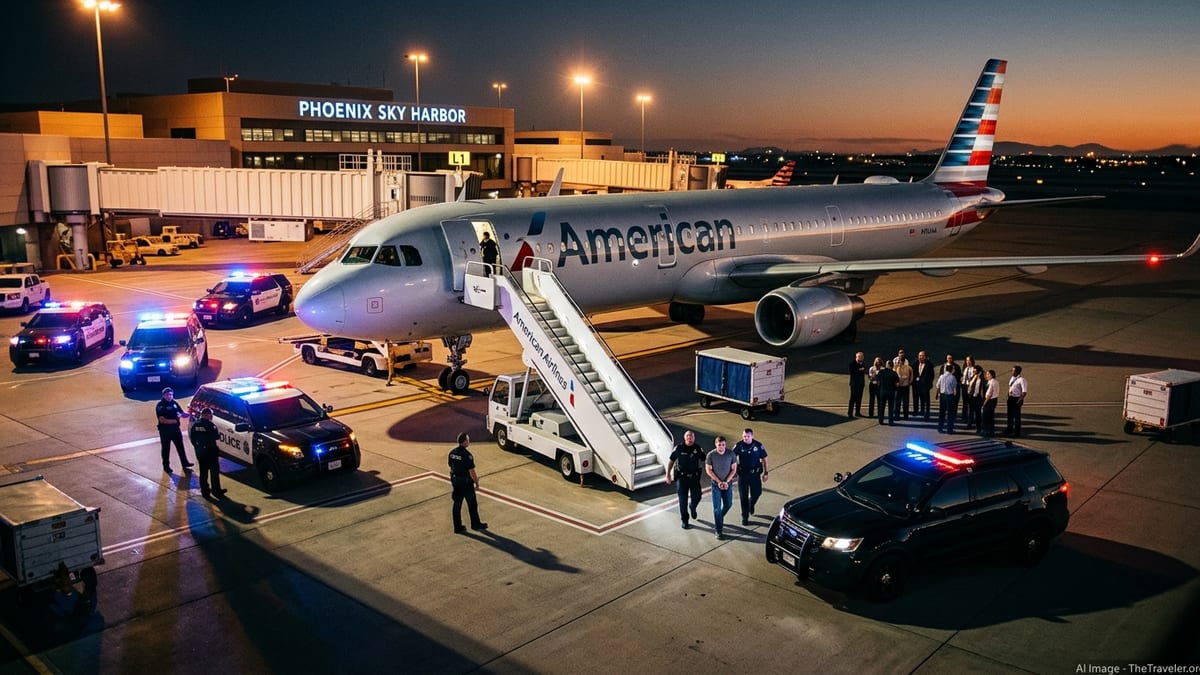
American Airlines flight 1494, a regularly scheduled red-eye service from San Diego International Airport to Chicago O’Hare International Airport, diverted to Phoenix Sky Harbor International Airport in the early hours of Wednesday, November 25, 2026. Multiple local outlets report that the Airbus narrowbody aircraft landed in Phoenix at around 1:00 a.m. local time after the cockpit reported what air traffic control described as a “Level 3 threat” on board, a classification typically used for serious security or safety concerns involving a passenger.
According to statements from American Airlines quoted by several news organizations, the Chicago-bound flight was diverted “due to a disruptive customer.” Passengers and Phoenix police provided further detail, saying the man at the center of the incident allegedly manipulated or attempted to manipulate one of the aircraft’s doors during cruise. Phoenix police said in a written statement that the crew reported a “passenger-related disturbance” and requested to divert to Sky Harbor so authorities could meet the aircraft.
While modern jet doors are designed so they cannot be opened at cruising altitude due to cabin pressurization and locking mechanisms, any attempt to interfere with an exit is treated as a serious safety event. Video recorded by people on board, shared with local television stations in Chicago and San Diego, shows several passengers and flight attendants restraining a man in the aisle near the middle of the cabin. Travelers interviewed after landing said cabin crew made an announcement about a disruptive passenger and asked for assistance before the diversion.
Timeline, response in Phoenix and passenger status
Based on airport and police information reported locally, flight 1494 departed San Diego late Tuesday night local time on November 24, operating as an overnight service to Chicago O’Hare. Roughly mid-flight, while the plane was over the southwestern United States, the situation with the passenger escalated and the crew informed air traffic control they needed to divert. Controllers vectored the aircraft to Phoenix, where the jet landed without further incident shortly after 1:00 a.m. on Wednesday, November 25.
Phoenix police officers and airport personnel met the aircraft at the gate. Law enforcement said the individual suspected of causing the disturbance was detained on arrival, removed from the aircraft and taken for questioning. Local reports indicate that the man was taken into custody, but as of November 26 there has been no public confirmation of specific charges or federal filings. The Federal Bureau of Investigation and federal prosecutors typically review such incidents, but any decision to prosecute often becomes public only after a complaint is filed, so some details may not yet be available.
American Airlines has confirmed that no injuries to passengers or crew were reported. After the diversion, the aircraft remained on the ground at Sky Harbor while police completed their work and the airline addressed what it called “operational concerns,” which can include crew duty-time limits, refueling and coordinating with dispatch. Passengers told local media that they were held on board for a period while law enforcement worked the jet’s aisle, then eventually disembarked into the terminal to await onward travel to Chicago.
Impact on passengers and onward travel to Chicago
Travelers on flight 1494 faced an unexpected overnight stop in Phoenix instead of a direct run to Chicago. Passengers interviewed by Chicago and Phoenix television stations described a tense period during the restraint itself, followed by a relatively calm arrival into Phoenix once the aircraft was on the ground. Some said fellow travelers acted quickly to help cabin crew subdue the man after it became clear he would not comply with instructions, which contributed to the crew’s decision to divert.
American Airlines has not publicly detailed the length of the delay each traveler experienced or whether the original aircraft continued on to Chicago after the diversion. Local coverage indicates the flight was significantly delayed while the airline worked through security, staffing and scheduling requirements. On occasions like this, carriers may choose between operating the original plane onward, assigning a new crew, or reaccommodating passengers onto later flights, depending on crew duty limits, aircraft positioning and nighttime operating constraints at both the diversion and destination airports.
For customers booked on the affected service, the main impact was arrival timing into Chicago and any missed onward connections out of O’Hare. Under current U.S. rules, airlines are not automatically obliged to pay cash compensation for disruption caused by unruly passengers. However, carriers frequently offer hotel accommodation or rebooking at no additional cost when an unexpected overnight stay results from a diversion, particularly on red-eye flights. In this case, travelers reported being rebooked onto later services, although specific accommodation arrangements have not been disclosed.
How rare are diversions for disruptive passengers?
While diversions for medical issues and weather remain more common, flight disruptions triggered by passenger behavior have become a regular feature of aviation reporting in recent years. The Phoenix incident fits a familiar pattern in which crew encounter a traveler who refuses to follow instructions or behaves in a visibly unsafe way, request assistance from nearby passengers if necessary, and then divert to the nearest suitable airport where law enforcement is available.
Airlines, airports and regulators treat any attempt to tamper with a cabin or exit door as a high-priority safety concern. Even though the door cannot be opened in flight under normal cruising conditions, crew must assume that a person willing to interfere with a critical safety device might escalate further, distract staff from other duties or distress nearby passengers. As a result, standard procedures typically call for the captain, in consultation with airline dispatch and sometimes government security agencies, to divert as soon as practical when such threats arise.
American Airlines is far from alone in facing this type of disruption. Public records and media reports across carriers show a steady flow of cases where disruptive behavior, physical altercations, intoxication or refusal to comply with mask or seatbelt rules have triggered flight diversions within the United States. However, there are no comprehensive, real-time figures specific to attempts to manipulate doors, and the Phoenix incident is being treated on an individual basis rather than as evidence of a broader trend.
What travelers should know after the Phoenix diversion
For travelers planning trips on American Airlines or other carriers, the diversion of flight 1494 underscores a few practical realities. First, unruly passenger behavior can disrupt even simple point-to-point overnight routes, particularly when a disturbance occurs early enough in the flight that diverting is operationally feasible. Booking longer connections, especially when crucial same-day meetings or events are involved, can provide a buffer in case of unexpected schedule changes caused by others’ behavior rather than weather or mechanical problems.
Second, authorities treat alleged tampering with aircraft doors and other safety equipment as a serious issue. Passengers who interfere with exits, ignore crew instructions or physically confront staff or other travelers risk removal from the flight, arrest on landing and potential federal charges. Travelers witnessing such incidents are not required to intervene, but multiple reports from the Phoenix diversion highlight that crew may request assistance from able-bodied volunteers when there is an immediate safety concern and no air marshal on board.
Finally, anyone booked on a flight affected by a diversion should monitor their airline’s app, email or departure boards for rebooking options and confirm any entitlements directly with the carrier. As of November 26, 2026, American Airlines has not issued a detailed public breakdown of how passengers from flight 1494 were reprotected, and no federal complaint related to the incident has yet appeared in public records. Further updates may emerge if prosecutors file charges or the airline provides a fuller account, so travelers connecting through San Diego, Phoenix or Chicago in the coming days may wish to check flight status information regularly and allow extra time for connections while operations normalize around the disrupted service.