


More news on this day
U.S. Transportation Secretary Sean Duffy says severe weather is behind a majority of flight delays during this year’s record-breaking Thanksgiving travel period, as storms sweep across key hubs and airlines work to keep average holdups near the half-hour mark.
Get the latest news straight to your inbox!
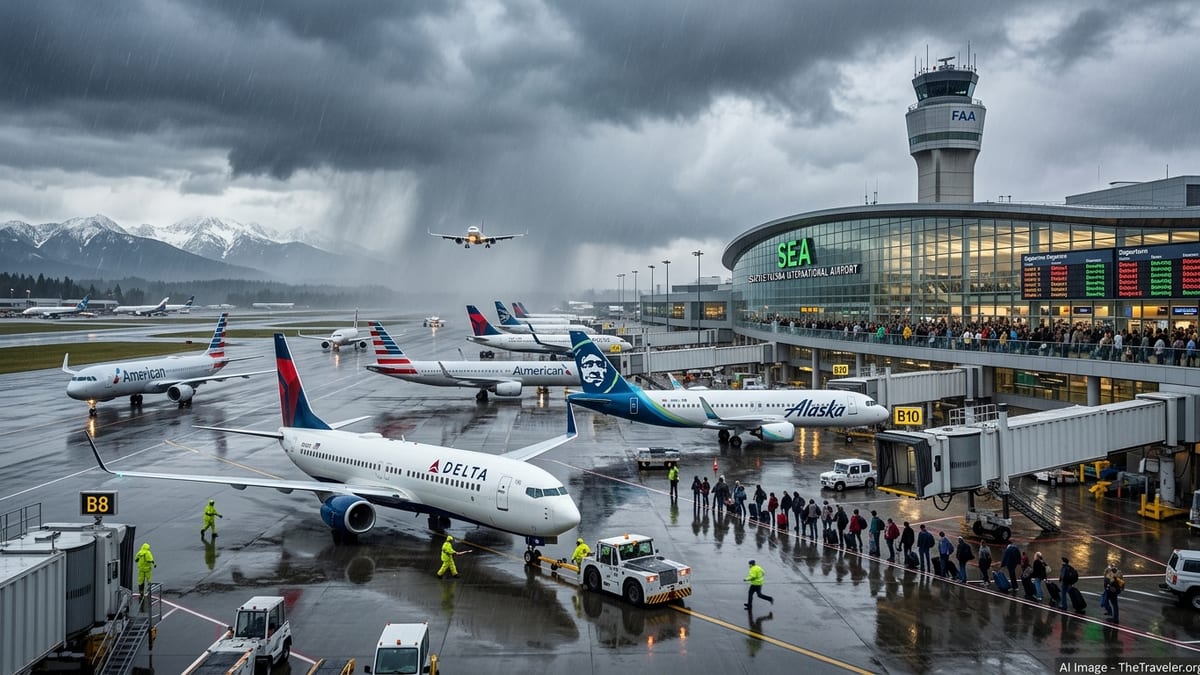
Record holiday air traffic meets an active storm pattern
This Thanksgiving week is shaping up to be the busiest for U.S. air travel in more than a decade, with the Federal Aviation Administration (FAA) forecasting the most holiday flights in 16 years. Federal data show tens of thousands of departures scheduled each day through Sunday, with peak volumes centered on the traditional getaway days of Wednesday, November 25, and the return rush from Friday through Sunday. Transportation officials say that, despite the scale of the operation, most flights are still operating, but weather is exerting growing pressure on the system.
Forecasters have flagged a series of storms affecting different parts of the country between Wednesday and Friday. A large system tracking up the East Coast is bringing periods of heavy rain and strong winds to major airports from Washington and Baltimore through Philadelphia, New York and Boston. In the Midwest and Great Lakes, low clouds, low visibility and gusty winds are causing intermittent delays at hubs including Chicago and Detroit. To the west, unsettled conditions are creating pockets of turbulence and mountain wave activity, particularly on transcontinental routes.
Weather services and aviation agencies have cautioned that many of the impacts will be indirect. Even airports with relatively benign local conditions can be hit by delays if arriving aircraft or crews are coming from storm-affected regions. As a result, passengers at secondary and regional airports may see rolling disruptions ripple outward from a handful of congested hubs, especially during the peak of the storm on Thanksgiving Day and into Friday morning.
Duffy cites preliminary delay breakdown, with weather the main driver
Duffy highlighted the early delay picture in a social media post on Wednesday, November 25, pointing to preliminary internal figures compiled from FAA operations data. According to his summary, about 50.5 percent of delays recorded so far during the Thanksgiving travel week were attributed to inclement weather. He said roughly 24.1 percent were linked to sheer flight volume, while 10.5 percent were associated with air traffic control staffing, 6.8 percent with air traffic control equipment problems, 5.4 percent with runway construction and 2.8 percent with other factors.
These categories reflect how the FAA and airlines classify the nominal cause of a delay based on operational logs. A flight held at the gate or on the taxiway while storms pass through a departure or arrival corridor, for example, would typically be tagged as weather-related. Delays that result from knock-on congestion after an earlier weather disruption might instead be recorded as a volume or air traffic control delay, even though the original trigger was a storm. Duffy noted that the distribution of causes this week is in line with a typical busy travel period, where weather remains the single biggest factor when conditions deteriorate over large parts of the network.
The secretary also said average delay times have hovered around 32 minutes despite what he described as “massive” passenger volumes. That figure is consistent with recent Air Travel Consumer Report data, which show that, in normal months, most delayed domestic flights arrive within 30 to 45 minutes of their scheduled time. Officials emphasized that these figures are preliminary and may shift as additional data from later in the week are incorporated, but they said the early numbers do not point to a systemic breakdown beyond the strain caused by storms and heavy traffic.
Storm impacts at major hubs and high-profile disruptions
The national picture has been complicated by several localized incidents and high-profile weather impacts that add to the impression of widespread disruption. On Wednesday night, a FedEx MD-11 cargo jet overran a runway at Miami International Airport, temporarily closing all but one runway on the eve of Thanksgiving. Although no injuries were reported and officials quickly reopened additional capacity, the incident contributed to hours-long delays early Thursday as airlines worked through a backlog of departures and arrivals at one of the country’s busiest international gateways.
Farther north, New York City’s severe-weather outlook had knock-on effects beyond aviation. Macy’s announced that its 100th Thanksgiving Day Parade would be postponed to Saturday for the first time in the event’s history after city officials warned of dangerous wind gusts on Thursday that could snap tree limbs and down power lines. While the parade does not directly control flight schedules, the same storm system has been affecting airports across the Northeast with low ceilings, heavy rain and wind, prompting air traffic managers to meter arrivals into the region and occasionally impose ground delay programs at major hubs.
Weather services have also highlighted potential travel issues on the post-holiday return days. Forecasts call for lingering rain, wind and periods of wet snow from the Ohio Valley into the Northeast on Friday, which could cause additional delays as travelers head home. In the South and parts of the Midwest, thunderstorms and low clouds may produce temporary restrictions on departures and arrivals. Forecasters stress that these are not definitive cancellation predictions but that the risk window for weather-related slowdowns remains open through at least Friday night.
How weather-related delays are managed and what travelers are seeing
When storms threaten to overwhelm the capacity of busy airspace or a large hub, the FAA typically responds with traffic management initiatives designed to slow but not stop the flow of flights. These can include ground delay programs, which space out departure times from multiple origin airports so that arrivals reach a congested hub at a manageable rate, or rerouting aircraft around hazardous weather. Duffy noted that a ground delay program at Chicago O’Hare, for example, was recently canceled once conditions improved and operations stabilized, underscoring that many of the most visible restrictions are temporary and adjusted as the weather evolves.
For passengers, these measures translate into longer gate holds, holding patterns in the air, missed connections and, in some cases, outright cancellations when crews run up against duty time limits or aircraft miss their slots. So far this week, delays have tended to cluster around the largest connecting hubs, including those in the Northeast corridor, Chicago, Atlanta and parts of Florida. Reports from airports such as San Francisco also describe extended taxi times and arrival queues during periods of heavy rain and low visibility, although some of the most severe congestion has eased as specific storms moved through.
Despite the disruptions, early figures and anecdotal reports suggest that the majority of scheduled flights are still operating, albeit with modest lateness. Airlines are deploying larger aircraft on some routes and adding extra staff at gates and call centers to handle rebooking. Federal officials have reiterated that travelers whose flights are canceled or significantly delayed for reasons within an airline’s control, such as mechanical problems or crew scheduling, may be entitled to rebooking and other assistance under carrier policies. Weather, by contrast, is generally classified as an uncontrollable factor, which limits mandatory compensation but still requires airlines to provide accurate, timely information about flight status.
What Thanksgiving travelers should watch for next
Transportation and weather authorities say the next 24 to 48 hours will be critical as the main Thanksgiving storm system reaches peak intensity over the eastern United States and then gradually moves away. Travelers flying on Thanksgiving Day itself, Thursday, November 26, and on Friday, November 27, are most likely to encounter weather-related delays, particularly if their itineraries touch the Northeast, Mid-Atlantic, Ohio Valley, Great Lakes or affected parts of the South. Those flying later in the weekend may benefit from calmer conditions, although residual congestion and aircraft repositioning could still affect some departures.
Duffy has urged passengers to build flexibility into their plans where possible, particularly if they are connecting through multiple hubs. Officials recommend that travelers monitor their flight status through airline apps and websites before leaving for the airport, allow extra time to clear security and reach their gate, and be prepared for gate or terminal changes. For those who have not yet departed, some airlines have issued weather-related travel waivers for specific cities and dates, allowing customers to change flights without standard fees or fare differences, subject to conditions.
Looking beyond the holiday, regulators and airlines are expected to study the full delay and cancellation data from this Thanksgiving period once it is finalized. That analysis will determine how much of the disruption can be attributed to weather alone and how much reflects underlying issues such as staffing, equipment outages or system upgrades. For now, based on the data available through Wednesday evening, Duffy maintains that the majority of this week’s delays are rooted in severe weather interacting with record traffic levels, and that aviation agencies are focused on managing that combination as safely and predictably as conditions allow.