


More news on this day
Spring weather and air traffic constraints have triggered fresh disruption at Dallas–Fort Worth International Airport, with flights operated by Spirit Airlines, Delta Air Lines and SkyWest among those grounded or heavily delayed on routes linking Garden City, Detroit, Fort Lauderdale, Toronto, London and other major cities.
Get the latest news straight to your inbox!
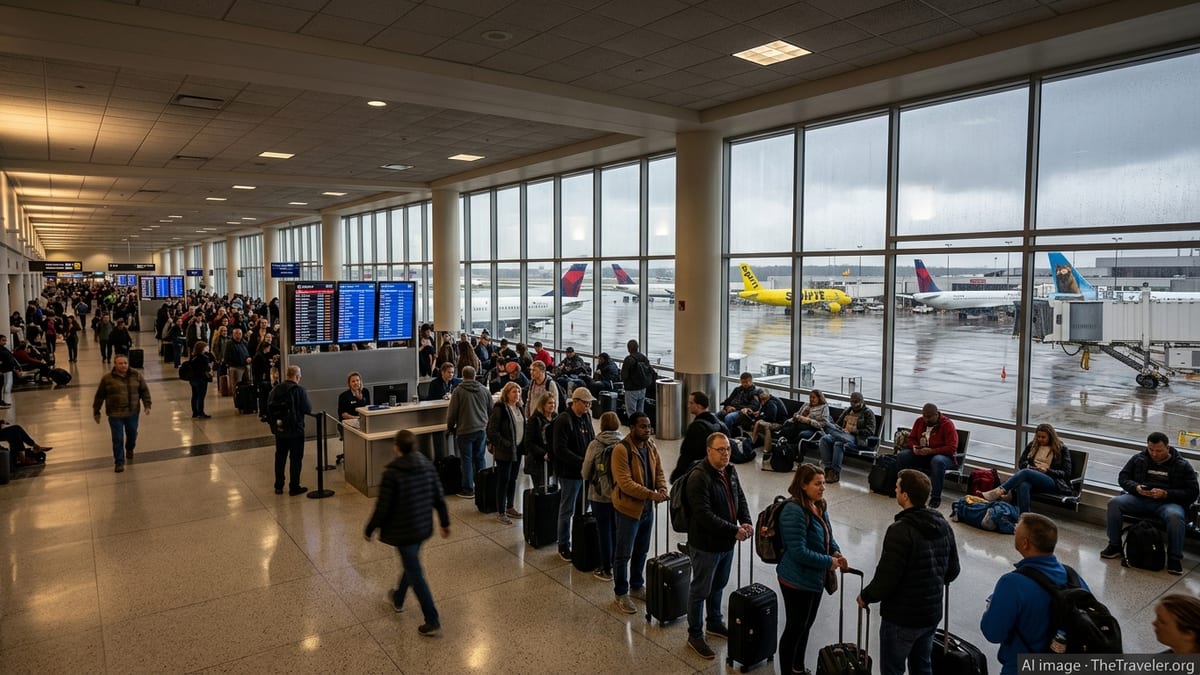
Grounded Flights at a Major U.S. Hub
Publicly available flight-status data for mid-April show Dallas–Fort Worth International Airport (DFW) once again near the center of a nationwide disruption pattern. Aggregated figures for Sunday, April 12, indicate that DFW logged more than 150 delays and a cluster of cancellations, while national totals surpassed 1,900 delayed departures and about 135 cancellations across all airlines.
Within those numbers, reports indicate that at least five departures and arrivals operated by or on behalf of Spirit Airlines, Delta Air Lines and SkyWest were fully canceled out of DFW during the latest disruption window, with several dozen more departures on those carriers facing departure holds or extended taxi times. Although that represents a fraction of the day’s schedule at the airport, the cancellations were concentrated at peak bank times, amplifying the effect on onward connections.
Coverage from aviation and travel outlets describes the episode as part of a broader pattern that has emerged since early April, when severe spring storms and convective weather repeatedly forced ground stops and flow restrictions at large hubs in Texas and the Midwest. DFW, which functions as a key domestic and international gateway, has been particularly sensitive to these constraints because many of its departures are scheduled into tightly timed connecting banks.
The latest disruption comes on the heels of earlier turbulence at the airport. In mid-March, an operational crunch at DFW produced 14 cancellations and more than 240 delays in a single day, with Delta, Spirit and SkyWest again listed among the most-affected carriers. Observers note that this repeated exposure underscores how quickly weather and airspace restrictions at one hub can reverberate across multiple airline networks.
Ripple Effects on Garden City, Detroit and Fort Lauderdale
Routes linking DFW with regional and secondary markets were among the first to feel the impact. Public flight logs show that at least one SkyWest-operated regional service was grounded as the airline adjusted its schedule to accommodate flow restrictions, affecting passengers traveling between DFW and smaller communities such as Garden City in western Kansas.
Detroit, another key U.S. hub and an important city in Delta’s network, has also been swept into the disruption. Recent nationwide tallies show Detroit Metropolitan Wayne County Airport recording double-digit cancellations and over 100 delays on the same weekend that DFW was grappling with its own operational strain. While not all of those issues were directly tied to Dallas, the combination of weather, airspace congestion and knock-on crew availability across shared routes complicated flight planning between the two hubs.
Fort Lauderdale, a major station for Spirit Airlines and a popular gateway to the Caribbean and Latin America, has recorded some of the highest delay counts in the current period. One recent report put Fort Lauderdale’s tally at more than 20 cancellations and over 300 delays in a single day, with low-cost carriers prominently represented. Because Spirit relies heavily on connecting flows between Fort Lauderdale and other focus cities such as DFW and Detroit, any disruption at one end of the network can quickly force aircraft swaps, schedule trimming or reactive cancellations.
Travel analysts note that these route-level complications can be particularly challenging for leisure travelers, who may depend on limited-frequency services to reach destinations like Garden City or on late-night departures from Fort Lauderdale to return home after cruises or beach holidays. When a single daily flight is canceled, alternatives can involve lengthy detours or overnight stays far from the original destination.
International Connections to Toronto, London and Beyond
The reverberations from DFW’s operational issues have extended well beyond U.S. borders. Published coverage tracking April’s turbulence points to delays and isolated cancellations affecting transborder services to Toronto Pearson International Airport and transatlantic links to London, among other long-haul markets served over U.S. hubs.
Toronto has featured in several disruption summaries this month, with reports highlighting elevated delay counts on routes touching both U.S. East Coast airports and central hubs such as Dallas and Chicago. When regional feeds from carriers like SkyWest into those hubs are interrupted, passengers traveling onward to Canada often face missed connections and rebookings on later flights, sometimes on different airlines entirely.
London-bound travelers have encountered similar complications. Recent storm systems and air traffic management initiatives across North America have prompted rolling delays at major long-haul gateways, including Dallas, Atlanta and Newark. Delta and its partners, as well as competing carriers, have in some cases held or retimed departures from U.S. hubs to London Heathrow and other European airports to maintain passenger connections and crew rest requirements after upstream delays.
Because long-haul departures typically operate once per day on fixed overnight schedules, even a modest ground delay at DFW can translate into missed connections for passengers originating in cities such as Garden City or Fort Lauderdale and aiming to continue to Toronto, London or other international destinations on the same day.
Weather, Congested Skies and Network Complexity
The current wave of disruption is occurring against a backdrop of volatile spring weather across large parts of the United States. Data compiled by passenger-rights organizations show that storms over the Easter period between April 2 and April 4 delayed more than 15,000 flights and canceled well over 2,000 nationwide, with Dallas–Fort Worth among the hardest-hit hubs.
As the storm systems moved east and north, operational pressure shifted but did not fully subside. Within a span of just over a week, additional disturbances were reported at hubs including Chicago O’Hare, Atlanta and Houston, while residual congestion continued to surface in flight-status feeds from Dallas. Aviation analysts commenting on the pattern have emphasized how narrow weather windows, air traffic control staffing and the high utilization of aircraft and crews can combine to amplify even brief ground stops.
Another factor is the structure of modern airline networks. Carriers such as Delta, Spirit and SkyWest rely heavily on connecting banks to funnel passengers through hubs at specific times of day. When a thunderstorm or airspace restriction disrupts a single bank, the effect cascades across multiple spokes, leading to rolling delays and, in some cases, the preemptive cancellation of a small number of flights to protect the remainder of the schedule.
Publicly available airline operations data from recent weeks illustrate this tradeoff. On some days, national cancellation rates have remained relatively low, around or below 1.5 percent of total scheduled flights, even as delay counts climb into the thousands. Industry observers interpret this as a sign that carriers are often choosing to delay and re-accommodate rather than cancel outright, while still selectively grounding flights that are operationally difficult to recover.
What Travelers Are Experiencing on the Ground
For travelers passing through Dallas–Fort Worth and its connected hubs, the statistics translate into crowded terminals, long lines at rebooking counters and a scramble for remaining seats on alternative flights. Passenger-rights groups and travel advisories describe scenes of backed-up security lanes, gate-area queues and stretched airport amenities as travelers attempt to adjust plans on short notice.
Many of the most disruptive cases involve missed connections. A delay of 60 to 90 minutes on an inbound regional flight operated by SkyWest or another feeder carrier can be enough to sever an onward link to a long-haul service bound for places like Toronto or London. In those situations, passengers may be rebooked onto departures the following day, requiring overnight accommodation near the airport or in an intermediate city.
Travel guidance published in recent days encourages passengers to monitor airline apps closely, enable alerts for schedule changes and use self-service tools when possible. These digital options can, in many cases, secure same-day alternatives more quickly than waiting in line for in-person assistance. Independent consumer advocates are also reminding U.S. travelers that federal rules generally entitle them to cash refunds when a flight is canceled and they choose not to travel, even when weather is a contributing factor.
With peak summer travel still ahead, the situation at Dallas–Fort Worth and its web of connected routes to Garden City, Detroit, Fort Lauderdale, Toronto, London and beyond is being closely watched by analysts and passengers alike. The recent cluster of five grounded flights at DFW involving Spirit, Delta and SkyWest serves as another reminder of how fragile large hub operations can be in the face of unsettled weather and tight network schedules.