


More news on this day
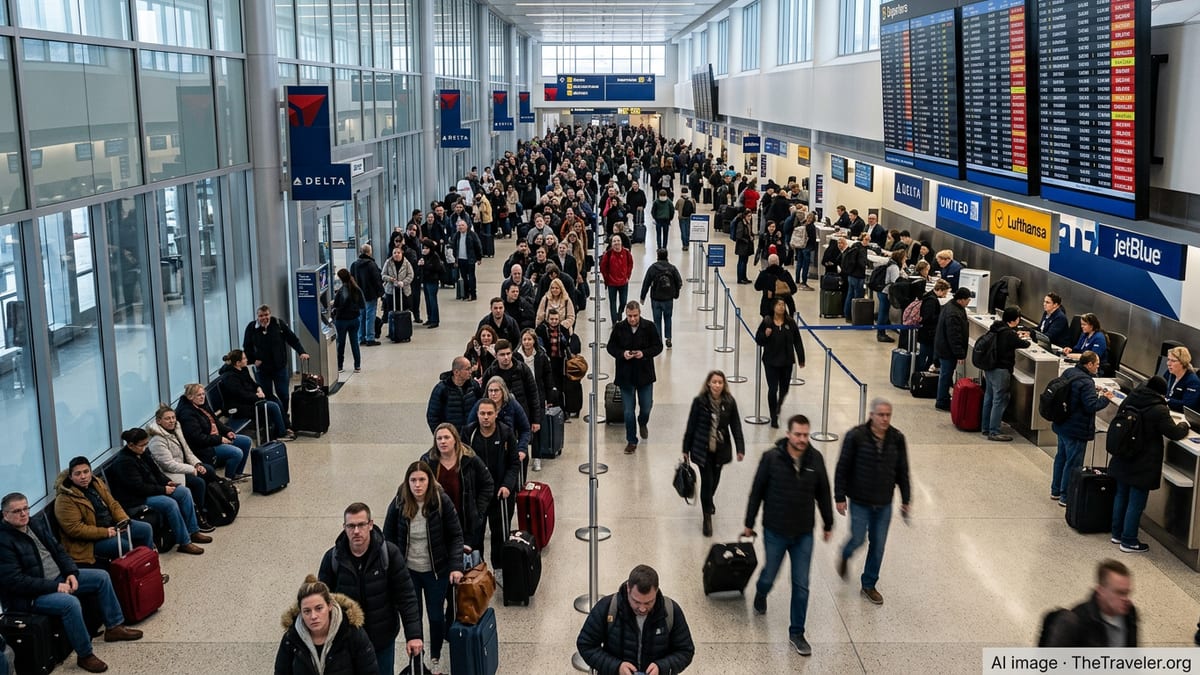
Dallas Fort Worth International Airport has recorded 421 delayed flights and eight cancellations in a single operational window in 2026, disrupting schedules for American, Delta, United and a wide range of global partner airlines across North America, Europe, Asia and Latin America.
Get the latest news straight to your inbox!
Weather, Congestion and Network Strain Converge Over North Texas
Publicly available data and industry reporting indicate that the latest disruption at Dallas Fort Worth International Airport unfolded against a backdrop of unstable summer weather and already busy skies over North Texas. Flight-tracking summaries for early July show periods of operational stress at the hub, with arrival and departure banks compressed by thunderstorms and low visibility, a recurring pattern during the peak travel season.
Recent analyses of delay patterns at Dallas Fort Worth point to a mix of primary weather impacts and secondary knock-on effects. When convective storms form over or near the airport, arrival rates are cut and departure queues lengthen, causing aircraft to miss their next rotations and crews to approach duty-time limits. As those constraints ripple through the system, even brief ground stops or flow-control measures can translate into hours-long disruptions for travelers passing through the hub.
The 421 delays and eight cancellations reported for this latest episode sit on top of several earlier weather-linked slowdowns at Dallas Fort Worth in 2026, including a severe ground stop in May that left hundreds of departures and arrivals running behind schedule. The repeated shocks are testing the resilience of airline schedules built around tight connection windows and high aircraft utilization.
Travel-industry coverage notes that the summer period has been defined by particularly volatile conditions across large parts of the United States, with major airports in Chicago and New York also registering significant delays. Dallas Fort Worth’s central position in many domestic and international networks means any disruption there can quickly acquire national and even transcontinental dimensions.
American, Delta, United and Partners Feel the Impact
As one of the world’s largest airline hubs, Dallas Fort Worth is heavily dominated by American Airlines and its regional affiliates, but the 421 delays and eight cancellations have also affected flights marketed or operated by Delta Air Lines, United Airlines and an array of global partners, including codeshare and alliance carriers. Schedules show that delays included transcontinental routes, cross-border services into Canada and Mexico, and long-haul connections linking Texas with Europe and Asia.
American’s hub-and-spoke model at Dallas Fort Worth concentrates large waves of arrivals and departures into narrow time windows to facilitate connections. When storms move through during those banks, even a modest reduction in arrival or departure capacity can force wholesale retiming of flights. Regional feeders operated on behalf of American are particularly vulnerable, as shorter sectors leave less slack in the daily rotation plan and smaller aircraft are often prioritized behind larger jets in constrained takeoff and landing slots.
Delta and United, while less prominent at Dallas Fort Worth than at their respective core hubs, also maintain a portfolio of services that depend on timely connections. Disruptions at Dallas Fort Worth can strand passengers bound for onward flights on either carrier’s network, especially when itineraries are stitched together using interline or codeshare agreements with international partners from Europe and Asia.
Global carriers and their regional affiliates similarly face challenges when a connecting hub experiences a high volume of delays. With eight cancellations recorded alongside the 421 delays, aircraft and crews scheduled to continue to secondary destinations can be left out of position, forcing downstream schedule changes far from Texas. That pattern has been evident throughout 2026 as severe weather and air traffic management constraints have cascaded through multiple airline systems.
Knock-On Effects Across the United States, Canada, Mexico and Beyond
The disruption footprint from the latest Dallas Fort Worth episode extends well beyond Texas. Reports on arrival and departure patterns show delayed and canceled flights touching cities across the continental United States, including key hubs such as Chicago, Los Angeles and Washington, as well as Canadian gateways like Vancouver and cross-border points in Mexico.
Because Dallas Fort Worth acts as a critical interchange for traffic between smaller U.S. markets and overseas destinations, delays at the hub frequently result in missed connections for passengers traveling between Latin America, Europe and Asia. When a flight inbound from Mexico or Canada reaches Dallas Fort Worth behind schedule, connecting travelers may find their onward transatlantic or transpacific services already boarding or closed, even if those long-haul flights are themselves delayed.
European and Asian carriers that rely on American, Delta, United or regional partners to feed their long-haul services are particularly sensitive to such mismatches. A late-arriving domestic leg can undercut the load factor on an intercontinental flight, with revenue implications on top of the immediate disruption to customer travel plans. Some airlines attempt to mitigate this risk by building extended minimum connection times into their Dallas Fort Worth itineraries during the storm-prone months, though that approach can make journeys less attractive when conditions are normal.
In recent weeks, similar pressure points have emerged at other major North American hubs, underscoring the interconnected nature of modern airline operations. When Chicago O’Hare or New York John F. Kennedy experience severe storms, the resulting delays and cancellations also feed back into the Dallas Fort Worth network, compounding local weather issues with inbound disruption from other corners of the continent.
Operational Challenges: Crews, Infrastructure and Air Traffic Management
Beyond headline delay and cancellation statistics, the Dallas Fort Worth disruption highlights deeper operational challenges for airlines and the broader aviation system. Industry observers note that when flights are held on the ground or in holding patterns, flight crews can quickly reach duty-time limits, forcing airlines to cancel or substitute services even after weather has improved. This has been a recurring complaint among travelers during 2026, as itineraries that initially show modest delays ultimately shift to outright cancellations when crew timing becomes unworkable.
Infrastructure and construction programs at Dallas Fort Worth also influence the airport’s capacity to recover from shocks. Federal aviation planning documents point to ongoing work related to future terminal expansion and taxiway adjustments, which can temporarily reduce operational flexibility on the airfield. While those projects aim to increase long-term capacity and resilience, they may limit the number of aircraft movements the airport can safely handle during peak hours in the near term.
On the air traffic management side, publicly accessible data from federal systems show that Dallas Fort Worth and the surrounding region periodically operate under ground delay or flow-control programs when thunderstorms form over North Texas. These measures are designed to keep traffic at safe levels and avoid gridlock on the taxiways and in the arrival streams, but they also extend average delay times for individual flights, contributing to the aggregate figure of 421 delays recorded in the latest disruption.
The combination of weather-sensitive infrastructure, dense schedules and finite crew resources has created a fragile operating environment at major hubs nationwide. Dallas Fort Worth’s experience in 2026 illustrates how quickly that fragility can surface when storms line up with peak travel windows, particularly during holiday weekends and busy summer travel periods.
What Travelers Can Expect for the Remainder of 2026
With the peak summer season underway and further convective weather likely across the central United States, analysts expect intermittent disruption at Dallas Fort Worth to continue through the coming months. Historical climatological data for the region show that storm activity and high temperatures often persist well into August, conditions that can amplify air traffic management constraints and stress aircraft performance.
Travel-focused platforms that monitor delays at Dallas Fort Worth note that days of relatively smooth operations can be followed by sudden spikes in disruption when storm cells pass directly over the airfield or key arrival and departure corridors. The latest count of 421 delays and eight cancellations underscores how quickly daily performance metrics can deteriorate once thresholds for capacity reductions are reached.
Industry commentary suggests that airlines using Dallas Fort Worth are adjusting some schedules, aircraft routings and crew pairings in an effort to build in more recovery space after major disruptions. However, high demand for summer travel, along with competitive pressure to offer frequent departures on popular routes, limits how much slack can be introduced into timetables without raising costs or reducing choice for passengers.
For now, publicly available information indicates that Dallas Fort Worth will remain a focal point of the North American air travel system throughout 2026, with its performance closely watched by travelers, airlines and aviation analysts alike. The latest wave of 421 delays and eight cancellations provides another reminder of how weather, infrastructure and network design intersect to shape the experience of millions of passengers moving through one of the world’s busiest hubs.