


More news on this day
Rail communication between Dhaka and northern Bangladesh was suspended on Monday afternoon after several wheels of the Panchagarh-bound Ekota Express derailed near Ishwardi Bypass Railway Station in Pabna, disrupting one of the country’s busiest intercity corridors at the height of the Eid travel rush.
Get the latest news straight to your inbox!
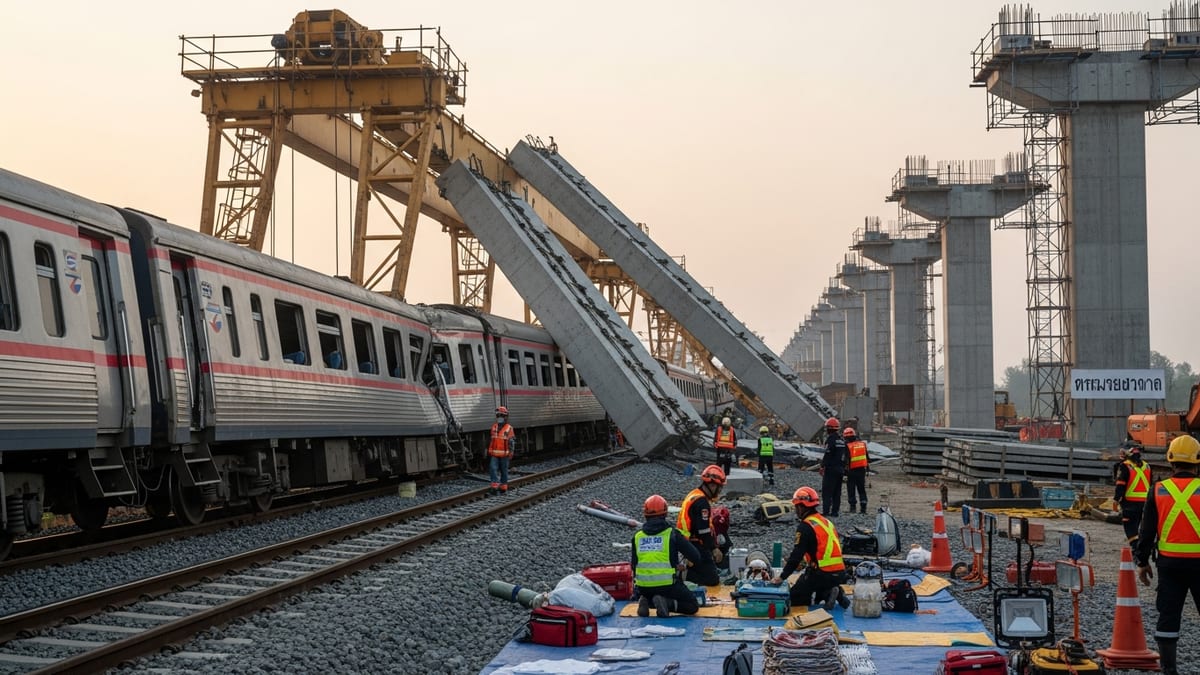
Key intercity service leaves tracks near Ishwardi
According to published coverage in national and regional outlets, the incident occurred around 3:50 to 4:00 p.m. local time on July 13 near the Ishwardi Bypass section of the Dhaka–Parbatipur route. Reports indicate that two coaches of the Ekota Express left the tracks as the train was approaching the bypass station, with eight wheels derailing in total.
Ekota Express is a long-distance intercity service linking the capital with Panchagarh in the far north, and it carries heavy passenger loads during religious holidays and peak travel periods. Initial reports from the scene suggest that the coaches remained upright and that no major injuries were reported among passengers, though many were forced to disembark and wait trackside as rail staff assessed the damage.
Publicly available information shows that the derailment took place on a key stretch that funnels traffic between Dhaka and multiple northern districts, turning a local infrastructure failure into a systemwide disruption. Rail operators halted movements on both up and down lines through Ishwardi, effectively snapping the main rail artery between the capital and the northwest.
Images shared by Bangladeshi media show the derailed coaches resting just off the main line, with track components and ballast disturbed across several meters. The position of the wagons is understood to be complicating efforts to quickly clear the route and resume normal traffic.
Dhaka–northbound connections brought to a standstill
Following the derailment, reports indicate that train services between Dhaka and the northern districts were shut in both directions, affecting intercity and mail services across the network. Trains scheduled to depart the capital for destinations including Dinajpur, Nilphamari and Panchagarh faced delays or cancellations as railway staff worked to divert or hold services at intermediate points.
Passengers already on northbound trains found themselves stranded at stations along the corridor, with some services held at Ishwardi and nearby junctions while the situation was evaluated. Local media coverage described scenes of crowded platforms as travelers attempted to rebook journeys or seek alternative transport by road at short notice.
The disruption is particularly acute because the Dhaka–north corridor is one of Bangladesh Railway’s primary long-distance axes, channeling both daily commuters and seasonal migrants. At busy times, each suspended intercity service represents thousands of passengers, magnifying the impact of even a single operational incident.
Publicly available rail planning documents highlight the Ishwardi area as a strategic node connecting lines that span towards the country’s northwest, meaning that incidents here tend to cascade across multiple routes rather than remaining localized. The latest derailment again underscores how sensitive the network is to failures on a handful of critical segments.
Rescue and recovery operations under way
Shortly after the derailment, Bangladesh Railway mobilized a relief train and technical crews from the Pakshi division to the Ishwardi Bypass site, according to published coverage. The relief consist is being used to stabilize the derailed coaches, separate them from the rest of the formation and lift them back onto the track or move them to a siding.
Media reports state that a formal inquiry committee has been constituted to examine the causes of the incident, including track condition, rolling-stock performance and train handling in the moments before the derailment. Investigators are expected to look at maintenance records for the Ishwardi section and any recent work on the line that could have affected stability.
Until the damaged portion of track is repaired and safety inspections are complete, rail movements through the bypass are expected to remain restricted. In previous derailments on key northern routes, full restoration of services has taken many hours, sometimes extending into the following day, depending on the severity of the damage and the availability of heavy lifting equipment.
For now, publicly available information suggests that priority is being given to clearing the main line to allow at least limited, slow-speed operations, which could permit some trains to pass under temporary speed restrictions while more extensive repairs continue.
Passengers face renewed disruption after recent rail setbacks
The latest suspension of services between Dhaka and northern Bangladesh comes just as another major rail corridor in the country is returning to normal. Over the weekend, train operations on the Chattogram–Cox’s Bazar route were restored after several days of disruption linked to flooding and water damage on sections of track in the southeast.
Published coverage over recent months shows that derailments, track washouts and infrastructure failures have repeatedly interrupted long-distance rail travel across Bangladesh, especially during the monsoon and peak holiday seasons. The Ishwardi derailment adds to a list of recent incidents that have underscored longstanding concerns about track maintenance, aging rolling stock and capacity constraints on heavily used lines.
For passengers, the timing of Monday’s incident is particularly challenging. Many travelers rely on trains as an affordable and comparatively safer alternative to crowded highways, and the Dhaka–north corridor is often booked to capacity around major religious and cultural events. When services are suddenly halted, options for replacement transport can be limited and costly, especially for low-income families.
Advocacy groups and transport analysts have frequently pointed to the need for additional investment in track renewal, signaling systems and dedicated maintenance machinery on routes linking Dhaka with northern and western regions. The derailment near Ishwardi is likely to renew public debate over how quickly these upgrades are being delivered and how the network can be made more resilient to both operational failures and extreme weather events.
Focus returns to safety and modernization of Bangladesh Railway
Bangladesh Railway has been engaged in multiple large-scale projects to strengthen connectivity between Dhaka and the north, including construction of the Jamuna Railway Bridge and additional dual-gauge lines. Planning documents and previous government statements describe these projects as crucial for relieving congestion on existing tracks and improving both safety and punctuality.
Despite this pipeline of investments, analysis in policy papers and academic studies continues to highlight derailment risk as a key safety issue. Factors frequently cited include track geometry faults, sleeper deterioration, overburdened maintenance schedules and the strain placed on infrastructure by growing passenger volumes.
Incidents like the Ekota Express derailment near Ishwardi tend to sharpen public scrutiny of how these underlying challenges are being addressed. While initial reports indicate that Monday’s accident did not result in serious casualties, the severing of a mainline connection between the capital and northern districts is a stark reminder of the consequences when critical infrastructure fails.
As recovery work continues and services gradually resume, attention is likely to center on the findings of the investigation and any recommendations it makes on inspection regimes, speed limits and investment priorities. For travelers who were left waiting on platforms or stranded along the route, the immediate concern remains simple: when reliable, uninterrupted rail links between Dhaka and the north can once again be taken for granted.