


I arrived in Saint-Tropez fully prepared not to like it. In my mind it was a floating catwalk of superyachts, velvet ropes and bottle-service beach clubs. The biggest surprise was how quickly that glossy image fell away the moment I stepped a few streets back from the port. Away from the camera-ready scenes, Saint-Tropez felt less like a billionaire’s playground and more like a sunburned fishing village that never entirely agreed to its own fame.
Get the latest updates straight to your inbox!
Beyond the Postcard: First Impressions That Did Not Match the Hype
My first glimpse of Saint-Tropez was exactly what I expected: the Vieux Port lined with polished yachts, hostess stands guarding waterfront terraces, and menus where a simple fish dish could easily run to 45 or 50 euros. It would have been easy to stop there and confirm every stereotype. Yet even while I was watching deckhands coil ropes on a 40-meter yacht, a different rhythm was visible in the background: local kids weaving past with ice creams, an older couple carting groceries home, a fisherman hosing down his small boat like it was any other Mediterranean harbor.
The real shift happened when I followed one of the narrow streets rising behind the port instead of looping endlessly along the quay. Within a five-minute walk, the designer storefronts gave way to laundry hanging from shutters and tiny épiceries selling tomatoes and peaches that actually smelled of summer. The prices changed too. An espresso that would have cost 4 or 5 euros on the marina dropped to 2 euros at a simple zinc-counter café tucked on a side street, where the only “brand” decor was a chalkboard of the day’s plat du jour.
What surprised me most was how small the historic center felt once I stepped off the main drag. For all its fame, Saint-Tropez is essentially a village, dense and walkable. You can cross the old town on foot in 15 or 20 minutes, and those minutes are where the myth starts to peel away. A grocer chats with a regular about the weather, a florist arranges buckets of sunflowers, a mechanic leans in the doorway of a workshop that looks completely unchanged by the decades of celebrity around it.
By the time I reached the top of the slope near the Citadel and turned back to look over the maze of terracotta roofs, the yachts were a sliver of white on the edge of the bay. What dominated the view was not luxury at all, but a jumble of modest houses and church towers that could belong to almost any Provençal town. It was the first of many moments when Saint-Tropez felt less like a stage set and more like a living place that just happens to share its streets with the world’s paparazzi for a few months each year.
Place des Lices: From Market Morning to Pétanque at Dusk
If the harbor is Saint-Tropez’s most photographed face, Place des Lices is its heartbeat. I reached the square on a Tuesday mid-morning, when the famed open-air market was in full swing beneath the grid of plane trees. Stalls spilled over with goat cheeses wrapped in chestnut leaves, rotisserie chickens turning slowly on spits, baskets of olives, linen dresses in sun-faded shades of blue and white, and straw hats that actually looked practical rather than theatrical. Officially, the market is held on Tuesday and Saturday mornings, roughly from 8 am to 1 pm, and by mid-morning it felt like the entire population of the peninsula had come to town to shop, gossip and people-watch.
Despite the crowds, the experience felt more village than VIP. A stallholder handed me a slice of saucisson to taste without a hint of sales pitch. At a produce stand, the woman ahead of me in line argued with the vendor about which melons were best for that evening; the entire exchange was in rapid-fire Provençal-accented French that made it clear this was not a show for tourists. I bought a bag of sun-warmed apricots, three for about 2 euros, and ate them sitting on the edge of a planter, watching a pair of locals greet each other with the double cheek-kiss and then launch straight into a debate about parking.
Later that same day, I cut back across Place des Lices just before sunset and could hardly believe it was the same space. The stalls were gone, swept away as efficiently as a theater set. In their place, long rectangles of sandy ground had been reclaimed by pétanque players. Retirees in pastel polos lined up shots under the trees, the click of metal boules punctuated by bursts of laughter and the occasional good-natured protest. A few children chased each other around the trunks, ignored by adults busy judging a tight measure between two glinting balls.
What struck me was how low-key the scene was. Yes, stories abound of film stars and musicians playing pétanque here, and every so often someone at a café table would discreetly point out a familiar face. But on an ordinary evening it felt like any small-town square in the south of France. Café tables around the perimeter were busy with people drinking pastis or a glass of cool rosé that cost roughly the same as it would in inland Provence. If you want a single place that captures how Saint-Tropez manages to be both a global symbol and a local hangout, Place des Lices from market morning to pétanque dusk is it.
La Ponche and the Back Alleys: A Fishing Village Hiding in Plain Sight
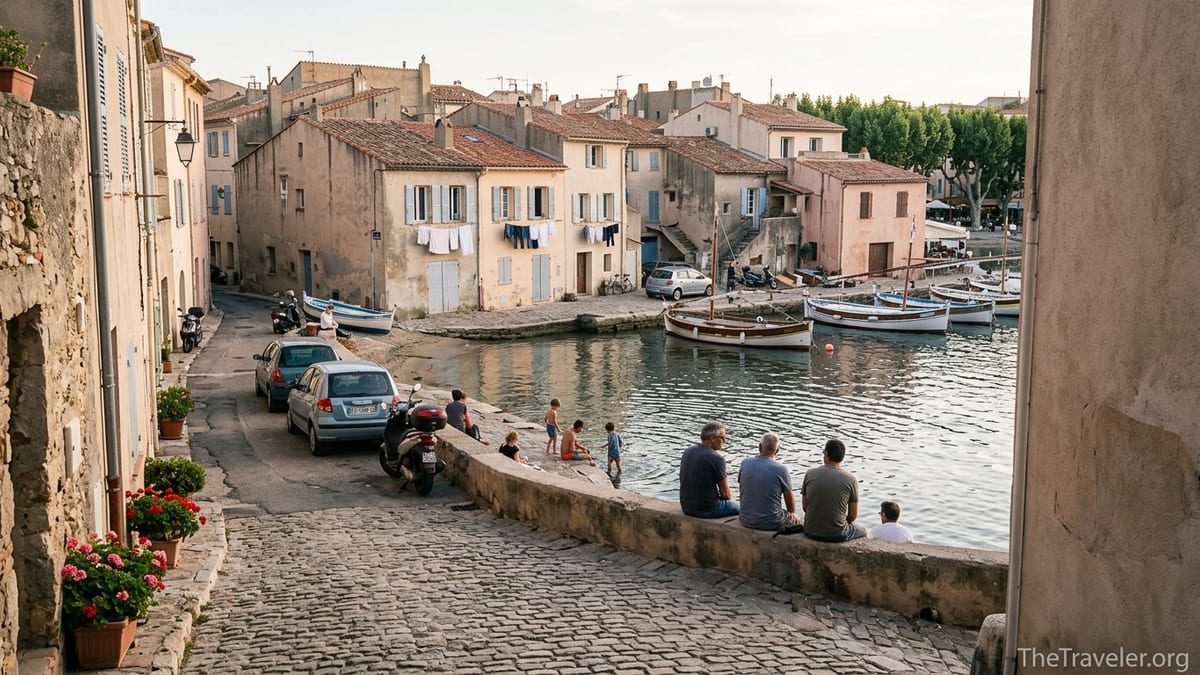
Walk down from Place des Lices toward the water, but avoid the direct route to the port, and you will eventually stumble into La Ponche, the oldest quarter of Saint-Tropez. Here, pastel facades lean in over cobbled lanes, and the streets feel just a little too narrow for the golf carts that try to squeeze through in high season. This was once the heart of the fishing village long before cinema made Saint-Tropez a dreamscape, and the atmosphere is very different from the polished quay.
I wandered into La Ponche on a hot afternoon, following the echo of laughter and the slap of waves against stone. At the edge of the quarter, a tiny pocket of shoreline called Plage de la Ponche unfolded: not a sweeping resort beach, but a short ribbon of coarse sand and pebbles right at the foot of the old fishermen’s houses. Locals sat on the low wall, feet dangling above the water, while a few brave swimmers climbed down ladders hammered into the rocks for a quick dip. There were no sun-lounger rows, no bottle-service menus. Just towels on stone, a dog chasing waves, and the occasional clink of cutlery from a small restaurant’s shaded terrace above.
What surprised me here was how everyday it all felt. A woman in a simple cotton dress rinsed snorkeling gear at a tap; a grandfather coaxed his grandchild into the shallows, pointing out tiny fish darting near the rocks. Tourists came and went with cameras, but they were incidental to the life unfolding around them. It was easy to imagine this little cove exactly as it might have looked before the Brigitte Bardot era, except perhaps for the modern beach bags.
From La Ponche, it is worth letting yourself get a little lost in the back alleys that rise and fall behind the waterfront. Here, the houses are close enough that neighbors can pass a forgotten ingredient between windows. I passed a door where the smell of garlic and tomatoes hinted at someone’s dinner simmering on the stove, and another where a hand-painted sign advertised homemade tapenade. Around one corner, three cats slept in a shaft of sunlight; around another, I found a simple chapel open to anyone looking for a cool, quiet moment away from the summer buzz.
Local Beaches Instead of Beach Clubs: Salins, Canebiers and Quiet Corners
The most persistent image of Saint-Tropez might be Pampelonne, the long arc of sand lined with beach clubs in the neighboring commune of Ramatuelle. Those clubs can be enormous fun, but they are only one part of the story. My biggest surprise was discovering how many Tropezians avoid them altogether in favor of smaller, more modest stretches of sand that still feel genuinely local.
One morning I caught a local bus out toward Plage des Salins at the eastern edge of the peninsula. After a short ride, the bus dropped a handful of us near a stand of pines, from which a sandy path led to a wide beach framed by low dunes and tamarisk trees. Several regional guides describe Salins as a favorite of residents precisely because it offers a long sweep of pale sand and clear water without the heavy concentration of clubs you find at Pampelonne. There is at least one beach restaurant with neatly arranged chairs and a more polished menu, but most people seemed content with towels, umbrellas they brought themselves, and picnic coolers.
Prices told their own story here. A coffee at the casual beachfront snack counter cost only a little more than in town, and you could still pick up a simple sandwich or pan bagnat for under 10 euros. Families arrived with inflatable toys, couples read paperback novels under pine shade, and an older man in a straw hat methodically collected driftwood from the waterline. Conversations drifted by mostly in French and Italian, with the occasional German or Dutch phrase. It felt like the Riviera at human scale.
Back toward town, I found the same low-key atmosphere at spots such as Plage des Canebiers and La Bouillabaisse. Canebiers, a broad bay within walking or cycling distance of the village, has long been known as a local gathering point, where modest sailboats and small motorboats bob on their moorings in sharp contrast to the superyachts off the port. Bouillabaisse, a sandy beach at the entrance to the gulf, mixes a couple of chic addresses with stretches of public shoreline where children kick a football at sunset and locals stroll with their dogs. At both, it was possible to simply spread a towel and swim for free, which feels like a small revelation in a place that sells itself so strongly on exclusive access.
Simple Meals, Everyday Errands and a Surprisingly Normal Cost of Living
Before visiting, I half-expected every meal in Saint-Tropez to require a reservation, a dress code and a willingness to watch my budget evaporate. Yet once again, stepping a few blocks back from the water changed everything. In residential streets behind the port and around Place des Lices, I found boulangeries where a still-warm baguette cost close to what it would in any French town, and corner cafés where a croissant and a coffee came in under 6 or 7 euros if you stood at the bar instead of sitting on the most coveted terrace.
On market days, locals clearly keep their spending sensible by shopping strategically. At Place des Lices, it is entirely possible to assemble a picnic of cheese, charcuterie, olives and bread for the price of a single starter on the harbor. A small round of goat cheese might cost 4 or 5 euros, a paper cone of just-cooked socca or an herb-scented flatbread a few more. Eaten on a bench overlooking the water or under the shade of a plane tree, that modest spread tastes every bit as luxurious as a more formal meal.
Even in the evening, there are plenty of restaurants that operate more like neighborhood bistros than scene-driven destinations. Away from the handful of institutions where tables are booked weeks in advance, you will find pizzerias, modest brasseries and family-run spots offering a plat du jour in the 18 to 25 euro range, perhaps a grilled fish or a slow-cooked lamb shoulder with local vegetables. These are the places where service is brisk but friendly, and where you are more likely to find families and couples from nearby villages than international influencers.
What really shifted my understanding was running small errands. I watched a line of residents at the post office, arms full of parcels, and an elderly man carefully choosing a newspaper from the kiosk. I stepped into a pharmacy where most customers were picking up everyday prescriptions, not designer sun creams. In the late afternoon, as workers rolled down the shutters on less glamorous businesses like hardware shops and garages, the spectacle of luxury felt further away than ever. You begin to realize that, for a significant part of the year and for many people who live here, Saint-Tropez functions as a normal small town with slightly less normal scenery.
Off-Season and Shoulder Months: When the Village Reclaims Itself
The timing of your visit has a huge impact on which Saint-Tropez you meet first. During the peak months of July and August, the town is at maximum intensity: day-trippers pour in by ferry from Sainte-Maxime, beach clubs along Pampelonne are full, and every pavement table seems to host a different language. Yet talk to locals, and many will tell you that the most authentic face of the village appears instead at the edges of the season, in late spring and early autumn.
In May and June, beach clubs and seasonal restaurants have opened, but the sheer crush of crowds has yet to arrive. There is a sense of anticipation rather than exhaustion. You can still walk into a café on the port for a morning coffee without queuing, and the waiters have time to chat. In September and early October, after the big regattas and last major parties, the light softens, the water stays warm, and the village exudes a calmer energy. Locals reclaim their routines, and the distinction between visitor and resident blurs just a little.
Traveling outside the height of summer also makes nearby villages feel more accessible as extensions of everyday life rather than as excursion checklists. Regular buses connect Saint-Tropez with places such as Ramatuelle, Gassin and Sainte-Maxime, and in shoulder season you share those buses mostly with commuters and schoolchildren instead of tour groups. The fares are modest by Riviera standards, and the journeys offer a window into how people actually move around this peninsula without a yacht or private driver.
It was in mid-September, during an earlier visit, that I first saw a very different Saint-Tropez evening: restaurants half-full, locals lingering over digestifs, and the sound of someone practicing saxophone drifting out of an apartment window. The port was still dotted with impressive boats, but many of the most ostentatious yachts had already gone. What remained was a compact, walkable village where you could almost forget, for a few hours, that this place is famous at all.
The Takeaway
My biggest surprise in Saint-Tropez was not that the luxury image exists. It absolutely does, from the gleaming decks of the Vieux Port to the choreographed afternoons at Pampelonne’s most sought-after clubs. The surprise was discovering how thin that glossy layer can feel once you look past it, and how quickly you can step into a parallel Saint-Tropez that belongs more to fishermen, schoolchildren and retirees than to stylists and DJs.
In that quieter version of the town, mornings mean shopping for fruit and cheese at Place des Lices, or swimming from a simple slip of sand at La Ponche before the streets heat up. Afternoons become lazy bus rides to Salins or Canebiers, where you can spread a towel on public sand and watch families and friends settle into their own rituals. Evenings shift from celebrity-spotting on the port to watching pétanque under the plane trees, or sharing a carafe of everyday rosé at a bistro where nobody particularly cares what you are wearing.
If you arrive expecting only opulence, it can be disorienting to realize how normal Saint-Tropez can feel once the logos blur and the crowds thin. Yet that is precisely what makes the village compelling. It is a reminder that even the most mythologized destinations are, at heart, places where people live, work, argue about parking, walk their dogs and buy bread. See that side of Saint-Tropez, and the luxury becomes a backdrop rather than the main event.
FAQ
Q1. Is Saint-Tropez worth visiting if I am not interested in luxury or nightlife?
Yes. If you skip the most high-profile clubs and focus on the old town, local beaches and markets, Saint-Tropez feels more like a characterful Provençal village with sea views than a nonstop party town.
Q2. When is the best time to visit Saint-Tropez for a quieter, more authentic experience?
The shoulder months of late May to late June and early September to early October usually offer warm weather, open restaurants and fewer crowds, so it is easier to see everyday village life.
Q3. Can I enjoy Saint-Tropez without spending a fortune?
Yes. Stay a few streets back from the port, use local buses or ferries, picnic with market produce and choose neighborhood cafés over scene-driven spots to keep costs much more reasonable.
Q4. Which beaches feel more local and low-key than Pampelonne?
Plage des Salins, Plage des Canebiers, La Bouillabaisse and the small cove at La Ponche all attract more residents and families, with public stretches of sand where you can simply lay a towel.
Q5. What are the market days in Saint-Tropez, and what can I buy there?
The main market at Place des Lices typically runs on Tuesday and Saturday mornings, with seasonal produce, cheeses, cured meats, bread, clothing, local crafts and household items.
Q6. Do I need a car to explore the area around Saint-Tropez?
A car offers flexibility, but it is not essential. Regular buses and seasonal boat shuttles connect the village with nearby towns and beaches, and many local spots are accessible by walking or cycling.
Q7. Is it possible to find reasonably priced food in Saint-Tropez?
Yes. Bakeries, simple brasseries, pizzerias and bar counters often offer breakfast, lunch or a plat du jour at prices closer to the French average than the luxury image suggests, especially away from the port.
Q8. How crowded is Saint-Tropez in peak summer?
In July and August the town can be extremely busy, with heavy traffic into the peninsula, full beach clubs and packed streets. Booking accommodation and restaurants well in advance is essential in that period.
Q9. What should I wear in Saint-Tropez if I am not aiming for a glam look?
Lightweight, casual summer clothing is fine in most situations. Simple dresses, shorts, shirts and comfortable sandals work well, with something slightly smarter only needed for a few upscale venues.
Q10. Is Saint-Tropez family-friendly for travelers with children?
Yes. Outside late-night hotspots, you will find family-friendly beaches, evening strolls along the port, ice cream shops and relaxed restaurants where children are common and welcomed, especially in early evenings.