


DomQuartier Salzburg is one of the city’s most rewarding cultural experiences, bringing together the baroque state rooms of the Residenz, the cathedral museum, and St Peter’s Abbey in a single, flowing circuit. Spread around the Domplatz in the heart of Salzburg’s UNESCO listed Old Town, it offers grand architecture, world class art, rooftop views and an unusually coherent story of power, religion and everyday life over 1,300 years. This guide brings together current ticket information, must see highlights and realistic tips so you know exactly what to expect before you step through the doors.
Get the latest updates straight to your inbox!
What Is DomQuartier Salzburg?
DomQuartier Salzburg is not a single museum but a connected complex of several historic institutions that once formed the center of power for the prince archbishops. The circuit links the State Rooms of the Salzburg Residenz, the Residenzgalerie art museum, the Cathedral Museum and organ loft, the Cabinet of Art and Curiosities, the Long Gallery and the Museum of St Peter’s Abbey. Together they frame the Domplatz and Residenzplatz, essentially enclosing the spiritual and political heart of baroque Salzburg in one walkable route.
The concept opened to visitors in 2014, when previously separate areas were joined so that you can move continuously through palatial rooms, galleries and church spaces without repeatedly exiting and re entering. Over the course of roughly 1.3 kilometers of galleries and corridors, you see how the prince archbishops used architecture, art and ceremony to project power over both religious and secular life, something that defined Salzburg well into the 19th century.
In practical terms, DomQuartier is experienced as a loop starting in the Residenz state apartments on Residenzplatz, continuing through the Residenzgalerie, over the cathedral arch terrace into the cathedral museum and organ loft, and finishing via the Long Gallery and St Peter’s Museum. You can follow a free audio guide that explains each stop, or simply wander at your own pace and absorb the atmosphere of frescoed ceilings, marble staircases and views across the city’s rooftops.
Because it combines several institutions, DomQuartier often feels less like a typical museum and more like a curated walk through an intact baroque cityscape. Unlike many attractions that focus on a single theme, here you get architecture, painting, religious treasures and city history in one visit, which makes it an efficient choice if you only have a day or two in Salzburg.
Tickets, Prices and Opening Hours
Standard DomQuartier tickets are structured as a single day pass that grants access to all parts of the circuit that are open on the day of your visit. As of late 2025, published prices from Salzburg’s official tourism information list adult tickets at around 15 euros, with reduced rates of roughly 12 euros for seniors, clergy and groups, and about 5 euros for students up to 25 with valid ID. Children up to 6 enter free, and there is a family ticket option at around 32 euros, which can make sense for two adults visiting with one or more children.
Travelers with disabilities benefit from generous concessions, with visitors holding an official disability card from 50 percent disability typically entering free, and one accompanying person also admitted free when indicated on the card. School groups are usually admitted without charge when arranged in advance. If you are using the Salzburg Card city pass, DomQuartier is currently included for one free visit, which can represent a substantial saving if you are also planning to ride public transport and see other major sights in a single day.
Opening hours are generally consistent and straightforward. DomQuartier is open daily except Tuesdays, from about 10:00 to 17:00, with last admission one hour before closing. In July and August, the complex extends its hours to around 10:00 to 18:00, again with last entry one hour before closing, which helps if you are combining it with a morning trip to Hohensalzburg Fortress or a Sound of Music themed tour. In the Advent and Christmas period up to early January, hours tend to revert to the 10:00 to 17:00 schedule, and the entire complex is closed on 24 December.
Because DomQuartier is composed of several historic buildings, occasional partial closures do occur for conservation works or special events. For example, there are scheduled works in 2026 that will close the Residenzgalerie for a period, and on some festival dates the state rooms and terrace can be closed for concerts or receptions. It is worth checking current closure notices on the official DomQuartier information channels shortly before your visit, especially if a particular area like the Dombogen terrace view is a priority for you.
What Your Ticket Includes and How Long to Allow
A regular DomQuartier ticket includes entry to the full circular route wherever open, plus access to special exhibitions that are being held in the Residenzgalerie and in the cathedral’s North Oratory. That means you can move through the richly decorated State Rooms, see the European paintings in the Residenzgalerie, step onto the cathedral arch terrace for an outdoor panorama, access the cathedral museum and the organ loft, then continue through the Cabinet of Art and Curiosities, the Long Gallery and the Museum of St Peter without paying any additional fees inside.
The museum recommends allowing at least 90 minutes for the circuit with the audio guide, which aligns with many visitors’ experiences. If you are a casual museum goer happy to glance at highlights and enjoy the architecture, you can complete the route in about one and a half hours, including time for photos on the terrace and in the organ loft. Art and history enthusiasts, however, often find themselves spending two to three hours, particularly if they read wall texts closely or linger in the painting galleries.
The free audio guide, available in multiple languages, is a practical way to structure your visit. You receive it at entry, typically on a small device or via an app, and can choose individual stops rather than following every single one. For example, a family might focus on stories about court festivities in the state rooms and legends connected with St Rupert or St Peter, while skipping some of the more detailed explanations about painting schools in the Residenzgalerie. Because the audio is self paced, you can pause for a coffee break and then re enter the circuit if you need to, as long as you remain within the same visit.
DomQuartier is indoors for most of the route, which makes it a useful option on rainy or cold days when outdoor sightseeing along the Salzach river or up at Hellbrunn Palace is less appealing. At the same time, the terrace and views from the cathedral organ loft still give a sense of Salzburg’s skyline, so you do not miss out entirely on city vistas. If you are pressed for time, consider prioritizing a straight walk-through of the core spaces, then doubling back to a favorite section such as the Cabinet of Art and Curiosities if you have energy left.
Highlights of the Route: From State Rooms to Organ Loft
The visitor route usually begins in the baroque State Rooms of the Residenz, which formed the ceremonial residence of the prince archbishops. Here you move through a sequence of halls and salons lined with stucco work, ceiling frescoes and chandeliers, including the Carabinierisaal, a grand hall that is still used for classical concerts today. Standing in this room, it is not hard to imagine 18th century balls and court ceremonies, especially if you have recently attended a Mozart concert in Salzburg and can connect the music to the setting.
From the state rooms you continue into the Residenzgalerie, where paintings from the 16th to 19th centuries are displayed. Works by European masters give a sense of the tastes of Salzburg’s ruling elite and their connections with Italy, Germany and the Low Countries. Travelers who have visited Vienna’s Kunsthistorisches Museum or Munich’s Alte Pinakothek will recognize similar artistic currents here, although on a more intimate scale. Temporary exhibitions often focus on particular artists or themes, such as baroque portraiture or landscape painting in the Alps, which can add variety for repeat visitors.
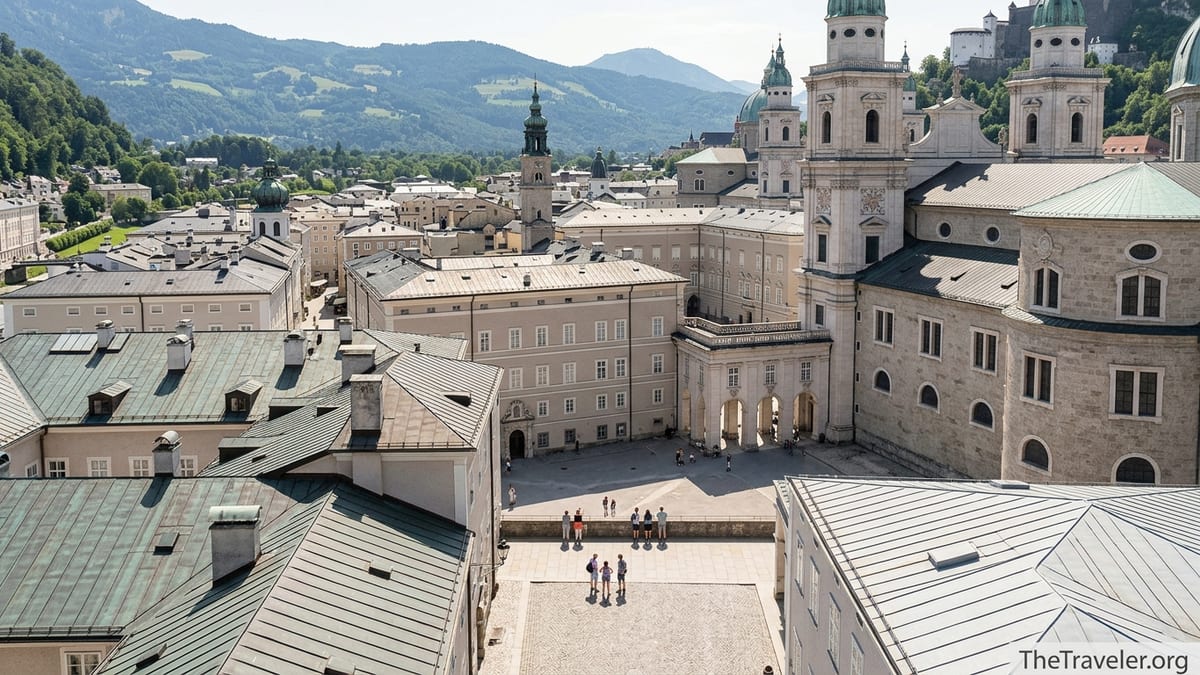
One of the most memorable moments of the DomQuartier circuit is stepping out onto the Dombogen terrace, which bridges the Residenz and the cathedral above the Domplatz. From here you get an elevated view of the square with its baroque fountain, the cathedral façade and, in winter, the Christmas market stalls. On a clear day you can see across the Old Town rooftops to the Hohensalzburg Fortress and the hills beyond, which makes this an excellent spot for wide angle photos. Many visitors who might never climb the fortress tower still leave Salzburg with a panoramic shot taken from this terrace.
Another highlight follows soon after: access to the organ loft inside Salzburg Cathedral. Instead of entering from the main doors at ground level, you look down into the nave from the level of the organ and side galleries. This unusual perspective reveals the scale of the columns and dome, and gives a close up view of the frescoes and stucco that are otherwise hard to appreciate from below. If you have previously attended a mass or concert in the cathedral, seeing the same space from this height adds an extra dimension to the experience.
Collections, Curiosities and St Peter’s Abbey
Beyond the grand state rooms and terraces, much of DomQuartier’s charm lies in its collections. The Cathedral Museum houses liturgical treasures such as chalices, vestments and carved altarpieces that narrate Salzburg’s religious history. Even travelers who are not particularly devout often find these objects fascinating for their craftsmanship and the way they illustrate the wealth and influence of the cathedral chapter over the centuries. Written descriptions tend to place them in context, mentioning key events like the baroque rebuilding of the cathedral in the 17th century.
The Cabinet of Art and Curiosities is a compact space but particularly enjoyable, especially for families. Here you encounter objects that echo the princely “Wunderkammern” of early modern Europe: exotic shells, scientific instruments, miniature sculptures and oddities that demonstrate both curiosity about the wider world and a desire to impress visitors. Travelers who have seen similar cabinets in places like Vienna’s Kunstkammer or Dresden’s Green Vault will recognize the same combination of scientific interest and showmanship. In DomQuartier, the display gives a window into how Salzburg’s rulers wanted to align themselves with other sophisticated courts.
Continuing through the Long Gallery, a corridor lined with paintings and decorative elements, you eventually reach the Museum of St Peter’s Abbey. This part of the route introduces the Benedictine monastery that, together with the Residenz and the cathedral, shapes the DomQuartier. The museum displays manuscripts, sculptures and everyday objects from monastic life, helping visitors understand how the abbey contributed to education, music and scholarship in Salzburg. For example, exhibits on Gregorian chant or the abbey’s scriptorium can be an interesting complement if you plan to attend an evening concert of sacred music in the city.
Because DomQuartier partners with the Salzburg Museum and other institutions, exhibitions in spaces like the North Oratory can change over time. You might encounter a show on baroque architecture, an in depth look at the Rossacher collection of baroque sketches and models, or a thematic exhibition linked to the Salzburg Festival season. It is worth checking current exhibition titles when you buy your ticket, especially if you have niche interests such as stage design, religious sculpture or Austrian painting of the 18th century.
Planning Your Visit: Timing, Crowds and Practical Tips
For most travelers, the best time to visit DomQuartier is late morning or early afternoon on a weekday other than Tuesday, when the complex is closed. If you arrive shortly after opening at 10:00, you can often enjoy the state rooms and galleries in relative quiet, especially outside of peak summer and major festival dates. This timing also lets you step onto the Dombogen terrace while the light is still flattering for photos, then have lunch in a nearby café on Residenzplatz or along the Kapitelplatz afterwards.
In July and August, when Salzburg receives many international tour groups, DomQuartier can be busier from late morning onwards. Even then, the length of the circuit and the number of rooms help disperse visitors, so it rarely feels as crowded as the narrow lanes around Getreidegasse. If you are visiting during the Salzburg Festival in late July and August, expect more elegant evening crowds on Residenzplatz and Domplatz, but daytime museum visits remain manageable. In Advent, DomQuartier pairs well with the Christmas markets directly outside on Domplatz and Residenzplatz, but budget extra time for moving through the stalls.
DomQuartier is generally accessible, but the buildings are historic. Elevators and ramps are installed in key locations, and staff can advise the best routes for visitors with limited mobility. If you are traveling with a stroller, be prepared for some tighter doorways and occasional short staircases, though families do successfully navigate the circuit. Service animals and assistance dogs are permitted, while other pets are not allowed inside, which is worth knowing if you are touring Salzburg with a dog.
Photography is typically allowed without flash in most areas, including the state rooms, galleries and terrace, though tripods are usually not permitted without prior permission. If you are planning a special shoot, such as engagement photos, contact the museum in advance as there may be restrictions or fees. For regular sightseeing, a compact mirrorless camera or a modern smartphone is sufficient; a wide angle setting is particularly useful in the state rooms and organ loft, where you want to capture ceilings and long perspectives.
Tickets in Practice: Where and How to Buy
You can purchase DomQuartier tickets on the day at the ticket counter in the Residenz on Residenzplatz, which is the usual entry point for the circuit. During shoulder seasons like March or November, same day purchase is typically straightforward, and you are unlikely to encounter long lines. In peak summer, waiting times can increase when several groups arrive simultaneously, but they are still modest compared with major city museums in places like Paris or Rome.
For travelers who prefer having everything arranged in advance, online ticket purchase is available through DomQuartier’s official online shop and through reputable ticketing platforms that sell timed entry or open date vouchers. Buying ahead can be helpful if you are fitting DomQuartier into a tight schedule that also includes fixed time tours, such as a 14:00 boat trip on the Salzach or an early evening concert at Mirabell Palace. In that case, selecting a specific entry window in the morning lets you plan the rest of your day with more confidence.
If you hold a Salzburg Card, you do not need to buy a separate DomQuartier ticket. Instead, you present the card at the counter and receive a day entry. This works well if you are also using the card for free admission to Hohensalzburg Fortress and for bus travel out to Hellbrunn Palace on the same day. Travelers who prefer not to commit to a city pass can simply compare the individual DomQuartier ticket price with other sights on their list to decide whether the card offers value for their particular itinerary.
Group visits, especially for more than ten people, should be booked ahead, as DomQuartier offers special guided tour options in multiple languages. These tours typically run around 90 minutes and may focus on specific themes such as baroque court life, music in Salzburg or the architecture of the cathedral and Residenz. If you are arranging a school group or a specialized cultural tour, contacting the museum office in advance also allows you to discuss accessibility, cloakroom use and timing around other events in the complex.
The Takeaway
DomQuartier Salzburg is one of the city’s most comprehensive cultural experiences, weaving together architecture, art and religious history across a remarkably intact baroque ensemble. In a single visit, you move from ornate state rooms to painting galleries, from a rooftop terrace over Domplatz to the organ loft of Salzburg Cathedral, and on through the collections of St Peter’s Abbey. The circuit tells a coherent story of how the prince archbishops shaped Salzburg as both a spiritual center and a small but influential court.
With clear ticketing, manageable crowds and a recommended visit time of around 90 minutes to two hours, DomQuartier fits smoothly into most itineraries, whether you are in Salzburg for a single overnight stop between Vienna and Munich or for a longer stay that includes concerts and excursions into the Salzkammergut. It works particularly well on days when the weather is mixed or cold, since most of the route is indoors yet still offers memorable views of the Old Town.
By checking current opening hours and any partial closures in advance, deciding whether to use a Salzburg Card or standalone ticket, and timing your visit to avoid the busiest parts of the day, you can experience the complex at its best. Whether you are drawn by baroque art, church history, city panoramas or simply the pleasure of wandering through beautiful historic interiors, DomQuartier rewards the time you give it and often becomes a highlight that visitors discuss long after their trip.
FAQ
Q1. How long should I plan for a visit to DomQuartier Salzburg?
Most visitors should plan about 90 minutes to two hours for a full circuit with the audio guide. Art and history enthusiasts who read more labels or study the paintings in detail may want up to three hours, while those mainly interested in architecture and views can comfortably see the highlights in around an hour and a half.
Q2. What does a standard DomQuartier ticket include?
A regular ticket includes entry to the entire DomQuartier circuit wherever open on the day of your visit. This covers the State Rooms of the Residenz, the Residenzgalerie, the cathedral museum and organ loft, the Cabinet of Art and Curiosities, the Long Gallery, the Museum of St Peter’s Abbey and access to current special exhibitions in the Residenzgalerie or North Oratory, as well as the Dombogen terrace above Domplatz.
Q3. Are there discounts or free entry options available?
Yes, there are discounted tickets for seniors, clergy, students and groups, plus a family ticket option. Children up to six years old generally enter free, and visitors with an official disability card from 50 percent disability often receive free admission, with one accompanying person also free when noted on the card. Holders of the Salzburg Card can enter DomQuartier once without paying an additional ticket fee.
Q4. Do I need to book tickets in advance?
Advance booking is not strictly necessary for individual visitors, and you can usually buy tickets on the day at the Residenz ticket counter, especially outside of the busiest summer weeks. Booking online in advance can still be useful if you want to secure a specific time slot in a tight schedule or are visiting during peak season, festival periods or with a larger group that may require special arrangements.
Q5. Is DomQuartier suitable for children and families?
DomQuartier can work very well for families, particularly with school age children who enjoy stories and visual experiences. The audio guide usually has a child friendly option in several languages, and the Cabinet of Art and Curiosities, terrace views and long grand corridors tend to capture younger visitors’ imagination. Because the route is quite extensive, it can help to plan short breaks and focus on a few key rooms rather than trying to study every exhibit in detail.
Q6. How accessible is DomQuartier for visitors with limited mobility?
DomQuartier is housed in historic buildings, but there are elevators and adapted routes that make most areas accessible to visitors with limited mobility. Staff at the entrance can advise on the best path through the circuit and assist with lift access. Some sections may involve slightly longer detours or have occasional limitations during building works, so it is wise to mention any specific mobility needs when you buy your ticket or to contact the museum office ahead of time.
Q7. Can I take photos inside DomQuartier?
Photography for personal use is generally allowed without flash in most parts of DomQuartier, including the state rooms, galleries, terrace and organ loft. Tripods and professional equipment usually require prior permission, and flash may be restricted to protect sensitive artworks. If you are unsure about a specific room, it is best to check the signage or ask a member of staff, but most visitors are able to take plenty of photos during a normal visit.
Q8. What is the best time of day to visit to avoid crowds?
Arriving soon after opening around 10:00 on weekdays typically offers the calmest experience, especially outside of high summer. Late afternoons can also be quieter, although you should keep in mind the last admission time, which is usually one hour before closing. During the Salzburg Festival or Advent market season, mornings still tend to be less crowded than midday, when more tour groups and market visitors are in the Old Town.
Q9. How does DomQuartier fit into a one day Salzburg itinerary?
Many travelers combine DomQuartier with a visit to Salzburg Cathedral at ground level, a walk through the Old Town lanes around Getreidegasse and a trip up to Hohensalzburg Fortress. A common pattern is to explore the fortress in the morning, have lunch in the Old Town, then visit DomQuartier in the early afternoon before heading to Mirabell Gardens or an evening concert. Because DomQuartier is centrally located, it is easy to adjust this order depending on weather and your other bookings.
Q10. Is DomQuartier worth it if I am not a big museum person?
Even travelers who normally skip art museums often find DomQuartier worthwhile because of its mix of grand interiors, city views and unusual vantage points in the cathedral. The route feels more like walking through a lived in baroque cityscape than standing in front of display cases all day. If you are unsure, you might focus on the state rooms, terrace and organ loft, using the audio guide selectively; many visitors in this situation leave feeling that DomQuartier was one of the most memorable parts of their time in Salzburg.