


Few places capture Salzburg’s baroque elegance as effortlessly as Mirabell Gardens. With sweeping flowerbeds aligned to Hohensalzburg Fortress, playful fountains and tucked-away terraces, this compact park is one of the city’s most photogenic corners and a favorite stop for Sound of Music fans, wedding couples and casual strollers alike. This guide walks you through the best views, fountains and photo spots, using up-to-date local details so you can experience Mirabell at its best.
Get the latest updates straight to your inbox!
Essential Facts: Opening Hours, Tickets and What to Expect
Mirabell Gardens sit on the right bank of the Salzach River, just north of Salzburg’s historic Old Town and directly in front of Mirabell Palace. The gardens are part of the city’s UNESCO-listed historic center and are treated both as a sightseeing highlight and a daily-use green space for locals. You will see everything from tour groups recreating Sound of Music scenes around the Pegasus Fountain to Salzburg residents cutting through the park on their way to work.
One of the biggest advantages for visitors is that Mirabell Gardens are generally open daily and are free to enter. According to current city tourism information, the garden gates are typically open from early morning until late evening, with exact times varying slightly by season. On a typical spring or summer day you can usually wander in by around 6 a.m. and stay until roughly dusk, which means photographers can easily catch both sunrise calm and golden-hour light without worrying about ticket windows or time slots.
There is no admission fee specifically for the gardens, and you do not need a reservation. This makes Mirabell one of the easiest sights to slot into a Salzburg itinerary, whether you have a full weekend or just a few hours between trains. Visitors who purchase a Salzburg Card will find that it covers many paid attractions nearby, but for Mirabell Gardens themselves you simply walk in through any of the main gates, such as those at Mirabellplatz or along the Schwarzstrasse side facing the river.
In high season, expect crowds from mid-morning onwards, especially when large bus tours and Sound of Music excursions stop at the Pegasus Fountain. On a sunny July afternoon, you might find dozens of people lining up to pose on the balustrade above the Grand Fountain. Early mornings, evenings and overcast days are much quieter, with more locals walking dogs and fewer organized groups, giving the park a more relaxed, everyday atmosphere.
Getting There: From Salzburg Hauptbahnhof and the Old Town
Reaching Mirabell Gardens is straightforward whether you are arriving by train, bus or on foot. From Salzburg Hauptbahnhof, the main train station, the gardens are roughly a 15 to 20 minute walk for most travelers. A common route follows Rainerstrasse directly south toward the city center, bringing you to Mirabellplatz, where one of the main entrances to the gardens sits opposite the palace façade. Many visitors on a day trip from Munich simply wheel their suitcase from the station and enjoy Mirabell as their first stop in Salzburg.
If you prefer not to walk, local trolleybus lines that serve the Hauptbahnhof also stop at or near Mirabellplatz according to current route maps. Riders typically pay a few euros for a single ticket purchased either from a machine at the stop or directly from the driver. For example, a short ride on one of the electric trolleybuses linking Hauptbahnhof to Mirabellplatz usually takes less than 10 minutes in normal traffic and drops you within a block of the palace. Taxis queue in front of the station as well; recent visitor reports suggest that a short ride to Mirabell costs in the range of 7 to 10 euros, depending on traffic.
From Salzburg’s Old Town on the left bank of the Salzach, Mirabell Gardens are still only a short stroll away. Many travelers walk over the Makartsteg footbridge, a popular span lined with love locks, then follow the gentle uphill streets inland for a few blocks until they reach the garden gates. This approach offers a memorable sequence of views: first the river and fortress, then the baroque streets around the Mozarteum, and finally the symmetrical flowerbeds with the fortress framed in the distance.
For drivers, it is worth knowing that central Salzburg parking is limited and relatively expensive by the hour. Public garages in the city center and along the river are often used by visitors, but many locals recommend leaving the car at a park-and-ride lot on the outskirts and using public transport, especially in summer when Salzburg’s narrow streets can feel congested. Because Mirabell Gardens are so central, walking and buses tend to be the most efficient choices.
The Grand Parterre: Classic Fortress Views and Central Fountain
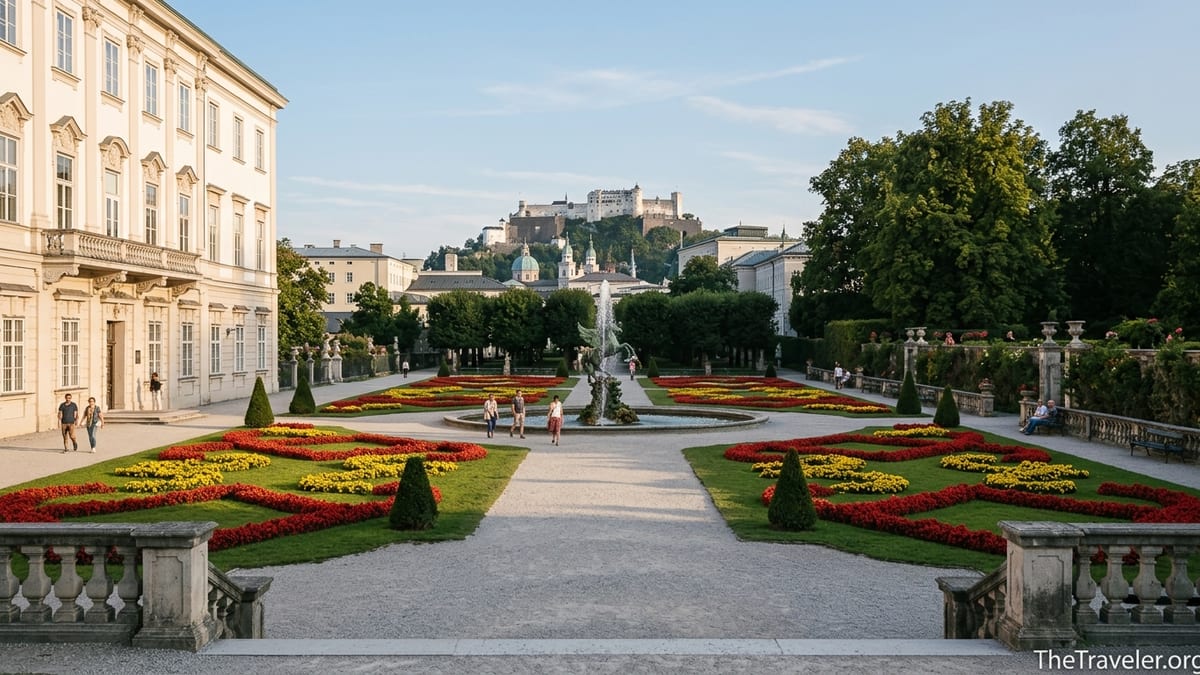
The heart of Mirabell Gardens is the Grand Parterre, the wide, symmetrical garden axis running between Mirabell Palace and the low balustrade overlooking the city. This is the view you will recognize from countless Salzburg postcards: manicured flowerbeds in geometric patterns, framed by baroque statues, with Hohensalzburg Fortress rising on the hill directly in line with the central path. On a clear day, the fortress appears almost perfectly centered above the main fountain when viewed from the palace side.
For one of the most iconic photos, enter from the Mirabellplatz side, turn your back to the palace façade and walk a few steps down into the center of the parterre. From here, compose your shot with the Grand Fountain in the foreground, the flowerbeds forming diagonal lines toward the horizon, and the fortress crowning the skyline. Photographers often choose a slightly low angle to emphasize the foreground flowers, especially in late spring and early summer when the beds are at their lushest, typically from May into September depending on weather and plantings.
The Grand Fountain itself is a focal point, ringed by stone sculptures with playful baroque energy. On a sunny afternoon you can capture water droplets sparkling against the fortress backdrop. Try standing slightly off-center to avoid a perfectly symmetrical postcard composition; this small adjustment gives your photo a more natural editorial feel. If you visit shortly after rain, the stone around the fountain darkens, creating richer contrasts that work well in black-and-white images.
Because this section sees heavy foot traffic, patience is important if you want people-free frames. Early morning, generally before 8:30 a.m., often brings a short window when gardeners are watering the beds and only a few joggers cross the parterre. In the evening, after most tour groups have left, you may find couples and locals enjoying the benches, which can add a gentle human touch to wider scene-setting photos.
Pegasus Fountain and Rose Garden: Sound of Music Magic
Just northeast of the Grand Parterre sits the Pegasus Fountain, perhaps the single most famous feature of Mirabell Gardens thanks to its appearance in the Do-Re-Mi sequence of The Sound of Music. The bronze Pegasus, dating back to the 17th century, rears above a circular basin surrounded by low steps and a stone balustrade. Today, almost every Sound of Music tour in Salzburg stops here, and you will frequently see groups posing on the steps or mimicking the choreography from the film.
For photography, the classic angle is to stand behind the fountain, on the side closest to the palace, and frame Pegasus in the center with Mirabell Palace off to one side and the fortress in the distant background. On a clear morning, the light tends to come softly from the east, giving good modeling on the statue and gentle reflections in the water. If you shoot at a slightly lower angle, you can include the colorful flowerbeds beyond the fountain, while a higher perspective from the surrounding ledge offers a more formal, documentary-style composition.
Climb the short marble staircase beside the Pegasus Fountain to reach the Rose Garden terraces. This upper level is edged with neat rose beds and trimmed hedges, offering a semi-formal setting that feels quieter than the parterre below. Wedding photographers in Salzburg often bring couples here in the late afternoon because the stone balustrades, climbing roses and filtered light create a soft, romantic mood ideal for portraits. From the corners of the terrace, you can capture layered views that include both the Roses, the Pegasus Fountain below and occasionally a glimpse of the cathedral domes across the river.
If you are primarily interested in Sound of Music history, look closely at the details around this area. Visitors often recreate the moment where the children run around the fountain, and you can stand roughly where the camera would have been placed for the film’s wide shots, with the castle and gardens perfectly aligned. Even if you have not seen the movie recently, watching present-day tour groups sing Do-Re-Mi in this very spot gives the terrace a lively and slightly nostalgic energy that is distinct from the more formal sections of the garden.
Dwarf Garden and Bastion: Quirky Statues and Elevated Angles
One of Mirabell Gardens’ most distinctive corners is the Dwarf Garden, a slightly tucked-away enclave populated by a ring of weathered marble figures. Historically, these baroque dwarfs formed part of a larger collection of garden sculptures. Today, several of them stand along a curved path, each with its own exaggerated facial expression, hat or musical instrument. Compared to the polished formality of the Grand Parterre, the Dwarf Garden feels playful and a bit eccentric.
To reach the Dwarf Garden from the Pegasus Fountain, you typically cross a small bridge and climb a short set of steps to a raised bastion area that runs along the garden’s northern edge. According to local descriptions, this bastion forms part of an old fortification wall and offers one of the better elevated views back across the parterre. Standing here, you can shoot over the tops of the flowerbeds and see the strict geometry of the garden layout, which is not as obvious from ground level.
The dwarf statues themselves make excellent detail shots. Photographers often focus on a single expressive face with the fortress or palace softly blurred in the background. Because this area sees fewer large tour groups than the Pegasus Fountain, you can usually experiment with compositions at your own pace. Late afternoon light tends to skim across the stone figures, bringing out surface textures and the patina of age, especially in early autumn when low sun angles and slightly cooler air give the garden a crisp, clear look.
Accessibility on the bastion is more limited than in the flat central areas, as it involves steps and uneven surfaces. Travelers with mobility challenges may find the main parterre and riverside paths more comfortable. For those who can manage the elevation, however, combining a wide bastion overview with a series of close dwarf portraits adds variety to any Mirabell photo set and gives a sense of the garden’s layered history beyond its postcard-famous views.
Hidden Corners: Hedge Theater, Side Paths and Riversides
Beyond the headline sections, Mirabell Gardens reward anyone willing to wander the side paths for half an hour. On the western side of the complex, you will find the Hedge Theater, a small open-air space enclosed by tall hedges that originally served as a baroque garden stage. Today it is usually quiet, with only occasional small performances; most of the time it functions as a secluded green room where locals sit on benches with a book or office workers enjoy a quick lunch break away from the main paths.
For photographers, the Hedge Theater offers strong lines and deep greens that contrast nicely with the bright flowerbeds out in the parterre. On overcast days, the even light under the foliage can be beautifully soft, ideal for portraits or detail shots of leaves, stone steps and arching hedges. Because it lies off the standard tour route, you may have the entire space to yourself even in mid-summer.
On the eastern and southern edges of the gardens, narrower gravel paths run between hedges, lawns and smaller planting beds. These paths often frame partial views of the fortress or the cathedral towers, peeking over rooftops and greenery. Couples who have just gotten married in Mirabell Palace’s marble hall frequently use these quieter side paths for intimate photo sessions right after their ceremony, with the tall hedges acting as a natural backdrop.
Just outside the gardens, along the Schwarzstrasse side and toward the Salzach River, you will find additional vantage points. Crossing the nearby pedestrian bridge or walking along the riverbank gives you context shots that include the entirety of Mirabell Gardens nestled against the city. These wider views work well if you want to tell a visual story of Salzburg in which Mirabell is just one element in a broader landscape of baroque towers, fortress walls and the flowing river.
Best Times for Photos: Light, Seasons and Crowds
Mirabell Gardens change character dramatically with light and season, so timing your visit can significantly affect both your experience and your photographs. In peak season from late spring through early autumn, the flowerbeds of the Grand Parterre are usually at their most colorful, with carefully arranged patterns of annuals and perennials. Morning light in this period tends to be gentle and slightly warm, making colors pop without blowing out highlights. Many photographers aim for an arrival between 7:00 and 9:00 a.m., when the sun is high enough to illuminate the fortress but before tour buses fully arrive.
Midday in summer can be harsh for photography and crowded for sightseeing. The high sun flattens textures and creates strong shadows on faces, while large groups in brightly colored clothing can dominate the central paths. If this is the only time you can visit, lean into detail shots: carve out compositions that focus on statues, fountains and flowers rather than broad vistas filled with people. For example, a tight frame of water splashing against a stone horse in the Grand Fountain or a close-up of a rose with the blurred silhouette of the fortress can still yield compelling images even at noon.
Late afternoon and early evening bring softer light again, often with a warm glow on Mirabell Palace and Hohensalzburg Fortress. In summer, golden hour can stretch from roughly 6:30 to 8:30 p.m., though exact times vary through the season. This is a prime period for couples’ portraits along the balustrades and for atmospheric wide shots of the parterre. Crowds thin gradually as day-trippers return to trains and buses, and by sunset you may share the bastion viewpoints with only a handful of locals.
In winter, Mirabell Gardens become a quieter, more understated place. Flowerbeds are less showy, but frost on stone statues, bare tree branches and occasional dustings of snow give the space a different kind of beauty. Photographers visiting around Christmas often combine a quick walk through Mirabell with the nearby Advent market that sets up at the square in front of the palace in some years. Even in the colder months, the gardens remain open as a public park, so you can capture moody, atmospheric scenes with fewer people and a deeper sense of season.
Practical Tips: Facilities, Accessibility and Etiquette
Because Mirabell Gardens function both as a major attraction and as a neighborhood park, facilities are adequate but not extensive. Public restrooms are available within or near the palace complex, and several cafes and bakeries around Mirabellplatz and the adjacent streets offer coffee, pastries and light meals. A visitor spending a relaxed morning here will often grab a takeaway coffee from a local bakery near the square and enjoy it on a bench overlooking the parterre or Pegasus Fountain.
Accessibility in the central areas of the garden is generally good. Main paths are wide and mostly level, with firm surfaces suitable for wheelchairs and strollers. The Grand Parterre, Pegasus Fountain plaza and much of the Rose Garden terrace can be reached without tackling long flights of stairs. As noted earlier, the bastion and Dwarf Garden involve steps and uneven surfaces, which may be challenging for some visitors. If you are traveling with a stroller or mobility aid, it is helpful to enter via Mirabellplatz or the main riverside gates, where the transitions from street to path are smoother.
As in any popular urban park, a bit of etiquette helps everything run smoothly. Walking on the lawns and stepping into flowerbeds are discouraged, both to protect the plantings and to keep views tidy for everyone. Tripods are generally tolerated for casual photography when used considerately, but setting up large lighting rigs or doing commercial shoots without permission can attract attention from staff. Wedding and event photographers who work at Mirabell regularly often arrange any necessary approvals in advance through local authorities.
Finally, remember that Mirabell Gardens are part of a residential and working city, not solely an open-air museum. Early in the morning you may encounter municipal workers cleaning paths or gardeners tending to beds with hoses and equipment. Lunchtime sees a wave of office workers using the park as a break spot. Being aware of this rhythm will make your visit feel more authentic and help you share busy paths politely with everyone who treasures this slice of Salzburg.
FAQ
Q1. Do I need a ticket to visit Mirabell Gardens in Salzburg?
Entry to Mirabell Gardens is currently free, and you do not need a ticket or reservation to walk through the park or enjoy the main viewpoints.
Q2. What are the usual opening hours for Mirabell Gardens?
The gardens are generally open daily from early morning until late evening, with exact gate times varying modestly by season and daylight hours.
Q3. How do I get to Mirabell Gardens from Salzburg Hauptbahnhof?
You can walk about 15 to 20 minutes along Rainerstrasse to Mirabellplatz, or take a short trolleybus ride from the station to stops near the palace square.
Q4. When is the best time of day to take photos at Mirabell Gardens?
Early morning and late afternoon usually offer softer light and fewer crowds, while midday is brighter and busier but still good for detail shots.
Q5. Where can I find the classic Sound of Music photo spot in Mirabell?
The iconic Sound of Music views are at the Pegasus Fountain and the nearby terrace staircase, where many tours stop to recreate the Do-Re-Mi scene.
Q6. Are Mirabell Gardens accessible for wheelchairs and strollers?
The main paths, Grand Parterre and Pegasus Fountain areas are mostly level and accessible, though the bastion and Dwarf Garden involve steps and uneven ground.
Q7. Can I take wedding or engagement photos in Mirabell Gardens?
Yes, couples often use the Rose Garden terraces and balustrades for portraits, but large professional shoots may require separate permission from local authorities.
Q8. Are there restrooms or cafes inside Mirabell Gardens?
Public restrooms are available in or near the palace complex, and several cafes and bakeries around Mirabellplatz provide easy options for coffee or snacks.
Q9. Is Mirabell Gardens worth visiting in winter?
Yes, even without full flowerbeds the gardens offer atmospheric views of statues, trees and the fortress, and they combine well with Salzburg’s Advent season activities.
Q10. How much time should I plan for a visit to Mirabell Gardens?
Most visitors spend between 45 minutes and two hours exploring the main viewpoints, though photographers may want longer to work with changing light and angles.