


Salzburg is not short on grand sights, but two places dominate most itineraries: the DomQuartier and Hohensalzburg Fortress. Both grew out of the same prince-archbishop power base, both are core parts of the UNESCO-listed old town, and both promise sweeping views and deep dives into Salzburg’s past. If you only have time or budget for one, though, choosing between them can feel surprisingly tricky. This guide breaks down how they compare in atmosphere, views, history, logistics, and value so you can decide which is better for your style of trip.
Get the latest updates straight to your inbox!
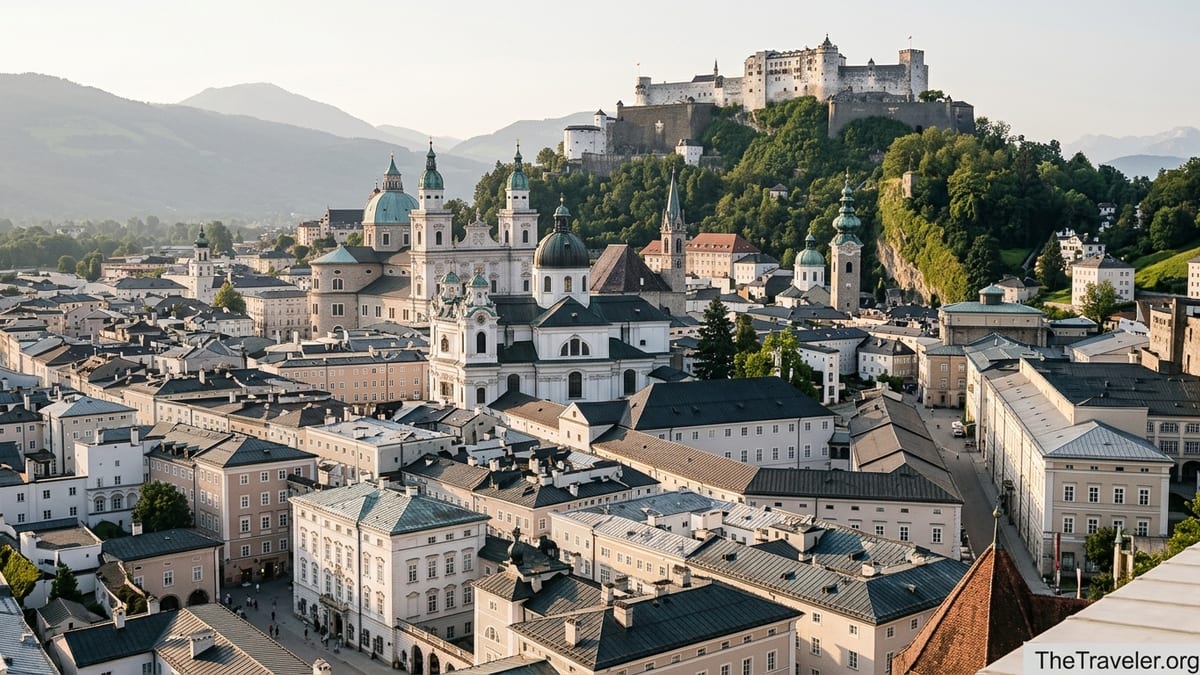
Overview: Two Very Different Windows Into Salzburg
Although they share a common story of prince-archbishops ruling church and state, the DomQuartier and Hohensalzburg Fortress feel very different on the ground. The DomQuartier is an interconnected museum route through the Baroque Residenz palace, cathedral galleries, and St Peter’s Abbey spaces, all woven through the fabric of the old town. It is about interiors, art, and ceremonial power, covering more than 1,300 years of religious and political history in curated rooms and galleries.
Hohensalzburg Fortress, by contrast, is a hilltop stronghold crowning the Festungsberg above the city. Dating back to the late 11th century and expanded over centuries, it is one of the largest preserved medieval castles in Europe, stretching roughly 250 meters by 150 meters along the ridge. Walking its ramparts, courtyards, and towers is as much about fresh air and big skies as it is about exhibitions.
Most visitors will have a markedly different emotional response to each site. At the DomQuartier, you might find yourself quietly contemplating a 17th century ceiling fresco or listening to Baroque music in a former state room. At Hohensalzburg, the memory is often the wind on the viewing platforms, the clang of the funicular, and the sight of the Alps framing the rooftops below. Understanding this contrast is the key to choosing which one suits you better.
Both attractions are central enough that they fit easily into a short Salzburg stay. The DomQuartier is a few minutes’ walk from the river across Residenzplatz, while the funicular to Hohensalzburg departs from the upper old town beside St Peter’s Abbey. In practice, you will walk past the base of the fortress on your way to the DomQuartier anyway, which makes it tempting to squeeze in both. Time, budget, and energy levels will usually decide the rest.
Atmosphere & Experience: Palace Circuit vs Hilltop Fortress
The DomQuartier delivers a refined, almost courtly experience. Once you step inside the Residenz, you move through a sequence of grand halls, stuccoed ceilings, mirrored salons, and gallery spaces that were once reserved for archbishops and their guests. Many travelers compare the feel to a compact, Austrian version of an Italian palazzo, which reflects Salzburg’s deliberate Baroque redesign in the 1600s. The lighting is soft, the temperature controlled, and the progression clearly signposted, so it feels like a classic European museum circuit.
A standout moment is reaching the Dom organ loft level, where you can look directly into the soaring nave of Salzburg Cathedral from above. Another is stepping onto the Domterrasse, the terrace that links the Residenz wing and the cathedral. From here you see the Baroque church façade from an unusual lateral angle, with Residenzplatz, the cathedral squares, and often street musicians far below. The crowds tend to be moderate compared with the fortress, and even in busy months it is usually possible to find corners of quiet, especially in the galleries.
Hohensalzburg Fortress is a more rugged, outdoorsy experience. Even if you opt for the funicular rather than the uphill walk, you emerge into courtyards and ramparts that are mostly open to the elements. The stone underfoot is uneven in places, staircases can be steep and narrow, and the wind on the upper platforms can be strong in shoulder seasons and winter. Travelers often describe it as feeling like a small fortress town, with different courtyards, chapels, and museum areas unfolding as you wander.
The atmosphere also shifts throughout the day. Mornings often feel calmer, with mist lingering over the Salzach and a gentler hum of tour groups. By midday in July and August, when river cruise groups and day trippers arrive, the fortress can feel crowded, especially at the main viewpoints and in the audio tour section. In the evening, when special concerts or dinners are held in the fortress, the mood turns surprisingly romantic, with golden light over the old town and the mountains taking on soft pastel shades.
Views: City Rooftops or Alpine Panorama?
Both attractions offer memorable views, but in very different ways. The DomQuartier’s best vantage points are the Domterrasse and several high-level windows along the circuit. From the terrace you look across the cathedral squares, the Baroque façades around Residenzplatz, and towards the fortress itself perched high on the Festungsberg. The perspective is horizontal, at roughly the height of nearby rooftops, so you feel embedded in the old town rather than above it.
These views are ideal if you are partial to architectural photography: tight frames of onion-domed towers, stucco façades, and pedestrians threading through the stone-paved squares. Because you are not dramatically higher than the surrounding structures, the DomQuartier vantage points are immersive rather than commanding. Many visitors enjoy stepping outside here between museum sections to reset before heading into the next gallery.
Hohensalzburg Fortress is the choice if you want Salzburg’s classic postcard panorama. From the viewing platforms and tower walks you look down over the entire old town, across the Salzach River to the newer districts, and out towards the northern limestone Alps. On clear days you can see multiple mountain ranges stacked against the horizon, which makes it particularly rewarding after a period of rainy weather. Snow in winter, or late afternoon light in autumn, can turn the scene almost monochrome, with the cathedral’s green domes and the orange-tiled roofs acting as the only strong color notes.
For photographers, the fortress offers wide-angle cityscapes and layered mountain backdrops. A typical visitor might spend 20 to 40 minutes simply looping around the different viewpoints, experimenting with compositions of spires and peaks. If you are traveling with friends or family, this is also the spot where group shots with Salzburg in the background are easiest. In practice, if your priority is big, open views and you only have time for one of the two sights, Hohensalzburg generally wins.
History & Culture: Curated Story vs Living Fortress
The DomQuartier is explicitly designed as a storytelling museum route, and it shows. The complex links multiple historic institutions: the state rooms of the Residenz, the Residenzgalerie with European paintings from the 16th to 19th centuries, cathedral oratories and the cathedral museum, sections of the St Peter’s monastery area, and a Baroque long gallery that ties them together. Panels and displays trace how Salzburg’s prince-archbishops used art, music, and architecture to project authority over both spiritual and secular life over more than a millennium.
Throughout the circuit you will encounter religious artworks, portraits of rulers, ceremonial furniture, and objects associated with liturgy and daily court life. A visitor interested in the church’s role in shaping central European politics will find a lot of context here. In some rooms, audio elements or temporary exhibitions add layers: for example, seasonal shows may explore themes such as Baroque soundscapes, craft traditions, or specific archbishops’ building campaigns. You can easily spend two or three hours if you read labels in detail.
Hohensalzburg Fortress presents history more as atmosphere and physical presence than as a continuous, curated narrative. The complex grew from a fortified core in the 11th century into a massive bastion-style fortress, adapting to different military threats, peasant uprisings, and changes in weaponry. Today, museum areas such as the Fortress Museum and the Princes’ Chambers explain this evolution with objects, models, and multimedia displays. The preserved princely rooms, with woodcarving and late Gothic detailing, hint at how comfortable a prince-archbishop’s residence could be even inside a fortress.
Many visitors, however, take in the history simply by walking the walls, seeing the strategic lines of sight down the valley, and noticing how different architectural layers meet where the fortress was expanded and modernized. The story here is less about church art and more about power, defense, and the daily realities of garrisons and prisoners. If your interest in Salzburg is tied to medieval and military history, Hohensalzburg offers a more visceral connection, while DomQuartier provides a more scholarly, art-and-architecture-focused backdrop.
Tickets, Time & Practicalities: What You Actually Spend
Deciding which site is better often comes down to time, cost, and how you like to structure your sightseeing day. Both DomQuartier and Hohensalzburg Fortress are included as one-time free entries with the Salzburg Card, a popular city pass that many travelers buy for 24 or 48 hours to bundle public transport and major attractions. Without a card, you purchase separate tickets on-site or online, with various add-ons available at the fortress for funicular rides and premium museum access.
The DomQuartier usually takes at least 90 minutes for a relaxed visit, and up to three hours if you read more thoroughly and linger on the terrace. Because the route is linear and indoors for most of the way, it is easy to budget your time and to keep a steady pace. It is also naturally weather-proof, which makes it an attractive choice on rainy or very hot days when being outside at the fortress would be less comfortable. Families with young children often appreciate being able to pause in quieter rooms or take short breaks without worrying about wind or steep paths.
Hohensalzburg Fortress, on the other hand, can easily stretch into a half-day outing once you factor in the funicular up and down, wandering the courtyards, joining the included audio tour, and spending time on the viewpoints. A compact visit that focuses on the main views and a quick loop through the exhibitions might still take around two hours. If you choose a ticket that includes the Princes’ Chambers and special exhibitions, it is easy to stay longer. In high season, allow extra time for lines at the funicular base station and for moving through bottlenecks inside narrow stairways.
In terms of pure cost-benefit without a city card, many travelers feel that Hohensalzburg gives more visible “wow” per euro because of the funicular ride and panoramic scenery. The DomQuartier’s value is strongest for those who actively enjoy galleries and historic interiors; if you tend to move quickly through art museums, you might feel that you are not getting the full return. With a Salzburg Card in hand, however, the financial comparison largely vanishes, and the decision becomes one of time and personal interest.
Crowds, Comfort & Accessibility
For visitors who are sensitive to crowds or have mobility concerns, the differences between the two sites are important. The DomQuartier typically sees a steady but manageable flow of visitors, with the possibility of short waits at the ticket desk in the middle of the day. Once you are on the route, people disperse through many rooms, so only a few bottleneck spots may feel busy. Several sections are accessible by elevator, and floors are mostly even, though there are some staircases and older surfaces where you need to watch your step.
The indoor setting means reliable temperatures and protection from rain and snow. In summer, this can be a welcome break from Salzburg’s occasional heatwaves when the stone streets of the old town radiate warmth. Visitors who wear glasses or carry cameras also benefit from not having to deal with sudden downpours, which are common in the mountains. Benches in some galleries and along corridors provide resting points for those who prefer to sit periodically.
Hohensalzburg Fortress presents more of a challenge. Even with the funicular, there are slopes, cobblestones, multiple levels, and steps to navigate between courtyards and viewing platforms. Those with limited mobility may find some areas difficult or impossible to access, and pushing a stroller over the rougher ground requires patience. Weather amplifies these issues: wet stone can be slick, snow and ice in winter require good footwear, and strong sun in July and August can make exposed sections uncomfortably hot.
Crowds at the fortress also tend to be denser at peak times, especially when river cruise groups arrive in clusters. Narrow staircases to tower viewpoints and interior museum sections can create temporary queues and tight spaces. Travelers who prefer quieter experiences often time their visit for the first funicular runs of the morning or after 4 pm, when day trippers start to leave. If ease and comfort are your top priorities, particularly in poor weather, the DomQuartier comes out ahead.
Which Is Better For You? Traveler Profiles & Real Scenarios
Because both sights are strong, the more useful question is not “Which is objectively better?” but “Which is better for the kind of trip you are taking right now?” Looking at a few common traveler profiles can help clarify the choice. Consider a couple on a short December city break who arrive in Salzburg to find sleet and low cloud. In their case, the DomQuartier might be the more rewarding first-day option: they stay mostly indoors, walk directly from their hotel in the old town, and end their visit with a coffee on nearby Residenzplatz or at the Christmas market, with the fortress wrapped in mist above them.
By contrast, imagine a summer backpacker passing through Salzburg on a one-night stop between Vienna and Munich. They may have just enough afternoon time to check into a hostel, stroll the old town briefly, and pick one major sight. For them, Hohensalzburg Fortress is often the clear winner, because it gives a powerful sense of place in a short timeframe. They ride the funicular, take in the full panorama of the city and mountains, snap a dozen photos, and feel they have “seen” Salzburg even without a deep dive into its interiors.
Families with school-age children often find Hohensalzburg more engaging, because the fortress looks and feels like the castles they know from stories and films. The idea of taking a hillside railway, exploring ramparts, and peering through arrow slits tends to hold children’s attention longer than paintings and ornate ceilings. On the other hand, multi-generational groups that include grandparents who tire easily might lean toward the DomQuartier, where climate control, elevators, and seating make for a gentler day.
Solo travelers, especially those who enjoy art, music history, and photography, can make excellent use of both. If time is limited to one choice, a visitor who loves Baroque music and church history will probably get more out of the DomQuartier’s curated narrative, while someone who prioritizes landscape views and atmosphere will walk away more satisfied from Hohensalzburg. If you have two full days in Salzburg and a Salzburg Card, treating them as complementary rather than competing is the ideal approach.
The Takeaway
If you are hoping for a quick verdict, the simplest way to think about it is this: Hohensalzburg Fortress is better for sweeping views, a sense of medieval drama, and a memorable hilltop experience, while the DomQuartier is better for understanding how Salzburg became a Baroque showpiece and for immersing yourself in art, interiors, and church history. Both are central, both are historically significant, and both reward a thoughtful visit.
Travelers who only have a few hours in the city and want that iconic Salzburg postcard shot tend to be happiest starting with Hohensalzburg. Those visiting in poor weather, in the depths of winter, or with a particular interest in religious art and architecture will often find the DomQuartier more satisfying. With a Salzburg Card, the best strategy for many itineraries is to visit one site on a day with good visibility for views, and the other on a day when conditions are less favorable for outdoor sightseeing.
In the end, neither attraction truly replaces the other. The DomQuartier lets you walk the same ceremonial routes once reserved for prince-archbishops, past frescoes and galleries that shaped Salzburg’s identity. Hohensalzburg lets you stand where sentries once watched for threats, with the entire city and the Alps spread below. Looking at your own priorities, energy level, and season of travel will tell you which is better for you on this particular trip.
FAQ
Q1. If I only have half a day in Salzburg, should I choose DomQuartier or Hohensalzburg Fortress?
If you want big views and a strong first impression of the city, Hohensalzburg Fortress is usually the better half-day choice. If the weather is poor or you prefer art and interiors, the DomQuartier is the more comfortable and rewarding option.
Q2. Which site is better in bad weather or winter conditions?
The DomQuartier is generally better in rain, snow, or extreme cold because it is largely indoors, climate controlled, and easy to navigate without worrying about slippery paths or strong wind.
Q3. Is Hohensalzburg Fortress very crowded in summer?
Yes, it can be. Midday in July and August often sees heavy crowds, especially around the funicular stations, main courtyards, and tower viewpoints. Visiting early in the morning or later in the afternoon usually feels calmer.
Q4. Can visitors with limited mobility enjoy both attractions?
DomQuartier is generally more accessible, with elevators to several sections and mostly even floors, though some areas still have stairs. Hohensalzburg has steep paths, cobblestones, and many steps, so it can be challenging for visitors with mobility issues.
Q5. Which is better for families with children?
Many families find Hohensalzburg more exciting for children, thanks to the funicular ride, castle walls, and open spaces to explore. However, calm children who enjoy stories and objects may also appreciate the DomQuartier’s museums, especially if visits are kept shorter.
Q6. Do I need to book tickets in advance?
For the DomQuartier, same-day tickets on-site usually work fine outside the very busiest periods. For Hohensalzburg, buying online tickets or using a Salzburg Card can help you avoid some queuing at the funicular base, particularly in high season.
Q7. Can I visit both DomQuartier and Hohensalzburg Fortress in one day?
Yes, many travelers do. A realistic plan is to visit Hohensalzburg in the morning for clearer views, have lunch in the old town, and then tour the DomQuartier in the afternoon when the weather may be hotter or less predictable.
Q8. Which site offers the best photo opportunities?
Hohensalzburg offers the broadest photo opportunities for cityscapes and mountain views. The DomQuartier provides excellent interior shots of Baroque rooms, ceiling frescoes, and more intimate views of Salzburg’s historic squares from above.
Q9. Is the Salzburg Card worth it if I plan to see both?
For most visitors who intend to visit both DomQuartier and Hohensalzburg Fortress plus a few other sights or use public transport, the Salzburg Card often represents good value and simplifies ticket decisions.
Q10. Which attraction should I choose if I am especially interested in Baroque music and church history?
If your focus is Baroque music, liturgy, and church art, the DomQuartier is the better fit, as it ties together the cathedral complex, monastic spaces, and art collections that shaped Salzburg’s religious and musical heritage.