


Few sights in Salzburg are as instantly recognizable as Mirabell Gardens, framed by the baroque façade of Mirabell Palace and the silhouette of Hohensalzburg Fortress. The garden is free to enter, open daily from around 6 am until dusk, and famously appeared in the Do-Re-Mi sequence of The Sound of Music. That combination of cinematic pedigree, historic architecture, and carefully planned Baroque landscaping makes it one of the city’s most visited spots. But is Mirabell Gardens really worth visiting in every season, or should you time your visit for peak bloom months only? Looking at what actually happens in the gardens through spring, summer, autumn, and winter helps answer that question.
Get the latest updates straight to your inbox!
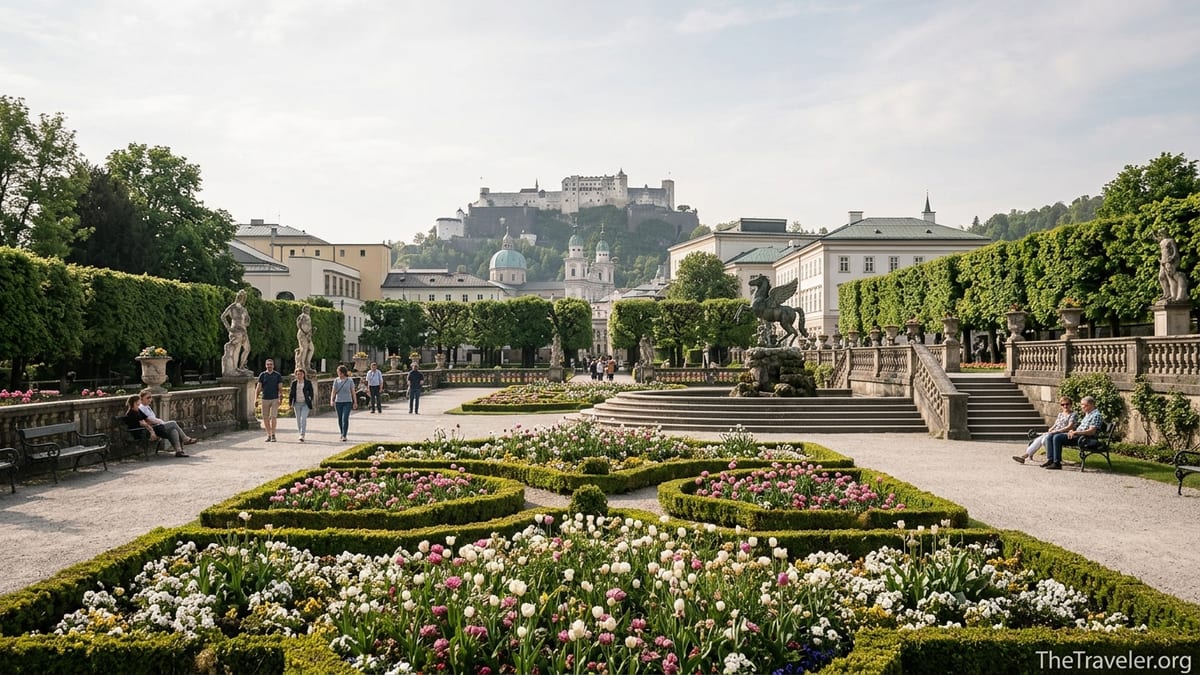
Understanding Mirabell Gardens Today
Mirabell Gardens belongs to the Mirabell Palace complex, a UNESCO World Heritage listed site in Salzburg’s historic center. The palace dates back to 1606, but the gardens assumed their current Baroque layout in the 18th century, with geometric flower beds, clipped hedges, statues, a Pegasus fountain and axial views that line up perfectly with Salzburg’s old town skyline. Today the palace houses city administration and the registry office, while the gardens remain open to the public free of charge. Visitors typically spend 30 to 60 minutes wandering the parterres, the rose hill and the Pegasus fountain area, often combining the garden with a walk across the Salzach River to the old town.
Practically speaking, Mirabell Gardens is one of Salzburg’s easiest attractions to fit into any itinerary. The official information office states the gardens open daily from approximately 6 am until dusk, with partial closures in winter for maintenance and safety. Admission is free, and you do not need to book a ticket or timeslot. That makes it an attractive stop for budget travelers, families and anyone on a tight schedule between trains. The Marble Hall inside the palace, a renowned concert venue, is normally open on weekdays during limited hours, and also hosts weddings and events, which may restrict access on certain days.
Mirabell’s role as a Sound of Music location has cemented it as a must-see for many international visitors. Numerous Sound of Music walking and bus tours include a stop in the gardens, sometimes even starting or ending there. Guides point out the Pegasus fountain where Maria and the children dance, the stone steps used in the finale of the song, and the hedge tunnel and dwarf garden that appear briefly in the film. If you visit in the middle of the day in high season, you are likely to see several tour groups re-enacting the scene, which adds both charm and crowds.
Because the basic elements of Mirabell Gardens are not seasonal, your experience is shaped less by whether the gardens are “open” and more by how they look and feel at different times of year. The clipped hedges, statuary, axial paths and fortress views are there in January as well as in June. What changes dramatically are the flower beds, the availability of certain garden sections such as the hedge theater and dwarf garden, and the overall atmosphere in and around the park.
Spring: First Color and Fewer Crowds
Spring, roughly from late March to May, is when Mirabell Gardens begins to emerge from winter’s bare structure into something more colorful. Municipal gardeners gradually replace winter planting schemes with tulips, pansies and other spring flowers, so the central parterres start to fill with color even while some trees are still bare. By late April and May, the famous rose hill behind the Pegasus fountain starts to show fresh greenery, though the main rose bloom typically peaks slightly later, around early summer.
From a visitor’s standpoint, spring offers a good balance between appearance and crowd levels. Daytime temperatures in Salzburg during April and May are often in the low to mid-teens Celsius, making it comfortable to stroll the gravel paths without the heat of July or August. You will still see organized tour groups, especially around Easter and public holiday weeks, but mornings can be relatively quiet. Travelers using Salzburg as a base for day trips to Hallstatt or the Salzkammergut often swing through Mirabell Gardens before catching a mid-morning train, taking advantage of the early opening time.
One practical advantage of spring is flexibility. If you are in Salzburg for a long weekend and the forecast looks mixed, you can use a clear morning or a break in the rain to wander the gardens. Since there is no ticket and no strict time slot, you can walk in spontaneously, even if you only have half an hour between museum visits. On a cool April morning, for example, many visitors grab a coffee from a nearby bakery on Mirabellplatz and sit on a bench overlooking the fountains, watching locals cross the park on their commute.
However, if your main priority is seeing fully developed roses and dense summer flower beds, an early spring visit may underwhelm. The garden’s structural beauty and skyline views are present, but the planting may look sparse, especially in March. Some peripheral sections, such as the dwarf garden or hedge theater, may still be in winter closure, and lawns might be roped off for regrowth after snow and frost. For photography, this season delivers soft, often overcast light and fewer people in the frame, ideal for capturing the fortress backdrop without constant foot traffic.
Summer: Peak Bloom and Peak Activity
Summer is the classic postcard season for Mirabell Gardens. From roughly June to early September, the parterres explode with carefully arranged carpets of annuals, the rose hill is in full bloom, and the plane trees and hedges form dense green walls around the central axis. The long days and warm temperatures mean the gardens are rarely empty outside of early morning, and this is when you see Mirabell functioning as both tourist magnet and neighborhood park.
In these months, many visitors plan an entire morning around the Mirabell area. They might start with coffee on a side street off Mirabellplatz, then walk into the gardens for photos at the Pegasus fountain, the Sound of Music steps and the hedge tunnel. Afterward, they cross the Staatsbrücke bridge to reach the Cathedral quarter or take a short trolley ride to Hellbrunn Palace. Free events also add to the atmosphere. In some summers, brass band concerts or folkloric performances take place in or near the gardens in the evening, and the Marble Hall hosts regular classical concerts, which many tour operators package with a brief garden stroll beforehand.
The trade-off for this lushness and activity is crowding. During July and August, by mid-morning the central axis of the garden can feel like a continuous stream of tour groups and independent travelers. Sound of Music bus tours stop here, and solo visitors often compete for space on the famous steps. If you are hoping for contemplative quiet or wide-angle photos without people, you will need to come close to opening time, often around 6 or 7 am depending on sunrise. At that hour, you will mainly share the space with dog walkers and locals cutting through on their way to work.
Heat can also affect your experience. While Salzburg is not as scorching as southern Europe, midday sun can still be intense in open sections of the garden. Many benches are in full sun, and shade is mostly limited to the tree-lined periphery and small seating areas near the dwarf garden. Travelers with young children or anyone sensitive to heat might plan their visit for early morning or late afternoon, using the middle of the day for indoor attractions such as the nearby Mozart Residence or museums in the old town. The long twilight of June and July makes an evening visit particularly attractive; you can watch the fortress glow in the last light while the garden gradually empties.
Autumn: Softer Light and a Calmer Pace
Autumn is often underrated in Salzburg, and Mirabell Gardens illustrates why it can be one of the most pleasant times to visit. From September into October, temperatures cool, crowds thin out after the main summer holidays, and the trees lining the garden paths take on golden tones. Some of the summer planting remains in good condition well into early fall, especially in milder years, but even as flower beds begin to be cleared, the combination of fall colors and baroque design creates a rich visual effect.
For photographers and travelers who prioritize atmosphere over floral abundance, this is a particularly rewarding season. The lower sun angle in September and October produces long shadows and warm light that flatter the fortress backdrop and statuary. You can stand on the rose hill and capture the axis leading to the palace with soft golden light rather than harsh midday glare. Many travelers time a stop in the gardens for late afternoon, after exploring Hohensalzburg Fortress or hiking on the nearby Mönchsberg, when the city is settling into evening.
Practically, autumn also sees more comfortable conditions for walking. You are less likely to encounter the peak season bottlenecks on the Sound of Music steps or at the Pegasus fountain, particularly on weekdays. Tour groups still arrive, but group sizes and frequency tend to be more manageable compared with July. Independent travelers can spend time observing locals using the park, from students on lunch breaks to children playing near the lawns, which gives a more everyday sense of Salzburg than at the height of summer tourism.
The main limitation of autumn is that certain peripheral attractions can start to close or look a bit tired. The dwarf garden and hedge theater, for example, remain accessible in early fall but may be roped off once maintenance for winter begins. Flower beds may be partially cleared or replanted with hardier species, so if you envision perfectly manicured summer-style parterres, an October visit may not match that expectation. Still, if your travel schedule is flexible and you want to balance aesthetics, comfort and local flavor, early to mid-autumn is arguably one of the best times to experience Mirabell Gardens.
Winter: Structure, Stillness and Seasonal Expectations
Winter, from late November through February, is the most debated season for Mirabell Gardens. Official information notes that the garden remains open daily from early morning until dusk, but with partial closures during winter months. In practice, several signature elements are often off limits: the dwarf garden may be closed, the hedge theater usually shuts, and central sections of the main and small parterres can be fenced to protect planting beds. Snow, ice and early darkness also limit how long most visitors choose to linger.
Yet many winter travelers still find Mirabell Gardens worth a brief visit, especially when combined with Salzburg’s Christmas markets. In December, there is usually a small but atmospheric Christmas market on Mirabellplatz, right outside the palace. Visitors coming from the main Christkindlmarkt near the cathedral often walk through Mirabell Gardens in the late afternoon, catching a view of the fortress as the sky darkens and lights come on in surrounding streets. Even without flowers, the geometry of paths and hedges, along with the statues and fountains, creates a striking monochrome beauty, particularly if there is fresh snow.
Realistically, a standalone winter visit to the gardens makes the most sense if you are already nearby or have a deep interest in The Sound of Music. For example, several tour companies run year-round Sound of Music bus tours that end at or pass through Mirabell Gardens. In this context, the garden serves as a recognizable backdrop for a final photo, even if the flower beds are empty. Travelers based in Salzburg for skiing in the Alps sometimes dedicate a rest day to exploring the city, strolling through the gardens as part of a loop that includes the old town, Kapuzinerberg viewpoints and a coffeehouse stop.
Winter’s limitations are primarily visual. Visitors who expect lush greenery based on summer photographs may be disappointed by bare beds and roped-off sections. Short daylight hours also mean that if you arrive after 4 pm in December, you might find the gardens already quite dim. On wet or icy days, gravel paths can be slippery, and benches may be unusable. On the other hand, if you enjoy quiet urban landscapes and do not mind minimal plant life, winter can provide unusually serene conditions. A crisp January morning walk through the nearly empty garden, with the fortress looming above, feels very different from the selfie-heavy summer scene.
Cost, Access and Time: How Mirabell Fits into Real Itineraries
One of the main reasons Mirabell Gardens is worth considering in every season is that the practical barriers to visiting are low. There is no entrance fee for the gardens at any time of year, so you do not need to weigh the cost of a ticket against the reduced floral display in winter or early spring. If the weather turns poor or you find the garden underwhelming, you can simply leave without feeling that you wasted money. This makes Mirabell especially attractive for budget travelers, interrailers passing through Salzburg, or families who want open space without paying admission.
Location is another strong argument in favor of a quick stop. Mirabell Gardens lies on the north bank of the Salzach, less than a 10 minute walk from the main shopping streets of the old town and around 15 to 20 minutes on foot from Salzburg’s central train station. Many visitors with only half a day in the city choose a simple loop: start or end at Mirabell, cross the river into the historic old town to see the cathedral and Mozart’s birthplace, then either head up to the fortress or back to the station. In this context, Mirabell is rarely a major detour.
Time commitment is modest. Most travelers spend between 30 minutes and one hour in the gardens, depending on how many photos they take, whether they climb to the rose hill viewpoint, and if they also peek into the palace corridors during public opening hours. Even in winter, when fewer sections are accessible, allocating 20 to 30 minutes for a walk through the main axis and up to the Pegasus fountain gives a solid impression of the site. For those with more time, the nearby Mozart Residence and several small cafes and bakeries offer additional ways to structure a morning or afternoon around the Mirabell area.
There are, however, certain scenarios in which Mirabell might not justify a special trip across town. If you are arriving late in the afternoon on a short winter day and staying outside the center, it may make more sense to prioritize indoor attractions, such as the cathedral, museums or a concert, rather than rushing to see a largely dormant garden in the dark. Similarly, travelers primarily interested in alpine scenery and hiking might value an extra hour on a nearby mountain trail over lingering in a city park, especially if visiting Salzburg in the peak of hiking season.
Special Experiences: Weddings, Concerts and Sound of Music Moments
Beyond casual strolling and photography, Mirabell Gardens and Palace host several experiences that can influence how worthwhile the site feels, depending on the season. The Marble Hall in Mirabell Palace is renowned for its acoustics and atmosphere, regularly hosting evening chamber music concerts featuring works by Mozart and other classical composers. Attending a concert here and walking through the gardens at dusk or under light snow can turn a simple park visit into a memorable highlight, especially if you are in Salzburg only for a night or two.
Another layer is Mirabell’s role in civil weddings. The palace is one of Salzburg’s most popular registry offices, and couples from around the world book ceremonies there months in advance. In spring and summer, you frequently see bridal parties using the gardens for photos, particularly near the rose hill, Pegasus fountain and the steps overlooking the main axis. For travelers who enjoy people watching, this adds a romantic, celebratory feel to the space. In winter, wedding parties are fewer but still present, often making use of the palace interiors more than the garden itself.
Sound of Music fans experience Mirabell differently again. Many join a dedicated tour that includes multiple filming locations and contextual information about the movie and real von Trapp family. These tours run year-round, but summer and shoulder seasons see higher frequency and larger groups. Standing in front of the Pegasus fountain and singing Do-Re-Mi may feel cliché, but for enthusiasts it is a key reason to visit Salzburg. Even travelers who have never seen the film often recognize the steps and fountain from travel photos and social media, turning a brief stop into a pop culture scavenger hunt.
In practical terms, these special activities also affect crowd patterns. Concert audiences and wedding parties are more common on Fridays and Saturdays, particularly from May to September, which can make certain palace corridors or viewpoints busier. Tour operators often time their Mirabell stops between late morning and mid-afternoon to fit around other sights, so early risers and late evening visitors can sidestep the peak. If you are planning an important personal moment, such as a proposal or professional photoshoot, contacting a local photographer or guide who knows the daily rhythms of the gardens can help you choose a quieter slot and corner.
The Takeaway
Whether Mirabell Gardens is worth visiting in every season depends largely on your expectations and how tight your schedule is, but for most travelers the answer is yes, with nuance. The gardens are free, central and quick to explore, which lowers the threshold for a worthwhile visit even in less visually impressive months. The underlying baroque layout, fortress views and Sound of Music landmarks give the site enduring appeal well beyond its flower beds.
If you want peak color and energy, plan for late spring through summer, accepting the trade-off of heavier crowds. For softer light, easier photography and a calmer atmosphere, early autumn is particularly rewarding. Winter offers quiet structure and, when combined with Christmas markets or a Sound of Music tour, can still justify a short detour, but travelers focused on floral displays should temper their expectations. Ultimately, Mirabell Gardens functions less as a stand-alone destination and more as a flexible, scenic anchor in central Salzburg, one that can adapt to almost any itinerary at almost any time of year.
FAQ
Q1. Is Mirabell Gardens free to visit?
Yes, admission to Mirabell Gardens is free year round. You can walk in without a ticket, which makes even a short visit good value, especially if you are on a budget or have only a brief window between trains or tours.
Q2. What are the opening hours of Mirabell Gardens?
The gardens generally open around 6 am and close at dusk. Exact times vary slightly with the season because they follow daylight rather than a fixed clock time. If you visit in winter, expect the gardens to close much earlier than in June or July.
Q3. Are Mirabell Gardens worth visiting in winter?
Yes, but for different reasons than in summer. In winter there are few or no flowers, some sections such as the dwarf garden and hedge theater may be closed, and daylight is short. However, the baroque layout, fortress views and calm atmosphere still make it a pleasant 20 to 30 minute stop, especially if you are already nearby for Christmas markets or a Sound of Music tour.
Q4. When is the best time of year to see the flowers in bloom?
For the fullest floral display, late spring through summer is best. Tulips and early flowers brighten the beds from April, while roses and dense annual plantings usually peak between June and August. By early autumn, many blooms are still attractive, but the emphasis gradually shifts from flowers to fall foliage.
Q5. How long should I plan to spend at Mirabell Gardens?
Most visitors spend 30 to 60 minutes in the gardens. That allows time to walk the main axis, see the Pegasus fountain and Sound of Music steps, climb to the rose hill viewpoint and take photos. If you also visit the palace corridors or attend a concert in the Marble Hall, you might extend your time in the area to a full morning or evening.
Q6. Are there seasonal closures inside the gardens?
Yes. In winter, certain sections such as the dwarf garden, hedge theater and parts of the central parterres are often closed for maintenance or safety. Paths can also be temporarily blocked during gardening work in other seasons. The main axial paths and central views usually remain accessible, but some side areas may be fenced off.
Q7. Is Mirabell Gardens suitable for children and strollers?
Yes, the gardens are generally very family friendly. Main paths are flat and surfaced with compacted gravel, suitable for strollers, and there are open spaces where children can walk or run under supervision. Keep in mind that fountains, steps and statuary have no special child safety barriers, and in busy summer periods you may need to keep younger children close in crowded areas.
Q8. Can I visit Mirabell Gardens if I have limited mobility?
Access is reasonably good for visitors with limited mobility. The main entrances are step free, major paths are wide and relatively level, and benches are placed throughout the central areas. Some elevated viewpoints, such as the top of the rose hill or certain staircases, involve steps and may not be suitable for everyone, but much of the garden’s key scenery can be enjoyed from ground level.
Q9. What is the best time of day to avoid crowds?
Early morning, soon after the gardens open, is usually the quietest time. Tour groups and visitors from day trips tend to arrive from mid-morning onward, peaking through the middle of the day. Early evening can also be calmer, especially outside the highest summer months, though closing around dusk limits how late you can stay.
Q10. Do I need to be a Sound of Music fan to enjoy Mirabell Gardens?
No, you do not need to know the film to appreciate Mirabell. While Sound of Music fans enjoy recognizing the Pegasus fountain, steps and hedge tunnel from the Do-Re-Mi scene, many visitors come mainly for the Baroque design, fortress views and relaxing green space. Even if you have never seen the movie, the gardens are a pleasant and photogenic part of central Salzburg.