


More news on this day
French border police have temporarily halted new biometric border checks at the Port of Dover after hours of gridlock, raising fresh questions for Irish motorists who rely on the UK land bridge to reach France.
Get the latest news straight to your inbox!
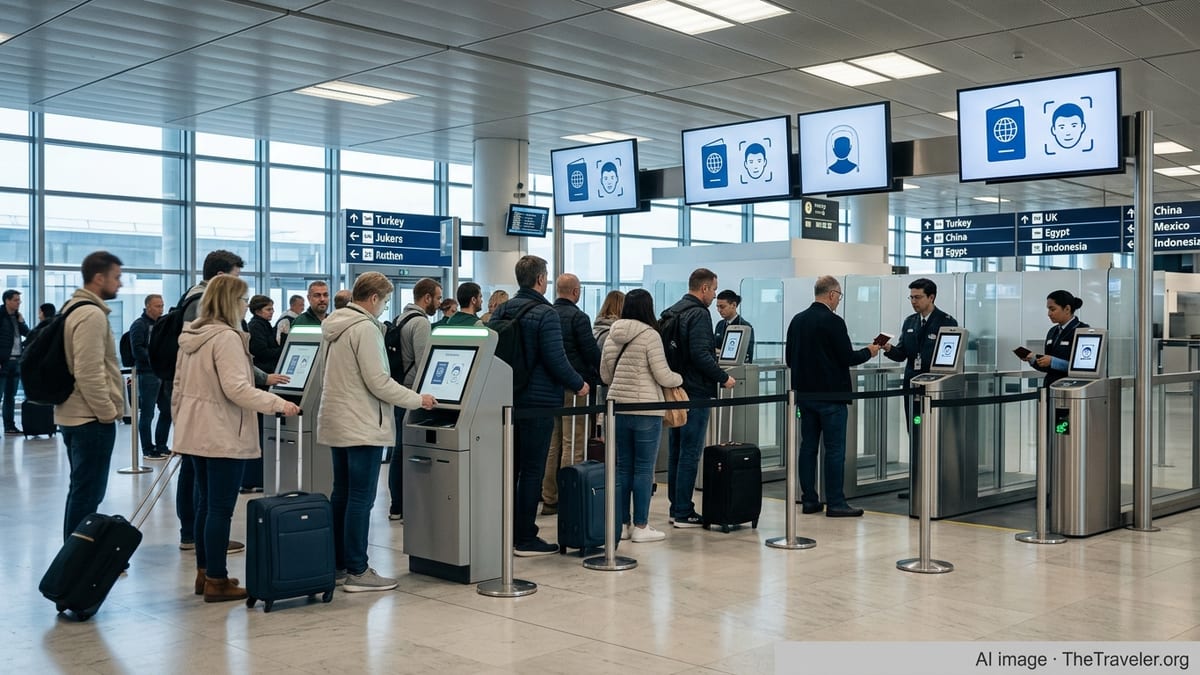
What happened at Dover and why biometric checks were paused
Traffic at the Port of Dover came under intense strain over the late May bank holiday weekend, as new biometric procedures for travellers heading to France collided with peak holiday demand and hot weather. Long queues built up on approach roads, with some drivers reporting waits of several hours before reaching the ferry terminal. Published coverage from British and international outlets indicates that tailbacks extended along key routes into the port, with vehicles effectively at a standstill for prolonged periods.
The disruption coincided with the latest phase of the European Union’s Entry/Exit System, a new border regime that registers non EU and non Schengen short stay visitors using fingerprints and facial images instead of traditional passport stamping. At Dover, where French immigration checks are conducted before departure, car passengers were being enrolled into the system as they left the UK for Calais and other Channel ports. Reports suggest that the combination of manual biometric capture, technical bottlenecks and limited physical space for processing quickly overwhelmed capacity.
In response, French border police at Dover suspended the biometric element of the checks in an effort to restore traffic flow. Passports continued to be inspected, but the collection of fingerprints and facial images was paused. This step, which EU rules allow in exceptional circumstances, brought some relief to queues but also underlined the challenge of applying airport style technology in a confined ferry port handling thousands of vehicles in short bursts.
The suspension is described in public reporting as temporary and tactical rather than a full reversal of the Entry/Exit System. France remains committed to the EU wide rollout, but the events at Dover highlight that implementation may be uneven, with member states scaling back or switching off biometric capture when gridlock becomes a safety or logistical concern.
Why Ireland is outside EES but Irish motorists are not
A particular complication for Irish travellers is that the Republic of Ireland has opted out of the EU’s Entry/Exit System at its own external borders, yet Irish motorists often cross into France via the UK. Under current EU arrangements, EES applies to most non Schengen external borders, but Ireland and Cyprus are exceptions and do not operate the system for incoming passengers. This means Irish citizens flying directly from Dublin, Cork or Shannon to France are not currently enrolled in EES on departure from Ireland.
However, Irish motorists who drive from Ireland to Great Britain and then onward to Dover to board a ferry for France are treated differently. From the perspective of French border control, these travellers are entering the Schengen area from the UK, a non EU and non Schengen country, and are therefore subject to the new registration rules in the same way as British residents and other third country nationals. Guidance aimed at hauliers and motorists confirms that using the UK land bridge does not exempt travellers from EU border systems when they eventually arrive at French controls.
This legal and geographic nuance is significant. Irish passport holders may not encounter EES when leaving Ireland itself, but once they reach Dover they enter the same funnel as UK based travellers. As a result, any congestion triggered by biometric checks at the Channel ports has a direct impact on Irish motorists who rely on that route to access the continent. The recent suspension at Dover illustrates how quickly pressures can build when the system is fully switched on during a peak getaway weekend.
For Irish drivers planning to transit Britain, the distinction between Ireland’s opt out from EES and France’s obligations at juxtaposed controls in Dover matters less than the practical reality on the ground. Regardless of where their journey began, all travellers in a car lane for France at Dover face the same processes if biometric capture is active on the day they travel.
Practical implications for Irish motorists using the UK land bridge
For now, the immediate impact of the suspension is that Irish motorists arriving at Dover are unlikely to undergo full biometric registration while the pause remains in effect. Passport checks still apply, and travellers should expect standard questions about their destination, length of stay and documentation such as accommodation details or proof of funds. However, the time consuming process of leaving the vehicle so that each passenger can provide fingerprints and facial images is not being carried out when the system is in abeyance.
That does not mean delays have vanished. Traffic management plans around Dover remain sensitive, and any renewed attempt to reintroduce biometric capture during a busy period could again slow processing. Irish travellers using the traditional Dublin Holyhead Dover route are therefore being advised in public guidance and media analysis to factor in a generous time buffer before scheduled sailings, monitor operator updates on the day of travel and carry water and supplies in case of unexpected queues in warm weather.
Another implication concerns the one time nature of EES registration for frequent visitors. Once fully operational, the system is designed so that biometric data is captured on a first trip, with subsequent crossings using that stored profile. Because Dover’s biometric kiosks have been repeatedly delayed or deactivated during surges, some Irish motorists who expected to complete their enrolment this season may find that their EES registration is still pending. That uncertainty could push the problem into a later holiday period when traffic is again heavy.
Families and groups driving from Ireland via Britain also need to consider the cumulative effect of processing multiple passengers per vehicle. Analysis from transport bodies and port operators has previously estimated that even modest increases in per passenger processing time can escalate into hours long tailbacks when multiplied across thousands of cars. The recent gridlock is being cited in policy discussions as evidence that car based routes are especially vulnerable if biometric checks proceed without sufficient equipment, staffing and space.
Alternative routes and timing strategies for Irish travellers
The latest disruption at Dover is prompting renewed interest among Irish travellers in alternative paths to France that avoid the most congested Channel crossings. Direct ferries from Irish ports to Cherbourg, Roscoff and other French destinations remain outside the biometric commitments currently affecting Dover, because these sailings depart from an EU country that has opted out of EES and arrive at French ports where different operational models apply. Publicly available information indicates that, for the time being, these direct links have been less exposed to the kind of gridlock seen in Kent.
Nevertheless, capacity and sailing schedules on direct Ireland France routes are limited compared with the dense timetable available from Dover and nearby English ports. Prices can also be higher, especially for peak season departures with cabins. Travel analysts suggest that the trade off between cost, sailing time and predictability now requires closer scrutiny, particularly for families with children or travellers who are anxious about prolonged queues at border checkpoints.
For those who continue to favour the land bridge, timing is becoming a crucial factor. Data and commentary emerging from recent EES tests indicate that overnight or off peak sailings are less likely to coincide with severe queues, although there is no guarantee that biometric capture will not be active at those times. Irish drivers may find it helpful to choose departure dates outside major UK school holidays or bank holiday weekends, when pressure on Dover is typically highest regardless of new systems.
Motorists are also being encouraged by travel advisors and ferry operators to ensure that all passengers in the vehicle are ready for document checks before reaching French controls. Having passports to hand, pre completing any carrier information requirements and being prepared to exit the vehicle promptly if instructed can reduce friction at the border, even while biometric procedures remain unpredictable.
What to watch next as biometric border rules evolve
The pause in biometric checks at Dover is unlikely to be the last adjustment to the EU Entry/Exit System this year. France faces a legal obligation to bring the system into full operation, yet recent events suggest that flexibility will continue to be used to suspend or scale back requirements during peak periods. For Irish motorists, the key question is not whether EES will proceed in principle, but how often and how intensively it will be applied at the specific ports they rely on.
Observers note that the Port of Dover has already invested in redesigned road layouts, new processing zones and equipment intended to handle biometric registration, but that technology shortfalls and software issues on the French side have repeatedly delayed activation. Further testing phases are expected, and any future attempt to run full biometric capture at scale is likely to be closely watched by operators, local authorities and travel industry representatives concerned about knock on effects for tourism and freight.
The broader policy debate around EES also has an Irish dimension. While Ireland’s opt out shields passengers on some direct routes, the country’s deep economic and social ties with both the UK and the rest of the EU mean that congestion at Channel crossings can still disrupt holiday plans, supply chains and regional tourism. Advocacy groups and business bodies are already using the Dover gridlock as a case study to argue for more realistic timetables, better contingency planning and clear public communication whenever new digital border systems are introduced.
In the short term, Irish travellers contemplating a drive to France are being advised by travel commentators to remain flexible, follow operator updates closely and consider alternative routes or travel dates where possible. The events at Dover show that while biometric border checks can be paused when gridlock becomes unsustainable, the underlying shift toward more data heavy controls at Europe’s external borders is continuing, with practical consequences for anyone planning to cross the Channel by car.