


More news on this day
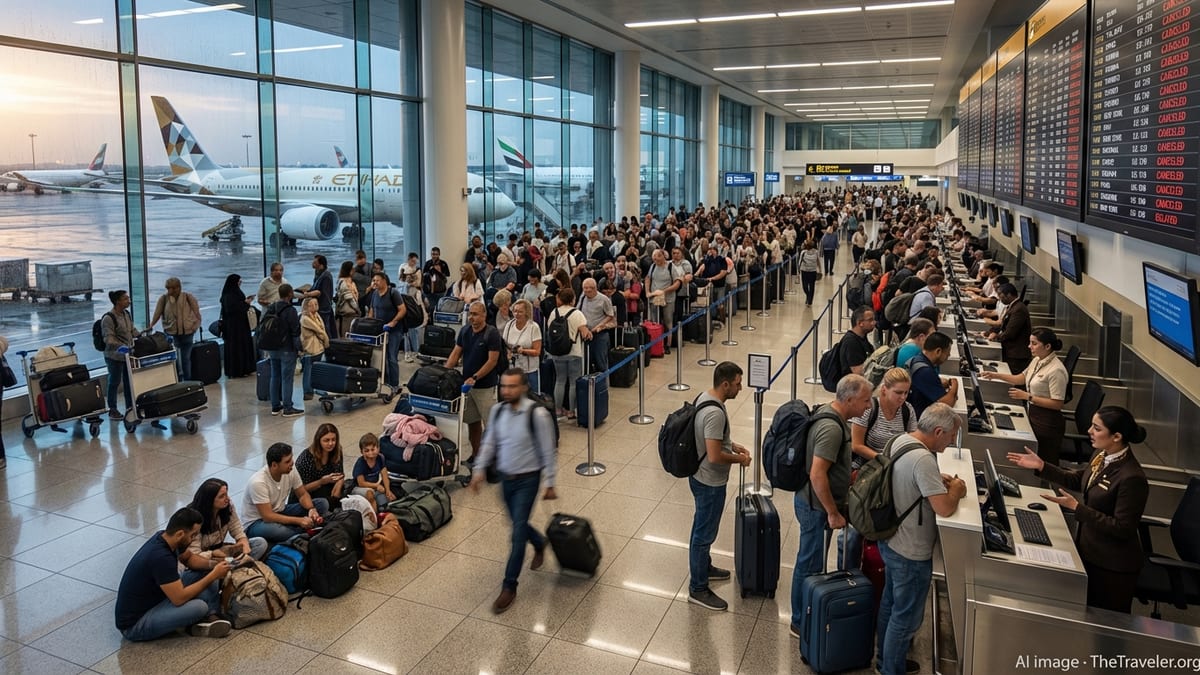
A fresh wave of regional security tensions centered on Kuwait is rippling across Gulf aviation, disrupting flights between Dubai, Abu Dhabi and Kuwait City and forcing leading UAE carriers Emirates, Etihad Airways and Air Arabia to cancel services and reroute passengers at the height of the busy summer travel season.
Get the latest news straight to your inbox!
Targeted cancellations on key UAE–Kuwait routes
Publicly available airline status pages and regional media reports indicate that Emirates has cancelled multiple flights between Dubai International Airport and Kuwait International Airport across 20 and 21 July, following earlier suspensions over the weekend. The Dubai carrier’s Dubai–Kuwait rotation is one of its core short-haul Gulf links, meaning even a limited number of cancellations is affecting hundreds of travellers each day.
Abu Dhabi based Etihad Airways has also withdrawn several services on its Abu Dhabi–Kuwait route. Listings for flights EY653 and EY654 between Zayed International Airport and Kuwait International Airport for 19 and 20 July show as cancelled for operational and security related reasons, according to recent schedule updates reviewed by regional outlets.
Low cost operator Air Arabia has joined the disruption, trimming services between Kuwait and its bases at Sharjah and Abu Dhabi. Coverage from Gulf focused business media describes multiple cancellations on 20 and 21 July, with the airline advising passengers to verify their flight status before heading to the airport as schedules remain fluid.
While the number of affected flights remains a fraction of total daily departures from Dubai and Abu Dhabi, the concentration on Kuwait routes is creating particular pressure for travellers who rely on short haul Gulf links for business, family visits and onward long haul connections.
Security shockwaves across Gulf airspace
The immediate trigger for the latest wave of disruptions is a security flare up focused on Kuwait, which has already seen temporary suspensions of air traffic at Kuwait International Airport in recent months. Travel and risk advisories circulated since March describe periods when Kuwaiti airspace was closed or heavily restricted following missile and drone incidents and heightened tensions between the United States and Iran.
Although much of the wider Gulf airspace remains open, a patchwork of restrictions and route adjustments over parts of Iran, Iraq and neighbouring states has added complexity for airlines plotting the most efficient paths through the region. Aviation risk assessments referenced by industry publications describe a more constrained corridor of safe overflight options, particularly for services linking the Gulf with Europe and North America.
In this context, carriers such as Emirates, Etihad and Air Arabia appear to be taking a conservative approach to their high frequency Kuwait schedules. By temporarily suspending selected rotations and consolidating capacity, airlines are seeking to limit exposure to potential further disruptions at Kuwait’s main gateway while preserving resilience on long haul trunk routes that underpin their global hub models.
The result is a travel landscape in which regional point to point passengers feel the most immediate impact, even as flagship long haul connections through Dubai and Abu Dhabi continue to operate largely as planned, albeit with occasional delays and minor rerouting.
Stormy summer for passengers and travel trade
The latest Kuwait focused cancellations arrive in the middle of an already turbulent summer for Middle East aviation. Over recent weeks, travellers from the United Arab Emirates have faced a combination of weather related disruptions, security alerts and operational challenges on routes to southern Saudi Arabia and other parts of the wider region.
Published coverage from Gulf based newsrooms notes that flights to Abha in southern Saudi Arabia have been suspended for several days at a time, while selected services to other regional destinations have experienced rolling delays or aircraft swaps. Although the current Kuwait disruption is driven primarily by security and airspace considerations, it adds to a perception among many travellers that the wider Gulf network is under unusual stress in 2026.
For travel agents and tour operators, the volatility complicates itinerary planning and corporate travel management. Industry briefings suggest that agents are increasingly steering time sensitive travellers towards itineraries with longer connection windows and more flexible fare conditions, particularly when itineraries involve Kuwait or other airports on the edge of current security advisories.
The combination of full peak season loads and sudden schedule changes is also creating challenges for rebooking. With many flights already operating close to capacity, finding same day alternatives for disrupted Kuwait services can be difficult, pushing some travellers onto next day departures or forcing them to reroute via other Gulf hubs.
How Emirates, Etihad and Air Arabia are responding
Across the three major UAE airlines most exposed to the Kuwait disruptions, publicly accessible information points to a broadly similar playbook. Emirates, Etihad and Air Arabia have all prioritised safety messaging in their travel advisories, while offering affected passengers options to rebook, reroute or obtain refunds within defined conditions.
Reports summarising airline statements note that Emirates has been contacting passengers booked on cancelled Dubai–Kuwait flights to arrange alternative travel dates or itineraries. Some travellers are being moved onto later services on days when a reduced schedule is still operating, while others are being offered travel on 22 July or beyond, when airlines hope to restore a more regular pattern of operations.
Etihad has adopted a comparable approach on the Abu Dhabi–Kuwait route. Recent updates shared with media outlets indicate that passengers on flights EY653 and EY654 over the affected days can change their bookings without penalty within a specified rebooking window. The carrier is also advising travellers connecting in Abu Dhabi to allow additional time and monitor their itineraries closely.
Air Arabia, with its lower cost point to point model, is directing customers to its digital channels and call centres for rebooking and refunds on cancelled Kuwait services. Travel reports suggest the airline is attempting to consolidate demand onto a smaller number of flights while retaining at least some connectivity between Kuwait and the UAE to serve essential travel.
What travellers should do now
For passengers planning to fly between Dubai, Abu Dhabi and Kuwait over the coming days, the dominant message from airlines and aviation authorities is to stay informed and flexible. Flight status pages for Emirates, Etihad and Air Arabia are being updated frequently as the security situation evolves and as operational assessments are revised.
Travel advisories compiled by regional media recommend that passengers check their flight status several hours before departure, sign up for airline notifications where available and arrive at the airport earlier than usual to allow for potential congestion at check in and security. Travellers with tight onward connections, particularly those transiting through Dubai or Abu Dhabi en route to Europe or Asia, are being encouraged to consider longer connection windows or to discuss backup options with their airline or travel agent.
Risk consultants and aviation analysts quoted in recent briefings suggest that while the current Kuwait centric disruption is significant for affected passengers, it does not yet amount to the system wide shutdown witnessed in earlier phases of the Gulf security crisis. Most flights into and out of the main UAE hubs continue to operate, and there is no indication that broad closures of UAE airspace are imminent.
Nevertheless, with regional security dynamics still unsettled and the summer peak travel period in full swing, travellers can expect a continued period of elevated uncertainty across parts of the Gulf network. For now, Kuwait routes remain at the sharp end of that storm, and Dubai and Abu Dhabi passengers bound for the country are likely to face schedule changes and last minute adjustments as airlines navigate a complex and fast moving situation.