


More news on this day
Flight schedules across Dubai and the wider Gulf are facing fresh disruption after a week of renewed attacks linked to the escalating confrontation between the United States and Iran, complicating travel at the height of the summer exodus from the Middle East.
Get the latest news straight to your inbox!
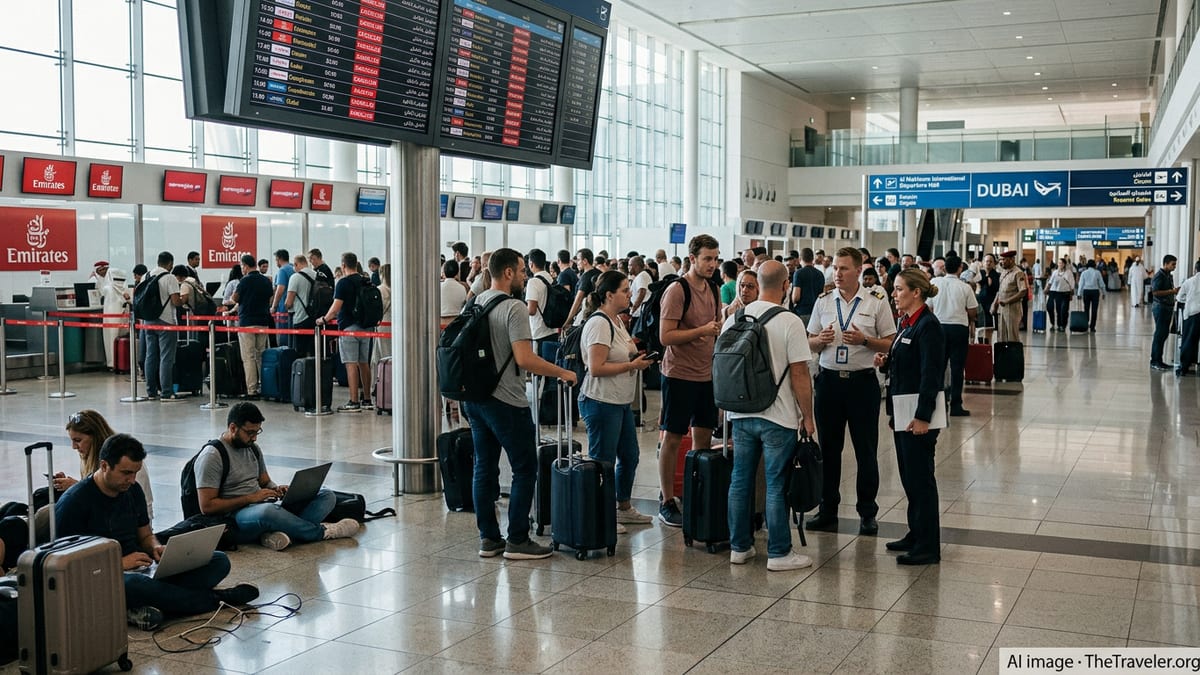
Fresh tensions revive airspace risks across the Gulf
The latest exchange of strikes between the United States and Iran, including reported attacks involving Bahrain, Kuwait and Qatar, has revived concerns over the stability of key air corridors in the Gulf region. Coverage from international news agencies and regional outlets indicates that recent operations have taken place close to some of the busiest aviation hubs in the world, including Dubai, Abu Dhabi and Doha.
The flare-up comes just months after the early 2026 outbreak of the US and Israel conflict with Iran that led to widespread airspace closures across Iran, Iraq, Israel, Jordan, Kuwait, Qatar, Bahrain, Syria and the United Arab Emirates. Analysis by industry bodies and risk consultancies shows that thousands of flights were cancelled or diverted in the initial weeks of that conflict, forcing long detours between Europe and Asia and creating congestion at alternative hubs.
While the United Arab Emirates lifted its emergency air traffic restrictions in May and gradually restored capacity, publicly available information from government advisories continues to highlight an ongoing threat of drone and missile activity in the wider region. The Federal Aviation Administration and other regulators have maintained warnings urging airlines to exercise caution when flying over parts of the Middle East, particularly in proximity to the Strait of Hormuz and the Arabian Gulf.
These renewed tensions are reintroducing operational uncertainty only weeks after airlines had begun to stabilise schedules and reopen routes that were suspended during the most intense phase of the Iran war.
Dubai flights operating, but under pressure during peak travel
Dubai International Airport remains open and functioning as a major global hub, with local reporting describing continued high passenger volumes as residents leave the Gulf for the northern hemisphere summer. Dubai Airports has previously indicated that the hub handled millions of passengers and tens of thousands of aircraft movements even while regional airspace was heavily constrained earlier this year.
However, those movements have been achieved partly through the use of restricted air corridors and longer routings that add flight time and reduce scheduling flexibility. Airline planners note that when routes must skirt closed or high-risk airspace, aircraft spend more time in the air, crew duty limits tighten and opportunities to add extra sectors in response to sudden demand or disruption are reduced.
Travel media in the region report that airlines serving Dubai and Abu Dhabi continue to adjust timings and routings as security assessments evolve. Some carriers are building additional ground time into schedules, warning passengers to expect longer journey times and advising travellers to monitor booking systems closely for last-minute changes or aircraft substitutions.
For passengers transiting Dubai between Europe, Asia and Australasia, the result can be longer layovers, altered connection windows and, occasionally, missed onward flights when delays cascade through a tightly wound global network.
Knock-on effects in Bahrain, Qatar, Kuwait and beyond
The latest escalation has had a particularly sharp impact on smaller Gulf states whose airspace sits along key east-west aviation corridors. Recent coverage from regional outlets describes heightened security alerts in Bahrain, Qatar and Kuwait following strikes and retaliatory action over the past week, coming on top of earlier incidents that temporarily closed airports or damaged infrastructure.
Kuwait International Airport, which suffered a drone strike in June, only resumed full international operations last month, according to local media reports, with airlines including Emirates, flydubai and Air Arabia restoring services. Any renewed security incidents risk reversing that progress or prompting overnight schedule changes as carriers reassess exposure.
Qatar has also experienced temporary airspace closures and airline suspensions since the onset of the Iran conflict in February. In recent weeks, Qatar Airways has rebuilt its Gulf network, re-establishing multiple daily flights to Dubai, Sharjah and Abu Dhabi and positioning Doha once again as a key connector between the Gulf and long-haul destinations. A further deterioration in regional security could force the carrier and its partners to revert to longer routings or reduce frequencies on some sectors.
Beyond the immediate Gulf, airlines in Turkey, Oman and Saudi Arabia have been recalibrating their schedules in response to shifting demand and evolving risk assessments. Some carriers have temporarily suspended flights to specific cities such as Kuwait City or Beirut, while maintaining or even adding capacity on routes viewed as lower risk. These decisions contribute to a patchwork of service levels that can change quickly, particularly for secondary destinations.
Global airlines continue rerouting and selective suspensions
Major international airlines outside the region are continuing to avoid swathes of Middle Eastern airspace, rerouting long-haul services between Europe and Asia along more southerly or northerly tracks. Industry data and airline statements compiled in recent weeks show that carriers including British Airways, Finnair and various Asian operators have cancelled or postponed the resumption of some routes to the Gulf and wider Middle East, while maintaining flights to key hubs such as Dubai at reduced frequencies.
Factboxes published by aviation and freight industry outlets indicate that several Asian and European airlines have suspended services to cities like Riyadh, Doha or Tel Aviv during the height of the conflict, with some now cautiously reintroducing flights. Others have kept schedules in place but are avoiding the airspace of Iran, Iraq, Syria and Israel, accepting longer flight times as a trade-off for risk mitigation.
Meanwhile, Gulf-based carriers such as Emirates, Etihad, Qatar Airways and flydubai are working to sustain their role as connectors between continents despite the constraints. Recent briefings from Dubai International Airport and airline updates suggest that schedules have been thinned and some frequencies consolidated, but that connectivity to major markets in Europe, Asia, Africa and the Americas has been preserved, albeit with less resilience to shocks.
This environment means that travellers booking multi-leg itineraries through Gulf hubs should pay close attention to minimum connection times and leave additional buffers where possible, particularly when flying on separate tickets or combining different airlines.
What travellers should expect in the coming days
With tensions between Washington and Tehran again elevated and the ceasefire framework described as fragile in recent economic and political analysis, aviation planners are preparing for the possibility of further short-notice changes. Industry presentations from airline associations suggest that routing constraints and higher fuel prices are likely to persist as long as uncertainty around the conflict continues.
Travel industry reporting indicates that, for now, most scheduled passenger flights to and from Dubai, Abu Dhabi and Doha are operating, albeit with occasional delays, lengthened flight times and scattered cancellations. The overall picture is one of a system under strain rather than a complete shutdown, very different from the near standstill seen immediately after the conflict erupted in late February.
Passengers planning to transit the region in the coming week are being encouraged by airlines and travel agents to reconfirm flight status frequently, ensure that contact details are up to date in reservations, and allow extra time for security and check-in. Flexible ticket policies introduced during the earlier phase of the crisis remain in place at several carriers, allowing date or routing changes without additional charges for affected flights.
As peak summer travel coincides with renewed geopolitical volatility, Dubai and its neighboring hubs are once again testing the resilience of their aviation systems. The coming days will show whether the cautiously rebuilt network can withstand another round of disruption or whether airlines will be forced into a new cycle of cuts and rerouting.