


Landing at Dublin Airport and trying to decide which bus into the city centre makes the most sense can feel confusing, especially after an early flight. You will see several different operators, zones, and route numbers as soon as you step outside the terminal. This guide brings everything together in one place, explaining Dublin Express, Aircoach and regular Dublin Bus options, where to find them, typical fares and journey times in 2026, and which choice is likely to suit different types of travellers.
Get the latest updates straight to your inbox!
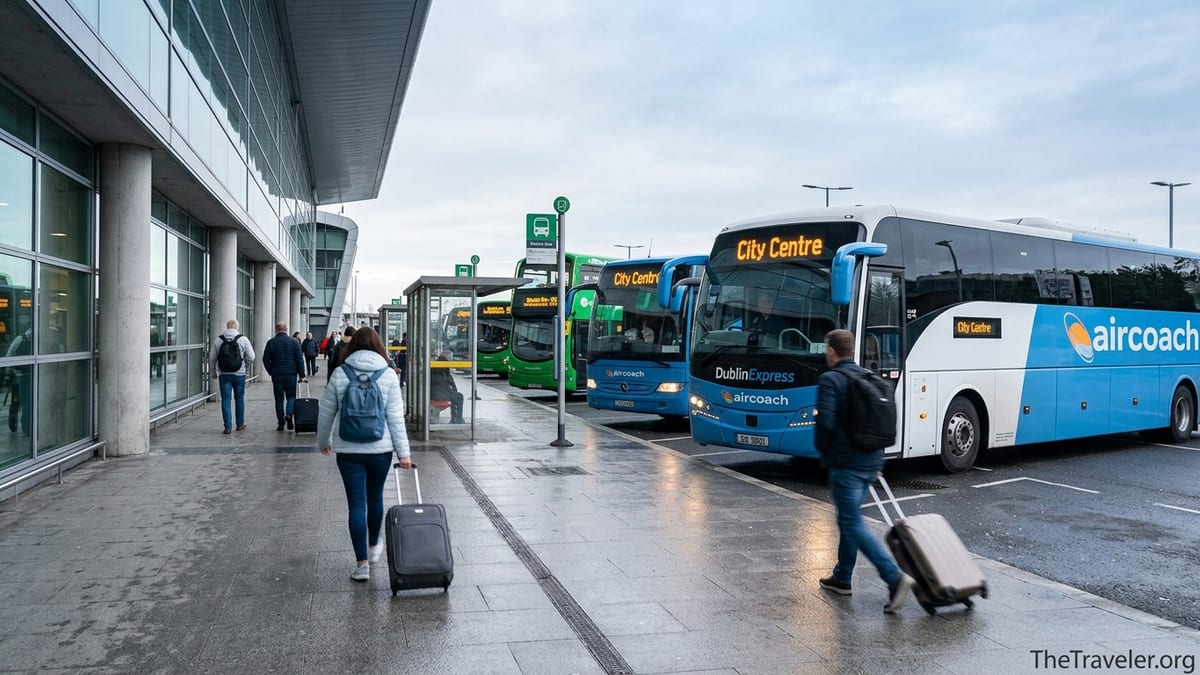
Overview: How the Dublin Airport buses work in 2026
Dublin Airport does not have a rail link yet, so buses and coaches are the main public transport option into the city centre. The good news is that services are frequent, run from early morning to late at night, and there are options for most budgets. The less good news is that you will see multiple brands and route numbers as you exit the terminals, and it is not always obvious which bus goes where if you are new to the city.
Broadly, you can think of three categories. Dublin Express and Aircoach are premium express coaches that run via the Port Tunnel or motorway, have luggage holds, and stop at key city locations like O’Connell Street, Temple Bar area and around Trinity College. Then there are standard public buses operated under the Transport for Ireland network, mainly Dublin Bus routes 16 and 41, which behave like city buses with more stops, slower journeys and lower fares.
In practice, most visitors heading to central Dublin and staying near Temple Bar, O’Connell Street or around Trinity College will choose between Dublin Express and Aircoach route 700. Budget travellers or those staying along the Drumcondra or Dorset Street corridors often prefer the regular Dublin Bus routes. If you arrive late at night or very early, it is worth checking timetables in advance, but in mid 2026 there is at least one 24 hour public route serving the airport, plus late services on the express coaches.
When deciding what suits you best, think about three things: where exactly your accommodation is, how much luggage you are carrying, and whether speed or price matters more. Someone staying beside Heuston Station with two large suitcases will have different needs from a solo backpacker staying off Dorset Street.
Dublin Express: Fast coach via Port Tunnel
Dublin Express is a dedicated airport coach service designed for visitors and commuters who want a quick link between Dublin Airport and central Dublin. Its main routes serving the city are the 782 and 784, both departing from clearly signed Dublin Express stops just outside Terminal 1 and Terminal 2. Buses typically run every 15 to 30 minutes through most of the day, with slightly reduced frequency early morning and late evening.
The routes focus on city centre and rail connections. For example, the 782 serves stops near the north quays, O’Connell Street, and continues to Heuston Station, which is useful if you are catching trains to Cork, Galway or Limerick. The 784 serves the Docklands and 3Arena area, handy for hotels around the Convention Centre and IFSC as well as for concertgoers. In both cases, the coaches use the Port Tunnel where traffic allows, which means the journey to central Dublin can be as quick as about 25 to 35 minutes in off peak times, though it is wise to allow 45 minutes in heavier traffic.
Tickets are usually cheapest booked online in advance, where typical one way adult fares at the time of writing sit around the high single digits to about 10 euro, depending on promotion and flexibility options. Buying at the airport counter or from a driver can be a little more expensive. Importantly, Dublin Express tickets include a guaranteed seat when prebooked, luggage goes in the underfloor hold, and there is usually free Wi Fi and charging points, which makes the service attractive after a long flight.
As an example, if you land from North America at 9:00 in the morning and are staying near Heuston Station, you could walk out of Terminal 1, follow the signs to the Dublin Express zone, and aim for the 782. With light traffic through the Port Tunnel, you might be checking into your hotel before 10:30, even factoring in passport control and baggage reclaim. Compared with a metered taxi that commonly costs well over 30 euro for the same trip, the coach is significantly cheaper for solo travellers or couples.
Aircoach: Route 700 and other services
Aircoach is another major airport coach operator and a very familiar sight outside both terminals. Its flagship service for visitors heading into town is route 700, which runs from Dublin Airport through the south side of the city and onwards to the business districts of Sandyford and Leopardstown. Within central Dublin it serves key locations such as Drumcondra, O’Connell Street area, O’Connell Bridge and Kildare Street, making it convenient for hotels around St Stephen’s Green and the south city centre.
Aircoach 700 usually runs up to every 15 minutes at busy times during the day, with less frequent but still regular departures early morning and late at night. The journey time between the airport and central stops such as O’Connell Street or Kildare Street is typically around 30 to 40 minutes off peak, although it can stretch longer in rush hour as the route uses city streets rather than bypassing everything via the Port Tunnel.
Fares on route 700 are in the same general range as Dublin Express. Approximate adult one way prices from the airport to the city are often in the high single digits euro if booked online, with return tickets slightly better value. Buying at the kerbside kiosks or on board can be a little more expensive. Aircoach also sells family tickets, which can work out well for two adults with one or two children compared with paying individual fares on the regular buses.
A typical real world scenario might be a family staying in a hotel just off St Stephen’s Green. On arrival they can wheel their luggage out to the Aircoach stand, board the 700 with their booked family ticket, and be dropped a short walk from the hotel without transfers. Because the coaches are designed with luggage holds and comfortable seating, this option avoids the challenge of navigating packed city buses with suitcases or dealing with taxi ranks during peak arrival times.
Dublin Bus routes 16 and 41: Cheapest but slower
For budget conscious travellers, the standard Dublin Bus routes 16 and 41 provide the cheapest direct public transport from Dublin Airport to many central areas. These are regular city buses that also happen to serve the airport, and they are part of the wider Transport for Ireland network. You will find them in Zone 15 outside Terminal 1, which is signposted as the main city bus zone on airport maps and in the terminal.
Route 16 runs from Dublin Airport through Santry, Drumcondra and the south inner city, eventually reaching Ballinteer. Along the way it passes through the north city fringe and crosses the River Liffey near Camden Street, which is useful if you are staying in that area or further south. Route 41 runs between Swords and Dublin city centre, terminating on Lower Abbey Street near O’Connell Street, which is directly central and close to many hotels and hostels.
Fares on these routes are significantly lower than the express coaches. With a Leap Card, which is the rechargeable smart card used across Dublin’s public transport, you typically pay just a few euro for the trip into town. Paying cash is a little more expensive and usually requires exact change in coins on Dublin Bus, although many visitors now rely on contactless bank cards or phone wallets where enabled. Because these are standard city routes, there is no luggage hold, and at busy commuting times the buses can be crowded, so boarding with multiple large suitcases is not ideal.
As an example, a solo backpacker staying at a guesthouse on Dorset Street could walk out to Zone 15, board the 41, and get off within a short walk of their accommodation for roughly half or less of the cost of an express coach. The trade off is a longer journey time, often 40 to 50 minutes depending on traffic, and a less comfortable ride with more stops. For those visiting on a tight budget or staying along the route, this compromise can be entirely worthwhile.
Pickup zones and finding the right stop at the airport
Dublin Airport is split across Terminal 1 and Terminal 2, and both terminals have clearly marked bus areas outside arrivals. It is worth paying attention to the zone numbers and operator branding, especially if you are tired after a flight, as express coaches and city buses board from different parts of the forecourt.
For Dublin Express, look for the dedicated stands signed with the Dublin Express name outside both terminals. These stands are typically in the express coach zones rather than the general city bus area, and there are large blue or similar coloured coach style vehicles with destination screens showing numbers such as 782 or 784 and city centre or Heuston as final destinations. Staff are often present during the day to help with questions about tickets and stops.
Aircoach services such as route 700 normally pick up from what the airport labels as the coach or express bus zone as well, with prominent Aircoach branding on the poles and shelters. If you walk straight out of Terminal 2 arrivals and follow signs for coaches and buses, you will see both Aircoach and Dublin Express stands within a short distance. At Terminal 1, the express coach stands are close to the short term car park and taxi rank area.
Standard Dublin Bus routes 16 and 41, along with some other public routes, depart from Zone 15 near Terminal 1. The zone number appears on airport maps and overhead signs, and you will see familiar green Dublin Bus vehicles. The bus stop poles show route numbers and major destinations like Ballinteer or Dublin City Centre. If you are transferring between terminals, there is a short signed walk airside or landside, and you can easily reach Zone 15 on foot from Terminal 2 in under ten minutes with luggage.
Tickets, payment options and Leap Card
Each category of bus has its own ticketing system, so it helps to know how payment works before you board. Dublin Express and Aircoach both sell tickets online, through their apps and at the airport. Prices tend to be a little lower when purchased in advance, and you can usually show a QR code or booking reference on your phone to board. These tickets are not integrated with city buses, trams or suburban rail, so if you use a coach into the city and then transfer to a bus or tram, you will pay again for the onward leg.
On the regular Dublin Bus routes like the 16 and 41, you can pay using a Leap Card, cash, or contactless payment where enabled. The Leap Card remains the most economical choice if you plan to use public transport several times during your stay, as it offers lower fares than cash and daily or weekly fare capping. You can buy a Leap Card at certain airport shops or vending machines, then tap on when boarding the bus and tap off where required on other modes.
As a concrete example, a visitor planning to spend three days exploring Dublin by bus and tram could buy a Leap visitor pass product, use it on route 41 from the airport into the city, then freely hop on and off trams and buses around town. Another visitor who is only in Dublin for one night and taking a taxi back to the airport might skip Leap entirely and pay a single express coach fare online, since the savings from a card would be minimal for such a short stay.
If you are unsure which ticket to buy when you arrive, look for staffed information desks in the arrivals halls, or ask at the coach operator kiosks. They can advise on the best combination of airport transfer and city travel for your itinerary, especially if you are arriving as a family or group and want to compare the cost of multiple bus tickets with a single taxi fare.
Frequency, journey times and when each option is best
In mid 2026, both Dublin Express and Aircoach operate frequent services between Dublin Airport and the city centre. During daytime and early evening, it is common to see departures roughly every 15 to 30 minutes on the main routes, with slightly less frequent overnight or very early morning services. Dublin Bus routes 16 and 41 also run at short intervals during the day, though headways can widen somewhat at night and on weekends.
In light traffic, a Dublin Express coach using the Port Tunnel can cover the distance between the airport and central stops in around half an hour, while Aircoach route 700 often takes around 30 to 40 minutes depending on which inner city stops you use. The slower city buses typically fall into the 40 to 50 minute range because they pick up and set down more often and move through residential streets rather than staying on faster routes. In heavy rush hour traffic or when there is congestion around the tunnel or city centre, all services can take longer, so allow extra time if you are heading to a specific tour or onward train.
For visitors, the best option depends heavily on priorities. If you want the simplest and most comfortable experience, especially with heavy luggage or children, one of the express coaches is usually worth the extra few euro. If you are travelling light, arriving at a quiet time and watching your budget closely, the public Dublin Bus routes provide excellent value. If you are arriving late at night or very early, you may find that one particular route offers the most convenient first departure, so checking the operator timetables before you fly can remove uncertainty.
Consider three real world profiles. A solo traveller with a hostel booking near O’Connell Street, arriving at lunchtime, might pick whichever express coach is leaving next and alight close to the hostel, valuing speed and comfort. A student arriving for a semester and staying in Drumcondra might choose the 16 or 41, as they pass through the neighbourhood directly and cost less when using a Leap Card. A business traveller staying near Heuston Station with a fixed afternoon meeting might favour Dublin Express 782 to minimise transfer time and guarantee a seat to work on the bus.
The Takeaway
By bus standards, Dublin Airport is well connected, with overlapping services that cover most central districts and price points. Once you understand the rough division between premium express coaches and standard city buses, the network becomes much easier to navigate, even on your first arrival.
If you value speed, comfort and easy luggage handling, Dublin Express and Aircoach 700 are the stand out choices. They cost more than public buses but remain far cheaper than a taxi for solo travellers or couples, and their clear city centre stops suit the majority of hotel locations. When budget is the main concern, or when your accommodation sits directly on one of the corridors served by routes 16 or 41, Dublin Bus offers a straightforward and inexpensive way into town.
Whichever option you choose, pay attention to your exact hotel address, check which stops are closest, and give yourself a little time margin for traffic. Doing this planning before you land means that, as you walk out of Dublin Airport arrivals, you will already know exactly which zone to follow and which bus or coach will carry you smoothly into the heart of the city.
FAQ
Q1. What is the quickest bus from Dublin Airport to the city centre?
The quickest services are usually the Dublin Express coaches, which often use the Port Tunnel and can reach central stops in around 30 minutes in light traffic, though you should allow extra time at peak hours.
Q2. Which option is cheapest for getting from Dublin Airport to central Dublin?
The lowest fares are typically on the regular Dublin Bus routes 16 and 41, especially when using a Leap Card, though you trade some comfort and speed compared with the express coaches.
Q3. How often do Dublin Express and Aircoach buses run from the airport?
Through most of the day in 2026, both Dublin Express routes and Aircoach 700 run roughly every 15 to 30 minutes, with somewhat reduced frequency in the very early morning and late at night.
Q4. Can I buy tickets for Dublin Airport buses when I arrive, or should I book in advance?
You can buy tickets on arrival at the airport or from drivers on many services, but booking Dublin Express or Aircoach online in advance often gives you slightly lower fares and a guaranteed seat.
Q5. Where exactly do I find the public Dublin Bus stops at Dublin Airport?
Standard Dublin Bus routes such as the 16 and 41 depart from Zone 15 outside Terminal 1, which is signposted in the terminal and on airport maps; it is a short walk from Terminal 2.
Q6. Is there space for large luggage on the airport buses?
Dublin Express and Aircoach coaches have underfloor luggage holds designed for suitcases, while regular Dublin Bus vehicles do not have dedicated holds and can be awkward with several large bags at busy times.
Q7. Are the Dublin Airport buses accessible for wheelchair users?
Most services, including express coaches and Dublin Bus routes, operate low floor or accessible vehicles, but if you have specific mobility needs it is wise to check the latest accessibility information with the operator before travel.
Q8. Does the Leap Card work on Dublin Express or Aircoach?
No, Leap Cards are generally for Transport for Ireland services like Dublin Bus, Luas trams and some commuter trains, and are not accepted as payment on Dublin Express or Aircoach routes, which use their own tickets.
Q9. What if my flight is delayed and I miss the coach I booked?
Policies vary by operator and ticket type; some tickets allow you to board the next available bus while cheaper promotional fares can be more restrictive, so always check the conditions when you book.
Q10. Is taking the bus from Dublin Airport safe late at night?
Airport buses are widely used at all hours and are generally considered safe, but as in any large city it is sensible to keep an eye on your luggage, sit near other passengers and follow normal late night travel precautions.