


For many travelers flying from Europe to the United States, Dublin Airport offers one of the smoothest entries into America thanks to its U.S. preclearance facility. Instead of facing long immigration lines after a red eye into JFK or Chicago O’Hare, you complete U.S. border checks in Dublin and arrive like a domestic passenger. This guide explains how Dublin’s preclearance works in 2026, when you should arrive, which flights use it, and how to avoid the most common pitfalls.
Get the latest updates straight to your inbox!
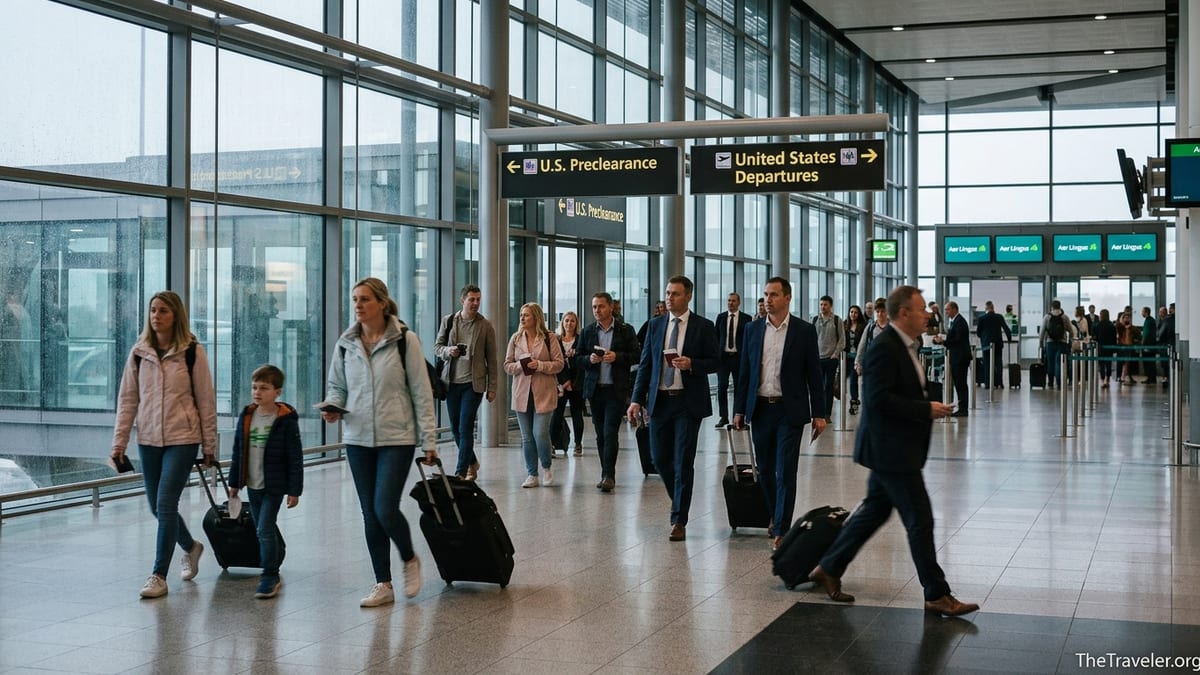
What U.S. Preclearance at Dublin Airport Actually Is
Dublin Airport is one of only a handful of airports worldwide where you can complete full U.S. immigration, customs and agriculture screening before you even board your flight. Operated by U.S. Customs and Border Protection (CBP) in a dedicated area of Terminal 2, the facility means that on arrival in the United States you are treated as a domestic passenger. Practically, that means you step off your Aer Lingus flight from Dublin into Chicago O’Hare or Boston Logan and walk straight to baggage claim or a connecting gate, with no further passport control.
Preclearance at Dublin covers the same checks you would face at a U.S. airport: identity and travel document verification, security screening to U.S. standards, fingerprint and photo capture for most non-U.S. citizens, and customs and agriculture questions. You answer the usual CBP questions about where you are staying, how long you will visit, and what you are bringing into the country. The difference is that all of this happens before departure, so delays or secondary screening occur in Dublin rather than eating into your first day in America.
For example, a traveler flying Dublin to New York JFK with Aer Lingus may land in Terminal 7 and be at the taxi rank within 20 minutes because they have already cleared U.S. formalities. A family connecting in Dallas Fort Worth from Dublin to Orlando can head straight from their arriving gate to the domestic departures concourse, instead of re-checking bags and passing through immigration along with passengers off long-haul flights from Latin America and Asia.
Legally, you still remain in Ireland until your aircraft departs. Irish law and authorities govern the preclearance area, even though U.S. officers conduct the checks. This setup is the result of bilateral agreements between Ireland and the United States, and it is designed to enhance connectivity, support tourism and foreign direct investment, and relieve pressure on major U.S. hubs by shifting part of the border process overseas.
Which Flights and Airlines Use Preclearance
In 2026, Dublin’s U.S. preclearance is located in Terminal 2 and is available for virtually all nonstop flights from Dublin to the United States. This includes services to major hubs such as New York JFK, Newark, Boston, Chicago O’Hare, Washington Dulles, Philadelphia and San Francisco, as well as seasonal or leisure routes like Orlando or Seattle when scheduled. Most passengers flying directly to the United States from Dublin will be routed through Terminal 2 and directed to preclearance before departure.
The main airline using the facility is Aer Lingus, which operates an extensive transatlantic network from Dublin. U.S. carriers such as American Airlines, Delta Air Lines and United Airlines also typically operate their Dublin flights from Terminal 2 so that passengers can benefit from preclearance. Some newer entrants or seasonal carriers may operate from Terminal 1 or may not participate in the preclearance program, so your eligibility can vary by airline and route.
To give a concrete example, an Aer Lingus flight from Dublin to Boston is expected to use preclearance, with passengers clearing U.S. checks in Dublin and then arriving into Boston’s domestic or mixed-use concourses. By contrast, if a carrier launched a Dublin to a smaller U.S. regional airport on a limited basis and chose not to use preclearance, passengers on that route would clear immigration after landing in the United States instead. The airport’s own passenger information pages, along with your airline’s booking and check-in systems, indicate whether your specific flight uses preclearance.
If you are connecting from another Irish or European city to the U.S. via Dublin, your through-ticket will typically be built around a preclearance connection if your transatlantic segment is scheduled to use it. For instance, a traveler flying from Glasgow to Dallas on a single Aer Lingus ticket would usually connect in Dublin, clear U.S. immigration there, and then arrive in Dallas as a domestic passenger. However, if you are on separate tickets or a non-participating carrier, you should confirm in advance whether preclearance applies to your onward flight.
When You Should Arrive at Dublin Airport for U.S. Flights
Because preclearance adds an extra layer of procedures beyond standard security, Dublin Airport and most airlines advise arriving earlier for U.S.-bound flights than for short European hops. As of 2026, a realistic rule of thumb is to be at the airport around three hours before your scheduled departure time if you are checking bags, and at least two and a half hours before departure if you are traveling with hand luggage only and can check in online.
In practice, this means that for a 10:30 flight from Dublin to Washington Dulles, you should aim to be in Terminal 2 around 7:30. That allows time to check bags, pass through regular Dublin Airport security, walk to the U.S. preclearance area, go through the additional U.S. security screening, and then clear CBP. On quieter afternoons in winter, some passengers report moving from check-in desk to precleared gate in just over an hour. On busy summer mornings between roughly 07:00 and 11:00, queues can build quickly and the process may take close to two hours from start to finish.
Connecting passengers need to be particularly conservative. While airlines may sell itineraries with relatively tight connections, such as 1 hour 45 minutes between an arriving European flight and a U.S. departure, these schedules assume everything runs on time. If your inbound flight is delayed, you can find yourself rushing through the terminal and arriving at preclearance with little margin. For a comfortable experience, many experienced travelers prefer at least 2 hours between landing in Dublin and their U.S. departure, especially in peak summer or around holidays like Easter and Thanksgiving.
One practical planning tip is to complete as many formalities as possible before you ever reach the airport. Check in online as soon as your airline opens it, confirm that your Electronic System for Travel Authorization (ESTA) or U.S. visa is valid and linked to your current passport, and keep boarding passes ready on your phone or printed. These small steps reduce the risk of delay at the check-in desk or airline service counters and help you get into the security queue sooner.
Step-by-Step: How Preclearance Works on the Day
The preclearance journey at Dublin begins like any other departure. You arrive at Terminal 2, proceed to your airline’s check-in or bag-drop area, and either drop your suitcase or confirm your online check-in. Airline staff typically verify your U.S. travel authorization at this stage. A traveler checking bags for a morning Aer Lingus flight to New York, for instance, might check their suitcase around 7:40, receive a boarding pass marked to indicate preclearance, and be directed upstairs to the main security screening area.
After regular Dublin security, you enter the departures level with shops, cafes and seating. For U.S. flights, you then follow clearly marked signs for “U.S. Preclearance” or “United States Departures.” This involves walking through a dedicated corridor to a secondary checkpoint. Here, most passengers must undergo an additional security screening that meets U.S. Transportation Security Administration standards, which sometimes involves more detailed checks of electronics and carry-on liquids than the main airport screening.
Once through this second security point, you enter the CBP inspection area. Travelers usually first interact with automated kiosks or e-gates, which capture your photo and may scan your passport. You then join the queue for an interview with a CBP officer. During this brief conversation, you can expect questions such as where you will stay in the U.S., the purpose of your trip, how long you plan to remain, and whether you are carrying any restricted foods or large amounts of cash. Fingerprints and a photo are typically taken for many visitors under current U.S. procedures.
After the officer admits you, you exit into a segregated departures zone that is effectively a “mini U.S. terminal” inside Dublin. Concessions here include cafes, seating areas and boarding gates reserved for precleared flights. From this point on, you cannot return to the main terminal, so this is where you should plan to buy any last-minute snacks or drinks for the flight. Boarding then proceeds in the usual way, and when your flight lands in the United States you disembark as a domestic arrival, free to walk directly to your connecting flight or the exit.
Security Rules, ESTA, and Documents You Need
Travelers using Dublin’s U.S. preclearance must meet the same entry requirements as if they were landing directly in the U.S. without preclearance. For citizens of countries in the Visa Waiver Program, that typically means holding a biometric passport valid for the duration of your stay and an approved ESTA linked to that passport. You should apply for or update ESTA at least several days before travel, as instant approvals are no longer guaranteed and some applications require additional processing time.
If you are traveling on a U.S. visa rather than ESTA, ensure that your visa type matches your purpose of travel and that it is still valid. Carry any supporting documents that may help explain your trip, such as conference invitations, university enrollment letters, or proof of onward travel. U.S. citizens and lawful permanent residents should have their U.S. passport or green card; dual nationals must enter the U.S. on their American passport if they hold one.
One point that often surprises travelers is the presence of a second security checkpoint specifically for U.S. flights. Dublin has begun deploying more advanced scanners that allow larger quantities of liquids at the main airport security, but the U.S. checkpoint may still apply traditional rules, including limits on liquids and separate screening for laptops and large electronics. In practice, this means that a bottle of water or duty-free liquids that passed Irish security might be taken from you if it does not meet U.S. standards at the preclearance checkpoint. Many regular travelers therefore wait to buy drinks or duty-free liquids until after they have cleared the U.S. screening area.
As with any border crossing, you should be prepared to answer questions clearly, politely and consistently. If you are carrying food items such as sausages, cheese or fresh fruit back to the United States, check in advance whether they are permitted, as agricultural restrictions can be strict. Even at preclearance, failing to declare items that should be declared can result in penalties, including fines or, in extreme cases, refusal of entry.
Common Mistakes at Dublin U.S. Preclearance and How to Avoid Them
The most frequent mistake travelers make at Dublin’s preclearance is underestimating the time required. People who would normally arrive at the airport 90 minutes before a flight within Europe sometimes use the same timing for a U.S.-bound service and end up sprinting through the terminal. A couple traveling to Orlando on a Saturday morning, for example, might find themselves stuck in a long line at the second security checkpoint and then queuing again for CBP, watching the clock tick towards boarding time. Arriving a full three hours in advance greatly reduces this stress.
Another common issue is failing to complete or update ESTA in time. A traveler who renews their passport but forgets that ESTA approvals are tied to the passport number can show up at check-in to discover that their authorization no longer matches. Airline staff may be able to help you access the online system, but last-minute applications are risky and, in some cases, boarding can be denied if approval does not arrive in time. Applying or confirming approval at least 72 hours before departure is a safer approach.
Many passengers are also caught out by the dual security systems. The main airport checkpoint now often allows passengers to keep laptops in bags and carry larger liquids thanks to new screening technology, but the U.S. checkpoint may revert to traditional rules. Passengers who stock up on bottled drinks or cosmetics in the main terminal sometimes lose them at the U.S. screening stage. A practical workaround is to keep your liquids within the standard 100 milliliter limit in a clear bag until after preclearance, then purchase larger items in the segregated U.S. departures area.
Finally, some connecting passengers misjudge the location and sequence of checks. A traveler landing from a regional airport like Donegal or Manchester with a relatively short connection might spend too long in the main terminal, assuming that preclearance will be just another passport control. In reality, you still need to clear regular security (in some cases only once, depending on the transfer arrangement), then the U.S. security and CBP interview. If you are on a tight schedule, head straight for preclearance rather than stopping for a sit-down meal or shopping in the main departures zone.
Benefits of Using Preclearance for U.S. Connections and Arrivals
Despite the extra steps before departure, most frequent transatlantic travelers view Dublin’s preclearance as a net benefit. The biggest advantage is on arrival. Instead of joining a long immigration queue at a busy U.S. airport after an overnight flight, you arrive as if you were coming from another American city. This is particularly helpful at congested hubs like New York JFK, Boston Logan, Chicago O’Hare and Dallas Fort Worth, where non-precleared international arrivals can sometimes face waits of an hour or more at immigration during peak periods.
For passengers connecting onwards, preclearance can transform a complicated international-to-domestic transfer into a simple gate change. A family flying from Dublin to Denver via Chicago, for instance, would arrive at O’Hare as domestic passengers, walk to their next gate, and board their connecting flight without reclaiming checked bags or going through U.S. immigration or customs. That reduces the minimum connection time needed and lowers the stress of making tight onward flights.
Preclearance can also help reduce the impact of U.S.-side delays related to crew, immigration staffing or system outages. While flights can still be delayed for many reasons, including weather, gate availability or air traffic control, some of the bottlenecks that occur when several long-haul flights land at once are mitigated for precleared passengers. In practical terms, this can mean slipping past lengthy lines at your U.S. gateway and getting to your hotel or rental car more quickly.
Another often-overlooked benefit is that if CBP officers need more time to clarify your situation, this happens before you board the aircraft. While being referred to secondary inspection is never pleasant, handling it in Dublin at least avoids the scenario where you arrive exhausted in the U.S. and then face a lengthy interview. For travelers with complex itineraries, unusual work situations or prior issues, having these discussions on European soil can feel slightly less daunting.
The Takeaway
Dublin Airport’s U.S. preclearance facility has turned Ireland’s capital into one of Europe’s most convenient gateways to America. By shifting immigration, customs and agriculture checks to Terminal 2, it allows passengers to step off their flights in the United States and walk straight into their onward journey, whether that means a domestic connection to a smaller city or a quick exit to a hotel in Manhattan or downtown Chicago.
To make the most of preclearance, treat your U.S. departure from Dublin more like a long-haul international flight than a short European hop. Arrive at least three hours before departure if you are checking luggage, complete ESTA or visa checks several days in advance, and remember that you will face two sets of security screening. Head directly to the preclearance area once you clear main security, and save shopping or meals for the segregated U.S. departures zone after you have been cleared by CBP.
With sensible preparation, preclearance can turn what used to be a daunting arrival in the U.S. into a routine domestic-style experience. For many travelers from Ireland, the U.K. and continental Europe, that convenience is enough reason to route trips through Dublin when crossing the Atlantic.
FAQ
Q1. Do all flights from Dublin to the United States use preclearance?
Not absolutely all, but the vast majority of nonstop scheduled flights from Dublin to major U.S. cities operate from Terminal 2 and use the U.S. preclearance facility. Always check your specific flight details to confirm.
Q2. How early should I arrive at Dublin Airport for a U.S.-bound flight?
Aim to be at the airport roughly three hours before departure if you are checking bags, and at least two and a half hours if you have hand luggage only. At busy times like summer mornings, earlier is better.
Q3. I have a tight connection into Dublin before my U.S. flight. Is 90 minutes enough?
While some travelers make a 90-minute connection, it leaves little margin for delays. If possible, plan for at least two hours between landing in Dublin and your scheduled U.S. departure, especially in peak seasons.
Q4. Do I still need ESTA or a U.S. visa if I am using preclearance?
Yes. Preclearance does not replace U.S. entry requirements. You must have a valid ESTA or appropriate visa and a passport that meets U.S. rules, exactly as if you were clearing immigration in America.
Q5. Why is there a second security check before U.S. preclearance?
The U.S. requires its own security standards, so passengers to America pass through an additional checkpoint that may apply different rules on liquids and electronics than the main airport security.
Q6. Can I buy duty-free liquids in Dublin before preclearance and take them on the flight?
You can, but large liquids purchased before the U.S. checkpoint may be confiscated if they do not meet U.S. rules. Many travelers wait to buy drinks or duty-free items until after clearing U.S. security in the preclearance area.
Q7. What happens if I am delayed at preclearance and miss my flight?
If long queues or additional screening cause you to miss your flight, your airline will usually handle rebooking according to its policies, similar to missing a departure due to long security lines. However, arriving early reduces this risk.
Q8. When I land in the U.S. from Dublin, do I have to go through immigration again?
No. If your flight used preclearance, you arrive as a domestic passenger. You go straight to baggage claim or your connecting gate, with no further U.S. immigration checks on arrival.
Q9. Is preclearance mandatory, or can I choose to clear immigration on arrival instead?
For flights that participate in the program, preclearance is part of the standard departure process in Dublin. You cannot opt out and choose to clear immigration in the U.S. instead.
Q10. Are the U.S. officers in Dublin the same as those in American airports?
Yes. The checks are carried out by U.S. Customs and Border Protection officers operating under a bilateral agreement in Ireland, and they apply the same entry rules and procedures you would encounter on arrival in the United States.